
Microsoft BitNet: Run 100B Parameter LLMs on Your CPU, No GPU Required
Veröffentlicht am 18. März 2026Aktualisiert am 27. Mai 2026
A 100 Billion Parameter Model on a Consumer CPU: The BitNet Breakthrough
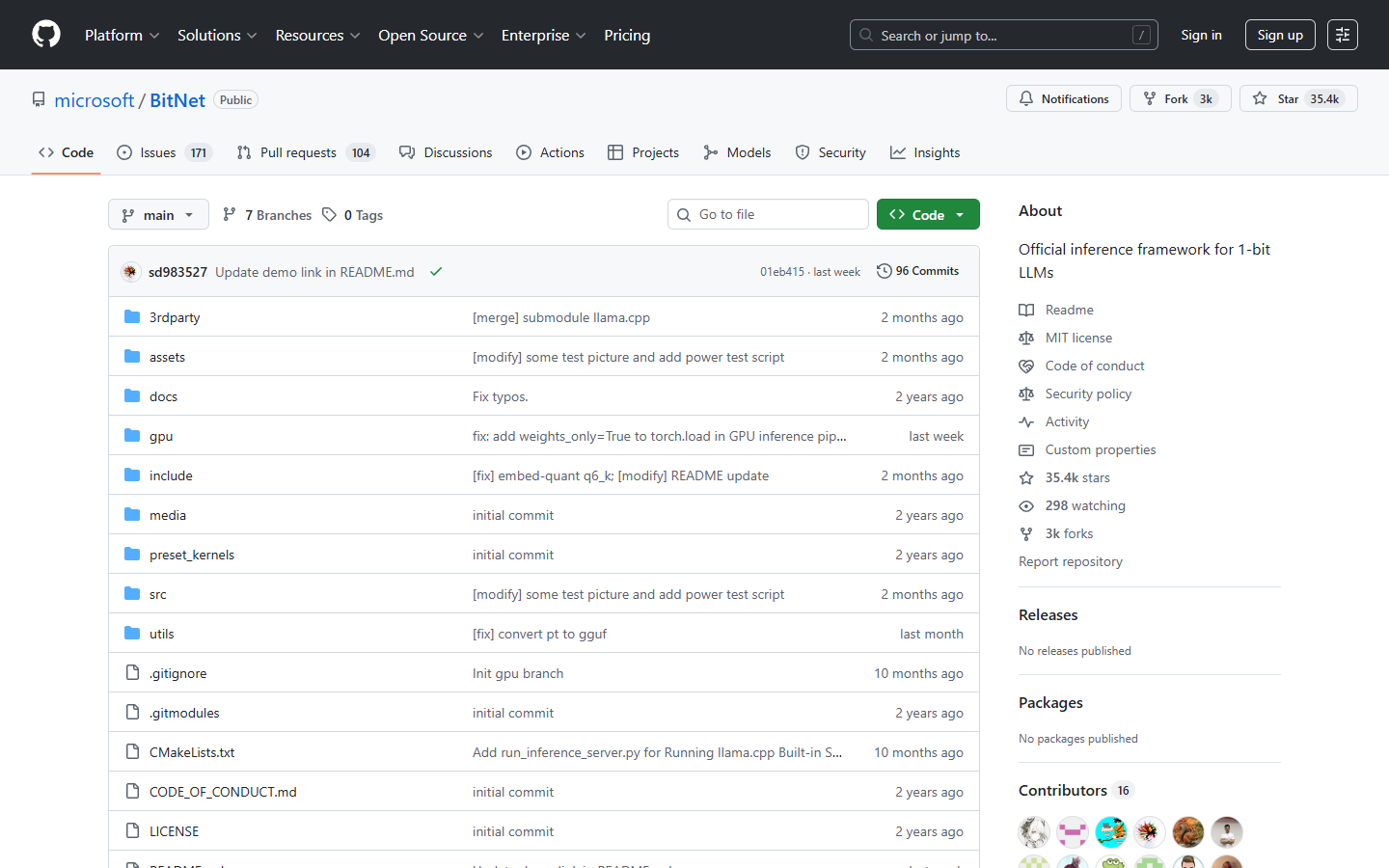
Running a 100 billion parameter LLM without a graphics card. That is the promise of BitNet, the open-source inference framework developed by Microsoft Research. Published on GitHub where it has amassed over 35,000 stars, BitNet rests on an idea that is as simple as it is radical: reduce a neural network's weights to just three values, namely -1, 0, and +1. This approach, called ternary quantization at 1.58 bits, eliminates floating-point operations in favor of simple integer additions. The result: a 100 billion parameter model capable of generating text at human reading speed (5 to 7 tokens per second) on a single CPU.
In April 2025, Microsoft reached a decisive milestone by releasing BitNet b1.58 2B4T, the first natively trained 1-bit LLM at the 2 billion parameter scale, trained on 4 trillion tokens and distributed under the MIT license. In January 2026, a CPU optimization update added an additional performance gain of 1.15x to 2.1x. With a steadily growing ecosystem, BitNet is no longer a lab curiosity but a credible alternative for local and edge inference.
What Is a 1-Bit LLM and How Does BitNet Work?
The Principle of Ternary Quantization
Traditional LLMs store their weights as floating-point numbers in 16 or 32 bits. Each weight is a precise decimal number, which demands significant memory and energy-expensive multiplication operations. BitNet takes a radically different approach: every weight in the network is constrained to one of three values, -1, 0, or +1. This is what is known as ternary quantization.
Mathematically, it takes log2(3) = 1.58 bits to encode three distinct values, hence the "1.58-bit" designation. This is not a crude approximation applied after the fact (post-training quantization): the model is natively trained with these constraints, allowing it to learn to compensate for the reduced precision from the start.
From Multiplications to Additions
The computational gain is immediate. When a weight is +1, you add the corresponding activation. When it is -1, you subtract it. When it is 0, you do nothing. The floating-point multiplications that account for the bulk of compute cost in a standard LLM disappear entirely in favor of integer operations. On a 7nm chip, this transformation reduces the energy per arithmetic operation by a factor greater than 70x, according to Microsoft Research estimates.
The BitLinear Architecture
In practice, BitNet replaces standard linear layers (torch.nn.Linear) with custom BitLinear layers. These layers use absmean quantization for weights (projecting them to ternary values) and absmax quantization for activations (as 8-bit integers, per token). The model also incorporates SubLN normalization, the Squared ReLU activation function, Rotary Positional Embeddings (RoPE), and the LLaMA 3 tokenizer with a vocabulary of 128,256 tokens. No bias terms are used in any linear or normalization layer.
BitNet Performance: Numbers That Speak for Themselves
BitNet b1.58 2B4T vs. Full-Precision LLMs
The ecosystem's flagship model, BitNet b1.58 2B4T, has been rigorously evaluated across a wide range of benchmarks. Its performance rivals the best open-weight LLMs of comparable size, while delivering substantial efficiency gains.
Metric | LLaMA 3.2 (1B) | Qwen2.5 (1.5B) | BitNet b1.58 (2B) |
|---|---|---|---|
Memory (non-embedding) | 2 GB | 2.6 GB | 0.4 GB |
CPU Latency (TPOT) | 48 ms | 65 ms | 29 ms |
Estimated Energy per Inference | 0.258 J | 0.347 J | 0.028 J |
ARC-Challenge (0-shot) | 37.80 | 46.67 | 49.91 |
PIQA (0-shot) | 74.21 | 76.12 | 77.09 |
WinoGrande (0-shot) | 59.51 | 62.83 | 71.90 |
GSM8K (4-shot, math) | 38.21 | 56.79 | 58.38 |
MMLU (5-shot) | 45.58 | 60.25 | 53.17 |
Overall Average | 44.90 | 55.23 | 54.19 |
Several results deserve attention. On GSM8K, which measures mathematical reasoning, BitNet b1.58 outperforms Qwen2.5 (58.38 vs. 56.79) despite a memory footprint 6.5 times smaller. On WinoGrande, which evaluates commonsense reasoning, the gap is even more striking: 71.90 for BitNet vs. 62.83 for Qwen2.5. On the overall average, BitNet reaches 54.19 vs. 55.23 for Qwen2.5, a minimal gap given the radical difference in efficiency.
Energy Efficiency: 12x Better Than Qwen2.5
The most striking figure is arguably the energy consumption: 0.028 joules per inference for BitNet, versus 0.347 joules for Qwen2.5. That makes BitNet approximately 12 times more energy efficient. Compared to LLaMA 3.2, the ratio is 9x. This efficiency is not limited to the 2B model: at larger scales, the gains become even more pronounced.
ARM vs. x86: Performance Gains by CPU Architecture
Performance in bitnet.cpp varies by processor architecture. Across the two major CPU families, the results are significant:
CPU Architecture | Speed Gain | Energy Reduction |
|---|---|---|
ARM (Apple M1/M2, Raspberry Pi) | 1.37x to 5.07x | 55.4% to 70.0% |
x86 (Intel, AMD) | 2.37x to 6.17x | 71.9% to 82.2% |
On x86 processors, the gains are particularly impressive, with speedups reaching 6.17x and energy consumption dropping by more than 82%. The January 2026 update introduced parallel kernel implementations with configurable tiling and embedding quantization, adding an extra 1.15x to 2.1x speedup on top of existing optimizations.
BitNet vs. Post-Training Quantization
A common question: why not simply quantize a standard model to 4 bits after training? Microsoft directly addressed this by comparing BitNet b1.58 to INT4 versions (GPTQ and AWQ) of Qwen2.5 1.5B. The result: BitNet offers an even smaller memory footprint (0.4 GB vs. 0.7 GB) and better average performance (55.01 vs. 52.15 for GPTQ-int4 and 51.17 for AWQ-int4). Native training-time quantization proves superior to quantization applied after the fact.
How to Install and Use BitNet
System Requirements
To use bitnet.cpp, you will need:
Python 3.9 or higher
CMake 3.22 or higher
Clang 18 or higher (or Visual Studio 2022 on Windows)
Conda (recommended for environment management)
The framework works on Linux, macOS, and Windows. On Mac with Apple Silicon (M1, M2, M3, M4), performance is particularly strong thanks to ARM optimizations.
Step-by-Step Installation
Installation requires just a few commands:
git clone --recursive https://github.com/microsoft/BitNet.git
cd BitNet
conda create -n bitnet-cpp python=3.9
conda activate bitnet-cpp
pip install -r requirements.txt
Then download the official model from Hugging Face and set up the environment:
huggingface-cli download microsoft/BitNet-b1.58-2B-4T-gguf --local-dir models/BitNet-b1.58-2B-4T
python setup_env.py -md models/BitNet-b1.58-2B-4T -q i2_s
Running Inference
Once installed, you can launch the model in conversational mode:
python run_inference.py -m models/BitNet-b1.58-2B-4T/ggml-model-i2_s.gguf -p "You are a helpful assistant" -cnvThe -cnv flag activates chat mode. You can adjust the number of threads (-t), context length (-c, up to 4,096 tokens), and temperature (-temp). To evaluate performance on your machine, a benchmarking script is included:
python utils/e2e_benchmark.py -m models/BitNet-b1.58-2B-4T/ggml-model-i2_s.gguf -n 200 -p 256 -t 4An Important Note
BitNet's performance gains are only achieved when using bitnet.cpp. If you load the model through standard Hugging Face Transformers, you will not benefit from the optimized kernels and performance will match that of a regular model. The specialized framework is essential.
The BitNet Ecosystem: Beyond the 2B Model
Compatible Models
BitNet is not limited to Microsoft's official model. The ecosystem includes several compatible models available on Hugging Face:
bitnet_b1_58-large (0.7B parameters)
bitnet_b1_58-3B (3.3B parameters)
Llama3-8B-1.58-100B-tokens (8B parameters, a 1-bit version of LLaMA 3)
Falcon3 Family (1B to 10B parameters, from TII)
Falcon-E Family (1B to 3B parameters)
The adoption by the Technology Innovation Institute's Falcon team is a strong signal: ternary quantization is no longer a Microsoft curiosity but a paradigm that other major players are beginning to embrace.
The Technical Roadmap
Microsoft has laid out clear milestones for BitNet's evolution:
October 2024: bitnet.cpp 1.0 release (CPU inference)
November 2024: BitNet a4.8 paper (4-bit activations for further cost reduction)
April 2025: Official 2B model on Hugging Face
May 2025: GPU inference kernels
January 2026: Additional CPU optimization (1.15x to 2.1x)
Coming soon: NPU (Neural Processing Unit) support
BitNet a4.8, presented in November 2024, pushes optimization further by using 4-bit activations and activating only 55% of parameters, further reducing latency. This variant also supports 3-bit KV cache.
How BitNet Compares to Traditional LLMs
The Cost of Inference
To put things in perspective: a traditional 70 billion parameter LLM at full precision requires approximately 140 GB of memory and a GPU cluster costing around $40,000. Inference runs between $2 and $4 per million tokens through cloud APIs. An equivalent BitNet model at 1.58 bits requires roughly 20 GB of memory, a 7x reduction, and can run on a single CPU. Inference cost drops to $0.20 to $0.40 per million tokens, a 90% reduction.
Current Limitations
It is important to remain clear-eyed about certain limitations. First, the largest publicly available natively trained 1-bit model remains the 2B4T at 2.4 billion parameters. The ability to run 100 billion parameters on a CPU has been demonstrated by Microsoft with test models, but no natively trained 100B model has been released to the public. Second, Microsoft states that it does not recommend using BitNet b1.58 in commercial or real-world applications without further testing and development. Third, on benchmarks like MMLU (general knowledge), BitNet trails Qwen2.5 (53.17 vs. 60.25), suggesting that ternary quantization has a cost on certain capabilities requiring fine-grained precision.
Finally, GPUs are not yet fully optimized for 1-bit models. Current GPU architectures are designed for floating-point operations, and the gains on GPU are less dramatic than on CPU. This is an area where hardware will need to evolve to fully leverage this approach.
The Impact on Local and Edge AI
AI Without Cloud, Without GPU, Without Bills
BitNet fits into a broader trend: the decentralization of AI. By making it possible to run massive models on consumer hardware, the framework opens up concrete possibilities:
Complete privacy: data never leaves the user's device
Offline operation: no internet connection required
Zero ongoing cost: no API subscriptions, no cloud bills
Deployment on embedded devices: phones, IoT devices, industrial equipment
Accessibility for researchers and independent developers
The Future of 1-Bit Hardware
Microsoft has mentioned in its publications the possibility of developing hardware accelerators specifically designed for 1-bit operations. If such processors were to be built, speed and energy efficiency gains could increase by several orders of magnitude. This is a signal to the entire semiconductor industry: the future of AI may not lie in ever more powerful GPUs, but in processors optimized for minimalist operations.
Key Takeaways
BitNet represents a paradigm shift in how we think about LLM deployment. By proving that a 100 billion parameter model can run on a single CPU at human reading speed, Microsoft Research is pushing the boundaries of what is possible without specialized hardware. The BitNet b1.58 2B4T model, the first natively trained 1-bit LLM released as open source, demonstrates that performance does not have to mean computational waste.
With 35,000 stars on GitHub, a growing model ecosystem (Falcon, 1-bit LLaMA), regular updates, and an MIT license, BitNet is today one of the most promising projects for democratizing access to artificial intelligence. The question is no longer whether local AI will become the norm, but how quickly frameworks like BitNet will transform the way we deploy and use LLMs.
Klare, transparente Preise ohne versteckte Kosten.
Keine Verpflichtung, Preise, die Ihnen helfen, Ihre Akquise zu steigern.

Credits(optional)
Sie benötigen keine Credits, wenn Sie nur E-Mails senden oder auf LinkedIn-Aktionen ausführen möchten
Können verwendet werden für:
E-Mails finden
KI-Aktion
Nummern finden
E-Mails verifizieren
€19pro Monat
1,000
5,000
10,000
50,000
100,000
1,000 Gefundene E-Mails
1,000 KI-Aktionen
20 Nummern
4,000 Verifizierungen
€19pro Monat
Entdecken Sie andere Artikel, die Sie interessieren könnten!
Alle Artikel ansehenSoftware
Veröffentlicht am 11. Juli 2024
7 Alternativen zu Expandi, um Ihre Akquisitionskosten zu senken
 Marie Head Of Sales
Weiterlesen
Software
Veröffentlicht am 22. Apr. 2024
Die 5 besten Alternativen zu Dropcontact für eine bessere B2B-Kundenakquise
Marie Head Of SalesWeiterlesen
Software
Veröffentlicht am 4. Juni 2024
Die 6 besten Alternativen zu GetProspect, um Ihre Kundenakquise anzukurbeln
Marie Head Of SalesWeiterlesen
Software
Veröffentlicht am 31. März 2025
9 Alternativen zu UpLead, um Ihre Kundenakquise WIRKLICH anzukurbeln
 Niels Co-founder
Weiterlesen
Software
Veröffentlicht am 8. März 2025
7 Alternativen zu Kaspr für Ihre B2B-Akquise 2026
Niels Co-founderWeiterlesen
Software
Veröffentlicht am 26. Apr. 2024
Email Finder 2026: Die 9 besten Hunter.io-Alternativen
Marie Head Of SalesWeiterlesen
Nützliche Links
HubKaltakquise-E-Mail: Kompletter LeitfadenZustellbarkeit: Kompletter LeitfadenAlternative zu LemlistAPIDemo anfordernPartnerprogrammFind emailÜber uns
Feedback & RoadmapDatenschutzrichtlinieAGBImpressumTestimonialsAlternativesVergleicheContact Maylee
Made with ❤ for Growth Marketers by Growth Marketers
Copyright © 2026 Emelia All Rights Reserved