
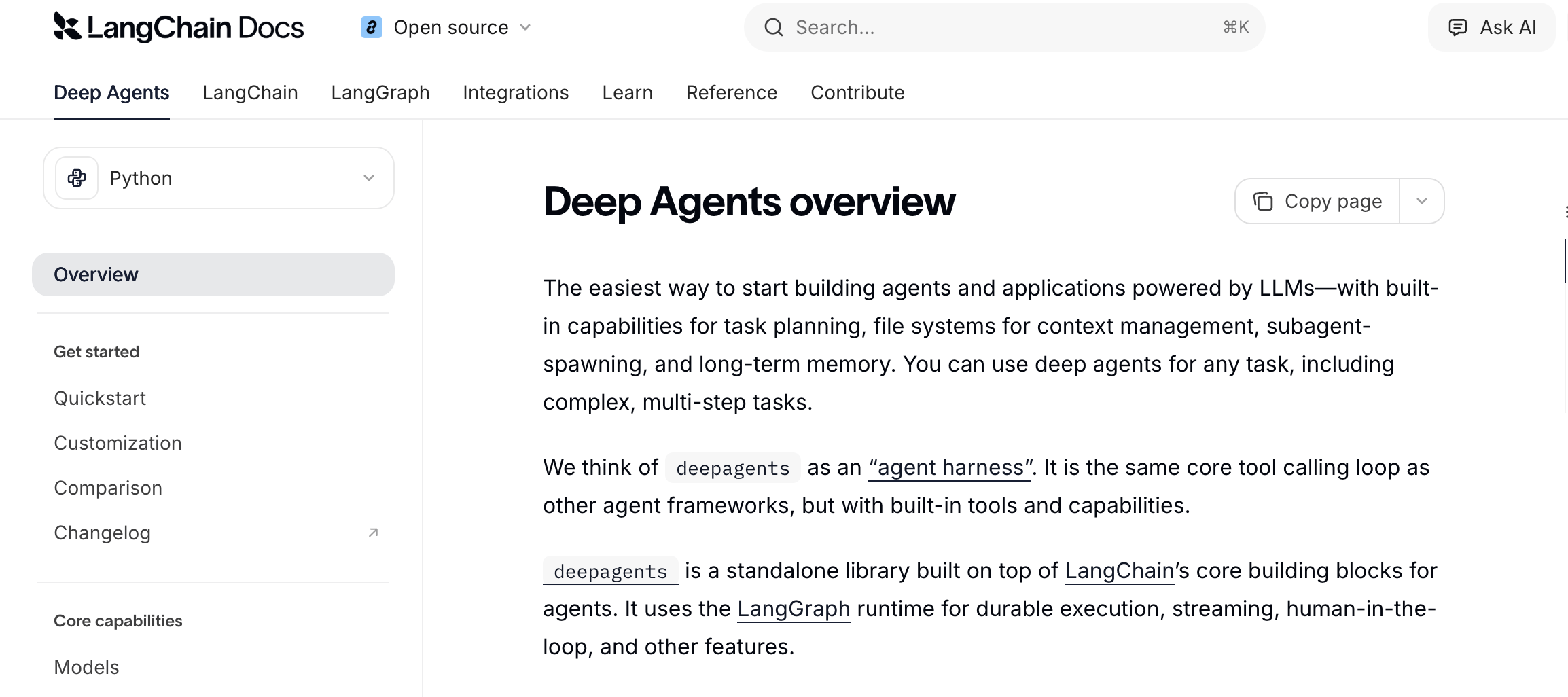
LangChain Deep Agents: Build Autonomous AI Agents to Automate Your Complex Tasks
Publicado el 17 mar 2026Actualizado el 27 may 2026
Traditional AI chatbots can answer a question. But ask them to conduct multi-step research, cross-reference sources, or coordinate several actions, and they fall apart. That is precisely the problem LangChain set out to solve with Deep Agents, an open-source framework that turns language models into truly autonomous agents.
Launched in July 2025 by Harrison Chase, LangChain's CEO, Deep Agents hit 9.9k GitHub stars in just 5 hours during its major March 2026 update. A strong signal of the tech community's appetite for a new generation of AI agents.
In this guide, you will learn what Deep Agents are, how they work, what sets them apart from standard chatbots, and most importantly, how businesses can use them to automate complex tasks.
What Is a Deep Agent, and How Does It Differ from an AI Chatbot?
A traditional chatbot is reactive: you ask a question, it generates a response. It has no structured working memory, no planning ability, and no way to coordinate multiple steps.
A Deep Agent, by contrast, is an AI agent capable of:
Planning its actions before executing them
Delegating subtasks to specialized agents
Storing intermediate results in a filesystem
Adapting in real time based on results
In practice, Harrison Chase reverse-engineered Claude Code by Anthropic to identify what makes an agent truly effective. His conclusion: it is not the model alone that makes the difference, but the architecture surrounding it.
“"When agents mess up, they mess up because they don't have the right context. When they succeed, they succeed because they have the right context." Harrison Chase, CEO of LangChain
”
The 4 Primitives That Make Deep Agents Effective
What sets Deep Agents apart from other frameworks is the combination of four built-in primitives. Each solves a specific problem that traditional AI agents face.
1. The Detailed System Prompt
The first primitive is a rich, structured system prompt directly inspired by Claude Code's approach. It contains detailed tool-use instructions, concrete examples, and behavioral rules. Prompting is not dead. On the contrary, it is one of the most powerful levers in context engineering.
2. The Planning Tool (write_todos)
Deep Agents includes a write_todos tool that lets the agent break down a complex task into discrete steps. Technically, it is a "no-op" (it does not execute any action itself), but it forces the agent to structure its thinking before acting. This is a context engineering strategy that prevents the agent from going off track on long tasks.
3. Subagents
The task tool lets the main agent delegate subtasks to specialized agents. Each subagent works in its own isolated context window. The result: the subagent's dozens of tool calls do not pollute the main agent's context. Only the final result comes back, compressed and token-efficient.
4. The Filesystem
The ls, read_file, write_file, and edit_file tools let the agent use a filesystem as a scratchpad. Why does this matter? Because web search results can easily reach 60,000 tokens. Instead of flooding the context window, the agent writes those results to a file, then reads back only what it needs.
Getting Started with Deep Agents: Code Example
Getting started with Deep Agents relies on a single Python function: create_deep_agent(). Here is a minimal example to build your first agent:
from deepagents import create_deep_agent

def get_weather(city: str) -> str:
    """Get weather for a given city."""
    return f"It's always sunny in {city}!"

agent = create_deep_agent(
    tools=[get_weather],
    system_prompt="You are a helpful assistant",
)

result = agent.invoke(
    {"messages": [{"role": "user", "content": "what is the weather in sf"}]}
)
This code creates an agent equipped with all four primitives (planning, filesystem, subagents, detailed prompt) plus your custom tool. The returned agent is a LangGraph graph, fully compatible with streaming, persistence, and human-in-the-loop features.
Deep Agents is model-agnostic: it works with Anthropic Claude, OpenAI GPT, Google Gemini, and even open-weight models like Qwen or Devstral via Ollama.
Comparison: Deep Agents vs CrewAI vs AutoGen vs Swarm
To help you understand where Deep Agents stands relative to other AI agent frameworks, here is a side-by-side comparison:
Criterion | Deep Agents | CrewAI | AutoGen (Microsoft) | Swarm (OpenAI) |
|---|---|---|---|---|
Type | Harness (batteries included) | Role-based framework | Conversational multi-agent | Experimental framework |
Built-in planning | Yes (write_todos) | No | No | No |
Filesystem | Yes (pluggable backends) | No | Manual | No |
Subagents | Yes (context isolation) | Yes (role-based agents) | Yes (conversational agents) | Yes (lightweight coordination) |
Model lock-in | None (any LangChain model) | LangChain | Flexible | OpenAI only |
Long tasks | Optimized (core use case) | Short structured workflows | Multi-turn conversations | Simple tasks |
Observability | Native LangSmith | Limited | Microsoft ecosystem | Limited |
License | MIT | Apache 2.0 | MIT | MIT |
Production-ready | Yes (LangGraph runtime) | Less battle-tested | Maturing | Experimental |
In short: Deep Agents excels at autonomous, long-running, complex tasks. CrewAI is better suited for short, structured workflows with well-defined roles. AutoGen integrates into the Microsoft ecosystem. Swarm remains an educational tool from OpenAI, not designed for production.
Real-World Use Cases for Businesses
Deep Research Automation
Deep Agents can conduct multi-step research: collecting data from the web, cross-referencing sources, and writing structured reports. The LangChain-NVIDIA partnership with the AI-Q Blueprint produced an enterprise research system that ranks number one on deep research benchmarks.
Customer Support Agents
By combining specialized subagents (FAQ, escalation, technical), you can build a multi-tier support system. The main agent triages requests, delegates to the right subagent, and maintains conversation context.
Personal Assistants with Memory
Thanks to long-term memory (cross-thread), a Deep Agent can learn your preferences over time. LangChain uses this internally for a personal email assistant that remembers scheduling rules and user habits.
DevOps and CI/CD Agents
Agents that can run automated tests, generate release notes, and manage deployment workflows. The Deep Agents CLI also works in non-interactive mode for integration into cron pipelines.
Sales Intelligence Agents
For sales teams, a Deep Agent can monitor sources, compile prospect profiles, and summarize industry news, all on a scheduled basis, without human intervention.
The NVIDIA AI-Q Partnership: Deep Agents for Enterprise
In March 2026, LangChain announced a strategic partnership with NVIDIA. The AI-Q Blueprint is a production enterprise research system built on Deep Agents, combining NVIDIA's parallel and speculative execution tools with the LangGraph runtime.
This partnership positions Deep Agents as an enterprise-ready solution backed by one of the largest players in AI hardware.
For context, the LangChain ecosystem represents over one billion cumulative downloads, one million practitioners, and 300 enterprise customers for LangSmith, which has processed over 15 billion traces and 100 trillion tokens.
Limitations and Caveats
Despite its strengths, Deep Agents is not without limitations. Here are the key points to consider before adopting it:
Moderate learning curve. While simpler than raw LangGraph, Deep Agents requires familiarity with the LangChain ecosystem. It is not a no-code tool.
Dependent on model quality. Agent performance remains tied to the underlying LLM. A weaker model will produce a less reliable agent.
Token costs. Autonomous agents consume a lot of tokens (planning, multiple tool calls, subagents). Costs can escalate quickly on long tasks.
Relative maturity. The project launched in July 2025. While v0.2 brings significant improvements (context compression, large result eviction), the ecosystem is still young.
TypeScript ecosystem lagging. The JavaScript version (DeepAgentJS) has gone through periods of uncertainty, though a revamp has been announced.
Mixed community reception. On Hacker News, some developers argue that Deep Agents does not introduce anything fundamentally new, criticizing LangChain for overcomplicating simple concepts. Others praise the quality of context engineering and the framework's practical utility.
Should Your Business Adopt Deep Agents?
Deep Agents is for teams that want to go beyond simple chatbots and build AI agents capable of handling complex tasks end-to-end. If you have workflows that require planning, multi-source research, or coordination across multiple systems, it is worth serious consideration.
The fact that it is open source (MIT license), model-agnostic, and natively integrated with LangSmith for observability makes it a solid option for businesses that want to keep control over their AI stack.
For simpler needs (FAQ chatbot, basic assistant), a standard agent will do. But for long-running, autonomous, multi-step tasks, Deep Agents represents one of the most complete approaches on the market today.
Precios claros, transparentes y sin costes ocultos.
Sin compromiso, precios para ayudarte a aumentar tu prospección.

Créditos(opcional)
No necesitas créditos si solo quieres enviar emails o hacer acciones en LinkedIn
Se pueden utilizar para:
Buscar Emails
Acción IA
Buscar Números
Verificar Emails
€19por mes
1,000
5,000
10,000
50,000
100,000
1,000 Emails encontrados
1,000 Acciones IA
20 Números
4,000 Verificaciones
€19por mes
Descubre otros artículos que te pueden interesar!
Ver todos los artículosSoftware
Publicado el 24 jun 2025
Expandi vs Waalaxy: Análisis COMPLETO
 Niels Co-founder
Leer más
IA
Publicado el 11 abr 2025
Cognism vs Waalaxy vs Emelia 2026: análisis completo B2B
Niels Co-founderLeer más
Prospección B2B
Publicado el 1 abr 2025
5 grandes proveedores de datos B2B 2026
Niels Co-founderLeer más
Prospección B2B
Publicado el 19 may 2025
Emails en BCC: buenas prácticas y alternativas B2B
 Mathieu Co-founder
Leer más
Software
Publicado el 24 jun 2025
LeadFuze vs Waalaxy: análisis completo para tomar la mejor decisión
Niels Co-founderLeer más
IA
Publicado el 18 jun 2025
5 mejores generadores de contenido con IA 2026 (cold email)
Niels Co-founderLeer más
Enlaces útiles
HubCold-email: Guía CompletaEntregabilidad: Guía completaAlternativa a LemlistAPISolicitar una demoPrograma de afiliadosFind email Maylee
Made with ❤ for Growth Marketers by Growth Marketers
Copyright © 2026 Emelia All Rights Reserved