Lemlist es uno de los pioneros del cold email personalizado. Imágenes dinámicas, páginas de destino, secuencias multicanal que combinan correo, LinkedIn y teléfono: la herramienta ha construido su reputación sobre una personalización profunda y una interfaz cuidada. Sobre el papel, el precio de entrada de 59 a 79 dólares parece razonable. Pero Lemlist factura por usuario, y ahí es exactamente donde la factura sube en cuanto su equipo crece. Entre el modelo por puesto, el salto obligado al multicanal, los buzones de envío adicionales y los créditos de enriquecimiento limitados, la pregunta ya no es cuánto cuesta Lemlist, sino cuánto cuesta de verdad una vez que su equipo y los volúmenes reales están en marcha.

Esta guía repasa cada plan de Lemlist en 2026, el coste mensual real según el tamaño del equipo, las tarifas que nadie destaca y la pregunta de fondo: ¿merece la pena? Veremos también dónde una herramienta multicanal todo en uno como Emelia sale mucho más barata a resultado equivalente, LinkedIn y calentamiento incluidos.
Lemlist en 2026: los planes
Lemlist estructura su oferta en torno a un plan gratuito muy limitado y tres planes de pago, todos facturados por usuario y mes. El plan gratuito es solo la extensión de Chrome y 100 leads al mes, sin campañas, sin calentamiento y sin LinkedIn: sirve para probar, no para prospectar. Los planes de pago suben rápido con el número de puestos.
Plan | Precio (por usuario) | Ideal para | Incluido |
Free | 0 dólares | Prueba rápida | Extensión de Chrome, 100 leads / mes, sin campañas |
Email Pro | 79 dólares / mes | Solo correo | Campañas ilimitadas, lemwarm, base de contactos, 3 direcciones de envío |
Multichannel Expert | 109 dólares / mes | Multicanal | Todo Email Pro más LinkedIn, paso telefónico, 5 direcciones, más créditos |
Outreach Scale | Desde 159 dólares (a medida) | Agencias y grandes equipos | SSO/SAML, roles, API avanzada, soporte dedicado, mínimo 5 puestos |
Común a todos los planes de pago: el calentamiento de correo (lemwarm) está incluido y las campañas de envío son ilimitadas. Pero la automatización de LinkedIn y el paso telefónico, la verdadera ventaja de Lemlist, solo están disponibles a partir del plan Multichannel Expert. Dicho de otro modo, el plan de entrada no basta si quiere el multicanal que hizo famosa la herramienta.
LinkedIn sin cambiar de plan
En Emelia, la automatización de LinkedIn y el cold email están en la misma suscripción, desde 37 € al mes.
¿Cuánto cuesta realmente Lemlist al mes?
Como la mayoría de las herramientas del sector, Lemlist muestra sus precios más bajos en facturación anual. Pagar mensualmente añade alrededor de un 20 por ciento, lo que lleva Email Pro a unos 79 dólares y Multichannel Expert a unos 109 dólares por usuario. Pero el verdadero motor del coste no es el modo de facturación: es el número de puestos.
Plan | Anual (por usuario) | Mensual (por usuario) | Coste para 5 personas / mes |
Email Pro | unos 59 dólares | 79 dólares | 295 a 395 dólares |
Multichannel Expert | unos 87 dólares | 109 dólares | 435 a 545 dólares |
Outreach Scale | a medida | desde 159 dólares | 795 dólares y más |
La lógica por puesto lo cambia todo. Donde una herramienta de precio fijo cuesta lo mismo para un usuario solo que para un equipo de diez, Lemlist multiplica su precio por el número de usuarios. Un equipo comercial de cinco personas en Multichannel Expert supera rápidamente los 500 dólares al mes, y esa cifra aún no incluye las tarifas adicionales.
La verdadera trampa: el precio por usuario
Es la parte más subestimada de la tarificación de Lemlist. Una suscripción por puesto parece inofensiva cuando se está solo, pero se convierte en la principal línea de coste en cuanto el equipo crece. Cada nuevo comercial, cada SDR añadido, es una suscripción completa más, envíe mucho o poco.
Para una agencia que gestiona varios clientes o un equipo comercial en crecimiento, esa linealidad duele. El coste de adquisición por prospecto sube mecánicamente con el tamaño del equipo, mientras que el valor añadido de la herramienta sigue siendo el mismo. Es exactamente lo contrario de un modelo de precio fijo, donde el coste por usuario baja a medida que se añaden miembros.
Los costes ocultos de Lemlist que nadie destaca
Más allá del precio por puesto, varios mecanismos inflan la factura muy por encima de la tarifa anunciada.
Los buzones de envío adicionales
Cada plan incluye un número limitado de direcciones de envío por usuario, tres en Email Pro, cinco en Multichannel Expert. Por encima, cada buzón adicional cuesta alrededor de 9 dólares al mes. Para una operación seria de cold email que reparte los envíos entre muchos buzones, esta línea suma rápido.
Los créditos de enriquecimiento limitados
El acceso a la base de contactos viene con una cuota de créditos de enriquecimiento por usuario y mes, aproximadamente de 1.000 a 1.500. Por encima, se compran más. Para un equipo que prospecta activamente, ese tope se alcanza pronto y convierte una suscripción fija en un gasto variable.
El salto al multicanal
Si quiere LinkedIn y el paso telefónico, debe pasar al más caro Multichannel Expert. Y sin embargo el multicanal es precisamente lo que distingue a Lemlist. Muchos equipos descubren que tienen que tomar el plan superior para usar la función que los atrajo a la herramienta.
Concepto de coste | Precio anunciado | Realidad sobre el terreno |
Suscripción Email Pro | 79 dólares / usuario | 79 dólares por persona, no por equipo |
Buzones de envío adicionales | No mostrado | alrededor de 9 dólares / buzón / mes |
Créditos de enriquecimiento por encima de la cuota | No mostrado | se compran aparte |
Coste real observado | 79 dólares | de un 30 a un 50 por ciento por encima del precio base |
¿Es rentable Lemlist? El verdadero cálculo
Una herramienta de prospección no se juzga por su precio de entrada sino por su coste total frente a los resultados. En Lemlist, la variable decisiva es el tamaño de su equipo. Para un fundador en solitario que explota a fondo la personalización y el multicanal, un solo puesto bien utilizado puede dar un retorno excelente. El problema aparece al añadir usuarios: el coste sube linealmente, sin que la tasa de respuesta por puesto suba en la misma medida.
Para una agencia o un equipo de varios SDR, hay que comparar honestamente el total mensual de Lemlist con una herramienta de precio fijo capaz de las mismas secuencias. En muchos casos, la diferencia asciende a cientos de dólares al mes con funciones comparables. Lemlist sigue siendo pertinente si la personalización avanzada y la facilidad de uso pesan más que el coste. En cuanto el presupuesto se vuelve un criterio, el modelo por puesto pesa mucho.
Cinco comerciales, la misma factura
Emelia cobra por buzón, no por usuario: tres buzones por 37 € al mes, cincuenta por 97 €.
Lo que Lemlist hace realmente bien
Un veredicto justo debe reconocer las fortalezas de Lemlist, porque son reales. La herramienta popularizó la personalización a gran escala: imágenes y vídeos personalizados, páginas de destino dinámicas, variables condicionales. Su editor de secuencias multicanal, que combina correo, LinkedIn y teléfono en un mismo flujo, sigue siendo uno de los más refinados del mercado. El calentamiento propio, lemwarm, es sólido y está incluido, y la interfaz es agradable, lo que reduce la curva de aprendizaje.
Para un equipo que apuesta por la calidad de la personalización y un multicanal fluido, y para el que el coste por puesto no es un obstáculo, Lemlist ofrece una experiencia premium. El problema nunca es que Lemlist haga las cosas mal, sino que su modelo de precios traslada directamente al cliente el coste del crecimiento del equipo.
Lemlist para el mercado europeo
Lemlist es una empresa europea, y tanto su conformidad con el RGPD como su soporte son bazas para un equipo europeo. La base de contactos integrada, en cambio, sigue siendo más densa en datos estadounidenses que europeos, y los créditos de enriquecimiento limitados empujan a menudo a los equipos a complementarla con una fuente de datos local. Para una prospección dirigida a decisores europeos, combinar Lemlist con una base local y fresca mejora notablemente el rendimiento, pero añade otra línea al presupuesto.
La cuestión del coste sigue siendo central. En mercados donde muchos equipos comerciales siguen siendo de tamaño modesto, el precio por puesto de Lemlist compite directamente con herramientas de precio fijo que ofrecen multicanal y calentamiento sin facturar por usuario. La diferencia de coste a lo largo de un año completo rara vez es despreciable.
Otras alternativas a Lemlist que conviene considerar
Lemlist no está solo en el cold email y el multicanal. Según si su prioridad es el precio, el volumen de envío o la base de datos, varias herramientas se solapan con su perímetro, a menudo con un modelo de precios distinto. Estas son las principales, centradas en lo que comparten con Lemlist y en lo que cuestan.
Instantly

Instantly se solapa con Lemlist en el envío de cold email, pero con un modelo radicalmente distinto: buzones ilimitados a precio fijo, sea cual sea el número de usuarios. Donde Lemlist factura por puesto, Instantly arranca en unos 37 dólares al mes para todo el equipo. En cambio, Instantly no tiene LinkedIn nativo: sigue centrado en el correo. Para envíos de gran volumen sin multicanal, es notablemente más barato que Lemlist.
En la práctica, Instantly construyó su reputación sobre la entregabilidad a escala: rotación de bandejas, una gran red de envío y una interfaz pensada para llevar decenas de cuentas en paralelo. Su Lead Finder integrado permite conseguir contactos sin salir de la herramienta, aunque los datos se inclinan hacia Estados Unidos. Para un equipo que quiere puro volumen de correo es una opción fuerte; para el multicanal de LinkedIn hará falta una segunda herramienta.
Smartlead

Smartlead comparte con Lemlist el envío de cold email y el calentamiento, pero también a precio fijo con buzones ilimitados, de 39 a 174 dólares al mes según el plan, sin facturar por usuario. Su ventaja es el panel de marca blanca para agencias. Como Instantly, carece del multicanal nativo de LinkedIn de Lemlist, pero para el envío puro de gran volumen su relación entre coste y volumen es mucho mejor.
Más allá del precio, Smartlead atrae sobre todo a las agencias gracias a su panel de marca blanca, sus subcuentas de cliente y una API completa para automatizar la gestión de campañas a escala. Su fuerza es la infraestructura de envío y el seguimiento centralizado en muchos dominios, menos la profundidad de la personalización. Si su trabajo es llevar la prospección de varios clientes, Smartlead cubre mucho terreno que Lemlist cobra más caro.
Apollo.io

Apollo.io se solapa con Lemlist en las secuencias y añade una enorme base de 275 millones de contactos. Su plan Basic está en 49 dólares por usuario y mes. Apollo apuesta por el dato y el enriquecimiento más que por la personalización avanzada, y su sistema de créditos cobra incluso cuando el correo no se encuentra. Para quien busca sobre todo una base integrada más que el multicanal pulido de Lemlist, Apollo es una opción, pero su modelo por puesto comparte el mismo defecto de linealidad.
Donde Apollo se distingue de verdad es en el dato: filtros firmográficos, señales de intención y enriquecimiento hacen de él tanto un CRM de prospección como un secuenciador. La contrapartida es un sistema de créditos que se consume rápido y una base muy centrada en Estados Unidos, menos fresca en Europa. Apollo conviene a quien quiere encontrar y contactar prospectos en un mismo sitio, siempre que acepte un modelo de créditos a veces frustrante.
Saleshandy

Saleshandy juega la carta del envío de cold email a precio fijo, con uno de los precios de entrada más bajos del mercado, alrededor de 25 dólares al mes para todo el equipo. El conjunto de funciones del primer nivel sigue siendo limitado, y le faltan la profundidad de personalización y el multicanal de Lemlist, pero para empezar con un presupuesto ajustado sin pagar por usuario, es una puerta de entrada asequible.
Saleshandy ha reforzado su oferta en los últimos años con la rotación de bandejas, una verificación de correo integrada y una base de leads. Sigue siendo una herramienta centrada en el correo, sin el multicanal nativo de LinkedIn ni la personalización visual que dio nombre a Lemlist. Para un equipo pequeño que quiere cold email limpio con presupuesto ajustado, es una de las entradas más asequibles del mercado.
Cada una de estas herramientas resuelve una parte de lo que Lemlist cubre. Para una visión detallada, nuestra recopilación de las mejores alternativas a Lemlist revisa varias opciones. Donde Emelia se distingue es al combinar correo, LinkedIn nativo, calentamiento y búsqueda de correos en una sola plataforma, con el multicanal incluido desde el nivel de entrada.
Lemlist frente a Emelia: la comparación de precios que cambia el cálculo

Si el coste total frente al tamaño del equipo es su verdadera brújula, la comparación con Emelia es reveladora. Donde Lemlist reserva el multicanal a sus planes más caros, Emelia incluye el multicanal nativo de LinkedIn, el calentamiento y el scraping desde su nivel de entrada, a 37 € al mes.
Antes de comparar precios, conviene aclarar lo que cubre cada herramienta. Este es el panorama función por función:
Función | Lemlist | Emelia |
Modelo de precios | Por usuario (por puesto) | Por suscripción, multicanal incluido desde la entrada |
Cold email y secuencias | Sí | Sí |
Multicanal LinkedIn | Desde Multichannel Expert | Nativo, todos los planes |
Calentamiento de correo | Incluido (lemwarm) | Incluido |
Búsqueda de correos | Base y créditos limitados | Email Finder, crédito cobrado si hay acierto |
Precio de entrada | 79 dólares / usuario | 37 € / mes todo incluido |
Coste para un equipo de 5 | 435 a 545 dólares / mes | 97 € (plan Grow, 5 cuentas de LinkedIn) |
En concreto, Emelia ofrece un plan Start a 37 € al mes, facturado por suscripción y no por usuario, que ya incluye envíos ilimitados, calentamiento, una cuenta de LinkedIn, scraping y créditos de búsqueda. El multicanal está por tanto disponible desde el nivel de entrada, mientras que Lemlist lo restringe a su plan más caro Multichannel Expert. A perímetro multicanal equivalente, la diferencia de coste por usuario se amplía a lo largo de un año completo.
Las tarifas de Emelia
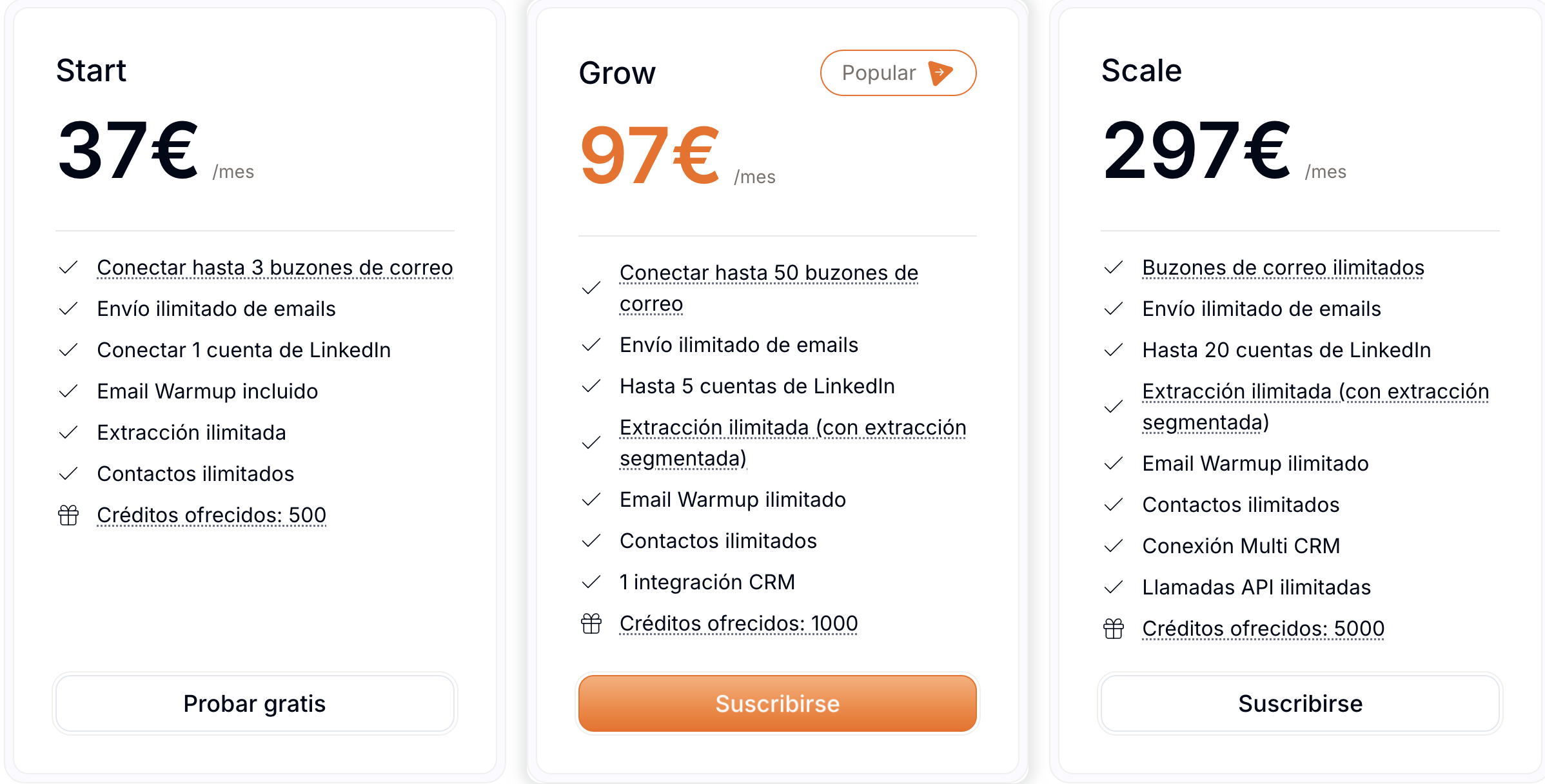
Emelia es una plataforma de prospección multicanal que reúne en una sola herramienta lo que Lemlist reparte entre varios niveles: envío ilimitado de cold email, calentamiento automático en cada buzón conectado, prospección nativa en LinkedIn, scraping de Sales Navigator y una búsqueda de correos facturada por resultado. Los créditos de enriquecimiento solo se descuentan cuando un correo se encuentra realmente, así que nunca paga direcciones fantasma. Todo empieza en 37 € al mes, con el multicanal disponible desde el nivel de entrada.
Conviene hacer el cálculo anual en lugar de quedarse con el titular mensual. Un equipo de cinco personas en Multichannel Expert con precio anual se sitúa en torno a 5.200 a 6.500 dólares al año solo por los puestos, antes de buzones y excesos de créditos. Una herramienta como Emelia, que incluye el mismo correo, LinkedIn y calentamiento desde un precio de entrada de 37 €, queda muy por debajo para esos mismos cinco usuarios, porque su multicanal no está encerrado tras un nivel por puesto más caro. En tres años y con un equipo que crece, esa diferencia se acumula hasta una cifra de cinco dígitos. Nada de esto hace de Lemlist un mal producto; simplemente significa que es el modelo de precios, y no el conjunto de funciones, lo que más a menudo decide si es la elección económica adecuada para un equipo dado.
Hay además un aspecto cualitativo que merece sopesarse. Lemlist justifica su prima por la profundidad de la personalización y un multicanal fluido, y para un equipo pequeño esas ventajas pueden elevar las tasas de respuesta lo suficiente como para justificar el coste por puesto. El cálculo solo se vuelve en contra de Lemlist cuando la plantilla crece más deprisa que el valor que aporta por puesto, que es precisamente cuando una alternativa multicanal más barata empieza a parecer obvia. Decidir bien significa ser honesto sobre cuántos puestos va a tener realmente, no sobre los pocos con los que empieza. Una proyección rápida del tamaño de su equipo dentro de doce meses suele decir más sobre el coste real que cualquier precio de titular, y es la cifra más útil que puede poner al lado de Lemlist antes de comprometerse.
A quién se dirige realmente Lemlist (y quién paga de más)
Lemlist está lejos de ser una mala herramienta: su rentabilidad depende de su perfil. Así se decide rápido.
Perfil | ¿Es Lemlist la elección adecuada? |
Solo o equipo pequeño que apuesta por la personalización | Sí, la experiencia y el multicanal son excelentes |
Equipo comercial en rápido crecimiento | Rara vez, el coste por puesto sube rápido |
Agencia con varios clientes | Quizá, pero compare el coste total por puesto |
Necesidad de coste controlado sea cual sea el tamaño | No, un precio fijo sale más barato |
Envío de muy alto volumen sin multicanal | No, una herramienta de precio fijo es más rentable |
En resumen, Lemlist brilla cuando la calidad de la personalización y la comodidad del multicanal van por delante, y cuando el equipo sigue siendo pequeño. En cuanto el número de usuarios sube o el presupuesto se vuelve prioritario, una herramienta de precio fijo toma la delantera.
Un ejemplo cifrado del coste real
Un ejemplo hace concreta la lógica. Un equipo comercial de cuatro personas que necesita multicanal toma cuatro puestos Multichannel Expert, aproximadamente 350 a 435 dólares al mes en facturación anual. Añada unos cuantos buzones de envío adicionales a 9 dólares y algo de exceso en créditos de enriquecimiento, y el total supera fácilmente los 500 dólares al mes, cuando los 109 dólares anunciados sugerían un gasto mucho menor. Es esa multiplicación por el número de puestos lo que más sorprende a los equipos cuando llega la factura.
Cómo reducir su factura de Lemlist
Si se queda en Lemlist, unos cuantos hábitos limitan el daño. Elija la facturación anual en lugar de la mensual para ahorrar alrededor de un 20 por ciento por puesto. Dé un puesto Multichannel Expert solo a las personas que trabajan realmente LinkedIn, y deje a las demás en Email Pro. Evite multiplicar los buzones de envío más allá de la cuota incluida, ya que cada dirección adicional se factura por separado. Y vigile el consumo de créditos de enriquecimiento: por encima del tope, a menudo sale más barato conectar una fuente de datos externa que comprar más de uno en uno.
El punto de fondo es que Lemlist premia a los equipos pequeños y enfocados y penaliza la escala. Su personalización y su multicanal son realmente fuertes, pero el modelo de precios hace que cada ganancia en plantilla sea una ganancia proporcional en coste, sin descuento por volumen. Juzgar a Lemlist solo por su precio de entrada pasa por alto la única variable que decide la factura real, que es cuántas personas van a conectarse realmente cada mes.
Veredicto: ¿es rentable Lemlist en 2026?
Lemlist sigue siendo una de las mejores plataformas de cold email personalizado y multicanal del mercado, y su experiencia de uso es difícil de igualar. Pero su precio anunciado induce a error, porque es por usuario. Entre el modelo por puesto, el paso obligado a Multichannel para LinkedIn, los buzones de envío adicionales y los créditos de enriquecimiento limitados, la factura real suele situarse entre un 30 y un 50 por ciento por encima de la tarifa base, y crece linealmente con el tamaño del equipo.
Para un usuario solo o un equipo pequeño que valora la personalización, Lemlist aguanta. Para un equipo que crece o que vigila su presupuesto, una herramienta como Emelia, que incluye multicanal y calentamiento desde su entrada a 37 €, sale mucho más barata a perímetro equivalente. Así que la verdadera pregunta no es cuánto cuesta Lemlist, sino cuánto costará cuando su equipo se haya duplicado. Y en esa medida, en 2026, una herramienta que no factura por usuario sigue siendo la estrategia más rentable.
Preguntas frecuentes sobre los precios de Lemlist
¿Lemlist ofrece un plan gratuito?+
Sí, pero es muy limitado: es solo la extensión de Chrome y 100 leads al mes, sin campañas de envío, sin calentamiento y sin LinkedIn. Sirve para probar la herramienta, no para prospectar.
¿Por qué mi factura de Lemlist es más alta que el precio anunciado?+
Porque el precio es por usuario. Cada puesto se paga íntegro, más los buzones de envío adicionales (alrededor de 9 dólares cada uno), los créditos de enriquecimiento por encima de la cuota y el paso al plan Multichannel para LinkedIn. El total suele situarse entre un 30 y un 50 por ciento por encima de la tarifa base.
¿El multicanal de LinkedIn está incluido en el plan de entrada?+
No. La automatización de LinkedIn y el paso telefónico solo están disponibles a partir del plan más caro Multichannel Expert. El plan de entrada cubre únicamente el correo.
¿Existe una alternativa más barata a Lemlist?+
Sí. Herramientas de precio fijo como Emelia incluyen correo, LinkedIn nativo, calentamiento y búsqueda de correos desde 37 $, sin facturar por usuario. Para un equipo de varias personas, el ahorro es significativo.