
PentAGI Review: Can This Open-Source AI Agent Really Automate Penetration Testing?
Publicado el 23 mar 2026Actualizado el 31 mar 2026
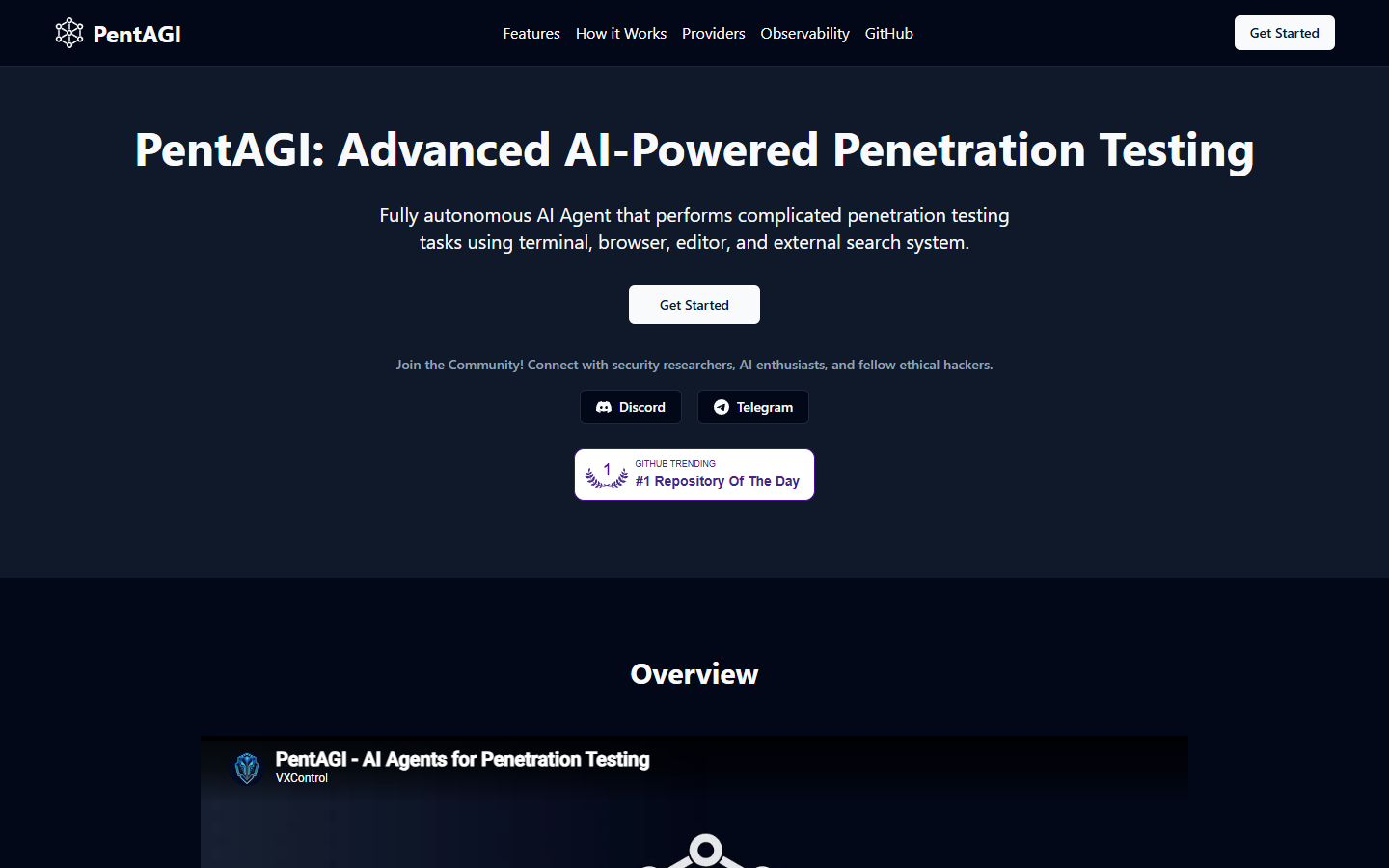
An AI system capable of conducting a full penetration test with no human intervention. That is the promise of PentAGI, an open-source project that has exploded onto the cybersecurity scene in early 2026. With over 12,500 GitHub stars, a sophisticated multi-agent architecture, and integration with more than twenty professional security tools, this project developed by VXControl has generated as much excitement as legitimate skepticism. Is this a genuine revolution in pentesting, or just another tool in an already crowded ecosystem? Here is our complete analysis.
PentAGI: The AI That Promises to Automate Penetration Testing
The name PentAGI compresses its ambition into a single word: Penetration testing Artificial General Intelligence. The project describes itself as a fully autonomous AI agent system capable of performing complex penetration testing tasks using a terminal, browser, code editor, and external search systems. In practice, you describe a target, and the system handles the rest: reconnaissance, port scanning, vulnerability identification, exploitation attempts, and report generation.
The project was launched in early 2025 by VXControl, a GitHub organization focused on security tools. The latest release, v1.2.0, was published on February 25, 2026. Licensed under MIT, PentAGI is entirely free and self-hostable. The only potential costs come from cloud LLM usage (OpenAI, Anthropic), but the tool also supports local models through Ollama, enabling a completely free setup.
Community reception has been explosive. The GitHub repository reached 12,500 stars and 1,600 forks, climbing to the top of trending repositories during its peak month. On social media, the virality was immediate.
This tweet, shared thousands of times, captures the prevailing sentiment: "Someone just open-sourced a fully autonomous AI Red Team. It's called PentAGI. Multiple AI agents that talk to each other to hack a target. Zero human input." A claim that deserves significant nuance, as we will see.
How PentAGI's Multi-Agent System Actually Works
What truly distinguishes PentAGI from predecessors like PentestGPT is its multi-agent architecture. Where a traditional tool uses a single language model to guide a human operator, PentAGI orchestrates more than thirteen specialized agents, each equipped with specific capabilities and permissions.
The core agents and their roles
The architecture is built on a precise division of labor, modeled after how a real pentest team operates:
Agent | Role |
|---|---|
Orchestrator | Coordinates the entire mission, plans steps, distributes tasks |
Searcher | Performs reconnaissance, OSINT research, DNS queries |
Coder | Writes exploitation scripts, generates target-specific code |
Pentester | Executes scans and exploits using integrated security tools |
Installer | Manages dependencies and packages required for operations |
Adviser | Provides strategic expertise and planning guidance |
Reflector | Analyzes results, identifies failures, proposes adjustments |
Enricher | Completes and contextualizes collected data |
Generator / Refiner | Produce and improve vulnerability reports |
The fundamental design principle is least privilege: each agent only sees the tools it needs. The searcher can run web searches and DNS queries but cannot launch exploits. The pentester can use Nmap and Metasploit but cannot write arbitrary files. This isolation is enforced in the Go backend through a dedicated permission registry, where every unauthorized tool call is blocked and logged.
The knowledge graph: adaptive memory
Beyond simple orchestration, PentAGI integrates a three-tier memory system. Long-term memory, powered by PostgreSQL and pgvector, stores research results and approaches that worked in the past. Working memory maintains the current mission context, active objectives, and system state. Episodic memory archives past actions, their results, and identified success patterns.
This is enriched by a knowledge graph powered by Neo4j and Graphiti, which enables the system to track semantic relationships between elements discovered during a test. For instance, if a scan reveals a vulnerable service on a specific port, the graph can link that information to known CVEs, available exploits, and similar configurations encountered in previous missions. This adaptive learning capability is what theoretically allows the system to improve over time.
Managing LLM context at scale
A major technical challenge for any LLM-based system is context management. Penetration tests generate enormous volumes of data: scan logs, server responses, source code, and more. PentAGI uses a "chain summarization" technique to condense intermediate results and maintain relevant context within the model's token window, supporting up to 200,000 tokens depending on the provider.
Built-In Security Tools: From Nmap to Metasploit
One of PentAGI's major strengths is its native integration with industry-standard offensive tools. The system embeds more than twenty professional security tools, all executed within a Docker container based on VXControl's Kali Linux image.
The offensive toolkit
Among the integrated tools, you will find the indispensable classics:
Nmap: the reference port and service scanner, used during the reconnaissance phase
Metasploit Framework: the most comprehensive exploitation platform available
sqlmap: specialized in detecting and exploiting SQL injection vulnerabilities
Nikto: web vulnerability scanner
Gobuster / Dirbuster: directory and hidden file discovery tools
Hydra: brute force attacks against authentication protocols
PentAGI's pentester agent does not simply run these tools blindly: it interprets their output, adapts its strategy based on responses, and chains steps logically. For example, an Nmap scan revealing a web server on port 443 will automatically trigger a Nikto scan, followed by directory discovery, then vulnerability analysis.
External search intelligence
Beyond offensive tools, PentAGI integrates seven external search systems: Tavily, Traversaal, Perplexity, DuckDuckGo, Google Custom Search, Sploitus (specialized in exploit searching), and SearXNG. This capability allows the system to search in real-time for information about recently published vulnerabilities, specific CVEs, or exploitation techniques suited to the target.
An isolated web browser (scraper) completes this arsenal, enabling the agent to gather information directly from web pages, technical documentation, or administration portals.
Technical Architecture: Go, React, and Docker Compose
The technology stack
PentAGI's architecture follows a modern microservices pattern with clear separation between components:
Component | Technology | Role |
|---|---|---|
Backend API | Go + GraphQL/REST | Business logic, agent orchestration |
Frontend | React + TypeScript | Monitoring and control interface |
Database | PostgreSQL + pgvector | Persistent storage, vector search |
Knowledge Graph | Neo4j + Graphiti | Semantic relationships, contextual memory |
Monitoring | Grafana, VictoriaMetrics, Jaeger, Loki | Dashboards, metrics, distributed tracing |
LLM Analytics | Langfuse + ClickHouse | Model interaction analysis |
Cache | Redis | Caching and rate limiting |
Object Storage | MinIO | S3-compatible storage |
Execution | Docker (sandboxed container) | Offensive operation isolation |
The choice of Go for the backend is deliberate. The language offers excellent performance for concurrent agent management and asynchronous task queues, both critical elements in a multi-agent system.
LLM agnosticism: 12+ supported providers
One of PentAGI's most interesting architectural decisions is its LLM agnosticism. Through LiteLLM, the system supports over twelve providers, which represents a considerable advantage. You can use the latest models from OpenAI (GPT-5.2, o4-mini), Anthropic (Claude Opus 4.6, Claude Sonnet 4.6), Google (Gemini 3.1 Pro, Gemini 2.5 Flash), as well as self-hosted models via Ollama (Llama 3.1, Qwen 3.5-27B) or aggregators like OpenRouter and DeepInfra.
This flexibility lets you match cost and performance to the task: a free local model for preliminary testing, a frontier model for critical engagements. Published benchmarks show that vLLM coupled with Qwen 3.5-27B-FP8 achieves approximately 13,000 tokens per second for prompt processing and 650 tokens per second for generation, on a setup with four RTX 5090 GPUs.
Installation and Deployment: Docker Compose in Minutes
PentAGI installation is designed to be accessible. Minimum requirements are modest: 2 vCPU, 4 GB of RAM, 20 GB of storage, plus Docker and Docker Compose.
Recommended method: the installer
The simplest way to deploy PentAGI is through the official installer:
mkdir -p pentagi && cd pentagi
wget -O installer.zip https://pentagi.com/downloads/linux/amd64/installer-latest.zip
unzip installer.zip
sudo ./installer
The installer is available for Linux (amd64, arm64), Windows (amd64), and macOS (Intel and Apple Silicon).
Manual method: Docker Compose
For users who prefer full control, the manual approach involves fetching the docker-compose.yml and .env configuration files, entering your LLM provider API keys, then launching everything:
docker compose up -dThe web interface is then accessible at https://localhost:8443 with default credentials. Optional stacks let you add Langfuse (LLM analytics), Graphiti (knowledge graph), and full observability (Grafana, Jaeger, Loki) through additional Docker Compose files.
However, this apparent simplicity deserves nuance. As security researcher Hafiq Iqmal noted in his analysis on InfoSec Write-ups, the "zero human input" promise needs an asterisk: you still need to configure three databases, provide API keys for a language model, and precisely define the target. This is not a one-click application.
Security of the Tool Itself: Sandboxing and Isolation
When an AI tool is designed to hack systems, its own security becomes paramount. The PentAGI team has implemented multiple layers of protection that deserve detailed examination, and that SitePoint has cited as a reference model for autonomous agent security.
Sandboxed execution
All offensive operations run inside isolated Docker containers with strict restrictions:
The container runs as the nobody user (UID 65534), never as root
The root filesystem is read-only
All Linux capabilities are dropped (cap_drop: ALL), with only NET_RAW added if required
A custom seccomp profile restricts allowed system calls
Resources are capped (1 CPU, 512 MB RAM by default)
The network is segmented: the execution container can only reach authorized targets
Human approval gates
For high-risk operations (shell execution, exploit launching, privilege escalation, resource deletion), PentAGI implements a human approval system. The React interface displays pending actions and lets the operator approve or deny each sensitive operation. On timeout (300 seconds by default), the action is automatically denied: the system defaults to fail-closed behavior.
Comprehensive audit logging
Every LLM prompt, every tool invocation, and every container action is logged in a structured format including agent ID, session, parameters, risk score, and execution time. This complete traceability is essential for audit and compliance purposes.
PentAGI vs Commercial Automated Pentesting Solutions
PentAGI does not exist in a vacuum. The AI-automated pentesting market is booming in 2026. Here is how it compares to the leading alternatives:
Criterion | PentAGI | NodeZero.ai | Pentera | XBOW | Escape |
|---|---|---|---|---|---|
Type | Open source, self-hosted | Enterprise SaaS | Enterprise SaaS | Offensive SaaS | API/Web SaaS |
Autonomy | Fully autonomous | Autonomous with validation | Automated validation | Autonomous web | Semi-autonomous |
Price | Free (LLM costs) | Quote-based (~$50k/yr+) | Quote-based (~$50k/yr+) | Quote-based | Quote-based |
Scope | Network, web, infrastructure | Infrastructure, network | Multi-layer validation | Web applications | API, business logic |
LLM | 12+ providers of choice | Proprietary | Proprietary | Proprietary | Proprietary |
Deployment | Self-hosted, Docker | Cloud | Cloud/On-prem | Cloud | Cloud |
License | MIT | Proprietary | Proprietary | Proprietary | Proprietary |
PentAGI's primary advantage is clear: it is the only fully free and open-source solution offering this level of autonomy. You retain complete control over your data, can audit the source code, and customize the tool to your needs. In exchange, commercial solutions like NodeZero.ai and Pentera offer professional support, mature enterprise integrations, and battle-tested results in production environments.
The most relevant comparison in the open-source world remains PentestGPT, which has accumulated 11,000 GitHub stars. But PentestGPT functions more as an assistant guiding a human operator, whereas PentAGI targets full autonomy with its multi-agent architecture and integrated execution environment.
Limitations and Real-World Caveats of Autonomous AI Pentesting
Real technical limitations
Despite the enthusiasm, it is important to evaluate PentAGI clear-eyed. Testing conducted by Ostorlab, which evaluated eight open-source AI pentest tools, revealed that PentAGI encountered failures on certain tests due to configuration issues. Open GitHub issues mention Docker errors, LLM interruptions, and reports that sometimes lack actionable detail.
The advanced agent supervision feature, while doubling result quality according to internal benchmarks, also multiplies execution time and token consumption by a factor of two to three. For models smaller than 32 billion parameters, this supervision is described as "essential" by the team, suggesting that smaller models alone are insufficient for reliable results.
Ethical and legal considerations
PentAGI is designed exclusively for authorized and ethical use. Using it on systems without explicit authorization is a criminal offense in virtually every jurisdiction. The project displays this warning clearly, but the very nature of such an accessible and powerful tool raises questions. Unlike a certified human pentester, an AI agent has no ethical judgment of its own and does not verify whether the authorized scope is being respected beyond what it is told.
Replacement tool or assistant?
The fundamental question many cybersecurity professionals are asking is whether PentAGI replaces a human pentester. The answer, as of March 2026, is no. As the Penligent analysis points out, a penetration test is not a single action but a chain of judgments. A human tester sees a login form, infers a likely authentication pattern, notices a secondary API route, hypothesizes a role mismatch, confirms session transitions, and documents the bug in a reproducible way. A system that only helps at one point in that chain provides assistance, not penetration testing in the full sense.
PentAGI nevertheless represents a significant advance in automating that chain. For understaffed security teams, it can serve as an advanced reconnaissance tool, an intelligent scanner capable of going beyond raw results, and a triage system that reduces noise so analysts can focus on the most critical vulnerabilities.
What PentAGI Signals for the Future of Penetration Testing
PentAGI sits at the intersection of a broader trend: the convergence of offensive automation, AI application security, and evidence-based validation. In 2026, according to Bugcrowd, 82% of hackers already use AI in their workflows, primarily for automation, code analysis, and getting unstuck during complex engagements.
VXControl's project has the merit of making this technology accessible to everyone, democratizing it through open source, and proposing a reference architecture for secure autonomous agents. With its thirteen specialized agents, multiple security layers, and flexibility in language model selection, PentAGI is less a finished product than an extraordinarily ambitious experimentation platform.
For cybersecurity professionals, the tool deserves to be tested, understood, and followed. For organizations, it does not yet replace a professional security audit, but it offers a striking preview of what pentesting will look like in the years ahead: faster, more continuous, and increasingly autonomous. The real question is no longer whether AI will transform penetration testing, but how fast.
Precios claros, transparentes y sin costes ocultos.
Sin compromiso, precios para ayudarte a aumentar tu prospección.

Créditos(opcional)
No necesitas créditos si solo quieres enviar emails o hacer acciones en LinkedIn
Se pueden utilizar para:
Buscar Emails
Acción IA
Buscar Números
Verificar Emails
€19por mes
1,000
5,000
10,000
50,000
100,000
1,000 Emails encontrados
1,000 Acciones IA
20 Números
4,000 Verificaciones
€19por mes
Descubre otros artículos que te pueden interesar!
Ver todos los artículosSoftware
Publicado el 7 abr 2025
7 alternativas a LEAD411 para revolucionar tu prospección B2B
 Niels Co-founder
Leer más
Blog
Publicado el 25 may 2025
Las 15 mejores aplicaciones de calendario en 2026: guía completa para una planificación inteligente
 Mathieu Co-founder
Leer más
Software
Publicado el 16 jul 2024
5 alternativas a Emailsherlock para una mejor verificación de los correos electrónicos
 Marie Head Of Sales
Leer más
Software
Publicado el 13 abr 2024
7 alternativas a Findymail para encontrar más correos electrónicos y números de teléfono
Marie Head Of SalesLeer más
Software
Publicado el 11 abr 2024
5 alternativas a PhantomBuster para recuperar datos
Marie Head Of SalesLeer más
Software
Publicado el 24 may 2024
5 alternativas a SalesQL: Hacks de prospección B2B 2026
Marie Head Of SalesLeer más
Enlaces útiles
HubCold-email: Guía CompletaEntregabilidad: Guía completaAlternativa a LemlistAPISolicitar una demoPrograma de afiliadosFind email Maylee
Made with ❤ for Growth Marketers by Growth Marketers
Copyright © 2026 Emelia All Rights Reserved