Zurück zum Hub
Blog
KI
Alibaba AI Coding Plan: Code with AI for $3/Month, Is It Worth It?
Veröffentlicht am 11. März 2026Aktualisiert am 18. März 2026
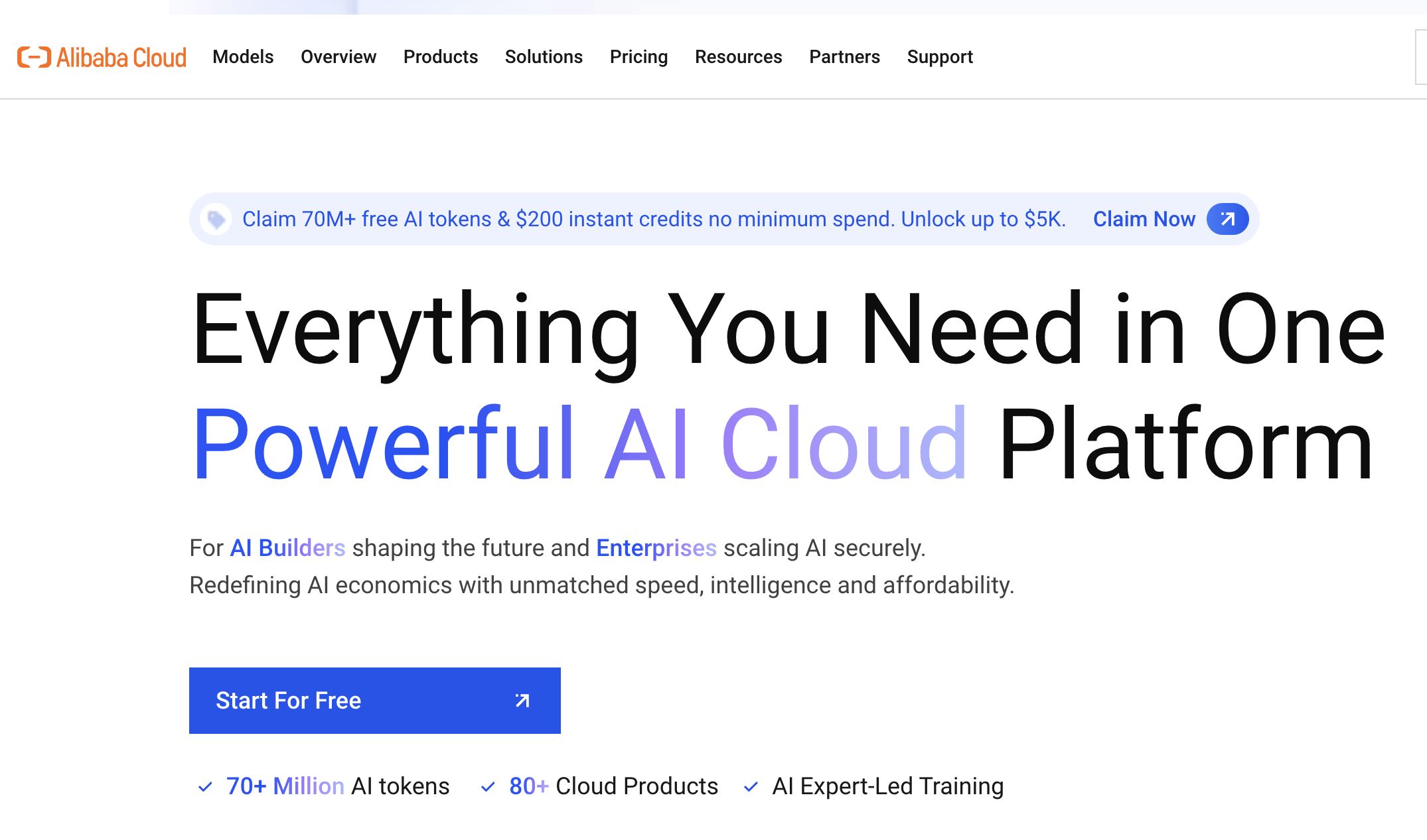
At Emelia, we use AI daily to build our B2B prospecting tools, and at Bridgers, we develop AI solutions for our clients. When a Chinese cloud giant launches a subscription that promises access to four frontier models for the price of a coffee, it demands attention. Alibaba Cloud just dropped its AI Coding Plan, and it is shaking up the market.
The problem is well-known: AI-assisted coding is expensive. Claude Code costs between $100 and $200/month for heavy use, GitHub Copilot Pro+ runs $39/month, and API bills can spike without warning when your agents loop unexpectedly. Alibaba Cloud is offering a radical alternative: a flat monthly subscription starting at $10/month ($3 for the first month) with access to multiple state-of-the-art models. Here is our full breakdown.
What Is Alibaba Cloud AI Coding Plan?
The AI Coding Plan is a monthly subscription launched by Alibaba Cloud through its Model Studio platform. The concept is straightforward: you pay a fixed price each month and get a defined number of API requests to use within your preferred development tools. No per-token billing, no surprises at the end of the month.
The plan comes in two tiers:
Lite: $10/month ($3 for the first month, $5 for the second), with 18,000 requests per month, capped at 1,200 requests per 5-hour window and 9,000 per week.
Pro: $50/month ($15 for the first month, $25 for the second), with 90,000 requests per month, capped at 6,000 requests per 5-hour window and 45,000 per week.
What sets this plan apart is multi-model access. With a single API key, you can switch between:
Qwen3.5-Plus (vision): Alibaba's flagship model, 1 million token context window
Kimi K2.5 (vision): Moonshot AI's model, 262,144 token context
GLM-5: Zhipu AI's model, 202,752 token context
MiniMax M2.5: 196,608 token context
Qwen3-Max, Qwen3-Coder-Next, Qwen3-Coder-Plus, GLM-4.7: additional variants
The plan works with all the major AI coding tools: Claude Code, OpenCode, Cursor, Cline, Qwen Code, OpenClaw, Codex, and even the Claude Code VS Code plugin.
Alibaba AI Coding Plan vs Claude Code: $3 vs $200/Month
The most striking comparison is with Claude Code. To use Claude Code intensively, Anthropic offers its Max plan at $200/month (20x) or $100/month (5x). The Pro plan at $20/month includes Claude Code, but usage limits are restrictive for sustained professional work.
Alibaba Cloud lets you plug its API directly into Claude Code. You keep the interface, the commands, the entire Claude Code workflow, but requests are handled by Alibaba's models instead of Claude Sonnet. The cost savings are dramatic, but there is a trade-off: Qwen and its peers are not at the same level as Claude Sonnet 4.5 or Opus on every task.
Feature | Alibaba Lite ($10) | Alibaba Pro ($50) | Claude Code Pro ($20) | Claude Code Max 20x ($200) | GitHub Copilot Pro+ ($39) |
|---|---|---|---|---|---|
Monthly price | $10/mo | $50/mo | $20/mo | $200/mo | $39/mo |
First month price | $3 | $15 | $20 | $200 | $39 |
Models included | Qwen3.5+, Kimi K2.5, GLM-5, MiniMax M2.5, +4 | Same | Claude Sonnet 4.5 (limited Opus) | Claude Sonnet 4.5 + Opus | GPT-4.1, Claude 3.7, Gemini 2.5 Pro |
Requests/month | 18,000 | 90,000 | ~40-80h/week | 20x Pro | 1,500 premium |
Max context window | 1M tokens (Qwen3.5+) | 1M tokens (Qwen3.5+) | 200K tokens | 200K tokens | Varies by model |
Coding agent support | Claude Code, OpenCode, Cursor, Cline, Codex | Same | Native Claude Code | Native Claude Code | Native GitHub Copilot |
Billing | Flat, no overages | Flat, no overages | Flat, usage caps | Flat, usage caps | Flat + $0.04/extra request |
Demand has been so high that Alibaba had to impose purchasing restrictions, with a first-come, first-served discount system.
Which Models Are Included in the Alibaba Plan?
The main advantage of the Coding Plan is its model diversity. Here is what each one brings to the table:
Qwen3.5-Plus is the most versatile model in the lineup. It supports vision (image analysis), has a 1 million token context window and 65,536 token output. This is the default choice for most coding tasks. Alibaba has also included Qwen3-Coder-Next and Qwen3-Coder-Plus, specialized code generation models with 262,144 to 1 million token context.
Kimi K2.5, developed by Moonshot AI, is known for handling long contexts well. It also supports vision and offers 262,144 tokens of context. Early feedback points to solid performance, with some notes about integration quirks in certain tools.
GLM-5 and GLM-4.7, developed by Zhipu AI, stand out for their deep thinking capabilities. GLM-4.7 saw such massive demand that access had to be restricted. Its context window is 202,752 tokens.
MiniMax M2.5 rounds out the offering with 196,608 tokens of context and reasoning capabilities.
An important detail: requests count the model's internal invocations, not just your messages. A simple task can generate 5 to 10 invocations, a complex one 10 to 30. On the Lite plan, 18,000 monthly requests translate to roughly 600 to 3,600 tasks depending on complexity.
How to Use the AI Coding Plan with Claude Code and OpenCode
Setup takes a few minutes. Here is the step-by-step guide:
Setting up with Claude Code
Subscribe to the plan on the Coding Plan page in Alibaba Cloud Model Studio.
Get your exclusive API key (format:
sk-sp-xxxxx) and the base URL.Configure the environment variables in the Claude Code config file:
On macOS/Linux, edit ~/.claude/settings.json:
{
  "env": {
    "ANTHROPIC_BASE_URL": "https://coding-intl.dashscope.aliyuncs.com/apps/anthropic",
    "ANTHROPIC_AUTH_TOKEN": "sk-sp-YOUR_API_KEY",
    "ANTHROPIC_MODEL": "qwen3.5-plus"
  }
}
Edit or create the file
~/.claude.jsonand set"hasCompletedOnboarding": true.Open a new terminal, launch Claude Code, and type
/statusto verify the configuration.Switch models on the fly with the
/modelcommand.
Setting up with OpenCode
Install OpenCode:
npm install -g opencode-aiCreate the configuration file at
~/.config/opencode/opencode.jsonwith the "bailian-coding-plan" provider, base URLhttps://coding-intl.dashscope.aliyuncs.com/apps/anthropic/v1, and your API key.Launch OpenCode and type
/modelsto select your model from Model Studio Coding Plan.
The plan also works with Cursor, Cline, Codex, the Claude Code VS Code plugin, and JetBrains IDEs.
Important: The Coding Plan API key (format sk-sp-xxxxx) is different from the standard Model Studio API key (format sk-xxxxx). Do not mix them up, or your requests will be billed outside the subscription.
Cheap GitHub Copilot Alternative: The Alibaba Plan
GitHub Copilot remains the reference tool for in-IDE code completion. But the comparison with Alibaba's Coding Plan is not entirely apples-to-apples.
Copilot Free offers 2,000 completions/month and 50 premium requests at no cost. Copilot Pro ($10/month) upgrades to unlimited completions and 300 premium requests. Copilot Pro+ ($39/month) goes to 1,500 premium requests with access to all models, including the coding agent.
Alibaba's Coding Plan at $10/month offers 18,000 requests, far more than Copilot Pro's 300 premium requests. But the use cases differ: Copilot integrates natively into your IDE with real-time autocomplete, while Alibaba's Coding Plan works through coding agents (Claude Code, OpenCode) operating at the terminal level or through extensions.
For a developer who primarily relies on in-IDE autocomplete, Copilot remains more ergonomic. For someone who works with autonomous coding agents, Alibaba's Coding Plan delivers unbeatable value per request.
Limitations of Alibaba Cloud's AI Coding Plan
Let's be straightforward: this plan is not perfect, and understanding its constraints is essential before subscribing.
Model Quality: The Price-Performance Trade-off
Chinese open-source models have improved dramatically, but they are not yet on par with Claude Sonnet 4.5 or Opus for every complex task. A developer who tested the Pro plan extensively reported on Reddit that quality is "generally good" for function generation, debugging, and small refactors, but noted weaknesses in indentation and complex code structuring.
According to a RAND report, Chinese models operate at roughly one-sixth to one-quarter the cost of comparable US systems. The quality-to-price ratio is excellent, but if you work on complex reasoning tasks or advanced software architecture, native Claude Code with Opus remains superior.
Latency and Speed
Alibaba Cloud's international servers are located in Singapore and Virginia (US). According to a user test from Mexico, response speed is "generally decent," faster than GLM via other providers but slightly slower than Anthropic or OpenAI models directly. For European users, expect some additional latency compared to native Claude Code.
A video test showed that Qwen3.5-Plus generated a complete Astro.js website in about 2 minutes, while GLM-5 had taken 15 minutes for a similar task. Performance varies significantly depending on the model chosen.
Usage Restrictions
The plan is restricted to interactive coding tools (IDEs, coding agents). It is prohibited to use it for automated scripts, application backends, or any non-interactive batch API calls. Alibaba reserves the right to suspend your subscription for misuse. The plan is non-refundable and cannot be cancelled.
Structured Request Limits
Caps are not just monthly; they are also hourly and weekly. On the Lite plan, 1,200 requests per 5 hours means that during an intensive coding session, you could hit this limit. This is a real constraint for developers chaining complex tasks back to back.
The Chinese AI Price War: Why It Matters
Alibaba's AI Coding Plan is part of a broader movement that has reshaped the global AI landscape over the past year. Since DeepSeek's emergence in early 2026, Chinese companies have systematically undercut AI pricing. DeepSeek demonstrated that a high-performing model could be trained for $5.6 million, compared to the typical $100 million in the United States. That single revelation sent shockwaves through Silicon Valley and forced Western AI companies to rethink their pricing strategies.
Alibaba's Qwen model surpassed 700 million downloads on Hugging Face by early 2026, making it the world's most widely used open-source AI system. Six of the top 10 AI models used by Japanese companies are built on DeepSeek and Qwen foundations. Even Japan's National Institute of Informatics adopted Qwen to organize training data for its domestic AI development.
The demand for Chinese AI coding tools has been staggering. Zhipu AI had to cap subscriptions to its GLM-4.7 coding model due to overwhelming demand, primarily from users in the US and China. American developers, with full access to tools like GPT, Claude, Copilot, and Cursor, are choosing Chinese open-source models in such numbers that they have overloaded servers.
The strategy from Chinese labs is clear: deliver models that provide 85-90% of the performance of American models at 10% of the price, betting on open source and mass adoption. While US companies race to build the "most advanced" models, raise prices, and tighten access, Chinese companies are building tools that are good enough, pricing them for mass adoption, and embedding them into real workflows.
As one Reddit user put it: "As an independent developer, spending $200 monthly on AI coding tools is not feasible. If GLM offers 85% of Cursor's functionality for around $15, it's an easy choice."
For developers worldwide, this price war is a direct benefit. Competition drives innovation and lowers costs. Whether you end up using Alibaba's plan or not, its existence is pushing every AI coding provider to offer better value.
Who Should Use This Plan (and Who Should Skip It)
The Lite plan ($10/month) is ideal for:
Hobbyists and learners discovering AI-assisted coding without investing hundreds of dollars. At $3 for the first month, the barrier to entry is essentially zero. You can test four different models and see if AI-assisted coding fits your workflow before committing to anything.
Indie developers building side projects who want to experiment with multiple models. The multi-model access means you can find which model works best for your specific language and framework without managing multiple API keys and accounts.
Budget-conscious developers who were already using free tiers but want more quota. The jump from Copilot Free's 50 premium requests to 18,000 Alibaba requests is enormous.
The Pro plan ($50/month) suits:
Active developers who use coding agents daily and need the headroom of 90,000 monthly requests. At 5x the Lite plan's capacity, this covers even intensive multi-agent workflows.
Small teams and startups that want generous access without the Claude Code Max price tag. A five-person team on Alibaba Pro costs $250/month total, compared to $1,000/month for Claude Code Max.
Multi-model developers who want to test which model performs best on their stack. Being able to switch between Qwen, Kimi, GLM, and MiniMax with a single command is genuinely useful for benchmarking.
You should stick with Claude Code or Copilot if:
You work on complex software architecture where model reasoning quality is critical. Claude Opus remains the gold standard for multi-step reasoning and architectural decisions.
Minimal latency is essential for your workflow. Native Claude Code or Copilot will always be faster than routing through Alibaba's international endpoints.
You need Claude Opus for advanced reasoning tasks that require the deepest understanding of code logic and interdependencies.
You are in an enterprise and need compliance guarantees, SSO, audit logs, and IP indemnity. Alibaba's Coding Plan currently lacks enterprise governance features.
Our Verdict: A Real Disruption, With Caveats
Alibaba's AI Coding Plan sends a strong signal to the market. At $10/month for 18,000 requests and access to four model families, it is objectively the best value-for-volume deal available for AI-assisted coding today.
But price is not everything. If you are building a production product and every minute of debugging matters, the quality gap between Qwen3.5-Plus and Claude Sonnet 4.5 can translate into lost hours. The models included are strong for routine development tasks like generating functions, writing tests, and refactoring code. But when you need deep architectural reasoning or nuanced understanding of complex codebases, Claude Opus still holds an edge that cheaper alternatives cannot match.
The real value of the Coding Plan lies in flexibility. The smartest approach for most developers is a hybrid strategy: use Alibaba's plan as your primary tool for routine coding tasks, scaffolding new projects, and rapid iteration, then keep a Claude Code subscription for the critical moments when you need the absolute best reasoning quality. This combination gives you the best of both worlds at a fraction of the cost of running Claude Code Max full time.
For the teams at Bridgers, this type of plan opens interesting possibilities: rapid prototyping on a controlled budget, testing different models for specific use cases, and reserving premium models for critical development phases. The ability to switch between Qwen, Kimi, GLM, and MiniMax within the same subscription also provides valuable insight into which models excel at different types of tasks.
One thing is certain: the AI coding market is in full flux. Prices are falling, models are improving at remarkable speed, and the competition between the US and China is directly benefiting developers worldwide. A year ago, the idea of accessing four frontier coding models for $10/month would have seemed absurd. Today it is reality. Alibaba's AI Coding Plan may not be the definitive solution, but it is an excellent way to start coding with AI without breaking the bank, and a clear sign that the best days for AI-assisted development are still ahead of us.
Klare, transparente Preise ohne versteckte Kosten.
Keine Verpflichtung, Preise, die Ihnen helfen, Ihre Akquise zu steigern.

Credits(optional)
Sie benötigen keine Credits, wenn Sie nur E-Mails senden oder auf LinkedIn-Aktionen ausführen möchten
Können verwendet werden für:
E-Mails finden
KI-Aktion
Nummern finden
E-Mails verifizieren
€19pro Monat
1,000
5,000
10,000
50,000
100,000
1,000 Gefundene E-Mails
1,000 KI-Aktionen
20 Nummern
4,000 Verifizierungen
€19pro Monat
Entdecken Sie andere Artikel, die Sie interessieren könnten!
Alle Artikel ansehenBlog
Veröffentlicht am 5. Apr. 2025
FullEnrich: Bewertungen, Preise und Alternativen, um böse Überraschungen zu vermeiden
 Mathieu Co-founder
Weiterlesen
Software
Veröffentlicht am 11. Juli 2024
7 Alternativen zu Expandi, um Ihre Akquisitionskosten zu senken
 Marie Head Of Sales
Weiterlesen
Software
Veröffentlicht am 22. Apr. 2024
Die 5 besten Alternativen zu Dropcontact für eine bessere B2B-Kundenakquise
Marie Head Of SalesWeiterlesen
Software
Veröffentlicht am 4. Juni 2024
Die 6 besten Alternativen zu GetProspect, um Ihre Kundenakquise anzukurbeln
Marie Head Of SalesWeiterlesen
Software
Veröffentlicht am 31. März 2025
9 Alternativen zu UpLead, um Ihre Kundenakquise WIRKLICH anzukurbeln
 Niels Co-founder
Weiterlesen
Software
Veröffentlicht am 26. Apr. 2024
Email Finder 2026: Die 9 besten Hunter.io-Alternativen
Marie Head Of SalesWeiterlesen
 Maylee
Made with ❤ for Growth Marketers by Growth Marketers
Copyright © 2026 Emelia All Rights Reserved