
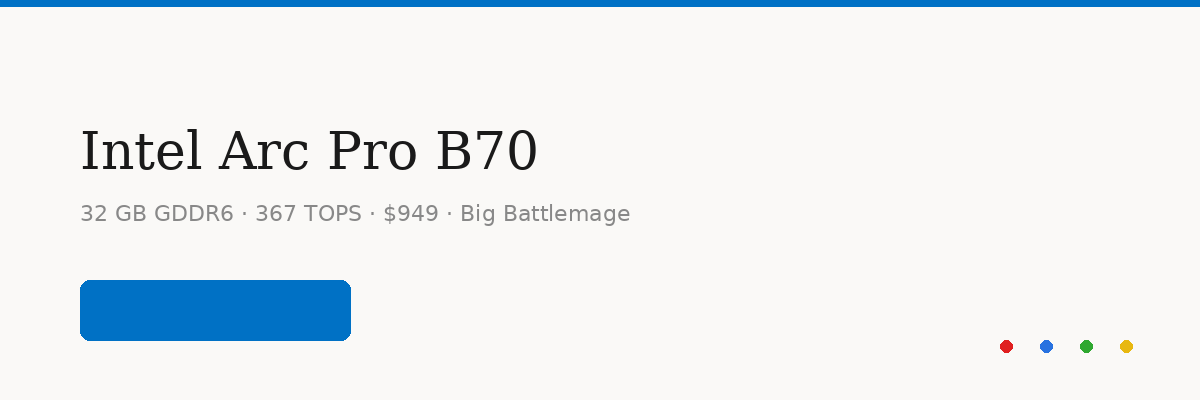
Intel Arc Pro B70: 32GB VRAM for $949, The Budget GPU for Running LLMs Locally
Veröffentlicht am 27. März 2026Aktualisiert am 27. Mai 2026
32GB of VRAM Under $1, 000: Intel Targets the Local AI Market
On March 25, 2026, Intel officially launched the Arc Pro B70, its first professional graphics card based on the "Big Battlemage" die (BMG-G31). The proposition is simple and striking: 32GB of GDDR6 VRAM for $949. In a market where memory capacity is the primary bottleneck for local language model inference, Intel is offering an option that simply did not exist at this price point.
The Arc Pro B70 is not a disguised gaming card. It is a professional product designed for AI workstations, with ISV-certified professional drivers, multi-GPU support on Linux, and optimization for inference frameworks via oneAPI and OpenVINO. Intel explicitly positions it as an alternative to NVIDIA and AMD cards for developers and businesses that want to run LLMs without relying on the cloud.
The Arc Pro B65, a variant using the same GPU but cut down to 20 Xe cores, is announced for mid-April 2026 with 32GB of VRAM as well.
Full Spec Sheet: 32 Xe Cores, 367 TOPS, 608 GB/s Memory Bandwidth
The Arc Pro B70 is built on Intel's Xe2-HPG (Battlemage) architecture, using the full BMG-G31 die. Here are the detailed specifications.
Specification | Arc Pro B70 | Arc Pro B65 |
|---|---|---|
Xe cores | 32 Xe2-HPG | 20 Xe2-HPG |
XMX engines | 256 | Not specified |
Ray Tracing units | 32 | Not specified |
VRAM | 32GB GDDR6 | 32GB GDDR6 |
Memory bus | 256-bit | 256-bit |
Bandwidth | 608 GB/s | 608 GB/s |
AI Performance (INT8) | 367 TOPS | 197 TOPS |
Interface | PCIe Gen5 x16 | PCIe Gen5 x16 |
TDP | 230W (ref.) / 160-290W (partners) | ~200W |
Display outputs | Up to 4x DisplayPort 2.1 | Variable |
Price | $949 | Not announced |
Availability | March 2026 | Mid-April 2026 |
The 608 GB/s memory bandwidth on a 256-bit bus with 19 Gbps GDDR6 is a central feature. For LLM inference, memory bandwidth directly determines token generation speed, as the model is bottlenecked by how quickly weights can be read from VRAM. At 608 GB/s, the Arc Pro B70 sits in a competitive range for its price category.
Native PCIe Gen5 x16 support is notable because it enables faster transfers between CPU and GPU, which matters for initial model loading and for multi-GPU configurations where data moves over the PCIe bus.
LLM Inference Performance: What Early Tests Show
At launch time, independent benchmarks remain limited, but early available results give a sense of the playing field.
On the Level1Techs forum, a test using vLLM with a Qwen 27B model in dynamic FP8 quantization produced interesting results. In single-request mode, generation throughput reached approximately 13 tokens per second. Under concurrent load with 50 simultaneous requests, output throughput climbed to 369.83 tokens per second, with peaks at 550 tokens per second. The tester notes, however, that single-GPU performance may be insufficient for certain larger models.
Intel also communicates "tokens per dollar" and latency metrics against the NVIDIA RTX Pro 4000 (24GB), but these figures come from internal tests rather than independent benchmarks. On SPECviewperf 15, Intel claims a 38% average improvement over the Arc Pro B60 (previous generation), with peaks of 69%.
An important technical point deserves emphasis: Battlemage XMX engines are primarily optimized for FP16 and INT8 precision. Unlike NVIDIA Blackwell GPUs that support FP4/NVFP4, the Arc Pro B70 does not benefit from the same throughput gains with the most aggressive quantization formats. For users relying on 4-bit quantized models, this may limit the card's practical advantage.
Why 32GB of VRAM Changes the Game for Local AI
VRAM capacity is the primary bottleneck for local LLM inference. A model must fit entirely in VRAM (model weights plus KV cache) to run at full speed. Once the model spills into system RAM, performance drops dramatically.
With 32GB of VRAM, here is what you can comfortably run.
7 billion parameter models in FP16 (approximately 14GB) fit without issue, with plenty of headroom for a generous KV cache. 13 billion parameter models in FP16 (approximately 26GB) also fit, with a more constrained KV cache. 27 to 34 billion parameter models work in 4-bit quantization (approximately 14-17GB), which includes popular models like Qwen 27B. 70 billion parameter models in 4-bit quantization (approximately 35-40GB) are at the upper limit and will likely require a multi-GPU configuration.
By comparison, most consumer cards top out at 16GB (RTX 4080 Super, RX 7900 XTX) or 24GB (RTX 4090, RTX Pro 4000). The Arc Pro B70's 32GB opens the door to a category of models that was previously reserved for much more expensive professional cards or Apple Silicon configurations with unified memory.
Intel vs. NVIDIA and AMD: Comparison for Local Inference
The Arc Pro B70's positioning is best understood through direct comparison with its competitors in the professional and semi-professional tier.
Against the NVIDIA RTX Pro 4000 (Blackwell, 24GB GDDR7), the Arc Pro B70 wins on memory capacity (32GB vs. 24GB) and potentially on price. NVIDIA wins on raw compute power, software ecosystem (CUDA remains dominant), and FP4 precision support. For a user who needs to run a 27B model without aggressive quantization, Intel's 32GB can be decisive. For a user who wants to maximize tokens per second on a model that fits in 24GB, NVIDIA is likely the better choice.
Against the AMD Radeon AI Pro R9700 (32GB), the comparison is tighter. Both cards offer the same memory capacity, and AMD has ROCm, an AI software ecosystem more mature than Intel's OneAPI. Independent comparative benchmarks are still lacking, but competition between the two should benefit end users in terms of pricing and software support.
Card | VRAM | Bandwidth | AI (INT8) | Ecosystem | Approx. Price |
|---|---|---|---|---|---|
Intel Arc Pro B70 | 32GB GDDR6 | 608 GB/s | 367 TOPS | OneAPI/OpenVINO | $949 |
NVIDIA RTX Pro 4000 | 24GB GDDR7 | Variable | Higher | CUDA | ~$1, 200+ |
AMD Radeon AI Pro R9700 | 32GB | Variable | Variable | ROCm | Variable |
Apple M4 Max (128GB) | Unified mem. | 546 GB/s | Variable | CoreML/MLX | $3, 500+ |
The real unexpected competitor is Apple Silicon with its unified memory. A MacBook Pro M4 Max with 128GB of memory can load much larger models than any discrete GPU, but at a significantly higher price and with lower memory bandwidth (546 GB/s for the M4 Max). For developers who want a dedicated desktop solution without the Apple investment, the Arc Pro B70 becomes a relevant option.
Intel's Software Ecosystem: The Open Question
Hardware is only as good as the software that runs on it, and this is where the Arc Pro B70 raises the most questions.
Intel offers OneAPI as an abstraction layer and OpenVINO as an optimized inference framework. For standard inference workloads, OpenVINO delivers competitive performance and supports a growing number of models. vLLM support on Intel GPUs is progressing, as evidenced by the Level1Techs benchmarks that successfully use vLLM.
The challenge remains the comparison with NVIDIA's CUDA ecosystem. The vast majority of frameworks, libraries, and tutorials in the AI ecosystem are first developed and optimized for CUDA. If you work with a popular framework, there is a strong chance that CUDA support is more mature and faster than OneAPI support. This is a factor to seriously consider before investing.
However, Intel is betting on multi-GPU Linux support as a differentiator. The ability to combine two or four Arc Pro B70 cards in a workstation to achieve 64 or 128GB of aggregate VRAM is attractive for workloads that exceed single-GPU capacity. If multi-GPU scaling works properly, this opens interesting possibilities for 70B+ parameter models without investing in datacenter hardware.
The cards are available directly from Intel and through board partners: ARKN, ASRock, Gunnir, Maxsun, and Sparkle offer their own variants with thermal designs and power envelopes ranging from 160W to 290W.
Should You Buy the Intel Arc Pro B70 for Local AI Inference?
The Arc Pro B70 will not be the right choice for everyone, but it fills a genuine gap in the market.
If your priority is memory capacity to run 25-35 billion parameter models without extreme quantization, and your budget is limited to $1, 000 per GPU, the Arc Pro B70 is currently the only option on the market. No other discrete GPU at this price offers 32GB of VRAM.
If your priority is maximum tokens-per-second throughput and your models fit in 24GB, an NVIDIA card will likely be a better investment thanks to CUDA's maturity and FP4 support.
If you are considering a multi-GPU configuration for 70B+ models, wait for independent multi-GPU benchmarks before investing. The promise is appealing, but real-world scaling performance will depend heavily on driver quality and software support.
The Arc Pro B70's arrival is good news for the local AI ecosystem as a whole. More competition in the high-VRAM professional GPU segment means falling prices and accelerated innovation. Whether you choose Intel, NVIDIA, or AMD, the fact that three manufacturers are now competing on this terrain can only benefit developers and businesses that want to keep their models local.
FAQ
What is the Intel Arc Pro B70?+
The Intel Arc Pro B70 is a professional Intel GPU equipped with 32 GB of VRAM, sold around 949 dollars. Its target: running LLMs locally at a much lower cost than NVIDIA equivalents.
Is the B70 powerful enough for local LLMs?+
With 32 GB of VRAM, it runs most open-source 7B-13B models smoothly in standard quantization. For 70B models, you need aggressive quantization or multiple GPUs in parallel.
Intel Arc Pro B70 vs NVIDIA RTX 4090?+
The RTX 4090 is still faster in pure inference but costs twice as much and offers less VRAM (24 GB). The B70 is unbeatable on VRAM/price ratio for local LLM workloads.
What software ecosystem for the B70?+
Intel offers its oneAPI/IPEX ecosystem which integrates with PyTorch and modern LLM frameworks (vLLM, llama.cpp, Ollama). Check compatibility with your framework before buying, support has improved significantly in recent months.
Klare, transparente Preise ohne versteckte Kosten.
Keine Verpflichtung, Preise, die Ihnen helfen, Ihre Akquise zu steigern.

Credits(optional)
Sie benötigen keine Credits, wenn Sie nur E-Mails senden oder auf LinkedIn-Aktionen ausführen möchten
Können verwendet werden für:
E-Mails finden
KI-Aktion
Nummern finden
E-Mails verifizieren
€19pro Monat
1,000
5,000
10,000
50,000
100,000
1,000 Gefundene E-Mails
1,000 KI-Aktionen
20 Nummern
4,000 Verifizierungen
€19pro Monat
Entdecken Sie andere Artikel, die Sie interessieren könnten!
Alle Artikel ansehenBlog
Veröffentlicht am 5. Apr. 2025
FullEnrich: Bewertungen, Preise und Alternativen, um böse Überraschungen zu vermeiden
 Mathieu Co-founder
Weiterlesen
Software
Veröffentlicht am 11. Juli 2024
7 Alternativen zu Expandi, um Ihre Akquisitionskosten zu senken
 Marie Head Of Sales
Weiterlesen
Software
Veröffentlicht am 22. Apr. 2024
Die 5 besten Alternativen zu Dropcontact für eine bessere B2B-Kundenakquise
Marie Head Of SalesWeiterlesen
Software
Veröffentlicht am 31. März 2025
9 Alternativen zu UpLead, um Ihre Kundenakquise WIRKLICH anzukurbeln
 Niels Co-founder
Weiterlesen
Software
Veröffentlicht am 8. März 2025
7 Alternativen zu Kaspr für Ihre B2B-Akquise 2026
Niels Co-founderWeiterlesen
Software
Veröffentlicht am 26. Apr. 2024
Email Finder 2026: Die 9 besten Hunter.io-Alternativen
Marie Head Of SalesWeiterlesen
Nützliche Links
HubKaltakquise-E-Mail: Kompletter LeitfadenZustellbarkeit: Kompletter LeitfadenAlternative zu LemlistAPIDemo anfordernPartnerprogrammFind emailÜber uns
Feedback & RoadmapDatenschutzrichtlinieAGBImpressumTestimonialsRoadmapAlternativesVergleicheContact Maylee
Made with ❤ for Growth Marketers by Growth Marketers
Copyright © 2026 Emelia All Rights Reserved