
Zurück zum Hub
Blog
KI
Context Gateway: Cut Your AI Agent Costs by 76%
Veröffentlicht am 15. März 2026Aktualisiert am 27. Mai 2026
At Emelia, artificial intelligence is not a marketing buzzword. It is the engine behind our B2B prospecting platform. Data enrichment, lead scoring, message personalization at scale: our AI pipelines process massive volumes of tokens every day. When a tool promises to cut our LLM bills by four while maintaining output quality, we test it immediately. Context Gateway, the new open-source proxy from Compresr (YC W26), makes exactly that promise. We started evaluating it as soon as it launched, and here is our complete analysis.
Why Your AI Agents Are Wasting 75% of Their Tokens
If you use Claude Code, Cursor, or any other AI development agent, you know the scenario. You launch a refactoring task on a large project. The agent chains tool calls: file reads, grep searches, shell executions. Each call returns hundreds, sometimes thousands of lines. The problem? Most of those tokens are noise.
A simple grep on a directory can return 8,000 tokens. The agent only needed 200. Multiply that ratio by the dozens of tool calls in a working session, and you understand why the context window saturates within minutes.
The consequences are threefold:
Costs explode. LLM providers charge per input token. Sending 100,000 tokens when 25,000 would suffice means paying four times too much. With intensive daily use, the monthly bill becomes significant.
Latency increases. Inference time directly correlates with context size. Transformer attention has quadratic complexity, O(n squared), relative to context length. The longer the context, the slower the response.
Accuracy drops. This is the most counterintuitive point. One-million-token context windows exist, but they do not guarantee quality. The GPT-5.4 launch notes cited by the Compresr team show accuracy dropping from 97.2% at 32K tokens to just 36.6% at 1M tokens. Claude Opus 4.6 shows a needle-in-a-haystack retrieval rate of 91.9% at 256K tokens, falling to 78.3% at 1M according to benchmarks compiled by AIMultiple.
The problem is not the model. The problem is that relevant information gets buried in noise. The longer the context, the harder the model works to find the needle in the haystack.
Context Gateway: A Transparent Proxy Between Your Agent and the LLM
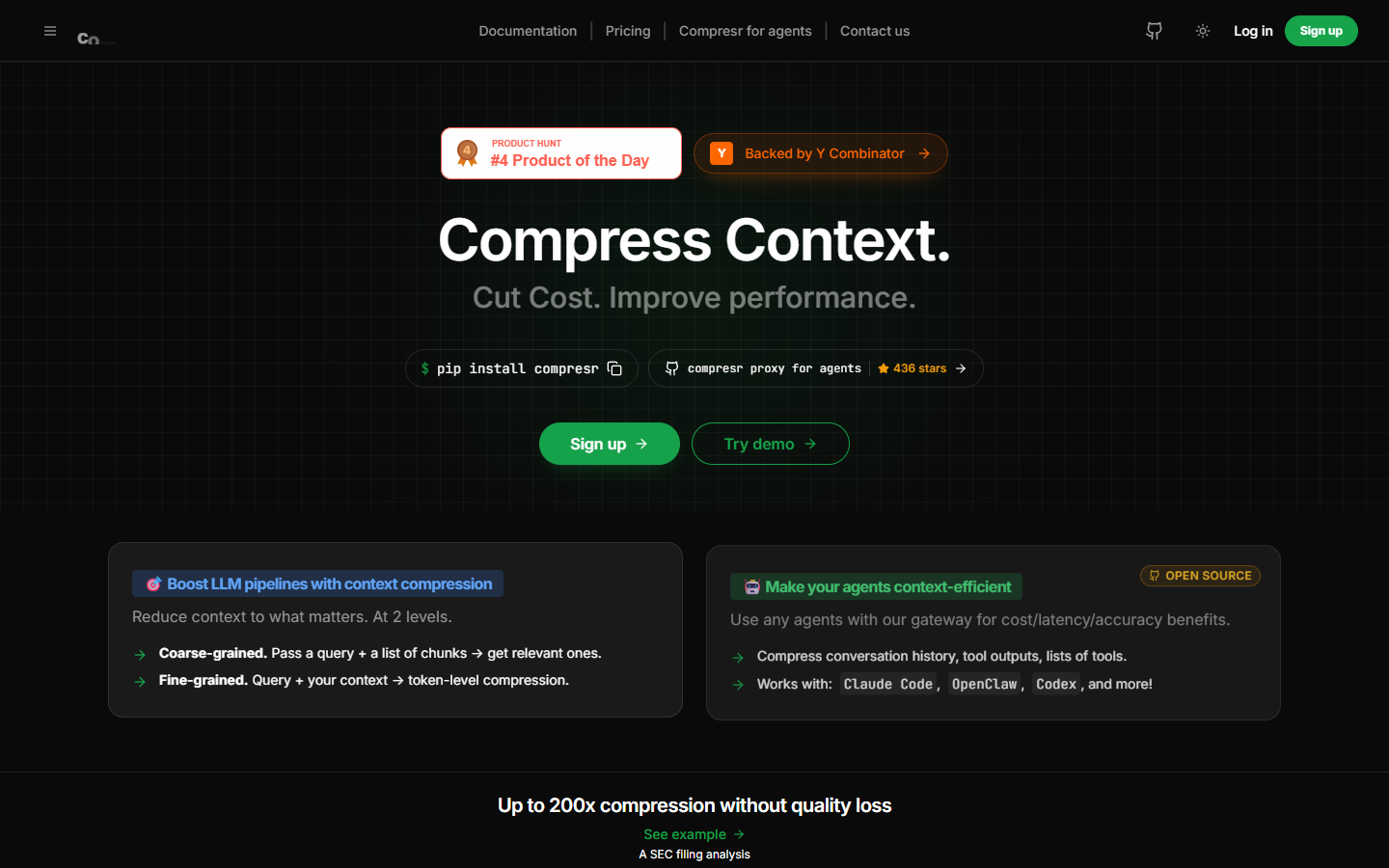
Context Gateway is an open-source local proxy written in Go that sits between your AI agent and the LLM provider's API. Its job: compress tool outputs and conversation history before the tokens ever reach the model.
The operation is transparent. You configure your agent to point at the local proxy instead of the Anthropic or OpenAI API. The proxy intercepts each request, compresses the content, then forwards the lighter version to the model. The agent does not even know compression happened.
How Context Gateway Compression Works
This is where Context Gateway differentiates itself from naive approaches. This is not summarization. The Compresr team has trained small language models (SLMs) that work as classifiers: they decide token by token what is relevant and what is not, without generating new text.
This distinction is fundamental:
No summary, no structural loss. The compressed output preserves the structure of the original. Variable names, error messages, file paths remain intact.
Intent-conditioned compression. The SLM knows why the agent called the tool. If you ran a grep looking for error handling patterns, the classifier keeps the relevant matches and strips the rest.
Fast and cheap. Because the model is a classifier rather than an autoregressive generator, compression adds minimal overhead in latency and cost.
Compresr offers three compression models through its API:
Model | Type | Use Case |
|---|---|---|
| Agnostic (token-level) | System prompts, static docs |
| Query-specific (token-level) | RAG pipelines, conditional Q&A |
| Chunk-level filtering | Coarse retrieval filtering, keep/drop whole chunks |
The expand() Function: The Safety Net
Compression is inherently lossy. What happens if the model later needs content that was compressed away? That is the role of the expand() function. The proxy stores all original tool outputs locally. If the LLM realizes it is missing information, it calls expand() to retrieve the uncompressed version on demand.
It is an elegant mechanism, but with a limit: it relies on the model's ability to recognize that it is missing something. In complex agentic chains, this is not always the case.
Background History Compaction
Beyond tool output compression, Context Gateway also manages conversation history compaction. When the context window reaches 85% of capacity, the proxy launches a background summary without blocking the session.
This is a direct advantage over Claude Code's native /compact command, which blocks the session for approximately 3 minutes while summarizing history. With Context Gateway, compaction is preemptive and transparent.
The Numbers: 200x Compression, 76% Savings, 30% Less Latency
The performance claims from Compresr deserve nuanced examination.
Metric | Claimed Value | Context |
|---|---|---|
Maximum compression | Up to 200x | Aggressive |
Cost reduction | 76%+ | Pendium.ai profile |
Latency improvement | 30% | Measured in the demo video |
Default proxy ratio | 0.5 (50% reduction) | Product Hunt comments |
YC headline | 100x compression | Y Combinator LinkedIn post |
An important transparency note. The 200x figure applies to the most aggressive compression mode on highly targeted RAG workloads. That is not what you will get in daily use with a coding agent. The default proxy compression ratio is fixed at 0.5, meaning a 50% token reduction per call. That is already significant, but far from the 200x headline.
Additionally, the benchmark presented on the Compresr website (FinanceBench, 141 questions across 79 SEC documents up to 230K tokens) references "GPT-5.2," which, as the YC Tier List analysis noted, does not match known OpenAI model naming as of March 2026, which "undermines credibility."
Installation and Integration: Claude Code, Cursor, Codex
Installation is deliberately simple:
curl -fsSL https://compresr.ai/api/install | sh context-gateway # launches interactive TUI wizardThe wizard walks you through configuration:
Agent type (Claude Code, Cursor, OpenClaw, Codex, custom)
Summarizer model and API key
Compression trigger threshold
Slack webhook (optional)
Supported integrations:
Claude Code: the primary integration and flagship use case
Cursor: the AI IDE
OpenClaw: the open-source Claude Code alternative
Codex: OpenAI's coding agent
Custom: bring your own agent via configuration
The proxy is API-agnostic: it works with any OpenAI-compatible endpoint. Compresr also publishes a Python SDK (pip install compresr) for integrating compression directly into application code.
For teams deploying agents in production, Context Gateway also provides a web dashboard for monitoring current and past sessions, configurable spend caps per session, and Slack notifications when the agent is waiting for user input.
The Compresr Team: 4 EPFL Researchers and Y Combinator W26
Compresr is a Y Combinator Winter 2026 startup based in San Francisco, partnered with Jared Friedman. The four-founder team comes from EPFL (Swiss Federal Institute of Technology Lausanne):
Founder | Role | Background |
|---|---|---|
Ivan Zakazov | CEO | EPFL PhD (LLM context compression), ex-Microsoft Research, EMNLP-25 and NeurIPS-24 publications |
Oussama Gabouj | CTO | EPFL dLab research, ex-AXA, EMNLP 2025 paper on prompt compression |
Berke Argın | CAIO | EPFL CS, ex-UBS |
Kamel Charaf | COO | EPFL Data Science Masters, ex-Bell Labs |
The fact that the CEO and CTO have published research papers at top-tier NLP conferences (EMNLP, NeurIPS) on the exact subject of their startup is a strong signal. This is not a team that discovered context compression by reading a Twitter thread. They have been working on this problem since their doctoral research.
The GitHub repository shows 412 stars, 34 forks, and 12 releases in 5 weeks since its creation on February 10, 2026, indicating a sustained development pace.
Community Reception: Enthusiasm Meets Skepticism
Hacker News: 85 Points and a Technical Debate
The Show HN for Context Gateway reached 85 points and 49 comments, ranking 20th on the front page on March 13, 2026.
Positive reactions acknowledge that context saturation is a real, painful problem and praise the SLM-based approach over naive summarization.
But skepticism is equally present. One commenter, @verdverm, noted: "The framework I use (ADK) already handles this... YC over-indexed on AI startups too early, not realizing how trivial these startup 'products' are, more of a line item in the feature list of a mature agent framework."
Another, @kuboble, warned: "It seems like the tool to solve the problem that won't last longer than a couple of months and is something that Claude Code can and probably will tackle themselves soon."
A critical technical point was also raised: Claude's prompt caching works on exact prefix matches. If compaction changes the context, the cache is invalidated, and you end up paying full price for the entire history again. This could partially or completely negate cost savings for cache-heavy workflows.
Product Hunt: 217 Upvotes
On Product Hunt, Context Gateway received 217 upvotes and 13 comments. Feedback highlighted spend caps and Slack notifications as quality-of-life features sorely missing from native Claude Code.
https://www.linkedin.com/posts/ivan-zakazov_we-realized-that-claude-code-and-openclaw-activity-7435618282168164352-RwSW
Context Gateway vs. the Competition: LLMLingua, Google ADK, Native Claude
Context Gateway does not operate in a vacuum. The context compression landscape is active, with academic players, frameworks, and native features.
Solution | Approach | Strengths | Limitations |
|---|---|---|---|
Context Gateway | Local proxy, SLM classifier | Transparent, expand(), dashboard | Young, fixed ratio |
Microsoft LLMLingua | Perplexity-based pruning (GPT2/LLaMA) | Up to 20x, well-documented | Not an agent proxy, research library |
Google ADK | Built-in | Native, one-line config | Limited to ADK ecosystem |
Claude Code /compact | Native compaction | No installation needed | Blocking (3 min), coarse control |
Sentinel (arXiv) | Attention probing, 0.5B proxy model | 5x compression on LongBench | No production release |
The Token Company (YC W26) | ML prompt compression | Also YC W26, prompt-focused | Not specifically a proxy |
The main competitive risk is well summarized by the YC Tier List analysis: "Microsoft Research already ships LLMLingua, and any major LLM provider can internalize compression natively, making this a feature rather than a company." If Anthropic improves Claude Code's native compaction, or if OpenAI integrates compression into Codex, the value proposition of an external proxy diminishes considerably.
Why Context Management Became Critical Infrastructure in 2026
Beyond Context Gateway, context management is becoming an infrastructure concern for any team deploying AI agents in production.
Context windows grew, but the problem did not disappear. Even with 1 million tokens, accuracy degrades nonlinearly. Sonnet 4.6 drops from 90.6% retrieval at 256K tokens to 65.1% at 1M. More context does not mean better performance.
Agentic workflows pollute context by nature. Every tool call adds tokens. A coding agent can issue dozens of calls per session (grep, read_file, bash...), each potentially returning thousands of tokens. A single file read can inject over 10,000 tokens into the window.
The ecosystem now treats context as infrastructure. Google ADK added a `compaction_interval` flag in version 1.16.0. Multiple YC W26 startups (Compresr, The Token Company) are building context compression as a standalone product. Kubernetes formed an AI Gateway Working Group to standardize context-aware routing infrastructure.
On the academic side, the Sentinel paper proposes attention probing for context compression, achieving 5x compression on LongBench with a proxy model of just 0.5 billion parameters.
Limitations You Should Know Before Adopting Context Gateway
We started testing Context Gateway locally on side projects, and it is important to give an honest assessment of its current limitations.
Compression is inherently lossy. Removing tokens means losing information. The team claims quality improves in practice because the model receives more condensed context, but edge cases exist where tokens deemed "irrelevant" turn out to matter later in the chain.
Prompt cache invalidation is a real risk. If you use Claude with prompt caching, compaction changes the context prefix, which invalidates the cache. You could end up paying more, not less, on workflows that rely heavily on caching.
The compression ratio is fixed. The default 0.5 ratio is a blunt instrument. Structured data (JSON, code) may need different treatment than verbose logs. The team acknowledges this limitation and is working on differential treatment, but it is not available yet.
Benchmarks lack independent verification. No third-party benchmarks are available. The reference to "GPT-5.2" in the website benchmarks does not match known OpenAI naming.
It is an early-stage product. Four founders, 52 commits, version 0.5.2. The product works and installs, but production hardening for enterprise deployments is still in progress. Version 0.4.4 introduced security hardening and OAuth support, suggesting earlier versions had security gaps.
The existential risk is real. If Anthropic, OpenAI, or Google natively integrate performant context compression into their agents, the use case for an external proxy shrinks drastically. Google ADK already does it with a single line of configuration.
Who Should Consider Context Gateway?
You should evaluate it if:
You use Claude Code, Cursor, or a similar agent on sizeable codebases and your token bill is becoming a notable cost item.
You deploy AI agents in production and need spend caps, monitoring, and notifications that native tools lack.
You manage RAG pipelines that ingest large documents (SEC filings, technical documentation, knowledge bases) and want to reduce per-query cost.
You are frustrated by Claude Code's blocking compaction and want a transparent alternative.
You can wait if:
Your agent usage is light and your token bill is negligible.
You are in the Google ADK ecosystem, which already offers native compaction.
You do not want to add a local intermediary that handles all your API keys and network traffic.
You prefer to wait for LLM providers to build these features natively, which will likely happen in the coming months.
Our Verdict: A Promising Tool Worth Watching Closely
Context Gateway solves a real problem that every intensive AI agent user has encountered. The technical approach is sound: SLM classifier-based compression rather than summarization is the right idea, and the team has the academic pedigree to execute it.
The 76% cost savings and 30% latency reduction are credible in the right scenarios, even if the 200x figure is an extreme case that should not be taken as a daily-use benchmark. The 412 GitHub stars and 12 releases in 5 weeks show an active project with genuine initial traction.
At Emelia, we have started evaluating it on our internal data processing pipelines. The promise of significantly reducing our token costs while maintaining or improving response quality is exactly what we need as our volumes grow. Context management is no longer a nice-to-have: it is an infrastructure layer that every serious AI team must address.
The real test for Compresr will not be technical. It will be whether they can establish a defensible position before LLM providers build this feature into their own products. The race is on.
Klare, transparente Preise ohne versteckte Kosten.
Keine Verpflichtung, Preise, die Ihnen helfen, Ihre Akquise zu steigern.

Credits(optional)
Sie benötigen keine Credits, wenn Sie nur E-Mails senden oder auf LinkedIn-Aktionen ausführen möchten
Können verwendet werden für:
E-Mails finden
KI-Aktion
Nummern finden
E-Mails verifizieren
€19pro Monat
1,000
5,000
10,000
50,000
100,000
1,000 Gefundene E-Mails
1,000 KI-Aktionen
20 Nummern
4,000 Verifizierungen
€19pro Monat
Entdecken Sie andere Artikel, die Sie interessieren könnten!
Alle Artikel ansehenBlog
Veröffentlicht am 5. Apr. 2025
FullEnrich: Bewertungen, Preise und Alternativen, um böse Überraschungen zu vermeiden
 Mathieu Co-founder
Weiterlesen
Software
Veröffentlicht am 11. Juli 2024
7 Alternativen zu Expandi, um Ihre Akquisitionskosten zu senken
 Marie Head Of Sales
Weiterlesen
Software
Veröffentlicht am 22. Apr. 2024
Die 5 besten Alternativen zu Dropcontact für eine bessere B2B-Kundenakquise
Marie Head Of SalesWeiterlesen
Software
Veröffentlicht am 31. März 2025
9 Alternativen zu UpLead, um Ihre Kundenakquise WIRKLICH anzukurbeln
 Niels Co-founder
Weiterlesen
Software
Veröffentlicht am 8. März 2025
7 Alternativen zu Kaspr für Ihre B2B-Akquise 2026
Niels Co-founderWeiterlesen
Software
Veröffentlicht am 26. Apr. 2024
Email Finder 2026: Die 9 besten Hunter.io-Alternativen
Marie Head Of SalesWeiterlesen
Nützliche Links
HubKaltakquise-E-Mail: Kompletter LeitfadenZustellbarkeit: Kompletter LeitfadenAlternative zu LemlistAPIDemo anfordernPartnerprogrammFind emailÜber uns
Feedback & RoadmapDatenschutzrichtlinieAGBImpressumTestimonialsRoadmapAlternativesVergleicheContact Maylee
Made with ❤ for Growth Marketers by Growth Marketers
Copyright © 2026 Emelia All Rights Reserved