
Zurück zum Hub
Blog
KI
Firecrawl: the Open Source API Turning Websites Into Prospect Gold
Veröffentlicht am 14. März 2026Aktualisiert am 18. März 2026
At Emelia, we build a B2B prospecting SaaS that combines cold email, LinkedIn automation, and data enrichment. Our daily mission is helping sales teams find the right prospects, with the right data, at the right time. And in that mission, one technological layer is becoming increasingly critical: web data extraction. Static databases age in real time. Pricing changes, teams shuffle, companies pivot. The freshest, most reliable, most complete data lives on company websites themselves. That is exactly where Firecrawl comes in.
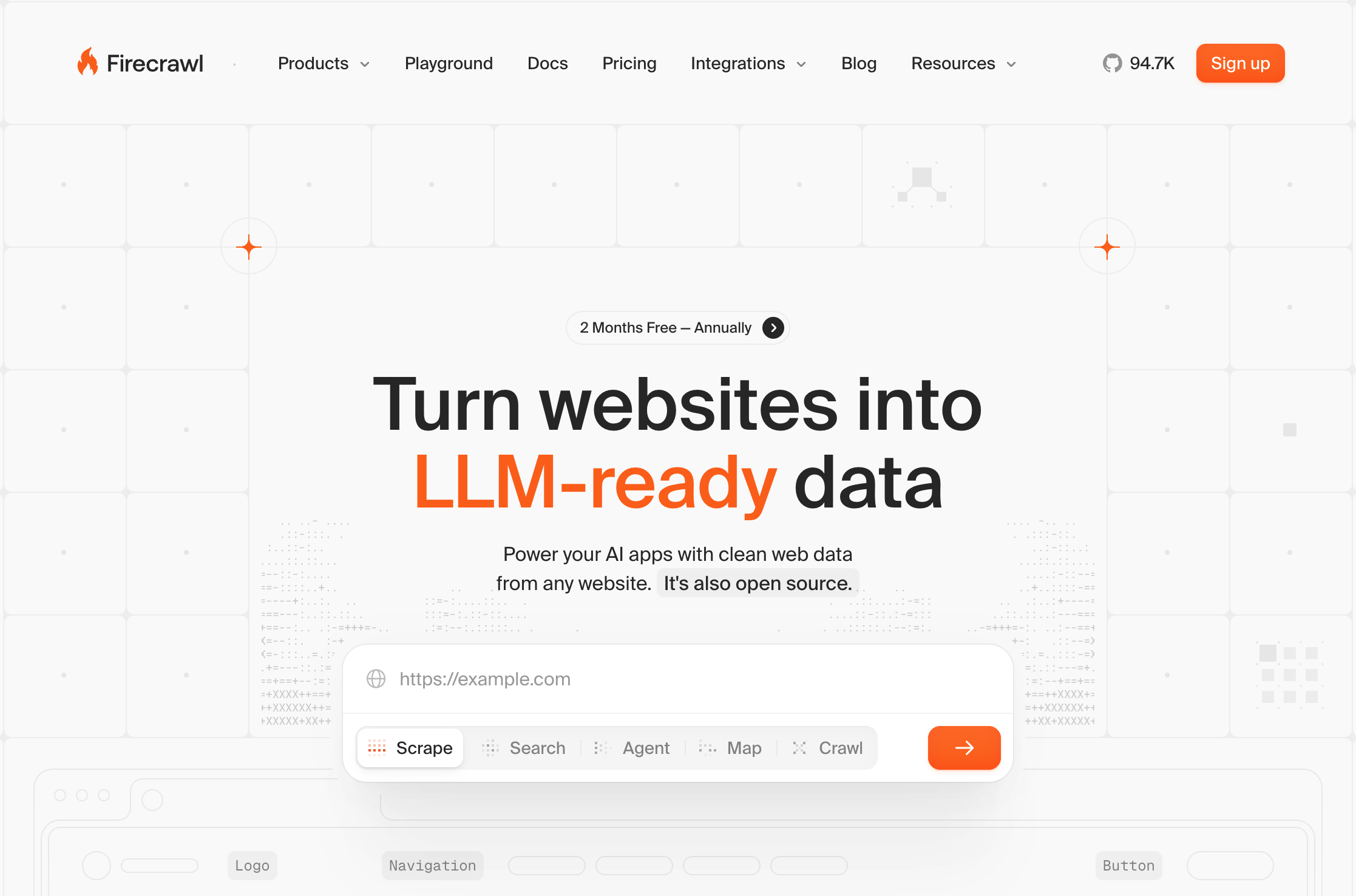
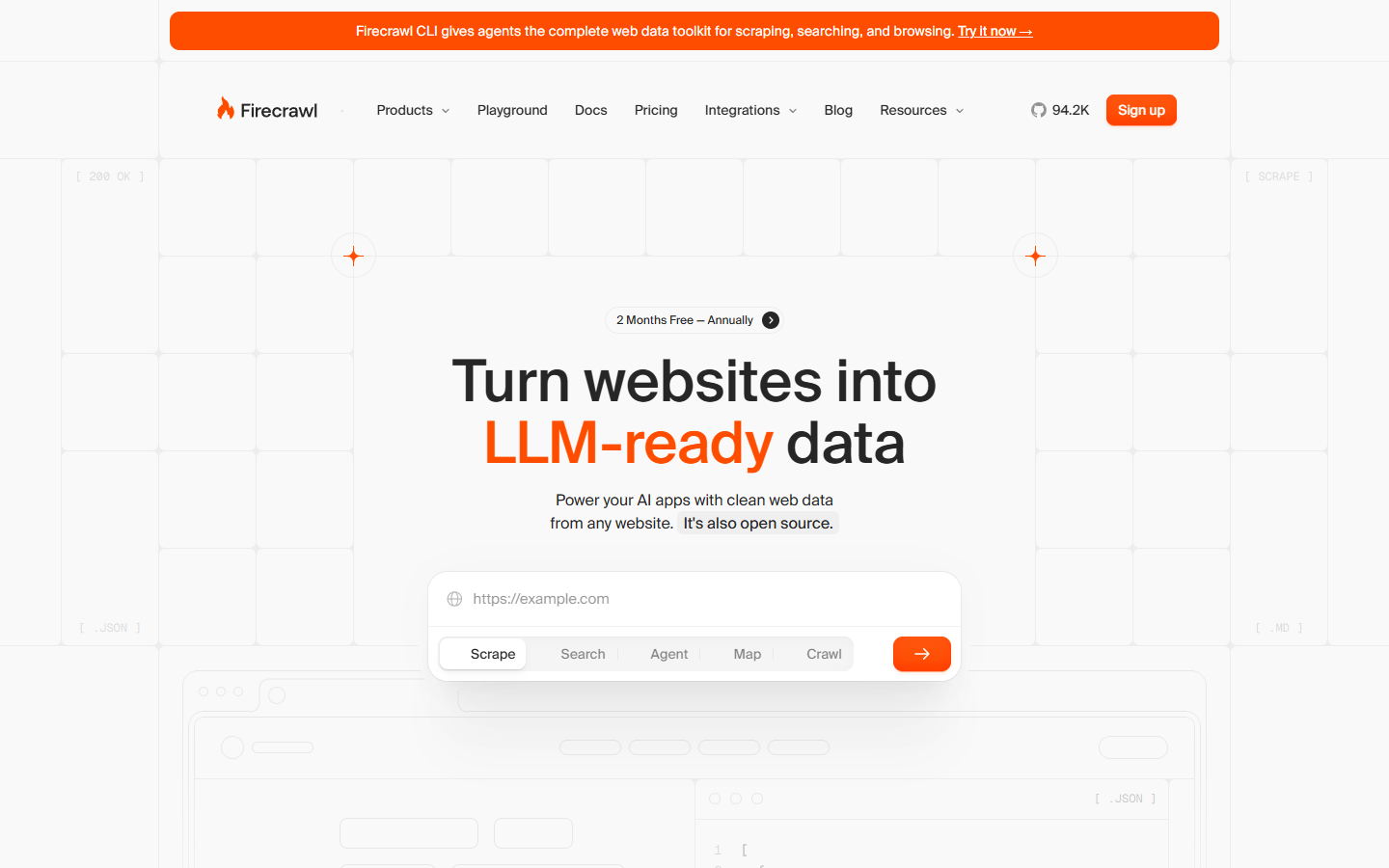
Firecrawl is an open source API that turns any URL into clean, structured data ready for AI consumption. Markdown, JSON, HTML, screenshots: you pick the format, Firecrawl handles the rest. No proxy configuration, no headless browser maintenance, no fragile custom scripts. For B2B sales and growth teams, the implications are massive.
What Is Firecrawl and Why Should Sales Teams Care?
Firecrawl was born from a real engineering pain point. The founding team was building Mendable, an AI chatbot for documentation used by Snapchat, MongoDB, and Coinbase. Their biggest obstacle was not the AI itself but data ingestion: turning entire websites into content that a language model could actually use was a brutal technical challenge. They extracted that infrastructure layer and shipped it as a standalone product in April 2024.
The results have been extraordinary. In less than two years, Firecrawl has built a traction profile that most developer tools companies would envy:
92,800+ GitHub stars, placing it in the top 400 repositories of all time
500,000+ developers registered on the platform
Over 1 billion requests served since launch
80,000+ companies using the product, including Zapier, Shopify, Replit, Amazon, and Nvidia
$16.2M in total funding, including a $14.5M Series A led by Nexus Venture Partners in August 2025
Profitable at the time of the Series A
The founding team includes Caleb Peffer (CEO), Eric Ciarla, and Nicolas Silberstein Camara (CTO, YC S22 alum). Strategic investors include Zapier, Shopify CEO Tobias Lutke, and Postman CEO Abhinav Asthana.
The 7 Core Features That Make Firecrawl a Prospecting Powerhouse
Scrape: Turn Any Page Into Structured Data
The foundational feature. Provide a URL, get back clean markdown, HTML, structured JSON, or a screenshot. The engine handles JavaScript rendering automatically, works on Single Page Applications, and can process PDFs and DOCX files. You can define a JSON schema or describe in plain English what you want to extract, without writing a single CSS selector.
For B2B prospecting, this means a single API call can extract a company's description, leadership team, tech stack, pricing, and contact information from their website.
from firecrawl import Firecrawl from pydantic import BaseModel
app = Firecrawl(api_key="fc-YOUR_API_KEY")
class CompanyProfile(BaseModel): company_name: str description: str industry: str employee_count: str tech_stack: list[str] key_personnel: list[str] recent_funding: str
result = app.scrape( 'https://target-company.com', formats=[{"type": "json", "schema": CompanyProfile.model_json_schema()}] )
Crawl: Map an Entire Website in One API Call
A single request kicks off a full website crawl. The engine respects robots.txt, handles depth configuration, URL filters, and can even access content behind authentication walls via custom headers. Jobs run asynchronously with webhook support.
Map: Discover Every URL on a Domain Instantly
Map is the scout. It identifies all accessible URLs on a domain and can filter them by relevance using a search term. For prospecting, this is the ideal starting point: map a professional directory or a competitor's site before launching a batch extraction.
Search: Web Search and Extraction Combined
A single call that combines web search with full content extraction from each result. Filters by country, language, and category (web, news, images). The B2B use case writes itself: "Find all SaaS companies in France that raised a Series A in 2025" returns directly usable content.
Agent: AI-Powered Autonomous Extraction
The most powerful feature. Describe what you need in plain English, without providing any URL. The agent autonomously searches, navigates, and extracts structured data. Two models are available: spark-1-mini (60% cheaper, suitable for most tasks) and spark-1-pro (maximum accuracy for complex multi-source research).
result = app.agent( prompt="Find the pricing plans for Notion", ) For GTM teams, imagine an agent that every morning automatically collects your competitors' pricing changes or new funding rounds in your industry.
Browse: Cloud Browser Sessions for AI Agents
Browse provides persistent cloud browser sessions. Your AI agents can execute Playwright, Python, or bash code to navigate, interact, and extract. Browser profiles (cookies, localStorage) persist across sessions.
Batch Scrape and Parallel Agents: Extraction at Scale
Batch Scrape processes thousands of URLs asynchronously. Parallel Agents, launched in January 2026, allow processing hundreds of /agent queries simultaneously in spreadsheet or JSON format. This is the missing link for B2B enrichment at scale.
How Firecrawl Is Transforming B2B Lead Enrichment
Real-Time Enrichment From Company Websites
Traditional enrichment databases (Clearbit, Apollo, ZoomInfo) work with data indexed at regular intervals. The lag can range from weeks to months. Firecrawl changes this dynamic by pulling information directly from the source, in real time, from the target company's website.
Cargo, a GTM data platform, uses Firecrawl to let sales teams instantly classify, personalize outreach, and enrich lead profiles from company websites without writing a single line of collection code.
Building Prospect Databases From Directories
The Map + Batch Scrape + Agent combination is formidable for building prospect lists from professional directories. The workflow is straightforward:
Map a directory site (G2, Crunchbase, industry directories) to get all company profile URLs
Batch Scrape those URLs to extract structured company data
Agent for hard-to-reach data: "Find all SaaS companies in France that raised a Series A in 2024"
In June 2025, Steven Tey, founder of Dub.co, showcased a tool built with Firecrawl that takes a CSV of emails and automatically enriches them with company size, funding information, and more, positioning it as an open source alternative to Clay.
https://x.com/steventey/status/1932945651761098889
The Open Source Clay Alternative for Data Enrichment
Clay is today's reference for GTM data enrichment, but its pricing remains steep for many teams. Firecrawl, combined with a Python script and a database, offers a credible and free alternative for technical teams. You retain full control over your data and enrichment pipeline.
Automated Competitive Intelligence With Firecrawl
Monitoring Competitor Pricing and Feature Changes
Firecrawl launched a Change Tracking feature in April 2025 that monitors website modifications automatically. For sales teams, this means getting alerted the moment a competitor changes pricing, adds a feature, or shifts positioning.
Practical use cases:
Track competitor pricing pages for changes
Extract competitor feature lists, positioning, and customer testimonials
Crawl entire competitor documentation sites
Monitor job postings as a growth signal for specific departments
Map competitor partner ecosystems
Market Research With the Autonomous Agent
The Agent endpoint can drive automated strategic intelligence:
result = app.agent( prompt="Compare enterprise features across Firecrawl, Apify, and ScrapingBee", model="spark-1-pro" ) The Deep Research API, launched in March 2025, takes the concept further with fully autonomous web research on any topic.
The MCP Integration: When AI Agents Prospect for You
The Model Context Protocol and AI Tooling Ecosystem
The Model Context Protocol (MCP) is a standard that allows AI tools to access external services. Firecrawl maintains an official MCP server with 5,800+ GitHub stars, providing direct access to all its capabilities from AI development tools.
A single command installs it:
npx -y firecrawl-cli@latest init --all --browser It works with Claude Code (official plugin since February 2026), Cursor (available in the marketplace), Windsurf, VS Code, Codex (OpenAI), and Gemini CLI.
What This Means for B2B Prospecting
In practice, an AI agent connected to Firecrawl via MCP can:
Automatically collect company data from a URL
Search the web and extract the most relevant results
Crawl an entire competitor site and synthesize its content
Run browser sessions to interact with complex sites
Launch autonomous multi-source research via the Agent endpoint
For prospecting teams, this opens the door to workflows where an AI agent automatically prepares a complete dossier on each prospect before a sales call: financial data, tech stack, recent news, team changes.
Integrations With Automation Platforms
Beyond MCP, Firecrawl integrates natively with LangChain (Python and JS), LlamaIndex, Zapier, n8n, Make, Crew.ai, Composio, Dify, and 20+ additional platforms. Zapier itself uses Firecrawl internally to power chatbot knowledge bases from websites.
Fire-Engine: Firecrawl's Anti-Blocking Technology
One of Firecrawl's strongest differentiators is its proprietary infrastructure called Fire-Engine, deployed in August 2024. It automatically manages rotating proxies, anti-bot mechanisms, JavaScript rendering, CAPTCHAs, and intelligent request throttling.
The web coverage numbers speak for themselves:
Tool | Web Coverage |
|---|---|
Firecrawl | 95% |
Puppeteer | 78% |
cURL | 74% |
Where a Puppeteer-based solution fails on nearly one in four sites, Firecrawl succeeds 95% of the time. For B2B enrichment or competitive intelligence, this reliability is critical: you cannot afford to lose 22% of your data because your collection tool gets blocked.
Fire-Engine also includes smart wait (intelligent content loading detection), iframe support, mobile emulation, and sub-second response times through aggressive caching.
Important note: Firecrawl does not support social media platforms (Instagram, YouTube, TikTok). This is a deliberate design choice. The tool is optimized for business websites, documentation, and help centers, which is exactly what B2B prospecting requires.
Open-Lovable: The Side Project With 12,500 Stars
Alongside its core API, the Firecrawl team shipped Open-Lovable, an open source Lovable clone that can replicate and recreate any website as a modern React app in seconds. The project quickly accumulated 12,500+ GitHub stars and 2,000+ forks.
The process is simple: paste a URL, Firecrawl extracts the structure, styling, and content, then an AI (Claude, GPT-4, Gemini, or Groq) generates a complete React codebase deployable to Vercel.
What matters for the prospecting ecosystem is the demonstration of capability: if Firecrawl can visually clone an entire website, imagine the precision of extraction when you only need a few structured data fields.
Firecrawl Pricing: Which Plan for Which Use Case?
The pricing model is credit-based: 1 credit = 1 page extracted for most operations.
Plan | Credits/Month | Monthly Price (annual) | Concurrent Requests | Extra Credits |
|---|---|---|---|---|
Free | 500 (one-time) | $0 | 2 | N/A |
Hobby | 3,000 | $16/mo | 5 | $9/1,000 |
Standard | 100,000 | $83/mo | 50 | $47/35,000 |
Growth | 500,000 | $333/mo | 100 | $177/175,000 |
Scale | 1,000,000 | $599/mo | 150 | Custom |
Enterprise | Custom | Custom | Custom | Bulk discounts |
For a B2B prospecting team enriching 100 company profiles per day, the Hobby plan at $16 is more than enough (3,000 credits/month is roughly 100 pages per day). A growth team that also monitors competitors and builds prospect databases at scale would look at the Standard plan at $83 for its 100,000 credits.
The Enterprise tier adds zero-data retention, SSO, dedicated support with SLA, and volume discounts. Firecrawl is SOC 2 Type 2 certified, a prerequisite for compliance-conscious organizations.
Firecrawl vs the Competition: Apify, Bright Data, ScrapingBee, Crawl4AI
How does Firecrawl stack up against the alternatives? Here is a detailed comparison.
Firecrawl | Apify | Bright Data | ScrapingBee | Crawl4AI | |
|---|---|---|---|---|---|
Best for | AI-ready data, lead enrichment, RAG pipelines | Pre-built collector marketplace | Enterprise, heavy compliance | Simple HTML collection | Open source, local LLMs |
Output format | Markdown, JSON, HTML, screenshot (AI-ready) | Variable (raw HTML/JSON) | Raw HTML | Rendered HTML | Markdown/JSON |
AI extraction | Natural language prompts | CSS selectors required | No | No | Yes (local LLM) |
Autonomous agent | Yes (/agent endpoint) | No | No | No | Limited |
Open source | Yes (AGPL-3.0) | Crawlee only | No | No | Yes |
Starting price | $16/mo | $29/mo | Enterprise | $49/mo | Free |
MCP support | Official | No | No | No | Limited |
Web coverage | 95% | Variable | High | Medium | Variable |
When to Choose Firecrawl
Firecrawl dominates when you need AI-ready data output, natural language extraction, and predictable pricing (1 credit = 1 page). The MCP integration and autonomous agent have no equivalent among competitors.
When to Choose a Competitor
Apify: You need pre-built collectors for specific platforms (Instagram, TikTok, Google Maps) or want to monetize your own Actors
Bright Data: Massive enterprise requirements with dedicated proxy networks and regulatory compliance documentation
ScrapingBee: Simple HTML collection without any need for AI-ready formats
Crawl4AI: Air-gapped environments, sensitive data handling, or local LLM integration (free, open source)
Eric Ciarla, Firecrawl co-founder, announced the Series A highlighting 15x growth in 12 months:
https://x.com/ericciarla/status/1957825548773667054
Alex Reibman, co-founder of AgentOps, shared his experience migrating from Apify:
https://x.com/AlexReibman/status/1780299595484131836
Who Should Use Firecrawl (and Who Should Skip It)
Firecrawl is for you if...
You are a growth/sales team that wants to enrich prospects with fresh data pulled directly from company websites
You build data pipelines feeding AI agents or language models
You run competitive intelligence and need to automatically monitor changes on competitor sites
You are a developer wanting to integrate web extraction into your workflows via a simple, predictable API
You use AI tools (Claude, Cursor, Windsurf) and want to give them real-time web access via MCP
Firecrawl is probably not for you if...
You need data from social media platforms (Instagram, YouTube, TikTok)
You want a full no-code solution with a visual point-and-click interface
Your needs are limited to basic HTML collection without AI processing
You operate in a fully air-gapped environment (in which case, self-hosted Crawl4AI would be a better fit)
What Firecrawl Means for the Future of B2B Prospecting
The convergence of web data extraction and artificial intelligence is redefining B2B prospecting. Static enrichment tools are gradually giving way to dynamic pipelines that pull information from the source, structure it automatically, and inject it into sales workflows.
Firecrawl sits at the center of this transformation. For Emelia users, the opportunity is clear: coupling the power of real-time web extraction with cold email and LinkedIn prospecting automation creates a significant competitive advantage. Teams that adopt these workflows are no longer just prospecting. They are building intelligent prospecting systems that improve with every iteration.
With 92,800+ GitHub stars, 500,000+ developers, established profitability, and SOC 2 Type 2 certification, Firecrawl is no longer an experimental project. It is production infrastructure relied upon by 80,000+ companies. The question is no longer whether web data extraction belongs in your prospecting stack, but when you will integrate it.
Klare, transparente Preise ohne versteckte Kosten.
Keine Verpflichtung, Preise, die Ihnen helfen, Ihre Akquise zu steigern.

Credits(optional)
Sie benötigen keine Credits, wenn Sie nur E-Mails senden oder auf LinkedIn-Aktionen ausführen möchten
Können verwendet werden für:
E-Mails finden
KI-Aktion
Nummern finden
E-Mails verifizieren
€19pro Monat
1,000
5,000
10,000
50,000
100,000
1,000 Gefundene E-Mails
1,000 KI-Aktionen
20 Nummern
4,000 Verifizierungen
€19pro Monat
Entdecken Sie andere Artikel, die Sie interessieren könnten!
Alle Artikel ansehenBlog
Veröffentlicht am 5. Apr. 2025
FullEnrich: Bewertungen, Preise und Alternativen, um böse Überraschungen zu vermeiden
 Mathieu Co-founder
Weiterlesen
Software
Veröffentlicht am 11. Juli 2024
7 Alternativen zu Expandi, um Ihre Akquisitionskosten zu senken
 Marie Head Of Sales
Weiterlesen
Software
Veröffentlicht am 22. Apr. 2024
Die 5 besten Alternativen zu Dropcontact für eine bessere B2B-Kundenakquise
Marie Head Of SalesWeiterlesen
Software
Veröffentlicht am 14. Juli 2024
6 Alternativen zu Skylead, um Kosten zu sparen und Ihre Lead-Generierung zu verbessern
Marie Head Of SalesWeiterlesen
Software
Veröffentlicht am 31. März 2025
9 Alternativen zu UpLead, um Ihre Kundenakquise WIRKLICH anzukurbeln
 Niels Co-founder
Weiterlesen
Software
Veröffentlicht am 26. Apr. 2024
Email Finder 2026: Die 9 besten Hunter.io-Alternativen
Marie Head Of SalesWeiterlesen
 Maylee
Made with ❤ for Growth Marketers by Growth Marketers
Copyright © 2026 Emelia All Rights Reserved