

MiroFish: The AI Swarm Engine That Simulates the Future With Thousands of Agents (And Got $4M in 24 Hours)
Veröffentlicht am 18. März 2026Aktualisiert am 19. März 2026
MiroFish: the swarm intelligence engine that wants to predict the future
Imagine a piece of software where you feed in a news article, a financial signal, or a draft policy, and it instantly builds a digital world populated by thousands of autonomous characters. These characters debate, form coalitions, change their minds, and their collective behaviors produce a prediction report about what might happen in the real world.
That software exists. It is called MiroFish, it is open source, and it was built in ten days by a 20-year-old Chinese student.
Since its launch in early March 2026, MiroFish has accumulated over 33,000 GitHub stars, reached the top of GitHub's global trending list, and secured 30 million yuan (roughly $4.1 million) in funding in under 24 hours. The project is as remarkable for its technical ambition as it is for the improbable story behind its creation.
What exactly is MiroFish?
MiroFish is a swarm intelligence prediction engine. Unlike traditional forecasting models that rely on time series or statistical regressions, MiroFish takes a radically different approach: it simulates collective human behavior.
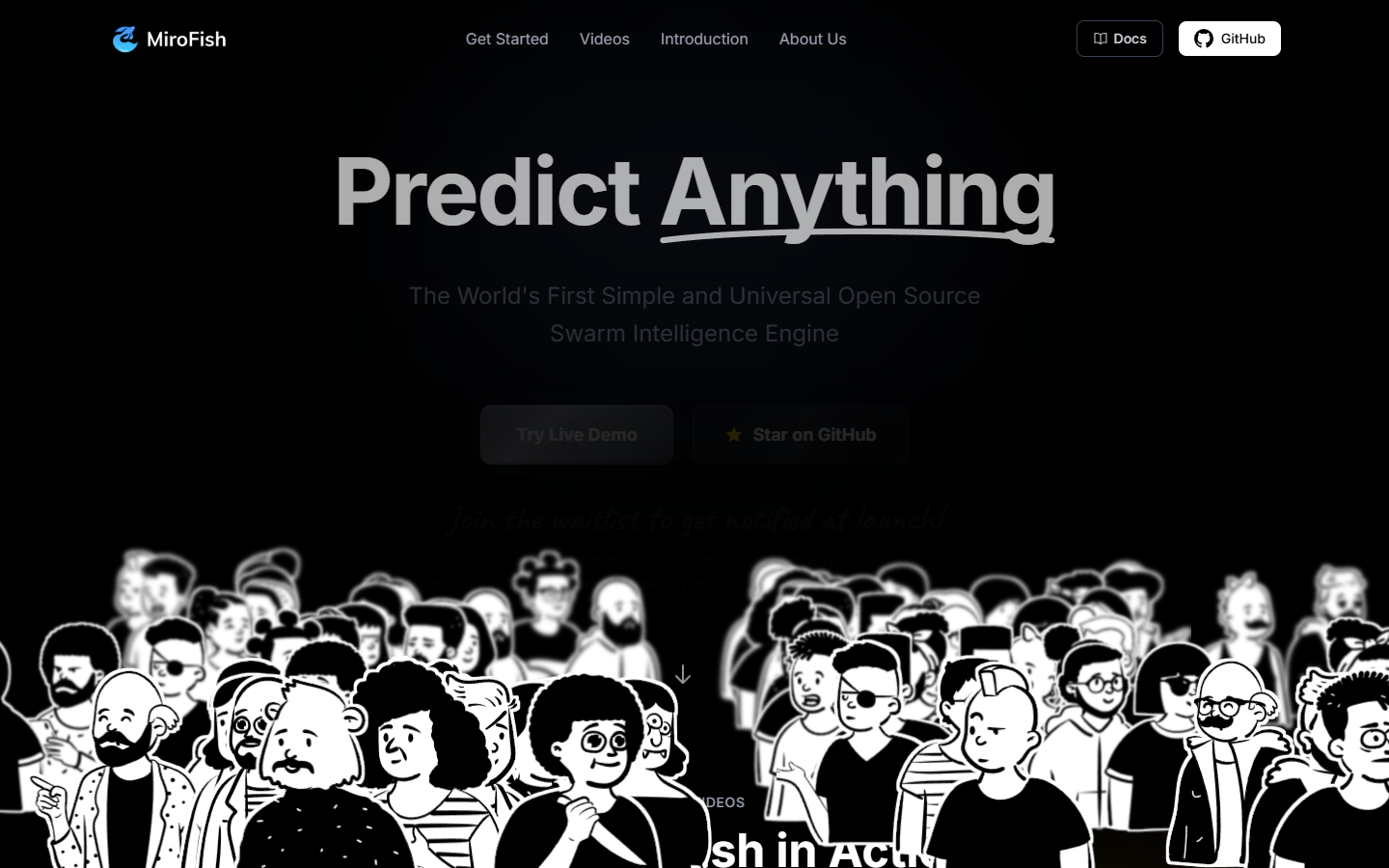
The principle is simple to grasp, even if the execution is complex. You provide the system with a source document: a news article, a financial report, a public policy draft, or even a novel. MiroFish extracts entities and relationships from that document to build a knowledge graph. From this graph, it generates thousands of autonomous AI agents, each equipped with a unique personality, long-term memory, social history, and behavioral logic.
These agents are then released into a digital environment that simulates social media platforms (Twitter-like and Reddit-like). They interact freely: they post, comment, follow, debate, and shift positions. The collective dynamics that emerge from these interactions (dominant opinion formation, polarization, herd effects, narrative shifts) are analyzed to produce a structured prediction report.
In short: MiroFish does not predict the future by extrapolating numbers. It builds a miniature version of the relevant social system and runs it forward at accelerated speed.
The backstory: a student, ten days, and a billionaire
The MiroFish story begins with Guo Hangjiang, a senior at the Beijing University of Posts and Telecommunications. Known as "Baifu" on developer platforms, Guo is deeply interested in intelligent agent architecture and graph computing.
In late 2024, his first open-source project, BettaFish (a multi-agent sentiment analysis tool), had already reached the number one spot on GitHub's global trending list and collected 20,000 stars in a single week. That success caught the eye of Chen Tianqiao, founder of Shanda Group and formerly China's richest man. Chen, who has since become a US-based technology investor, promotes what he calls the "super-individual" theory: the idea that in the AI era, a single person can create the equivalent of an entire company.
Chen invited Guo for an internship at Shanda with complete freedom. In ten days, using what Guo calls "vibe coding" (a rapid, intuitive development approach powered by AI coding assistants), MiroFish was functional. That same evening, Guo recorded a demo video and sent it directly to Chen Tianqiao.
Within 24 hours, Chen committed 30 million yuan (approximately $4.1 million) to incubate the project. Guo went from intern to CEO overnight. On March 7, 2026, MiroFish reached the top of GitHub's global trending list, accumulating 18,000 stars and nearly 1,900 forks within days.
How the MiroFish prediction pipeline works
MiroFish operates through a clearly defined five-stage pipeline. Here is how the system transforms a simple document into a full predictive simulation.
Stage 1: Knowledge graph construction
The source document (news article, financial report, policy draft, literary work) is processed by GraphRAG, a retrieval-augmented generation technology optimized for structured data. The system extracts entities (people, organizations, events, concepts) and their relationships to build a knowledge graph that serves as the simulation's foundation.
Stage 2: Agent generation and environment setup
From the graph, MiroFish generates thousands of agent personas. Each agent receives a unique profile comprising a distinct personality, background, initial stance on the topic, and social relationships with other agents. An environment configuration agent sets the simulation rules. Each agent's long-term memory is managed by Zep Cloud, allowing them to retain and evolve their experiences over time.
Stage 3: Dual-platform parallel simulation
The simulation launches on two parallel platforms (one Twitter-like, one Reddit-like) powered by the OASIS engine, developed by the CAMEL-AI research community. This engine is designed to handle up to one million simultaneous agents with 23 types of social actions (posting, commenting, liking, following, and more). During the simulation, agent memories are dynamically updated based on their interactions.
Stage 4: Prediction report generation
A specialized agent called the ReportAgent analyzes the simulation results. It examines opinion shifts, coalition formations, and emergent behavioral patterns, then compiles a structured, readable prediction report. The report identifies the most likely scenarios and the key dynamics observed.
Stage 5: Deep interaction
After the simulation, you can interact directly with any agent or with the ReportAgent. You can ask follow-up questions, inject new variables ("what would happen if the Fed cut rates?", "what if the CEO resigned?"), and rerun modified scenarios. This is what MiroFish calls the "God's-eye view": the ability to alter conditions mid-simulation and observe in real time how the digital world reorganizes.
MiroFish vs traditional forecasting: what actually changes
To understand what MiroFish brings to the table, it helps to compare it with conventional forecasting methods.
Criteria | Traditional Forecasting | MiroFish |
|---|---|---|
Method | Statistical models, time series, regression | Multi-agent simulation via swarm intelligence |
Data inputs | Structured historical data | Text documents (news, reports, policies) |
Approach | Extrapolation from past trends | Building a miniature social system and running it forward |
Social dynamics | Not accounted for | Core of the model (coalitions, polarization, herd effects) |
Variable injection | Limited to model parameters | Any scenario via "God's-eye view" |
Output | Numbers, probabilities | Structured narrative report with emergent scenarios |
Interaction | Static | Dialogue with individual agents post-simulation |
Cost | Varies by infrastructure | High LLM API costs (each agent consumes tokens) |
Maturity | Decades of validation | Early stage (v0.1.2, March 2026) |
These two approaches are not mutually exclusive. MiroFish's value lies in surfacing scenarios and dynamics that statistical models miss: opinion reversals, cascade effects, unexpected coalitions. Traditional forecasting remains superior for precise quantitative estimates.
Use cases: finance, policy, marketing, and beyond
Finance and markets
MiroFish can simulate the collective reaction of different investor profiles (retail, institutional, analysts) to a market signal. One demonstration simulated the consequences of a Fed rate hike by observing how group sentiments converge and how public opinion trajectories form. For financial strategy teams, this is a narrative stress-testing tool: not "what will the price be?" but "how will market participants react and influence each other?"
Policy and public affairs
Before launching a public policy, it is possible to simulate stakeholder reactions: citizens, lobbies, media, and opposition. MiroFish can surface unexpected alliances or blocking points that conventional analysis would miss. Extensions into geopolitical modeling and wargaming are a natural fit for this architecture.
Crisis communication and PR
Facing a potential crisis, MiroFish allows you to simulate how public opinion would evolve across social media. Which narratives would dominate? Which groups would form? Where would the tipping points be? It is a crisis simulator before the crisis arrives.
Marketing and brand strategy
To evaluate a marketing campaign or product launch, MiroFish can simulate the reactions of thousands of consumer profiles with different personalities and preferences. Instead of surveys or focus groups, you get a dynamic simulation of message propagation and its effects across different segments.
The tech stack: what makes MiroFish possible
The project runs on a combination of technologies that individually have existed for some time, but whose assembly is what makes MiroFish innovative.
Component | Technology | Role |
|---|---|---|
Backend | Python 3.11+ | Core engine language |
Frontend | Vue.js | User interface |
Knowledge graphs | GraphRAG | Entity and relationship extraction |
Agent memory | Zep Cloud | Persistent long-term memory |
Simulation engine | OASIS (CAMEL-AI) | Large-scale multi-agent simulation |
LLM | OpenAI SDK-compatible | Agent reasoning and decision-making |
Deployment | Docker Compose | One-click setup |
License | AGPL-3.0 | Open source |
The OASIS engine, developed by the CAMEL-AI research community, is the central piece. Published in peer-reviewed research, OASIS can simulate up to one million agents with 23 types of social interactions. It replicates documented social phenomena: information propagation, group polarization, and herd effects. This solid scientific foundation is what gives MiroFish its technical credibility.
The fact that Guo Hangjiang assembled all of this in ten days says as much about the maturity of these components (LLMs, GraphRAG, cloud memory for agents) as about his developer skills. Vibe coding, often dismissed, finds a concrete illustration of its power here: the ability of a single individual to build a complex system by leveraging existing AI building blocks.
Why we did not install it (and why the concept is still fascinating)
Let us be transparent: at Bridgers, we have not installed MiroFish on our machines, and we will not be doing so for now.
The reason is straightforward and pragmatic. For information security reasons, our internal policy does not allow us to directly install Chinese open-source repositories on our infrastructure. This is not a judgment on the code quality or the project's intentions. It is a standard precaution that many European companies apply, particularly when the repository is recent, the documentation is partially in Mandarin, and the project requires API keys and network access.
That said, the concept remains absolutely fascinating, which is precisely why we are writing about it.
MiroFish's approach represents a potential paradigm shift in how we think about forecasting. Instead of asking "what does the historical data say?", it asks "what would thousands of simulated people do when faced with this situation?" For finance, marketing, public policy, or crisis management, that is a powerful lens.
The open-source community has already started creating forks and alternative versions. One developer published a fully local, English-language version that runs without cloud APIs, which eliminates some of the security and third-party dependency concerns.
Limitations to know before getting carried away
MiroFish is a promising project, but it is important to maintain a critical perspective.
First, there are no published benchmarks comparing MiroFish predictions to actual outcomes. The system produces plausible scenarios, but no study yet demonstrates that these scenarios are more reliable than other forecasting methods. "Scarily accurate" is an impression shared on social media, not a rigorous scientific evaluation.
Second, API costs are significant. Each agent consumes LLM tokens with every interaction, and a simulation with hundreds of agents over several dozen rounds can become very expensive. The project itself recommends limiting simulations to fewer than 40 rounds.
Third, agents inherit biases from their underlying language models. LLMs tend to produce group behaviors that are more polarized and more herd-like than real humans. MiroFish simulations could therefore amplify certain dynamics beyond what would occur in reality.
Finally, the project is at version 0.1.2. It is a functional prototype, not a mature product. The team is actively recruiting (positions are listed on the GitHub repository with @shanda.com email addresses), which confirms that development is just getting started.
The future of swarm intelligence and predictive simulation
MiroFish is part of a broader trend: using multi-agent systems not to execute tasks, but to simulate complex systems. This approach could transform several domains in the coming years.
In epidemiology, agent swarms could simulate disease spread and the effectiveness of different containment strategies. In urban planning, they could test the impact of new infrastructure on population flows. In insurance, they could model evacuation behaviors during natural disasters.
The fact that a 20-year-old student built such a system in ten days illustrates how accessible the necessary components (LLMs, knowledge graphs, persistent agent memory, large-scale simulation engines) have become. The next milestone will be validation: proving that these simulations produce genuinely predictive results, not just plausible ones.
In the meantime, MiroFish remains what you might call a "SimCity for prediction": a fascinating tool for exploring possible futures, asking "what if" questions, and visualizing complex social dynamics. For strategy, finance, or communications teams, it is a concept worth following closely, even if direct installation is not yet on the agenda.
Klare, transparente Preise ohne versteckte Kosten.
Keine Verpflichtung, Preise, die Ihnen helfen, Ihre Akquise zu steigern.

Credits(optional)
Sie benötigen keine Credits, wenn Sie nur E-Mails senden oder auf LinkedIn-Aktionen ausführen möchten
Können verwendet werden für:
E-Mails finden
KI-Aktion
Nummern finden
E-Mails verifizieren
€19pro Monat
1,000
5,000
10,000
50,000
100,000
1,000 Gefundene E-Mails
1,000 KI-Aktionen
20 Nummern
4,000 Verifizierungen
€19pro Monat
Entdecken Sie andere Artikel, die Sie interessieren könnten!
Alle Artikel ansehenBlog
Veröffentlicht am 5. Apr. 2025
FullEnrich: Bewertungen, Preise und Alternativen, um böse Überraschungen zu vermeiden
 Mathieu Co-founder
Weiterlesen
Software
Veröffentlicht am 11. Juli 2024
7 Alternativen zu Expandi, um Ihre Akquisitionskosten zu senken
 Marie Head Of Sales
Weiterlesen
Software
Veröffentlicht am 22. Apr. 2024
Die 5 besten Alternativen zu Dropcontact für eine bessere B2B-Kundenakquise
Marie Head Of SalesWeiterlesen
Software
Veröffentlicht am 31. März 2025
9 Alternativen zu UpLead, um Ihre Kundenakquise WIRKLICH anzukurbeln
 Niels Co-founder
Weiterlesen
Software
Veröffentlicht am 8. März 2025
7 Alternativen zu Kaspr für Ihre B2B-Akquise 2026
Niels Co-founderWeiterlesen
Software
Veröffentlicht am 26. Apr. 2024
Email Finder 2026: Die 9 besten Hunter.io-Alternativen
Marie Head Of SalesWeiterlesen
 Maylee
Made with ❤ for Growth Marketers by Growth Marketers
Copyright © 2026 Emelia All Rights Reserved