

Vercel Knowledge Agents: Build Reliable AI Agents Without Embeddings or Vector DBs
Veröffentlicht am 11. Apr. 2026Aktualisiert am 14. Apr. 2026
Vercel just published an open source template that challenges much of what the industry takes for granted about building AI agents: its Knowledge Agent Template uses no embeddings, no vector database, and no RAG pipeline. Instead, it relies on classic Unix commands (grep, find, cat) executed in an isolated sandbox to search and extract information.
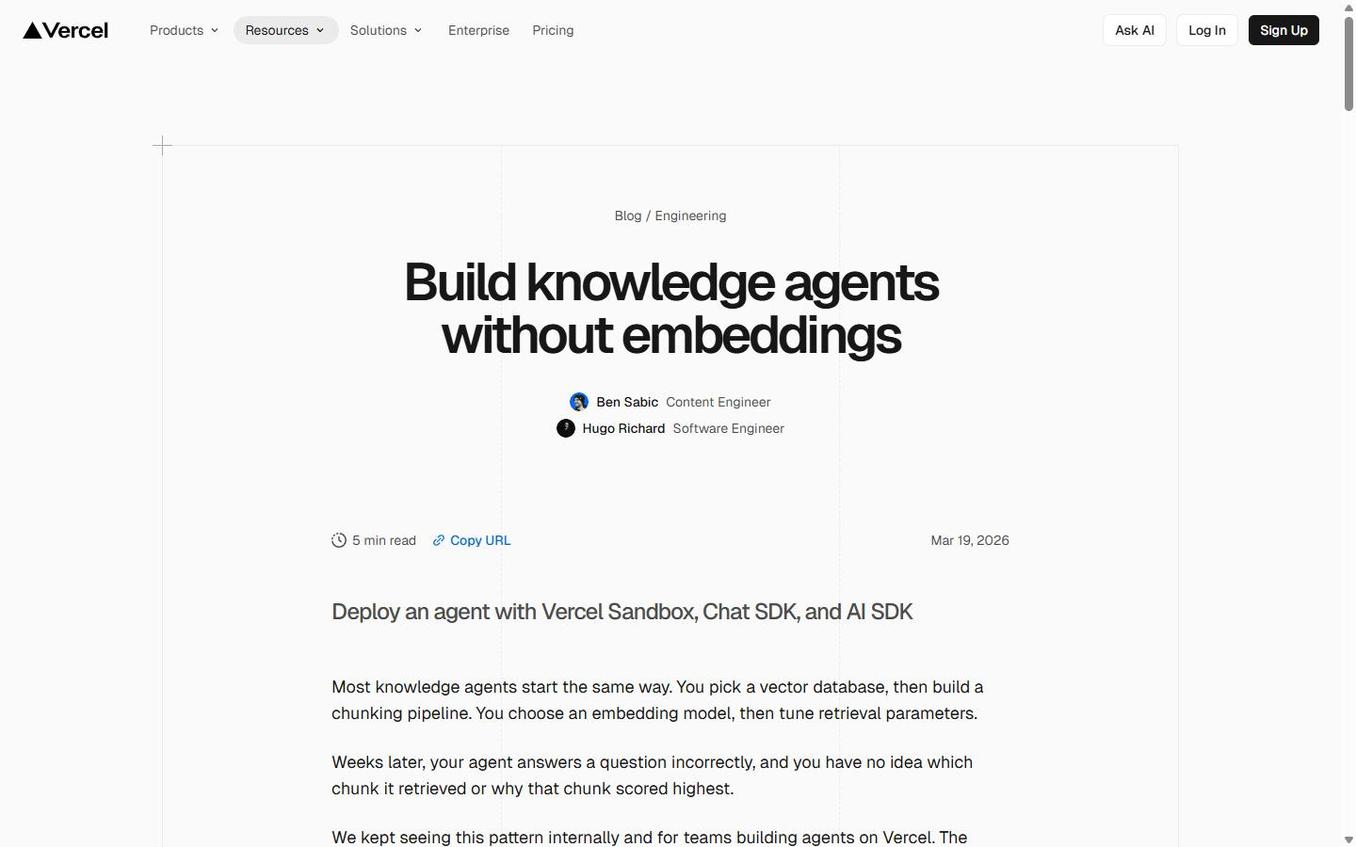
The announcement, published in March 2026 by Ben Sabic on the Vercel blog, comes with a number that commands attention: the cost per call for a sales agent dropped from $1.00 to $0.25, a 75% reduction. All while improving response quality.
The repository is public on GitHub (vercel-labs/knowledge-agent-template), deployment is one-click on Vercel, and the template is built with the AI SDK and Nuxt. This is a radically different approach from traditional RAG, and it deserves an in-depth analysis to understand when it works, when it does not, and who it is built for.
Why Embeddings and RAG Are Problematic for AI Agents
To understand Vercel's approach, you first need to understand why RAG (Retrieval-Augmented Generation) has become as much of a problem as a solution.
The classic RAG pipeline works like this: you split your documents into chunks, transform them into vectors via an embedding model, store them in a vector database (Pinecone, Weaviate, Chroma, etc.), and for each query, you perform a semantic search to find the most relevant chunks, which you inject into the LLM prompt.
In theory, it is elegant. In practice, problems pile up. Chunking is more art than science: split too small and you lose context, too large and results are noisy. The embedding model choice strongly impacts semantic search quality. The vector database adds an infrastructure layer to maintain, monitor, and pay for. And worst of all: when RAG gives a wrong answer, debugging is opaque. Which chunk was selected? Why was that embedding considered relevant? How do you improve results?
RAG's "silent failures" are particularly insidious. The agent returns an answer that seems plausible but is based on a poorly chunked document or misaligned embedding. Without clear traceability, you do not know if your agent is reliable or not.
"Tuning hell" is another common problem. Improving RAG pipeline quality often means simultaneously adjusting chunking, the embedding model, search parameters, similarity thresholds, and sometimes the structure of the source documents themselves. Each adjustment can have unpredictable side effects.
How Does an AI Agent Based on grep, find, and cat Actually Work?
Vercel's approach is almost disarmingly simple. Instead of building an embeddings pipeline, the Knowledge Agent Template stores sources as files in a standard file system and uses standard bash commands to explore them.
The technical workflow is as follows: sources are added via an admin UI, stored in Postgres, then synced to a snapshot repository via Vercel Workflow. When a user asks a question, the agent loads the snapshot in an isolated Vercel Sandbox and uses bash tools (grep -r, find, cat) to search for information.
Why does this work? The key is that modern LLMs have been massively trained on code and developer workflows. They already "know" how to use grep, find, and cat effectively. When you give an LLM a file system and bash commands, it naturally adopts a structured search strategy: search for a term across all files, refine the search, read the relevant file, extract the information.
The major advantage of this approach is deterministic traceability. Every agent action is a visible, reproducible bash command. If the agent gives a wrong answer, you can trace exactly which files it consulted, which commands it executed, and what results it obtained. To fix things, you edit the source file or adjust the search strategy, not an opaque embedding parameter.
The complexity router is another interesting component. It classifies incoming queries and routes them to the optimal model via AI Gateway. Simple questions go to a cheaper model, complex questions to a more powerful one. This optimization contributes to the 75% cost reduction.
What Types of Sources Can You Use With the Knowledge Agent?
The template is designed to work with structured and semi-structured sources: GitHub repos, YouTube transcripts, technical documentation, text files. Anything that can be stored as a file in a file system is a valid source.
The admin interface lets you add, manage, and sync sources. Content is stored in Postgres for persistence, then exported to a snapshot that is loaded into the sandbox for each agent session.
For multi-platform deployment, the template uses Vercel's Chat SDK with adapters for different interfaces: web chat, GitHub bot, Discord bot, and extensible to Slack and other platforms. This is an agent you deploy once and make accessible everywhere.
An AI administration agent is also included, with tools like query_stats and run_sql for analyzing usage statistics, logs, and agent performance. You can literally ask the AI to analyze your AI's performance.
The main limitation is clear: this approach works best with structured, textual content. For very long documents without clear structure, or for searches requiring deep semantic understanding (synonyms, related concepts, implicit associations), RAG with embeddings remains superior. The filesystem approach is deterministic and traceable, but it is also more literal in its search.
Vercel Agent vs Traditional RAG: When to Choose One Over the Other
The choice between Vercel's filesystem approach and a classic RAG pipeline depends on your use case, your debugging tolerance, and your cost constraints.
Criteria | Vercel Agent (Filesystem) | Traditional RAG |
|---|---|---|
Supported sources | Code, docs, FAQ, transcripts | Any text, structured or unstructured |
Infrastructure required | No vector database needed | Pinecone, Weaviate, Qdrant, etc. |
Estimated monthly cost | LLM cost only | $70–200/mo (vector DB) + LLM |
Debuggability | Full traces (grep, find, cat) | Opaque (similarity scores) |
Semantic search | No (text-based search) | Yes (embeddings) |
Maintenance | Minimal (no re-indexing) | Regular re-chunking, re-embedding |
Setup time | < 10 minutes (template) | Days to weeks |
Choose the Vercel approach if your sources are structured (code, documentation, FAQs, transcripts), if traceability and debugging are critical for your use case, if you want to minimize infrastructure (no vector database to manage), and if cost per query is an important factor.
Choose RAG if your sources are highly heterogeneous or unstructured, if you need fuzzy semantic search (finding similar concepts even without exact terms), if your documents are very long and poorly indexable by keywords, or if you already have vector infrastructure in place.
In terms of cost: the Vercel approach eliminates vector database fees (Pinecone can cost $70 to $200 per month for average use) and reduces LLM calls through the complexity router. The 75% cost reduction figure is not a theoretical benchmark but a reported result from a real use case (sales agent).
In terms of debuggability: the filesystem approach advantage is massive. Every trace is a sequence of bash commands that any developer can understand and reproduce. Fixing a problem means editing a file or adjusting a command, not recalculating embeddings or reindexing a vector database.
In terms of search quality: RAG has a theoretical advantage for semantic search, but this advantage is often nullified in practice by chunking and embedding problems. For structured content, keyword search with grep is often more precise and more reliable than vector search.
How to Deploy a Vercel Knowledge Agent in Under 10 Minutes
Deployment is one-click from the Vercel template (vercel.com/templates/nuxt/chat-sdk-knowledge-agent). The template automatically creates the application, the Postgres database, and the sandbox.
The next step is adding your sources through the admin interface. You can point to a GitHub repo, upload text files, or connect YouTube transcripts. The system automatically syncs sources and creates the snapshot used by the agent.
Customization happens at two levels: agent prompts (how it interprets queries and formulates responses) and search strategy (which bash commands it prioritizes). If the agent gives a wrong answer, you identify the problem through deterministic traces and adjust either the source content or the search strategy.
The template is built with the Vercel AI SDK and Nuxt. Developers familiar with these technologies can extend it easily: add new source types, create adapters for new platforms, or integrate custom tools via the @savoir/sdk.
The broader implications of Vercel's approach deserve attention. The RAG paradigm became dominant not because it was the best solution for every problem, but because it was the first scalable approach that worked reasonably well across many use cases. As LLMs become more capable at tool use and filesystem navigation, the calculus changes. Why build a complex retrieval pipeline when the model can simply search through files like a developer would?
This is not a theoretical argument. The coding agent revolution (Claude Code, OpenClaw, Cursor, and similar tools) has already proven that LLMs are remarkably effective at navigating codebases and documentation through filesystem operations. Vercel's Knowledge Agent Template takes that proven capability and packages it as a deployable product.
The cost implications extend beyond the 75% per-call reduction. Consider the total cost of ownership: no vector database subscription, no embedding model API calls, no re-indexing when sources change, no chunking strategy optimization, and dramatically simpler debugging. For a startup or small team building their first AI agent, the difference between a $200/month Pinecone bill plus engineering time for RAG tuning versus a simple filesystem approach can be decisive.
Vercel's anti-RAG approach will not replace RAG for every use case. But it offers a concrete, immediately deployable, and significantly cheaper alternative for a wide category of projects. For teams building support, documentation, or sales agents on structured sources, this may be the most pragmatic solution available today. The fact that it works with Unix commands that are 50 years old is, paradoxically, what makes it so reliable.
```
Klare, transparente Preise ohne versteckte Kosten.
Keine Verpflichtung, Preise, die Ihnen helfen, Ihre Akquise zu steigern.

Credits(optional)
Sie benötigen keine Credits, wenn Sie nur E-Mails senden oder auf LinkedIn-Aktionen ausführen möchten
Können verwendet werden für:
E-Mails finden
KI-Aktion
Nummern finden
E-Mails verifizieren
€19pro Monat
1,000
5,000
10,000
50,000
100,000
1,000 Gefundene E-Mails
1,000 KI-Aktionen
20 Nummern
4,000 Verifizierungen
€19pro Monat
Entdecken Sie andere Artikel, die Sie interessieren könnten!
Alle Artikel ansehenSoftware
Veröffentlicht am 14. Mai 2024
7 Alternativen zu Folderly, um Ihre Zustellbarkeit im Jahr 2026 zu verbessern
 Marie Head Of Sales
Weiterlesen
Blog
Veröffentlicht am 5. Apr. 2025
FullEnrich: Bewertungen, Preise und Alternativen, um böse Überraschungen zu vermeiden
 Mathieu Co-founder
Weiterlesen
Software
Veröffentlicht am 11. Juli 2024
7 Alternativen zu Expandi, um Ihre Akquisitionskosten zu senken
Marie Head Of SalesWeiterlesen
Software
Veröffentlicht am 22. Apr. 2024
Die 5 besten Alternativen zu Dropcontact für eine bessere B2B-Kundenakquise
Marie Head Of SalesWeiterlesen
Software
Veröffentlicht am 14. Juli 2024
6 Alternativen zu Skylead, um Kosten zu sparen und Ihre Lead-Generierung zu verbessern
Marie Head Of SalesWeiterlesen
Software
Veröffentlicht am 31. März 2025
9 Alternativen zu UpLead, um Ihre Kundenakquise WIRKLICH anzukurbeln
 Niels Co-founder
Weiterlesen
 Maylee
Made with ❤ for Growth Marketers by Growth Marketers
Copyright © 2026 Emelia All Rights Reserved