
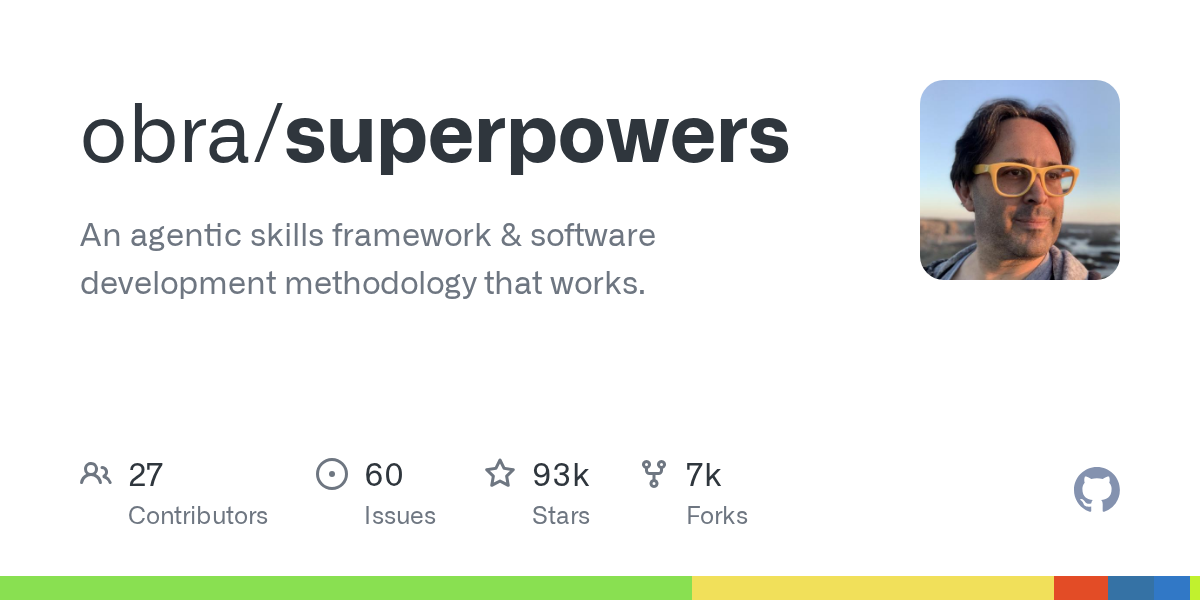
Superpowers for Claude Code: The #1 Skills Framework That Makes AI Actually Ship Production Code
Publicado em 16 de mar. de 2026Atualizado em 27 de mai. de 2026
Why AI Coding Agents Fail Without Structure
Point a vanilla Claude Code instance at a complex project, and you will get a predictable outcome: the agent jumps straight into writing code, skips tests, mixes responsibilities, and eventually produces a fragile prototype that needs to be rewritten. The problem is not the model's intelligence. It is the absence of discipline.
Experienced developers know this instinctively. Software quality does not come from the ability to write code fast. It comes from process. Specification, task breakdown, unit tests before implementation, code review, branch isolation. These practices, forged over decades of software engineering, are precisely what AI agents ignore when left to their own devices.
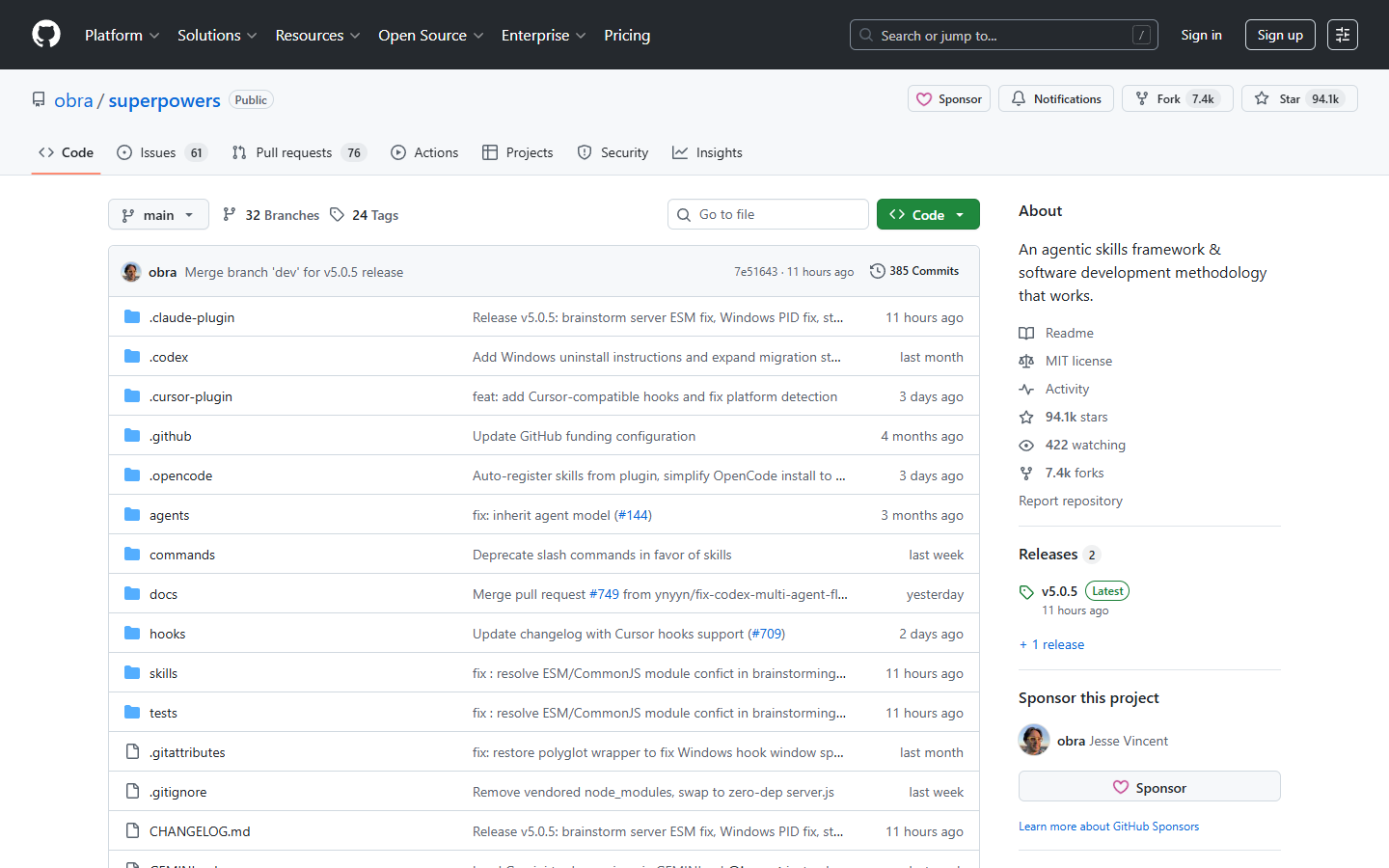
This is exactly what Superpowers solves. Created by Jesse Vincent (known as obra on GitHub), this agentic skills framework and software development methodology has become the most popular plugin in the Claude Code ecosystem, with over 93,000 GitHub stars. Its principle is simple but radical: instead of making the agent smarter, it enforces the discipline that human developers spent decades building.
Who Is Jesse Vincent, the Creator of Superpowers
Jesse Vincent is no newcomer to the open-source world. He created Request Tracker (RT), the open-source ticketing system written in Perl that is used by thousands of organizations worldwide, including the Perl community itself for bug tracking. He served as the "pumpking" of Perl 5, the person responsible for language releases. More recently, he co-founded Keyboardio, a company designing and manufacturing high-end ergonomic mechanical keyboards.
His background explains much of the philosophy behind Superpowers. Vincent comes from a world where process rigor, automated testing, and documentation are not optional. When he started working intensively with Claude Code in 2025, he quickly identified the gap between the model's raw capabilities and the actual quality of the code it produced. His response was to build a system of composable "skills" that turn the agent into a structured development team.
As Simon Willison, the respected Python developer and creator of Datasette, noted, Jesse Vincent is "one of the most creative users of coding agents" he knows. The first version of Superpowers was published in October 2025, the same day Anthropic launched its plugin system for Claude Code. Since then, the project has experienced explosive growth, going from a few thousand stars to over 93,000 by March 2026.
How Superpowers Works: A Complete Development Methodology
Superpowers is not an enhanced prompt or a collection of isolated instructions. It is a complete software development workflow built on composable skills and a set of initial instructions that force the agent to use them. The key word here is "force": skills are not suggestions. They are mandatory.
The Core Workflow in Seven Steps
Here is how a complete development cycle works with Superpowers:
1. Brainstorming (Socratic design)
The moment the agent detects you are building something, it does not rush to write code. It steps back and asks you what you are really trying to do. Through a Socratic question-and-answer process, it refines your idea, identifies edge cases, and produces a design document. This document is presented in short sections so you can validate it progressively without being overwhelmed.
2. Git worktree creation
Once the design is approved, Superpowers automatically creates an isolated Git worktree on a new branch. This isolation is fundamental: it allows parallel tasks on the same project without changes stepping on each other. The agent also verifies that the test baseline is clean before starting.
3. Implementation plan writing
The design document is broken down into two-to-five-minute tasks, each with exact file paths, complete expected code, and verification steps. The plan is written as though "an enthusiastic junior engineer with poor taste, no judgment, no project context, and an aversion to testing" had to follow it. This phrasing, typical of Vincent's humor, ensures that every task is explicit enough to leave no room for interpretation.
4. Subagent-driven development
This is the core of the system. Instead of executing all tasks in a single context (which causes drift on long projects), Superpowers launches a fresh subagent for each task. Each subagent goes through a two-stage review: spec compliance first, then code quality. This mechanism allows Claude to work autonomously for several hours without deviating from the plan.
5. Strict Test-Driven Development
Superpowers enforces the RED-GREEN-REFACTOR cycle without negotiation. The agent must write a failing test (RED), then write the minimum code to make that test pass (GREEN), then refactor. If code is written before a failing test exists, the framework deletes it. This radical approach to TDD eliminates one of the most common problems with AI-generated code: the complete absence of test coverage.
6. Automated code review
Between each task, a code review is performed against the plan. Issues are classified by severity, and critical issues block progress. The agent cannot move to the next task until critical issues are resolved.
7. Branch finalization
When all tasks are complete, the agent verifies that all tests pass, then presents four options: merge the branch, create a GitHub pull request, keep the branch for later, or discard everything. The worktree is then cleaned up.
The Full Skills Library
Beyond the main workflow, Superpowers includes a library of specialized skills:
Category | Skills | Purpose |
|---|---|---|
Testing | test-driven-development | RED-GREEN-REFACTOR cycle with anti-pattern reference |
Debugging | systematic-debugging, verification-before-completion | 4-phase root cause process |
Collaboration | brainstorming, writing-plans, executing-plans, dispatching-parallel-agents | Design, planning, batch execution |
Review | requesting-code-review, receiving-code-review | Pre-review checklist, feedback response |
Git | using-git-worktrees, finishing-a-development-branch | Parallel branches, merge workflow |
Orchestration | subagent-driven-development | Fast iteration with two-stage review |
Meta | writing-skills, using-superpowers | New skill creation, system introduction |
One remarkable aspect is the "writing-skills" skill: Superpowers can create new skills. Vincent has described how he asks Claude to read a programming book and extract reusable skills from it. The framework even uses TDD to test the skills themselves, submitting them to subagents to verify they are comprehensible and that agents comply with them.
Coding With vs. Without Superpowers
To understand the practical impact of Superpowers, here is a comparison between a standard Claude Code workflow and one structured by Superpowers:
Aspect | Standard Claude Code | Claude Code with Superpowers |
|---|---|---|
Starting point | Agent starts coding immediately | Socratic brainstorming phase and validated design |
Planning | None, or a vague one-time plan | Detailed plan with 2-to-5-minute tasks, exact file paths |
Testing | Written after the fact, often incomplete | Strict TDD: failing test before every line of code |
Long context | Progressive drift, forgotten initial instructions | Fresh subagent per task, no drift |
Code review | None | Automated review after each task, blocks on critical issues |
Isolation | Direct changes on main branch | Isolated Git worktree, dedicated branch |
Autonomy | Works well for 10 to 15 minutes | Can work for several hours without intervention |
Output | Functional but fragile prototype | Production code with tests, review, and clean Git history |
Installation and Setup
Installing Superpowers takes seconds. For Claude Code, two commands in the terminal:
/plugin marketplace add obra/superpowers-marketplace
/plugin install superpowers@superpowers-marketplace
To verify the installation, type /help and you should see the Superpowers commands. The three main commands are:
/superpowers:brainstorm     - Start a brainstorming session
/superpowers:write-plan     - Create an implementation plan
/superpowers:execute-plan   - Execute the plan with subagents
The plugin updates automatically via /plugin update superpowers.
Superpowers also works with other tools. For Codex, you tell the agent to fetch installation instructions from the GitHub repository. For OpenCode, the procedure is similar.
Recommended Setup
Superpowers works out of the box without additional configuration. However, for best results, it is recommended to use a powerful model like Claude Opus for brainstorming and planning tasks. Implementation subagents can use faster models without significant quality loss, since each task is explicit enough not to require complex reasoning.
Our Experience at Bridgers
At Bridgers, we have been using Superpowers daily for several months. Our CTO, Charles, relies particularly heavily on this framework for structuring the team's development workflows. What convinced him from the start was the brainstorming phase: instead of having to write a detailed spec before launching Claude Code, he describes a feature in a few sentences and lets Superpowers organize the design through structured dialogue.
The most tangible gain is in testing. Before Superpowers, AI-generated code often arrived without test coverage, or with superficial tests written after the fact. With the TDD enforced by the framework, every piece of delivered code has its associated tests from the start. This has considerably reduced the time spent on manual code review and debugging.
The other major advantage is the agent's ability to work through long sessions without losing track. On complex projects, Charles regularly launches autonomous development sessions lasting several hours. The fresh-subagent-per-task mechanism prevents the context drift that used to make long sessions unusable.
The one caveat is that Superpowers works best when you know what you want to build. For rapid exploratory prototyping where you are still figuring out the direction, the structured workflow can feel heavy. But once requirements are clear, even approximately, the gain in quality and reliability is undeniable.
The Philosophy Behind the Framework
The philosophy of Superpowers rests on five foundational principles worth examining in detail:
Test-Driven Development: tests come first, always. This is not a recommendation; it is a system constraint. The idea is that if an AI agent can write code, it can also write tests. And if it writes tests first, the code that follows is mechanically more reliable.
Systematic over ad-hoc: every decision follows a defined process. No shortcuts, no "I will just quickly modify this file." This rigidity, which might seem constraining, is actually liberating: it allows the agent to work autonomously for hours without constant supervision.
Complexity reduction: simplicity is the primary goal. Each task is broken into two-to-five-minute units. Each subagent has a single responsibility. The produced code follows YAGNI (You Aren't Gonna Need It) and DRY (Don't Repeat Yourself) principles.
Evidence over claims: the agent cannot declare a task complete without evidence. Tests must pass. The code review must be validated. Verifications must be executed.
Skills as units of knowledge: perhaps the deepest innovation of Superpowers is the concept of skills itself. These are structured documents that capture not instructions but complete methodologies. They can be tested, shared, and composed. Vincent even used persuasion principles (authority, commitment, social proof) to ensure agents actually follow the skills.
Superpowers in the Claude Code Skills Ecosystem
Superpowers sits within a broader ecosystem of Claude Code skills that includes projects like Impeccable (for interface design) and Vercel Best Practices (for React and Next.js). But Superpowers occupies a unique position: it is the only framework that covers the entire development cycle, from brainstorming to merge.
Anthropic's plugin marketplace, launched in late 2025, played a key role in Superpowers' adoption. Before the marketplace, installation required cloning a Git repository and manually configuring symlinks. Direct integration into Claude Code made the framework accessible to all developers, even those unfamiliar with command-line tool configuration.
The project's growth reflects a genuine industry need. As one widely-shared LinkedIn comment summarized: "82,000 developers just agreed on something: the biggest problem with AI coding is not intelligence. It is discipline." In March 2026, Superpowers is still gaining nearly 2,000 stars per day, making it one of the fastest-growing open-source projects of the year.
Conclusion: Discipline as a Competitive Advantage
Superpowers represents a paradigm shift in how we use AI coding agents. Rather than seeking a smarter model, Jesse Vincent has demonstrated that imposing rigorous methodology on an existing model produces better results than letting a superior model work without constraints.
For development teams using Claude Code in production, Superpowers has become essential. The framework transforms an unpredictable AI assistant into a reliable, documented, and testable development process. And with a community of over 93,000 developers contributing and improving the skills, the project is only accelerating.
If you have not installed Superpowers yet, the two installation commands take less than thirty seconds. The time you invest in the brainstorming phase will be more than offset by the quality of the code produced and the time saved on debugging.
Preços claros, transparentes e sem custos ocultos.
Sem compromisso, preços para ajudá-lo a aumentar sua prospecção.

Créditos(opcional)
Você não precisa de créditos se você quiser apenas enviar e-mails ou fazer ações no LinkedIn
Podem ser usados para:
Encontrar E-mails
Ação de IA
Encontrar Números
Verificar E-mails
€19por mês
1,000
5,000
10,000
50,000
100,000
1,000 E-mails encontrados
1,000 Ações de IA
20 Números
4,000 Verificações
€19por mês
Descubra outros artigos que podem lhe interessar!
Ver todos os artigosSoftware
Publicado em 5 de abr. de 2025
SignalHire alternativas: melhores ferramentas B2B 2026
 Niels Co-founder
Leia mais
Software
Publicado em 14 de jul. de 2024
6 alternativas ao Skylead para gastar menos e melhorar sua geração de leads
 Marie Head Of Sales
Leia mais
Prospecção B2B
Publicado em 28 de mai. de 2025
Marketing B2B 2026: definição, estratégias e exemplos
Niels Co-founderLeia mais
Marketing
Publicado em 2 de mar. de 2025
Plano de ação comercial 2026: método + exemplo outbound
Niels Co-founderLeia mais
Marketing
Publicado em 9 de jun. de 2023
Cold email: guia completo para iniciar em 2026
Niels Co-founderLeia mais
IA
Publicado em 18 de jun. de 2025
Os 5 melhores geradores de voz com IA para 2026
 Mathieu Co-founder
Leia mais
Links úteis
HubCold-email: Guia CompletoEntregabilidade: Guia completoAlternativa ao LemlistAPISolicitar uma demonstraçãoPrograma de afiliadosFind emailSobre
Feedback & RoadmapPolítica de privacidadeCGVAvisos legaisTestimonialsRoadmapAlternativesComparaçõesContact Maylee
Made with ❤ for Growth Marketers by Growth Marketers
Copyright © 2026 Emelia All Rights Reserved