
NVIDIA Agent Toolkit: The Open Source Enterprise AI Agent Platform (Full Breakdown)
Publicado el 11 abr 2026Actualizado el 14 abr 2026
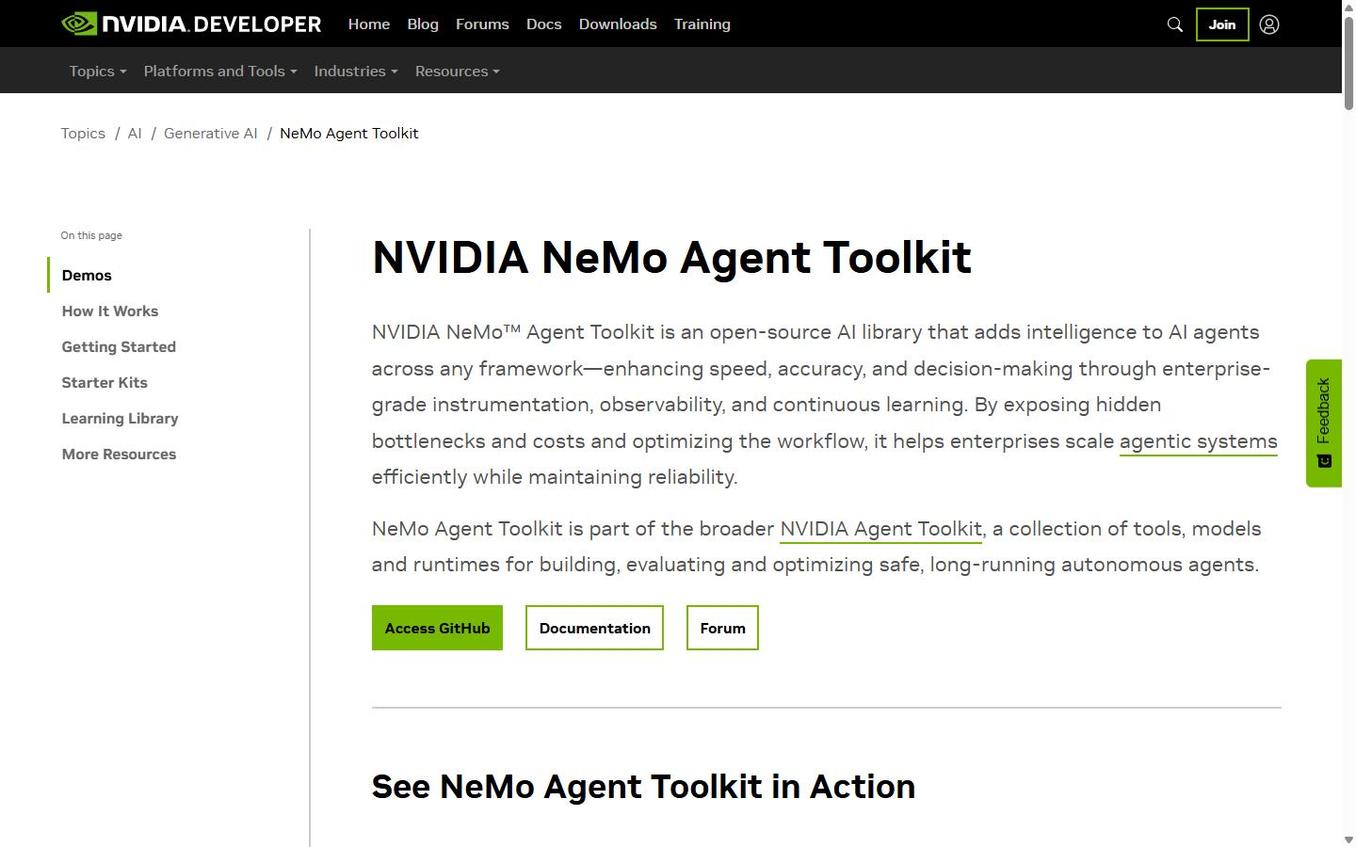
NVIDIA announced the Agent Toolkit at GTC 2026 on March 16. This is not just another framework: it is a complete platform combining a secure runtime (OpenShell), open models (Nemotron), and a research agent blueprint (AI-Q), all designed to let enterprises build and deploy autonomous AI agents in production. With NVIDIA's fiscal year 2026 revenue reaching a record $215.9 billion, the company has the resources to back this ambition with serious engineering investment.
Jensen Huang summarized the platform's ambition during his keynote: "Claude Code and OpenClaw have sparked the agent inflection point, extending AI beyond generation and reasoning into action. Employees will be supercharged by teams of frontier, specialized and custom-built agents they deploy and manage."
The list of companies adopting Agent Toolkit is impressive: Adobe, Atlassian, Cisco, CrowdStrike, Salesforce, ServiceNow, SAP, Siemens, Synopsys, and many others. NVIDIA is not just selling GPUs here. The company is positioning itself as the provider of the complete software infrastructure for the autonomous agent era.
What Is OpenShell and Why Do Your AI Agents Need It?
OpenShell is the Agent Toolkit's most critical component. It is an open source runtime that allows autonomous agents to operate while enforcing policy-based security, network, and privacy guardrails.
The problem OpenShell solves is fundamental. Autonomous AI agents, by definition, make decisions and execute actions without direct human supervision. Without a robust security framework, a misconfigured agent could access sensitive data, execute dangerous commands, or communicate confidential information to external services.
OpenShell works as a sandboxed environment with least-privilege access controls. It manages network routing to control agent communications, applies privacy policies to protect sensitive data, and provides an audit framework to trace all agent actions.
NVIDIA is collaborating with major security vendors to integrate OpenShell with their tools: Cisco, CrowdStrike, Google, Microsoft Security, and TrendAI. This "compatible with your existing security stack" approach is pragmatic and lowers the adoption barrier for enterprises that have already invested in cybersecurity solutions.
Jensen Huang compared OpenClaw (the underlying technology) to Linux and Kubernetes, calling it the "new computer." That is an ambitious statement, but it reflects NVIDIA's vision: autonomous agents are the next computing paradigm, and they need an OS to run safely.
How Does the AI-Q Hybrid Architecture Cut Costs by 50%?
AI-Q is NVIDIA's research agent blueprint, and its hybrid architecture is perhaps the Toolkit's most concretely useful feature for cost-conscious enterprises.
The principle is simple but effective: use frontier models (the most powerful and expensive) for orchestration and high-level decision-making, and NVIDIA Nemotron models (open, cheaper) for research and execution tasks. This split reduces query costs by more than 50% compared to a frontier-only approach while maintaining top-tier accuracy.
NVIDIA validated this approach by using the AI-Q blueprint to develop the top-ranking agent on both the DeepResearch Bench and DeepResearch Bench II leaderboards. This is not an internal benchmark: it is a public ranking that evaluates the quality of research produced by AI agents.
The AI-Q architecture includes several components: a built-in evaluation system that explains how each answer is produced, automatic selection of analysis depth and data sources, and the ability to perceive, reason, and act on enterprise knowledge.
For developers, AI-Q integrates with LangChain and LangGraph, meaning existing agents built with these frameworks can be migrated to the hybrid architecture with minimal modifications. LangChain, whose open source frameworks have been downloaded over 1 billion times, is an official partner in this initiative.
Which Fortune 500 Companies Are Using NVIDIA Agent Toolkit?
The adoption partner list is probably Agent Toolkit's most convincing argument. This is not a lab prototype: it is a platform that the world's largest companies are actively integrating.
Adobe is using Agent Toolkit as the foundation for its creativity, productivity, and marketing agents. The goal is to run hybrid, long-running agents in a personalized, more secure, and cost-efficient environment.
Salesforce is working with Agent Toolkit, including Nemotron models, to let its customers build and customize AI agents through Agentforce. The reference architecture uses Slack as the primary conversational interface and orchestration layer.
ServiceNow is building its "Autonomous Workforce of AI Specialists" on the ServiceNow AI Platform, leveraging the AI-Q Blueprint with a mix of closed and open models, including Nemotron and ServiceNow's Apriel models.
CrowdStrike unveiled a "Secure-by-Design AI Blueprint" that embeds Falcon platform protection directly into NVIDIA's AI agent architectures. The company is also using Nemotron reasoning models for cybersecurity investigation workflows.
Siemens is launching the Fuse EDA AI Agent, using Nemotron to autonomously orchestrate electronic design workflows across Siemens' EDA portfolio, from conception to manufacturing sign-off.
Other partners include Atlassian (integration with Rovo AI for Jira and Confluence), SAP (agents via Joule Studio), Synopsys (multi-agent framework for semiconductor design), and IQVIA (over 150 agents deployed across 19 of the top 20 pharmaceutical companies).
How to Deploy an NVIDIA Agent in Production With LangChain
The LangChain-NVIDIA integration is the most documented and accessible deployment path for developers.
The combined stack lets you build agents at different complexity levels. LangGraph provides a runtime for multi-agent orchestration with complex control flows and human-in-the-loop patterns. Deep Agents, LangChain's framework for long-running tasks, adds task planning, sub-agent spawning, long-term memory, and context management.
The NeMo Agent Toolkit allows onboarding existing LangGraph agents with minimal code changes and immediately provides access to advanced profiling, evaluation, and MCP/A2A protocol support for composing multi-agent systems.
For deployment, NIM microservices deliver up to 2.6x higher throughput than standard deployments, supporting cloud, on-premise, and hybrid environments. The Nemotron 3 Super model with its MoE architecture enables cost-efficient deployment on a single GPU.
Observability is a strong point: the telemetry system natively exports to LangSmith, creating a unified view where infrastructure-level profiling (token usage, timing, throughput) combines with LangSmith's application-level tracing.
The toolkit also includes a GPU cluster sizing calculator that lets teams profile LangGraph workflows under load and forecast exact hardware requirements for scaling.
Nemotron vs Frontier Models: When Should You Use an Open Model for Your Agents?
The Nemotron family is at the heart of Agent Toolkit's economic value proposition. Three sizes are available: Nemotron 3 Nano (30B/3B active), Super (approximately 100B/10B active), and Ultra (approximately 500B/50B active). All use MoE architecture to maximize the performance-to-cost ratio.
Model | Parameters | Type | Recommended use case |
|---|---|---|---|
Nemotron-Mini | 8B | Open (NVIDIA) | Lightweight tasks, edge, low latency |
Nemotron-Medium | 48B | Open (NVIDIA) | Business agents, moderate reasoning |
Nemotron-Ultra | 256B | Open (NVIDIA) | Complex tasks, critical production |
GPT-5 | Undisclosed | Closed (OpenAI) | Advanced reasoning, general use |
Claude Opus 4 | Undisclosed | Closed (Anthropic) | Code, long analysis, reliability |
Gemini 3 Pro | Undisclosed | Closed (Google) | Multimodal, long context |
The idea is not to replace frontier models everywhere, but to use them where they add the most value. For high-level orchestration and complex decisions, a frontier model remains optimal. But for research tasks, execution, and repetitive sub-tasks, a Nemotron model offers sufficient performance at a fraction of the cost.
LangSmith and the NeMo Agent Toolkit provide evaluation tools that let you benchmark the same agent across different Nemotron models and measure trade-offs between accuracy, latency, and cost. The NeMo Agent Toolkit's automatic reinforcement learning optimizer can then fine-tune the chosen model for specific workflows.
For enterprises, inference providers are numerous: Baseten, CoreWeave, DeepInfra, DigitalOcean, Fireworks, Together AI, and others. On-premise deployment is also supported via servers from Cisco, Dell, HPE, Lenovo, and Supermicro, or in the cloud through AWS, Google Cloud, Microsoft Azure, and Oracle Cloud.
An often underestimated aspect is continuous evaluation. LangSmith and the NeMo Agent Toolkit together provide offline evaluation tools (human review, LLM-as-judge, pairwise comparison, CI/CD integration via pytest and GitHub workflows) and online evaluation (multi-turn assessments that score complete conversation trajectories for task completion and decision quality). The NeMo Agent Toolkit complements this with RAG-specific evaluators, agent trajectory analysis, and a hyperparameter and prompt optimizer.
These capabilities are particularly powerful when applied across the Nemotron family. Teams can benchmark the same agent on Nemotron Nano, Super, and Ultra, measure trade-offs between accuracy, latency, and cost, then use automatic reinforcement learning to fine-tune the chosen model for their specific workflows.
The broader picture is that NVIDIA is not just providing tools. It is establishing the reference architecture that enterprise developers will build on for the next decade of AI agent development. The combination of open source, enterprise security, cost optimization, and a partner ecosystem that reads like a who's-who of the Fortune 500 creates a gravitational pull that competitors will struggle to match.
Looking ahead, the LangChain-NVIDIA collaboration is also laying the groundwork for Deep Agents to operate within GPU-accelerated compute sandboxes powered by NVIDIA CUDA-X libraries. This would enable agents to perform computationally intensive data processing using tools like NVIDIA cuDF for large-scale structured data manipulation and NeMo Curator for petabyte-scale data curation. For industries like financial services and healthcare, where agents need to process massive datasets as part of their reasoning, this opens entirely new categories of autonomous workflows.
NVIDIA is no longer just selling hardware. With Agent Toolkit, the company is building the complete software layer between the GPU and the business application. The secure runtime, open models, validated blueprints, and integration with the biggest names in enterprise software form an ecosystem that is hard to ignore. The question for businesses is no longer whether they will have autonomous AI agents, but on which platform they will build them.
```
Precios claros, transparentes y sin costes ocultos.
Sin compromiso, precios para ayudarte a aumentar tu prospección.

Créditos(opcional)
No necesitas créditos si solo quieres enviar emails o hacer acciones en LinkedIn
Se pueden utilizar para:
Buscar Emails
Acción IA
Buscar Números
Verificar Emails
€19por mes
1,000
5,000
10,000
50,000
100,000
1,000 Emails encontrados
1,000 Acciones IA
20 Números
4,000 Verificaciones
€19por mes
Descubre otros artículos que te pueden interesar!
Ver todos los artículosSoftware
Publicado el 6 jul 2025
Lead411 vs Lusha vs Emelia: el duelo definitivo entre las herramientas de prospección B2B
 Mathieu Co-founder
Leer más
IA
Publicado el 26 may 2025
Los mejores editores de fotos con IA en 2026: transforma tus imágenes como un profesional
Mathieu Co-founderLeer más
Software
Publicado el 1 jul 2025
Lusha vs Waalaxy vs Emelia: ¿quién dominará en 2026?
 Niels Co-founder
Leer más
Software
Publicado el 25 may 2025
Los 15 mejores programas gratuitos para sustituir a Photoshop
Mathieu Co-founderLeer más
Software
Publicado el 15 may 2025
Los 6 mejores programas gratuitos de edición de vídeo: contenidos profesionales gratuitos
Mathieu Co-founderLeer más
Software
Publicado el 2 may 2024
Las 7 mejores alternativas a Lemlist: la guía definitiva para 2026
 Marie Head Of Sales
Leer más
Enlaces útiles
HubCold-email: Guía CompletaEntregabilidad: Guía completaAlternativa a LemlistAPISolicitar una demoPrograma de afiliadosFind email Maylee
Made with ❤ for Growth Marketers by Growth Marketers
Copyright © 2026 Emelia All Rights Reserved