The short answer
- 1In Sales Navigator, filter on the Owner seniority level and a company headcount of 1-10 or 11-50, plus your region and industry.
- 2Send the search to Emelia with the Export with Emelia button: it becomes a lead list with name, title, company and LinkedIn URL.
- 3Run Find email on the list. You pay 1 credit per email found, and the credit is given back when no address is found.
- 4For a single owner, open their LinkedIn profile and use the Emelia Chrome extension. For a file you already have, import the CSV.
- 5Then attach the list to a campaign and write a short, specific email. Owners read their own inbox: be brief.
Who exactly is a "business owner"?
A business owner runs a company they own, fully or in part. In practice it is the person who signs the checks in a company of 1 to 50 people: the owner of an agency, a clinic, a construction firm, a shop, a small software company. They make the buying decision alone and quickly, which is why they are such a good target, and also why they get a lot of solicitations.
The title they use varies a lot by country and by company type. If you only search for "Owner", you miss most of them. Search for the family of titles below, then keep only companies small enough for the owner to be the decision maker.
The titles to search for
Job titles to include
Job titles to leave out
In large companies, "Business Owner" is often an internal project role, and "Product Owner" is a product job. Excluding these titles removes a lot of noise from your list.
Where business owners show up online
- LinkedIn: most owners of B2B service companies have a profile, often with the company page linked. It is your main source of names.
- The company website: the About, Team or Contact page often names the owner, and sometimes gives a direct address.
- Google Business Profile and local directories: useful for local businesses (trades, clinics, restaurants), with the website and phone number of the business.
- Official company registers: Companies House in the UK lists the officers, and Secretary of State filings in the US often name them (some only show a registered agent). Neither gives an email. Good for confirming who the owner is.
- Industry associations and chambers of commerce: member directories list the business and often the owner.
Why it is harder than for a corporate executive
- Many small businesses have no website, or only a Facebook page. Without a domain, a finder has less to work with.
- Some owners use a personal Gmail or Outlook address for the business. No professional email finder can guess a personal address, and it is not the address to prospect anyway.
- The public address is generic (info@, contact@, hello@): it reaches a shared inbox, not the owner.
- The LinkedIn company name differs from the brand or legal name, which makes the match with the website harder. Emelia handles part of this for you (see the tip on automatic retries below).
- Small companies open, close and change hands often: a list bought last year is already partly wrong. Build the list yourself, right before the campaign.
Which method should you use?
It depends on where you start. The three methods end up in the same place: a list of owners with their verified email, ready for a campaign.
Build the list in Sales Navigator
Filter owners by company size, region and industry, then send the whole search to Emelia.
Best for: a new list of dozens to thousands of owners.
See the stepsOne profile at a time
On a LinkedIn profile, the Emelia extension finds the email and adds the owner to a campaign.
Best for: a handful of hand-picked owners.
See the stepsYou already have a file
Import a CSV or sync HubSpot or Pipedrive, then find the missing emails of the whole list.
Best for: a list of names and companies you already own.
See the stepsMethod 2: find one owner's email from their LinkedIn profile
When you only need a few owners, for example after spotting them in a LinkedIn post or at an event, there is no need to build a list. The extension does it from the profile.
- Step 1
Open the owner's LinkedIn profile
Once the Emelia extension is installed and connected to your account, a button appears on every LinkedIn profile.
- Step 2
Click Find email
Emelia reads the name, the company and its website on the profile and looks for the work email. You can also look for the phone number (Find phone) or both at once.
The Emelia extension on a LinkedIn profile: find the email, then add the contact to a campaign. - Step 3
Add the owner to a campaign
Pick one of your campaigns in Add to the campaign. The contact is added directly to it, with the email you just found.
Without the extension: unitary searches
In Emelia, the Unitary searches button at the top of the Lists page finds one email from a full name, a company and a domain. Always fill in the country: it is used by the search.
Method 3: you already have a list of owners
A trade show export, a CRM segment, a file from a partner: if you already have names and companies, import them and let Emelia find the missing emails in one run.
| Column | Required | What it is for |
|---|---|---|
| First name + Last name (or Full name) | Yes | Without a name, no email can be searched. |
| Company website or domain | Optional | The most reliable starting point for the search. |
| Company name | Optional | Needed when there is no website, and used as a second chance when the domain finds nothing. You need at least the website, the domain or the name. |
| LinkedIn profile URL | Optional | Needed for LinkedIn steps in the campaign, and to look for a phone number. |
Required
What it is for
Required
What it is for
Required
What it is for
Required
What it is for
- Step 1
Import the file
In Emelia, go to Lists, then New List, and choose CSV File (or HubSpot or Pipedrive). The file must be a .csv, not an .xlsx. The columns are recognized automatically, and you can fix the mapping before the import.
Emelia: create a new list from a CSV file, Sales Navigator, HubSpot or Pipedrive. - Step 2
Launch Find email on the list
Emelia shows the number of entries without an email, the credits to be used and the leads missing a name or a company. Choose the column that contains the domain or the company name if it was not detected, pick the country, and launch. The search keeps running even if you close the tab.
Emelia: find the missing emails of a whole list in one run. - Step 3
Check the results
Leads that already had an email are skipped and not charged. The found addresses land in the email column with their qualification. Keep the valid ones for the campaign, and if in doubt, run them through the email verifier.
Why keeping the company name pays off
When the search by domain returns nothing and the lead has a company name, Emelia automatically runs a second search with the name alone. For owners of small companies, whose website is often missing or different from the company name, this second chance finds addresses the first search misses. So keep both columns in your file.
Doing it by API
Developers can do the same search from their own tools: one call to submit the search, then one call to read the result. The country is required. Each email found costs 1 credit, like in the app.
POST https://api.emelia.io/tools/find/email
Authorization: <API_KEY>

{
  "fullname": "Priya Shah",
  "companyName": "Northwind Repairs",
  "country": "US",
  "companyWebsite": "northwindrepairs.com"
}

→ { "success": true, "jobId": "…" }
GET https://api.emelia.io/tools/find/email/{jobId}The free methods, for one or two owners
When you only need an address or two, you can often find it by hand. It takes time, and you still need to check the address before writing to it.
1.The company website
Look at the About, Team and Contact pages, and at the legal notice or imprint page when there is one. Small companies often name the owner there, and sometimes give a direct address.
2.A Google search on the domain
Search for "@company-domain.com" along with the owner's name. Press releases, podcasts, event pages and old newsletters sometimes show their address.
3.The LinkedIn contact info
Some owners display their email in the Contact info section of their profile. It is usually visible once you are connected.
4.Guess, then verify
Try the common formats for small companies (see below) and check them with an email verifier before sending. Never send to a guessed address that has not been checked: bounces hurt your deliverability.
5.The official register
Companies House (UK) lists the officers of a company, and state business filings (US) often do too. They do not give emails, but they tell you which name to look for.
The email formats you will see most at small companies
In a company of a few people, the owner often has the shortest address of the domain. These are the formats to try first when you guess.
| Pattern | Example | Where you see it |
|---|---|---|
| firstname@ | olivia@carterco.io | Very common when the owner was the first employee. |
| firstname.lastname@ | priya.shah@northwindrepairs.com | Common as soon as the team grows. |
| f.lastname@ / flastname@ | hlee@leearchitects.co | Frequent in professional firms. |
| firstnamelastname@ | tomwalsh@walshlogistics.io | Less common, but it exists. |
| info@ / contact@ / hello@ | hello@brooklinestudio.co | A shared inbox: someone else often reads it first. |
Example
Where you see it
Example
Where you see it
Example
Where you see it
Example
Where you see it
Example
Where you see it
Then email them: the campaign in Emelia
Finding the email is half the job. Here is how to turn the list into a campaign in Emelia, without exporting anything.
- Step 1
Create the campaign
In Campaigns, click create, give it a name, and start from scratch or from a template such as LinkedIn then Email or Email then LinkedIn.
- Step 2
Write the sequence
In the Campaign tab, add your steps: emails, LinkedIn visits, invitations and messages, and the delays between them. Personalize with variables such as
{{firstName}}and{{companyName}}.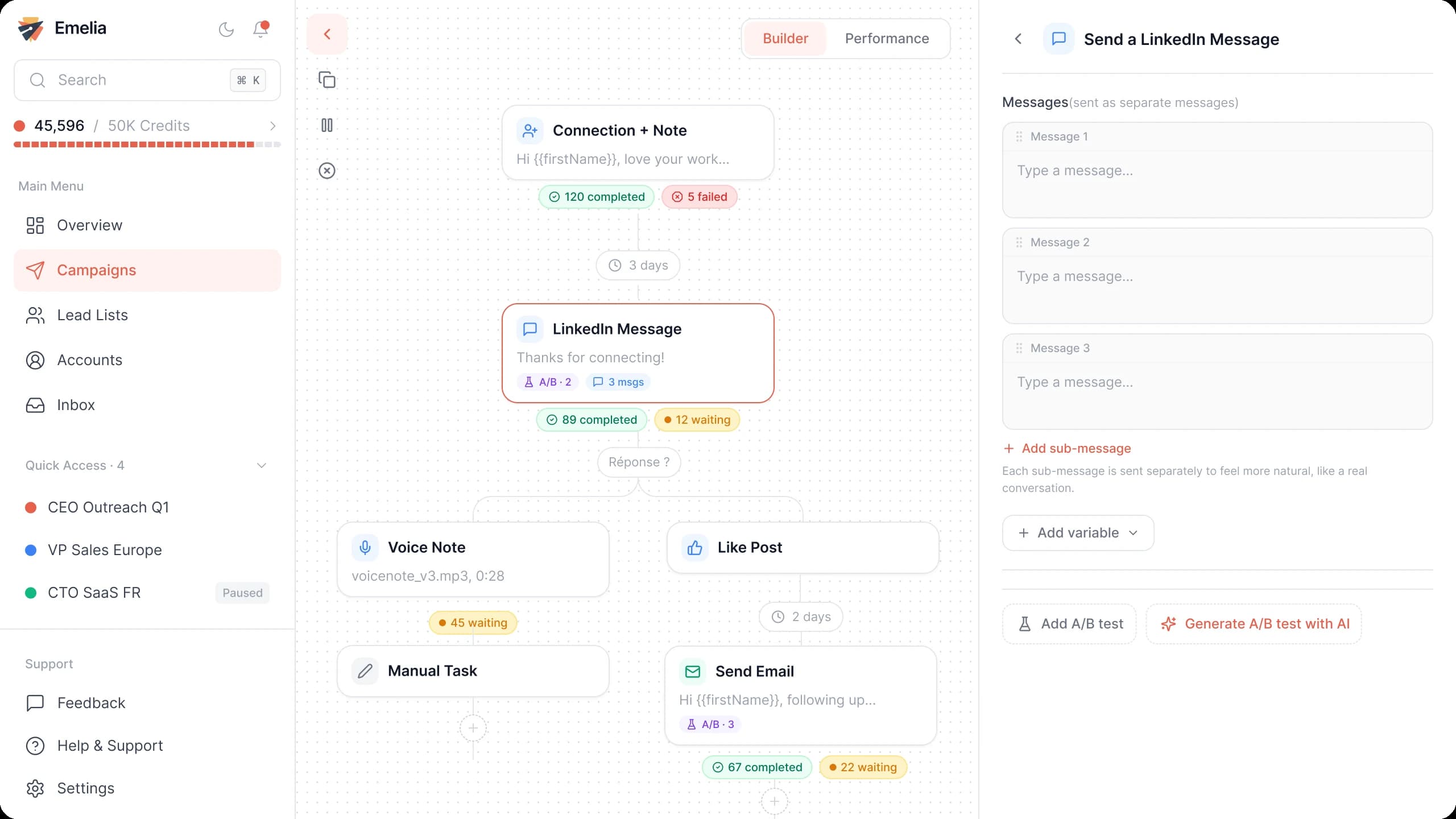
The Emelia sequence builder: emails and LinkedIn steps in the same campaign. - Step 3
Attach the list of owners
In Settings, choose the sending accounts, then in Lead list tick the list you just enriched. Save.
Emelia: attach one or more lead lists to the campaign, then launch it. - Step 4
Launch or schedule
Launch now or schedule the start. Before a first campaign, warm up your mailboxes with email warmup so your emails land in the inbox.
A short email that owners actually read
Owners read their own inbox between two customers. Three to five lines, one idea, one easy question.
Subject: Question about {{companyName}}
Hi {{firstName}},
I work with owners of companies like {{companyName}} who want to [your result] without [the pain it avoids].
One of them, a [similar business] in [city], [concrete result] in [time frame].
Would it be worth a 15-minute call next week to see if it applies to you?
Replace the brackets with your own facts. A figure you can prove works better than a superlative, and the question at the end must be easy to answer with a yes or a no.
Mistakes to avoid
Targeting companies that are too big
Above 50 people, the "owner" is often a founder who no longer buys day to day. Keep the headcount filter tight, or change your target to the right department.
Keeping "Product Owner" in the list
It is the most common false positive in this search. Exclude it in the title filter before exporting.
Writing to info@ and hoping for the best
A shared inbox is read by someone else first. Find the owner's name, then their own address.
Buying an old list of owners
Small companies change a lot every year. A list built right before the campaign bounces less than a file bought months ago.
Sending before checking
Keep the addresses qualified as valid and warm up your mailboxes. A burst of bounces on a new domain can send your next emails to spam.