The short answer
- 1In Sales Navigator, set Function to Marketing and choose the Seniority level that fits your offer: CXO and VP for strategic deals, Director and Manager for a tool one team buys.
- 2Match the level to the company headcount: under 50 people there is rarely a CMO, and above 1,000 the CMO rarely picks tools. Exclude agency industries unless agencies are your market.
- 3Click Export with Emelia, then run Find email on the list: 1 credit per email found, given back when no address is found.
- 4For a marketer you spotted in a post or a webinar, use the Emelia Chrome extension on their LinkedIn profile. For a file you already have, import the CSV.
- 5Then attach the list to a campaign and write like a peer: marketers send campaigns for a living and spot a template in one line.
Who exactly are you looking for in marketing?
"Marketing manager" covers a whole ladder: the CMO (Chief Marketing Officer), who owns the brand, the pipeline and the budget, then the VP Marketing or Head of Marketing, the Marketing Director, the marketing managers who run programs, and the owners of each channel (demand generation, content, SEO, product marketing, brand). Each level buys different things: pick the one that decides on what you sell.
Company size tells you which titles exist. Under 50 people, marketing is often one person, or the founder, who decides alone. From 50 to 500, expect a Head of Marketing or a VP Marketing with a small team. Above 1,000, the CMO sets the strategy and directors choose the vendors of each channel: sell a webinar platform to the demand generation lead, not to the CMO.
One trap is specific to this function: agencies. A "Marketing Manager" at an agency runs campaigns for clients: a provider, not a buyer, unless agencies are your market. The same goes for freelance consultants and fractional CMOs.
The titles to search for
Job titles to include
Job titles to leave out
In the UK, a Marketing Executive is usually a junior role, not an executive. Product Marketing Manager suits launch and sales enablement offers, and is noise for most others: decide before you export.
Where marketers show up online
- LinkedIn: marketers keep their profiles current, with exact titles, and their posts show what they are working on right now.
- The company website: the leadership page names the CMO, and the newsroom often lists a media contact from marketing.
- Events, webinars and podcasts: speaker pages give the current title, and the talk gives you a reason to write.
- The company blog and newsletter: bylines and signatures often name the marketing lead.
- Job postings: a marketing job ad often says who the role reports to.
Why marketing leaders are harder to reach than they look
- They move often. Marketing leaders change jobs more often than most executives: last year's list is full of people who have left.
- Agencies and freelancers blur every search. Without an industry exclusion, many of your "marketing managers" work for agencies or for themselves.
- The brand is not the mailbox. A brand manager works on a brand website, but their email often sits on the parent company domain. Regional teams usually share the global domain.
- Public addresses are shared. marketing@, press@ or hello@ reach an assistant or the PR agency, never the CMO.
- They are the most pitched team in the company. Vendors, agencies and media sellers all write to marketing, so generic emails die fast.
Which method should you use?
It depends on what you start from: a target market, a few names or a file. All three end with marketers and their verified work email, ready for a campaign.
Build the list in Sales Navigator
Filter by function, seniority and company size, keep agencies out, then send the whole search to Emelia.
Best for: a new list of dozens to thousands of marketing leaders.
See the stepsOne profile at a time
On a LinkedIn profile, the Emelia extension finds the email and adds the marketer to a campaign.
Best for: a speaker, an author or a CMO you want to reach this week.
See the stepsYou already have a file
Import a CSV or sync HubSpot or Pipedrive, then find the missing emails of every contact in one run.
Best for: target accounts or event lists where you already know the names.
See the stepsMethod 2: find one marketer's email from their LinkedIn profile
You read a post from a Head of Growth, or watched a CMO speak at a webinar, and want to write while it is fresh. No list needed.
- Step 1
Open their LinkedIn profile
Go to the speaker's or author's own profile, not the company or event page: with the Emelia extension installed and connected, a floating button appears there.
- Step 2
Click Find email
Emelia reads the name, company and website on the profile, then looks for the work email. Find phone looks for a number, Find email & phone does both.
The Emelia extension on a LinkedIn profile: find the email, then add the contact to a campaign. - Step 3
Add them to a campaign
Pick a campaign in Add to the campaign: the marketer joins it with the email just found, and your first message can mention the post while it is recent.
Without the extension: unitary searches
In Emelia, Unitary searches at the top of the Lists page finds one email from a full name, a company and a domain. Always fill in the country: the search uses it. For a brand manager, enter their employer's domain, not the brand website.
Method 3: you already have a list of marketers
Target accounts where you know the marketing lead, conference speakers, a CRM segment without emails: import the list and let Emelia fill the gaps in one run.
| Column | Required | What it is for |
|---|---|---|
| First name + Last name (or Full name) | Yes | Without a name, no email can be searched. |
| Company website or domain | Optional | The best starting point. For brand teams, use the employer's domain, not the brand site. |
| Company name | Optional | Used without a domain, and as a second chance when the domain finds nothing. You need a website, a domain or a name. |
| Job title | Optional | Not used by the search, but it lets you split CMOs from managers. |
| LinkedIn profile URL | Optional | Needed for LinkedIn steps in the campaign and to look for a phone number. |
Required
What it is for
Required
What it is for
Required
What it is for
Required
What it is for
Required
What it is for
- Step 1
Import the file
Save the speaker list or the CRM segment as a .csv (an .xlsx will not import). In Emelia, go to Lists, click New list and choose CSV file, or connect HubSpot or Pipedrive if your marketing contacts already live there. The columns are recognized automatically, and you can fix the mapping before the import.
Emelia: create a new list from a CSV file, Sales Navigator, HubSpot or Pipedrive. - Step 2
Launch Find email on the list
The panel shows the entries without an email, the credits needed and the leads missing a name or a company. Pick the domain or company name column if needed, choose the country, and launch. Split a file that mixes countries into one list per country. The search keeps running if you close the tab.
Emelia: find the missing emails of a whole list in one run. - Step 3
Check the results
Contacts that already had an email are skipped and not charged. Keep the addresses qualified as valid, run the doubtful ones through the email verifier, and remove anyone who has left since the file was built.
Keep the company name, even when you have a domain
When the domain returns nothing and the lead has a company name, Emelia automatically searches again with the name. With marketers, the website in a file is often a campaign microsite, a regional site or a product brand: the second search gives those leads another chance.
Doing it by API
Developers can run the same search from their own tools, for example on the speaker lists of the events they follow: one call to submit it, one to read the result, with the country required and 1 credit per email found. See the API documentation.
POST https://api.emelia.io/tools/find/email
Authorization: <API_KEY>

{
  "fullname": "Aisha Bello",
  "companyName": "Quorra Health",
  "country": "US",
  "companyWebsite": "quorrahealth.io"
}

→ { "success": true, "jobId": "…" }
GET https://api.emelia.io/tools/find/email/{jobId}The free methods, for one or two marketers
For a single CMO, you can often find the address by hand: marketers leave more public traces than most roles. Verify any guess before sending.
1.The newsroom and press releases
Press releases usually end with a media contact from marketing or communications, sometimes with a direct address. Search "media contact" with the company name.
2.Speaker and podcast pages
Conference programs, webinar pages and podcast notes give the current title, sometimes a contact link, and a topic for your first line.
3.The company newsletter
Subscribe to it. Many B2B newsletters are signed by the marketing lead, and the sender or reply-to address shows the company's email format.
4.LinkedIn contact info and posts
Some marketers show their email in the Contact info section of their profile, or invite readers to write to them in their posts.
5.Guess, then verify
Try the formats below and check the address with an email verifier. Never send to unverified guesses: bounces hurt the reputation of your sending domain.
The email formats marketing teams use
The format follows the company more than the job, with two traps specific to marketers: brand domains and regional domains.
| Pattern | Example | Where you see it |
|---|---|---|
| firstname.lastname@ | rachel.moreno@tidewellanalytics.com | The most common format in mid-size and large companies. |
| flastname@ | abello@quorrahealth.io | Frequent in US companies. |
| firstname@ | liam@orchardbyte.io | Typical of startups, where the Head of Growth was an early hire. |
| firstname.lastname@ on the parent domain | chloe.hammond@wrenfieldfoodsgroup.com | Brand teams often write from the group domain, not from the brand website (here wrenfieldfoods.co.uk). |
| firstname.lastname@ on the global domain | megan.price@harrowgatepay.com | Regional marketing teams usually share the global domain, even when their local site uses a country domain. |
| marketing@ / press@ / hello@ | press@tidewellanalytics.com | A shared inbox, read by an assistant or by the PR agency. |
Example
Where you see it
Example
Where you see it
Example
Where you see it
Example
Where you see it
Example
Where you see it
Example
Where you see it
Then email them: the campaign in Emelia
With marketers, this is the harder half: they judge your email as a piece of marketing. Here is how to go from list to campaign in Emelia without exporting anything.
- Step 1
Create the campaign
In Campaigns, create a campaign, name it, and start from scratch or from a template: a multichannel sequence such as LinkedIn then Email suits an audience that lives on LinkedIn.
- Step 2
Write the sequence
In the Campaign tab, add emails, profile visits, invitations, LinkedIn messages and delays. Personalize with
{{firstName}},{{companyName}}or{{jobTitle}}. An AI column on the list can also write an icebreaker per lead (1 credit per action).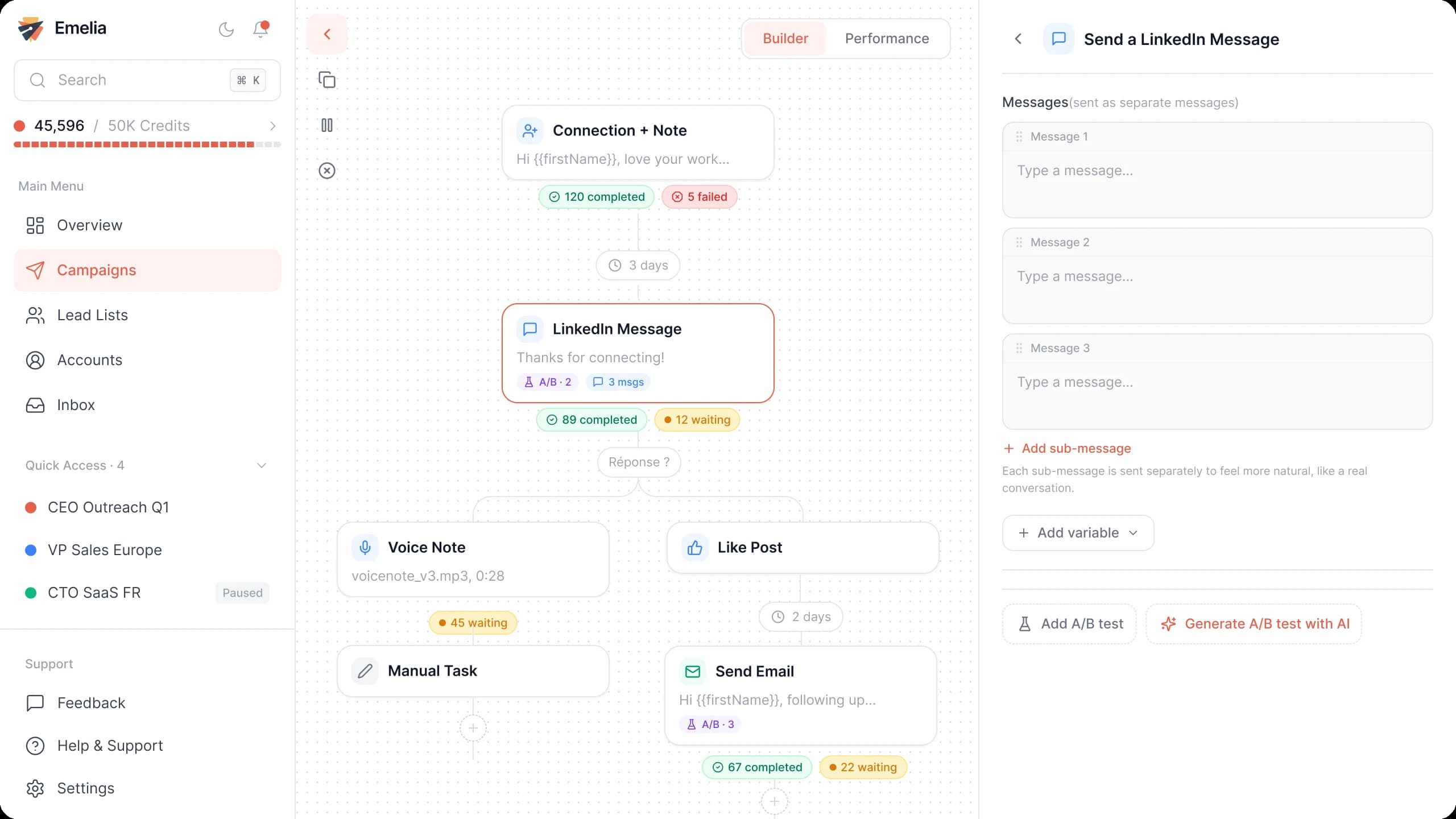
The Emelia sequence builder: emails and LinkedIn steps in the same campaign. - Step 3
Attach the list
In Settings, choose the sending accounts, tick your enriched list in Lead list, and save. Keep one list per level (CMOs, managers) so each group gets its own message.
Emelia: attach one or more lead lists to the campaign, then launch it. - Step 4
Launch or schedule
Launch now or pick a start date. Warm up new mailboxes first with email warmup: an email that lands in spam reaches nobody.
A short email that marketers do not delete
Show that you looked at their work, tie your offer to a number they report on, and ask a question that takes five seconds to answer.
Subject: [Channel] at {{companyName}}
Hi {{firstName}},
I saw [the campaign, post or job ad you noticed]: it looks like {{companyName}} is investing in [channel or goal] this year.
We help marketing teams improve [the metric they report on] without [extra headcount or another agency]. [Similar company] got [proven result] in [time frame].
Worth a 15-minute look, or is [channel] not a priority this quarter?
Replace the brackets with facts you can prove. Only use {{jobTitle}} if your titles are clean: a variable that prints "Sr. Mgr, Brand & Content EMEA" gives the template away to the people most trained to notice.
Mistakes to avoid
Pitching the CMO a tool one team buys
In a large company, the CMO does not choose an SEO platform. Find the channel owner, and keep the CMO for strategic offers.
Leaving agencies in the list
Without the industry exclusion, your list fills up with agency staff who cannot buy for anyone else.
Reusing last year's list
Marketing leaders move often: an old list means bounces, and bounces hurt your deliverability.
Sending a template to template experts
Marketers write sequences themselves. A generic opener, a fake "Re:" or a broken variable is spotted in one line.
Writing to marketing@ or press@
Shared inboxes are read by assistants or the PR agency. Get the name, then the person's own address.