MillionVerifier built its reputation on a simple promise: verify your emails cheaper than anyone else, with credits that never expire and no frills. At $$39 per 10,000 verifications, $89 to $97 per 50,000 and $449 for a million, meaning $3.90 down to under $0.50 per 1,000 depending on the tier, it is genuinely one of the best price-to-volume ratios on the market.
So why look for a MillionVerifier alternative in 2026? Because price is almost never the only thing that matters when you clean a list. The objection that keeps coming back from users is scope: MillionVerifier verifies, and that is all. No email finder, no warmup, no sequencer, no risk scoring, no inbox placement testing. And on support, some users report inconsistent response times.
So the real question becomes this: can I find something equally cheap elsewhere, or would a few extra cents per thousand buy me capabilities I am currently paying for in a separate subscription?
This guide compares the 7 best MillionVerifier alternatives in 2026, with pricing taken from official sites, the real cost worked out per thousand verifications, a clear read on credit policies, and a verdict for each profile.

What MillionVerifier actually does in 2026
MillionVerifier is operated from Hungary by GBD Software as a Service, which makes it, alongside Bouncer, one of the very few genuinely European verifiers on the market. A point English-language comparisons routinely ignore, even though it matters a great deal to a company prospecting in Europe.
Bulk and API verification, with result categorisation and deduplication.
Claimed accuracy above 99 % and 99.9 % API uptime.
Catch-all validation included at no extra cost, where other verifiers charge several credits per check.
Credits that never expire, with no mandatory subscription.
Money-back guarantee on any email the service cannot verify with certainty, plus a satisfaction guarantee on results flagged risky.
100 free credits on account creation, no card required.
European company, hosting inside the EU.
What MillionVerifier does not do: no email finder, no warmup, no cold email sequencer, no LinkedIn automation, no spam-trap style risk scoring, no inbox placement testing, no real-time form protection.
Verifying cheaper is good. Not paying for four tools is better.
Emelia: verifier, email finder, unlimited warmup, cold email and LinkedIn from €37/month.
Why look for a MillionVerifier alternative in 2026
The scope is deliberately minimal. That is both the product's strength and its ceiling. You clean a list you sourced elsewhere, warmed up elsewhere, and will activate elsewhere. Three subscriptions on top of this one.
No quality scoring. MillionVerifier tells you whether an address is valid, not whether it is risky. On purchased or ageing data, Bouncer's Toxicity Check or ZeroBounce's AI Scoring give you information MillionVerifier simply does not provide.
Support is the complaint that comes up most often in reviews. It runs mainly by email, and some users report inconsistent response times, which can hurt on a stuck batch or a disputed invoice. This is not a universal experience: plenty of users have never needed to contact support at all.
No real-time API built for forms. There is no JavaScript SDK and no signup protection widget, unlike Kickbox or Bouncer.
Debounce is cheaper at comparable volume, at roughly $2 per 1,000 on its first tier against $3.90 at MillionVerifier, with a rate advertised down to $0.00045 per verification at very high volume.
The interface is functional but dated, with no deliverability dashboard and no historical tracking of list quality.
The free tier is capped at 100 credits, once, where ZeroBounce tops up 100 credits every month.
The real cost per thousand verifications
This is the table that matters when you are leaving MillionVerifier. Prices come from official sites, converted to a per-thousand cost so they can be compared.
Tool | Indicative cost per 1,000 | Credits expire | Free tier | Model |
|---|---|---|---|---|
Debounce | around $2, down to $0.45 at very high volume | No | 100 credits | Pay-as-you-go only |
MillionVerifier (benchmark) | $3.90, then $1.78 to $1.94 at 50,000 | No | 100 credits | Pay-as-you-go |
Emelia | $4.75 | No | 7-day trial | Platform subscription + credits |
EmailListVerify | around $5 | No | 100 credits | Pay-as-you-go or monthly |
Bouncer | $8 on the first tier | No | 100 credits | Pay-as-you-go + modules |
Kickbox | around $8 | Yes, 12 months | 100 credits | Pay-as-you-go or monthly |
ZeroBounce | included in ONE from $99/month | No | 100 credits per month | Monthly bundle |
Clearout | not published | No | 100 credits | Subscription or pay-as-you-go |
What a real MillionVerifier alternative has to cover
A comparable or lower cost per thousand, otherwise switching makes no economic sense.
Credits that do not expire. This is the golden rule of verification, a spiky usage pattern rather than a steady flow.
A clear policy on uncertain results. Some tools do not charge for unknowns, others charge several credits per catch-all: that detail alone can swing the real invoice by 30 % or more.
Accuracy you can actually test before paying, through a free tier or a trial.
Support reachable on more than one channel, which is precisely the most frequent complaint against MillionVerifier.
Something extra if you pay more: finder, warmup, sequencer, risk scoring or form protection. Paying more for the same thing is pointless.
Compliance that fits your market, bearing in mind MillionVerifier is already European.
Emelia, the alternative that bundles four tools into one

We start with Emelia because it is the only tool in this selection that addresses MillionVerifier's real limitation: scope.
MillionVerifier verifies very well and very cheaply. But once the list is clean, you still need an email finder, a warmup tool and a sequencer. Emelia bundles those four building blocks into a single subscription.
Verification there costs $0.00475 per email through the credit packs (that is $4.75 per 1,000). More expensive than MillionVerifier per thousand. In exchange, the subscription starts at $37/month and natively includes:
So the right calculation is not the price per thousand, it is the total cost of the stack. If you are currently paying MillionVerifier plus a finder plus a warmup tool plus a sequencer, Emelia replaces those four line items with one.
Like MillionVerifier, Emelia is a European player (French company, data hosted in Europe). You lose nothing on that front.
Emelia pricing
7-day free trial, no commitment
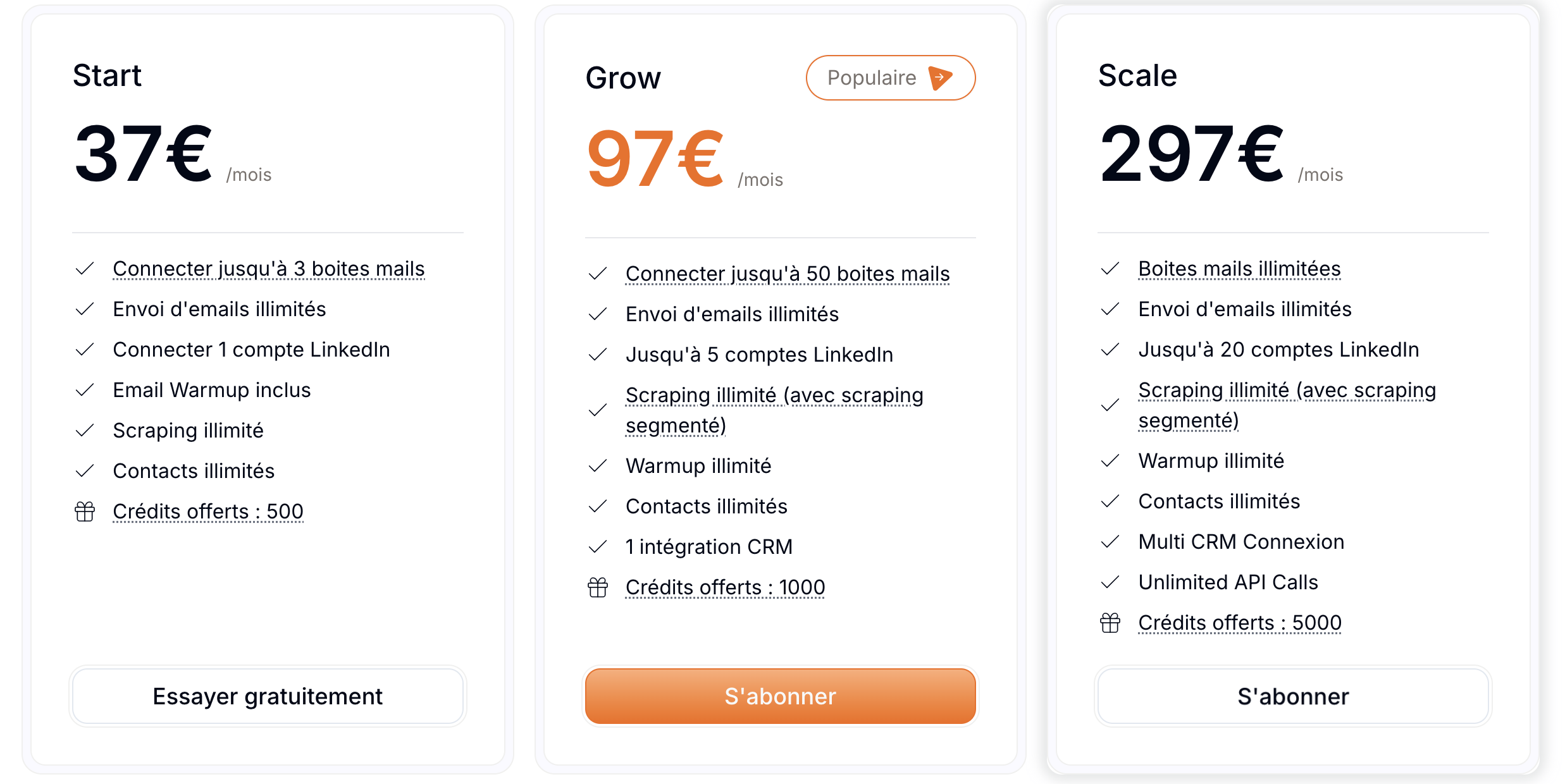
Start: $37/month, 3 mailboxes, 1 LinkedIn account, 500 free credits, unlimited warmup, Sales Navigator scraping
Grow: $97/month, up to 50 mailboxes, 3 LinkedIn accounts, 1,000 credits
Scale: $297/month, unlimited mailboxes, 10 LinkedIn accounts, 5,000 credits, multi-CRM, API
Unit pricing
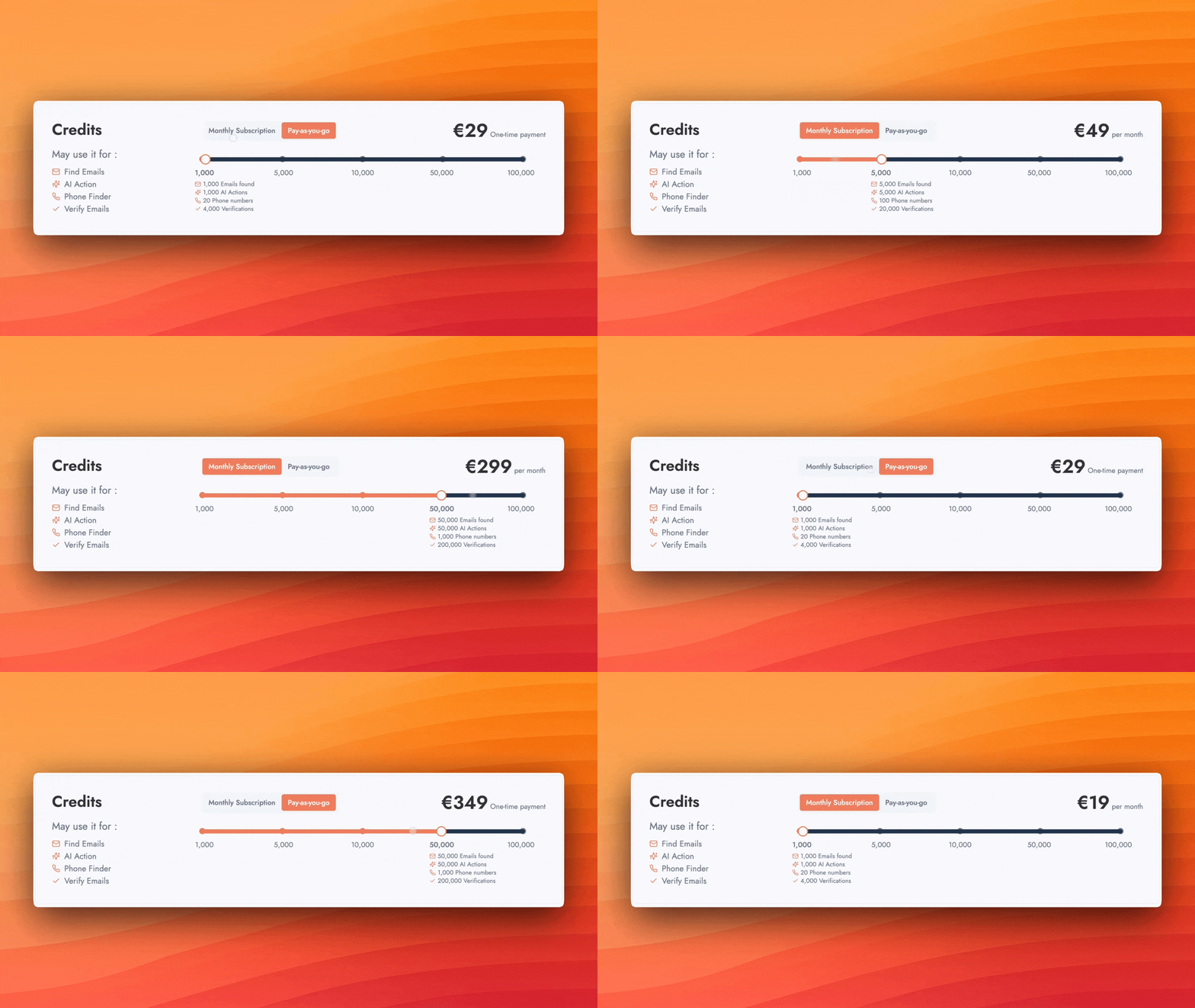
Email Verifier: $0.00475 per email, through the credit packs
Email Finder: $0.0050 per email found and verified, through the credit packs
Advantages vs MillionVerifier
Built-in self-service email finder
Unlimited native warmup included
Cold email and LinkedIn in the same tool
Versatile credits (verification, finder, AI, phone finder)
Human support and European hosting, whatever the plan
Drawbacks
More expensive per thousand on pure verification
Overkill if you only clean lists without doing any outreach
No risk scoring along the lines of Toxicity Check or AI Scoring
Verdict: the best alternative if your real problem is not the price of verification but the number of subscriptions you are stacking. You pay slightly more per thousand and you remove three lines from your invoice.
One subscription for your entire outbound chain
Verification at €0.00475, finder at €0.0050, unlimited native warmup, European hosting.
Debounce

Debounce is the only tool in this selection that beats MillionVerifier on its own ground: price.
Founded in 2018, it runs on pay-as-you-go only, with no subscription, at roughly $2 per 1,000 on the first tier and down to an advertised $0.00045 per verification at very high volume. Credits never expire.
Its distinguishing feature is a rare commercial choice: every capability is open to every customer, whatever pack they bought. There is no plan to unlock before you can reach the API or deduplication.
Debounce pricing
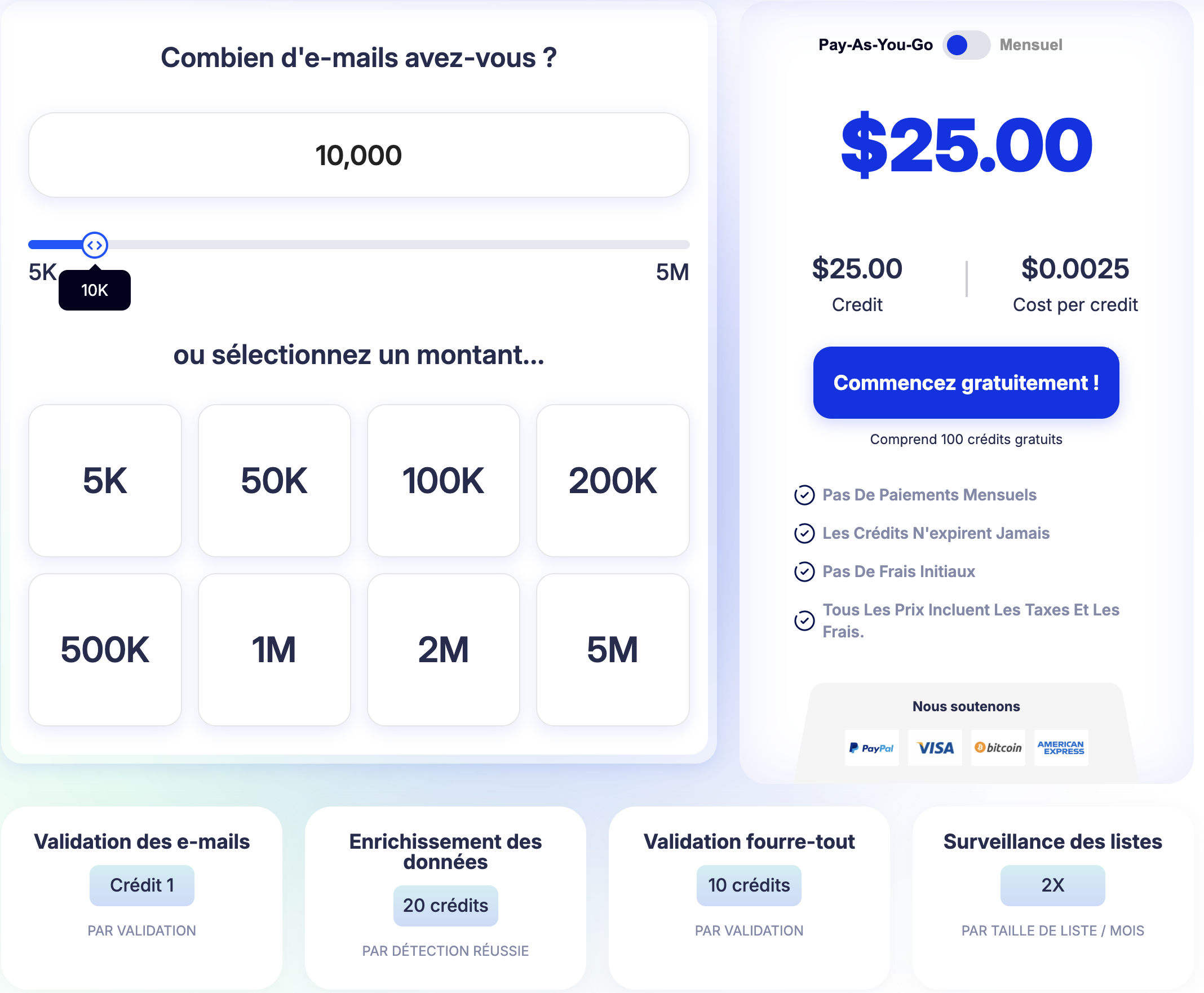
Pay-as-you-go only, with packs of 5,000, 50,000, 100,000, 200,000, 500,000, 1, 2 and 5 million credits.
Around $2 per 1,000 on the first tier ($10 for 5,000 credits), down to an advertised $0.00045 per verification at very high volume.
1 credit per standard validation, 10 credits for a catch-all validation, 20 credits per successful data enrichment.
List monitoring: twice the list size in credits per month.
Credits never expire.
Free: 100 credits on signup, no card required.
Free deduplication and API access included without separate credits.
Advertised deliverability guarantee of 97.5 % or better.
Advantages vs MillionVerifier
Cheaper than MillionVerifier at very high volume, which is rare.
Credits that never expire, same as MillionVerifier.
Every feature open to every customer, with no functional tiering.
Free deduplication, which mechanically cuts consumption.
API included without buying dedicated credits.
Data enrichment module, absent from MillionVerifier.
List monitoring over time, also absent from MillionVerifier.
Drawbacks
Catch-all validation costs 10 credits each, where MillionVerifier includes it at no extra cost. On a list heavy in catch-all domains, the price advantage reverses completely.
Advertised deliverability guarantee of 97.5 %, below the 99 % MillionVerifier claims.
US servers, so you lose MillionVerifier's European footing.
Support mainly by email.
Less modern interface than the premium verifiers.
Verdict: the only genuinely cheaper alternative to MillionVerifier, provided your list contains few catch-all domains. Test on a sample before switching.
EmailListVerify

EmailListVerify is a US verifier founded in 2012, in the same family as MillionVerifier: volume, contained pricing, little packaging.
The difference is a bonus: since 2023, EmailListVerify ships a basic email finder, billed at 5 credits per address found with medium confidence or above. That is exactly the piece MillionVerifier lacks, even if it stays rudimentary.
Eight distinct checks run on every address: syntax, MX, SMTP, spam trap, catch-all, duplicates, disposable addresses and hard bounces. Advertised throughput exceeds 100,000 verifications per hour per customer.
EmailListVerify pricing
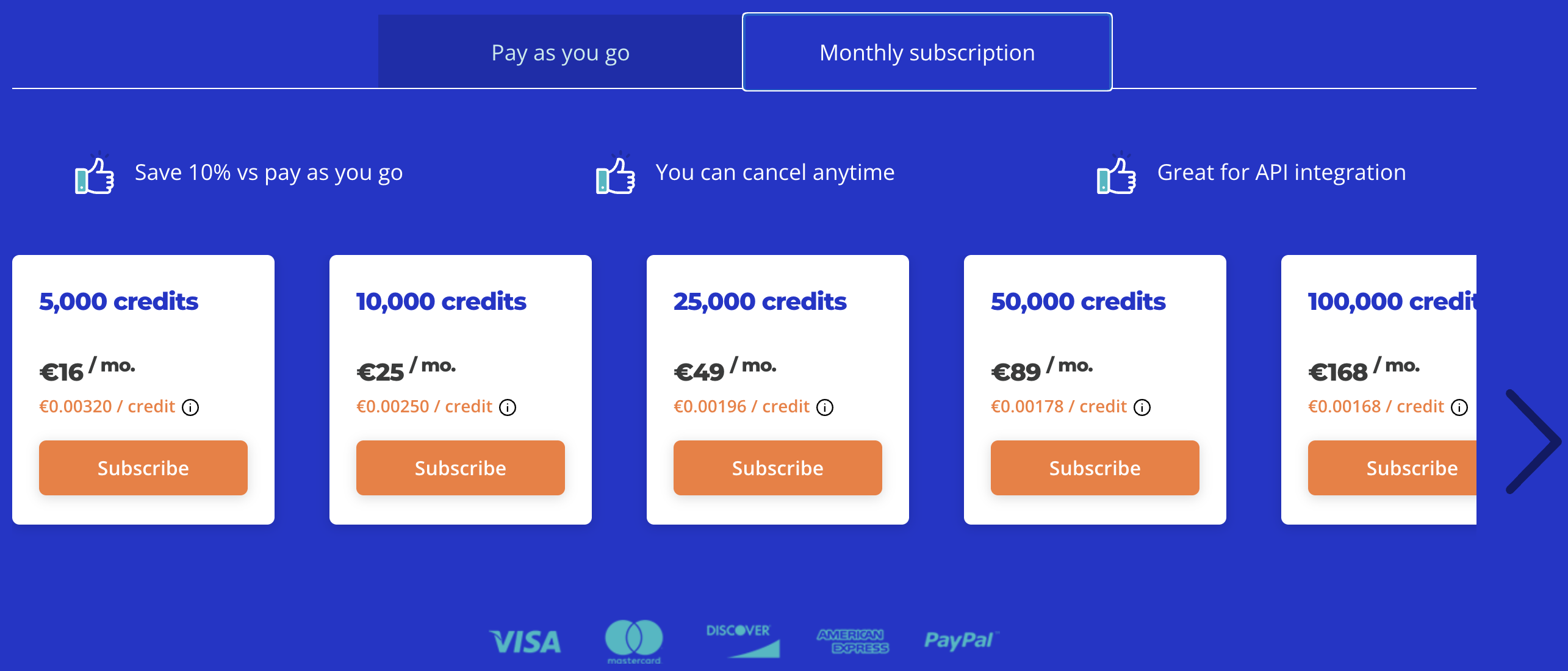
Pay-as-you-go: around $5 per 1,000 credits, with sliding tiers up to a million. Credits do not expire.
Monthly subscription: around 10 % cheaper than pay-as-you-go at equivalent volume.
Email finder: 5 credits per address found, roughly $0.025 per email.
Free: 100 verifications on signup.
Above a million emails per month, pricing on request.
Advantages vs MillionVerifier
Email finder included, which fills MillionVerifier's main gap.
Credits that do not expire, same as MillionVerifier.
Eight distinct documented checks, against a more opaque categorisation at MillionVerifier.
Around 10 % discount by moving to the monthly subscription.
High throughput on large lists.
Drawbacks
Around three times more expensive than MillionVerifier per thousand at comparable volume.
Claimed accuracy of 97 %, against more than 99 % at MillionVerifier.
US servers, losing the European footing.
Minimal, ageing interface.
Support mainly by email, with no better reputation than MillionVerifier's.
The email finder stays basic, with no detailed confidence score.
Verdict: only worth it if you want to consolidate verification and basic email lookup into one tool. On pure verification you pay more for lower claimed accuracy.
Bouncer

Bouncer is the Polish verifier founded in 2017, hosted inside the European Union, and it is the alternative to look at if you chose MillionVerifier for its European footing but are hitting the absence of quality scoring.
Its Toxicity Check is the feature that exists nowhere else in this form: it scores a contact on its likelihood of being a spam trap, a widely circulated address or a source of complaints. That is precisely the information you need when you inherit a purchased list or a three-year-old file.
Bouncer rounds this out with Bouncer Shield, real-time signup form protection, and a Deliverability Kit that tests inbox placement, blocklists, SPF, DKIM, DMARC and SpamAssassin. Both modules are billed separately.
Bouncer pricing
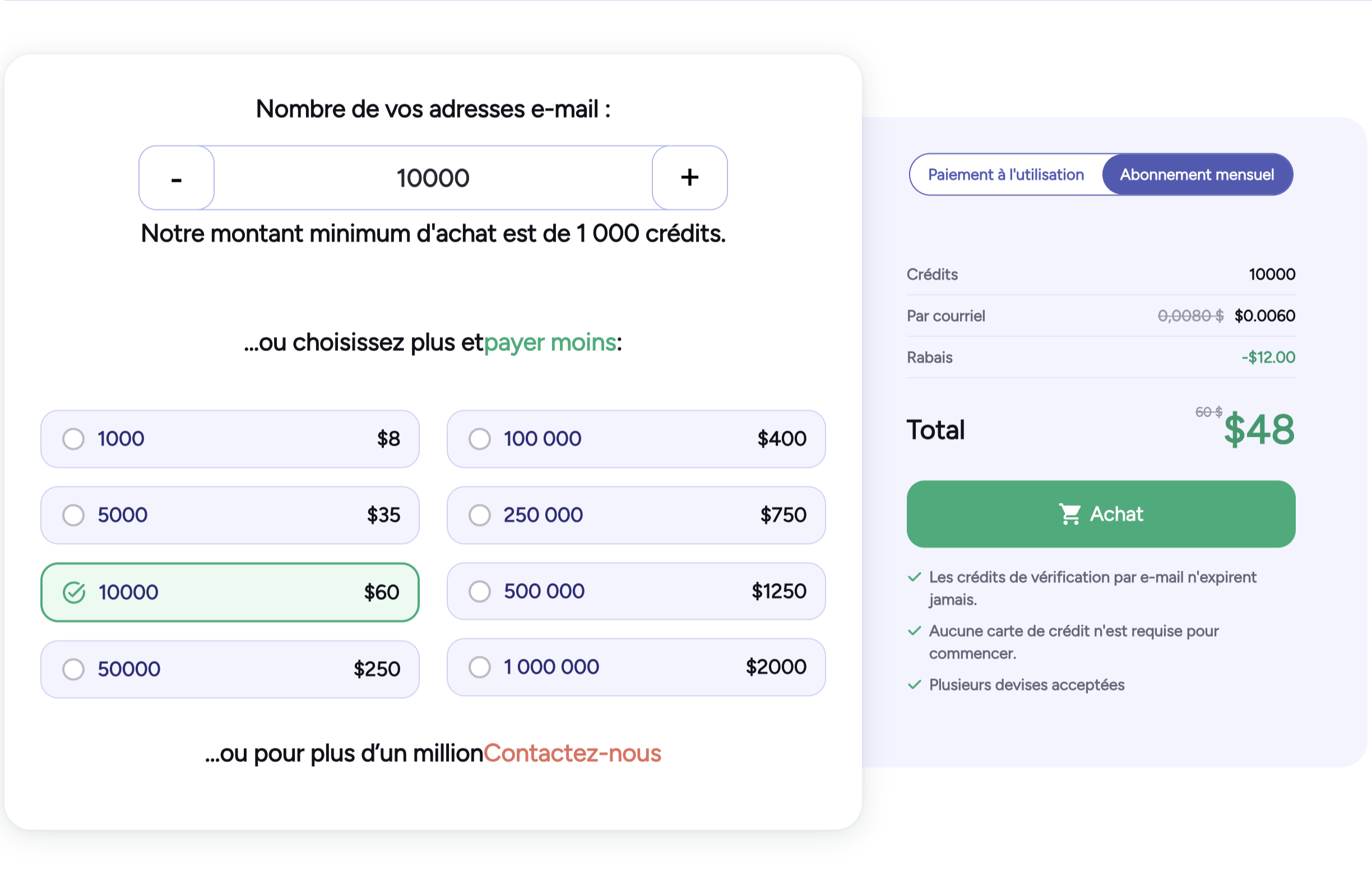
Pay-as-you-go: $8 per 1,000 verifications, $35 per 5,000, $60 per 10,000, $250 per 50,000, $400 per 100,000, $750 per 250,000, $1,250 per 500,000 and $2,000 per million. Credits never expire.
Deliverability Kit: $25/month for 250 tests and 10 IPs or domains, $125/month for 1,000 tests, $250/month for 2,500 tests, Enterprise on request.
Bouncer Shield: from $2 for 1,000 real-time checks per month to $1,050 for a million.
100 free credits on signup, no card required, then a first paid pack at 1,000 credits.
Advantages vs MillionVerifier
Toxicity Check, a risk score with no equivalent at MillionVerifier.
Real-time form protection with Bouncer Shield, from $2 per month.
Inbox placement testing and blocklist monitoring through the Deliverability Kit.
Hosting inside the European Union and a data processing agreement available, on a par with MillionVerifier.
Credits that never expire, same as MillionVerifier.
Noticeably better documentation and interface.
Drawbacks
Around four times more expensive than MillionVerifier at comparable volume.
Modular model: the verifier, the Deliverability Kit and Bouncer Shield are each paid for separately.
No recurring free tier: the 100 free credits are given once only.
No email finder, no warmup, no sequencer.
Less established brand and integration ecosystem outside Europe.
Verdict: the right pick if you are staying with a European verifier but need to qualify the risk in your list, not just its validity. The price is the price of that information.
ZeroBounce

ZeroBounce is a US deliverability suite founded in 2015, and it is the exact opposite of MillionVerifier: one sells the minimum at the best price, the other sells the maximum in a monthly bundle.
The ZeroBounce ONE plan brings together validation, AI Scoring, email finder, domain search, Warmup Seeds, inbox placement testing, blacklist monitoring, DMARC monitoring and mail server testing. Everything draws on the same credit pool.
The free tier is the most generous in this selection: 100 validation credits topped up every month, plus one inbox test, one mail server test, one blacklist monitor and 10 email finder credits.
ZeroBounce pricing

ZeroBounce ONE: from $99/month for a minimum of 10,000 monthly credits, volume customisable, with 20 % off on annual billing.
Pay-as-you-go: credits bought on demand, with 15 % off when autopay is enabled.
Free and permanent: 100 validation credits topped up monthly, 1 inbox test, 1 mail server test, 1 blacklist monitor, 10 email finder credits.
Email finder: 20 credits per successful lookup.
Unknown results do not consume credits.
Claimed accuracy of 99.6 %, contractually guaranteed.
Credits never expire.
Advantages vs MillionVerifier
An incomparably wider scope: warmup, inbox placement, blacklist, DMARC, AI Scoring, email finder.
Claimed and guaranteed accuracy of 99.6 %, slightly above MillionVerifier.
A permanent free tier topped up monthly, where MillionVerifier gives 100 credits once.
Unknowns are free, which improves the real cost per usable address.
Support available around the clock, which answers the main complaint against MillionVerifier.
Drawbacks
The bundle starts at $99/month with a 10,000-credit minimum. On irregular usage that is far more expensive than MillionVerifier's pay-as-you-go.
Email finder at 20 credits per lookup, very costly relative to the unit price.
US servers, losing MillionVerifier's European footing.
No cold email sequencer and no LinkedIn automation.
Dense interface with a lot of nested tools.
Verdict: the right pick if your problem is not price but the overall deliverability of your sending. You pay a lot, you get a genuine monitoring suite.
Kickbox

Kickbox is a US verifier founded in 2013 and acquired by Sinch in 2020. It is the alternative for engineering teams.
Where MillionVerifier is built to take a CSV and hand back a clean file, Kickbox is built to be wired into a product: exemplary documentation, a very reliable real-time API, a JavaScript SDK that drops straight onto a signup form.
Its Sendex score adds a dimension MillionVerifier does not have: it predicts the engagement quality of an address beyond its bare technical validity.
Kickbox pricing

Pay-as-you-go: around $5 for 500 verifications, $40 for 5,000 and $800 for 100,000.
Monthly subscription: around $159/month for up to 50,000 verifications.
Free: 100 verifications on signup.
Enterprise: on request above a million.
Risky and unknown results do not consume credits.
Advantages vs MillionVerifier
The best API and the best documentation on the market.
Real-time JavaScript SDK to protect forms at the source.
Sendex score that qualifies an address's engagement potential.
Risky and unknown results are free, which noticeably cuts the real cost on mid-quality lists.
Backed by Sinch, which brings a durability guarantee an independent player cannot match.
Drawbacks
Around four times more expensive than MillionVerifier per thousand.
Credits expire after 12 months, the opposite of the MillionVerifier model.
US servers.
No email finder, no warmup, no sequencer.
Overkill if your usage amounts to uploading a file once a quarter.
Verdict: the best pick if verification has to live inside your product rather than in a spreadsheet. On one-off list cleaning, MillionVerifier remains unbeatable.
Clearout

Clearout is a verifier playing on the same ground as MillionVerifier: claimed accuracy around 99 %, credits that never expire and roll over month to month, 100 credits on account creation.
The tool offers three payment models, annual subscription, monthly subscription and pay-as-you-go, with discounts advertised up to 20 % on subscription plans and the ability to change tier at any time.
One important reservation: at the time of writing, Clearout does not display detailed pricing publicly. You have to create an account or contact sales to get the grid. That is real friction against MillionVerifier's pricing transparency.
Clearout pricing
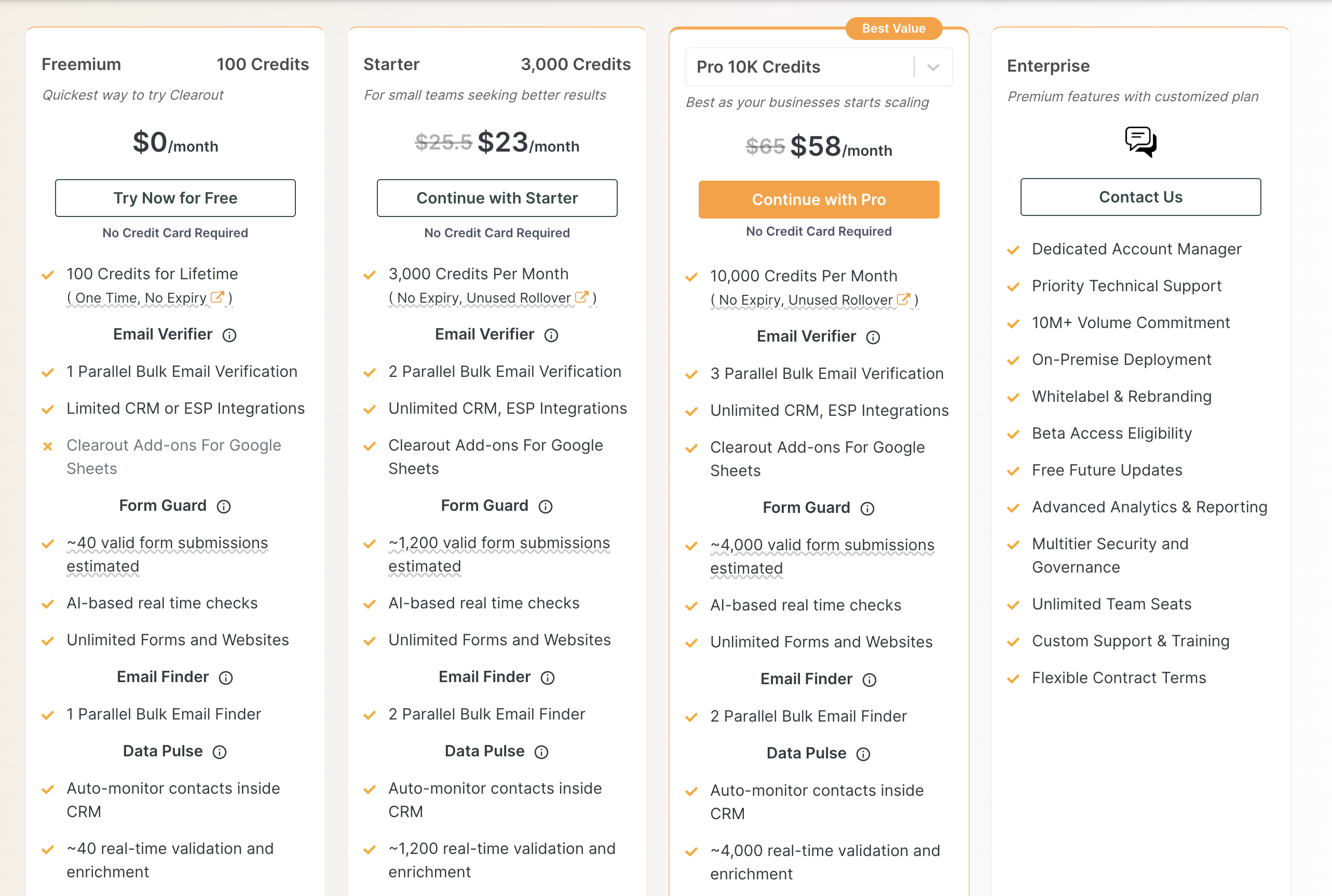
Three models: annual subscription, monthly subscription and pay-as-you-go.
Discounts advertised up to 20 % on subscription plans.
Credits never expire and roll over.
Free: 100 credits on account creation.
Detailed pricing grid not published publicly.
Advantages vs MillionVerifier
Credits roll over from one period to the next, avoiding the loss of unused volume on subscription plans.
Freedom to change tier at any time, up or down.
Claimed accuracy around 99 %, comparable to MillionVerifier.
Three payment models instead of one.
100-credit free tier, on a par with MillionVerifier.
Drawbacks
Pricing not published publicly, which makes any objective comparison impossible without creating an account. That is the main criticism to make of the tool.
No risk scoring equivalent to Bouncer's Toxicity Check.
No warmup and no sequencer.
Lower profile than the other players in this selection.
Thinner documentation than Kickbox's.
Verdict: a credible alternative on paper, with a credit policy close to MillionVerifier's. But the absence of public pricing is a real obstacle: you cannot compare objectively without creating an account, when every other tool in this selection publishes its grid. It is the one case where we cannot give you a cost per thousand.
What is your stack really costing you, verifier included?
Emelia bundles verification, finder, warmup, cold email and LinkedIn. 7-day free trial.
Which MillionVerifier alternative to choose for your profile
You just want to pay even less at very high volume. Debounce, around $2 per 1,000 on the first tier and down to an advertised $0.00045 per verification at very high volume, provided your list contains few catch-all domains.
You want to stop stacking verifier, finder, warmup and sequencer. Emelia from $37/month, European hosting, verification at $0.00475 per email and finder at $0.0050.
You inherit purchased or ageing lists and need to qualify the risk. Bouncer and its Toxicity Check, while staying with a European player.
Your real problem is deliverability, not list hygiene. ZeroBounce ONE from $99/month, with warmup, inbox placement, blacklist and DMARC.
You need verification wired into your product or your forms. Kickbox, the best API on the market, JavaScript SDK included, risky and unknown free.
You want to consolidate verification and basic email lookup. EmailListVerify, around $5 per 1,000 credits that do not expire, with a finder at 5 credits per address.
You want a flexible credit policy with roll-over. Clearout, subject to obtaining the pricing grid.
You only do one-off list cleaning and price beats everything. Stay with MillionVerifier, still one of the best price-to-quality ratios on the market.
In short, which MillionVerifier alternative in 2026
MillionVerifier does exactly what it promises, and it does it cheaper than almost the entire market while remaining a European player with credits acquired for life. On pure, occasional verification there is objectively not much to hold against it, beyond occasionally variable support response times.
The real issue is elsewhere. A verifier does not build your list, does not warm your mailboxes and does not send your campaigns. If MillionVerifier is the fourth line on your outbound invoice, saving a few euros per thousand is wiped out by the cost of the other three subscriptions.
The best MillionVerifier alternative in 2026 therefore depends on what is actually costing you. To save even more at very high volume, Debounce. To qualify the risk in a purchased list, Bouncer. For overall deliverability, ZeroBounce. And to stop stacking tools, Emelia from $37/month bundles verification, email finder, unlimited warmup, cold email and LinkedIn into a single subscription, with data hosted in Europe and the same human support for every customer.
Try Emelia free for 7 days and compare the real cost of your stack, not just the cost of your verifier.
Support that answers, whatever your plan
Same level of service at €19 as at €297 per month.
Frequently asked questions about MillionVerifier alternatives in 2026
Is there a MillionVerifier alternative that is genuinely cheaper?+
Yes, one in this selection: Debounce, at roughly $2 per 1,000 on its first tier and down to an advertised $0.00045 per verification at very high volume, against $3.70 per 1,000 at MillionVerifier on the first tier and $1.78 to $1.94 at 50,000 credits. One caveat though: Debounce charges 10 credits for a catch-all validation, where MillionVerifier includes it at no extra cost. On a list heavy in catch-all domains, the pricing advantage can reverse completely.
Do MillionVerifier credits really never expire?+
No, they never expire. It is one of the tool's central arguments, and it is shared by Bouncer, Debounce, EmailListVerify, ZeroBounce, Clearout and Emelia. Kickbox and NeverBounce, on the other hand, expire their credits after 12 months, which is a problem for spiky usage.
Why pay more than a verifier at $3.70 per 1,000?+
For three reasons only. Risk scoring, if you work with purchased data, which MillionVerifier does not provide. Deliverability, if your real problem is inbox placement rather than list hygiene. And scope, if verification is only one of the four blocks you pay for to run outbound. In every other case, paying more to verify buys you nothing.
How good is MillionVerifier support?+
It is the complaint that comes up most often in reviews, without being a universal experience. Support runs mainly by email, and some users report inconsistent response times. That is not blocking on occasional cleaning, but it can become so on a production batch or a disputed invoice. ZeroBounce offers round-the-clock support, and Emelia applies the same level of human support to every customer, whatever their plan.
Is MillionVerifier as accurate as the premium verifiers?+
MillionVerifier claims more than 99 % accuracy and 99.9 % API uptime, which puts it level with ZeroBounce, which guarantees 99.6 %, and above EmailListVerify, which claims 97 %, and Debounce, which guarantees 97.5 % deliverability. The tool also includes catch-all validation at no extra cost and refunds emails it cannot resolve with certainty, which is a good indicator of confidence in its own engine.