Smartlead plans in 2026: Base, Pro, Unlimited Smart and Unlimited Prime
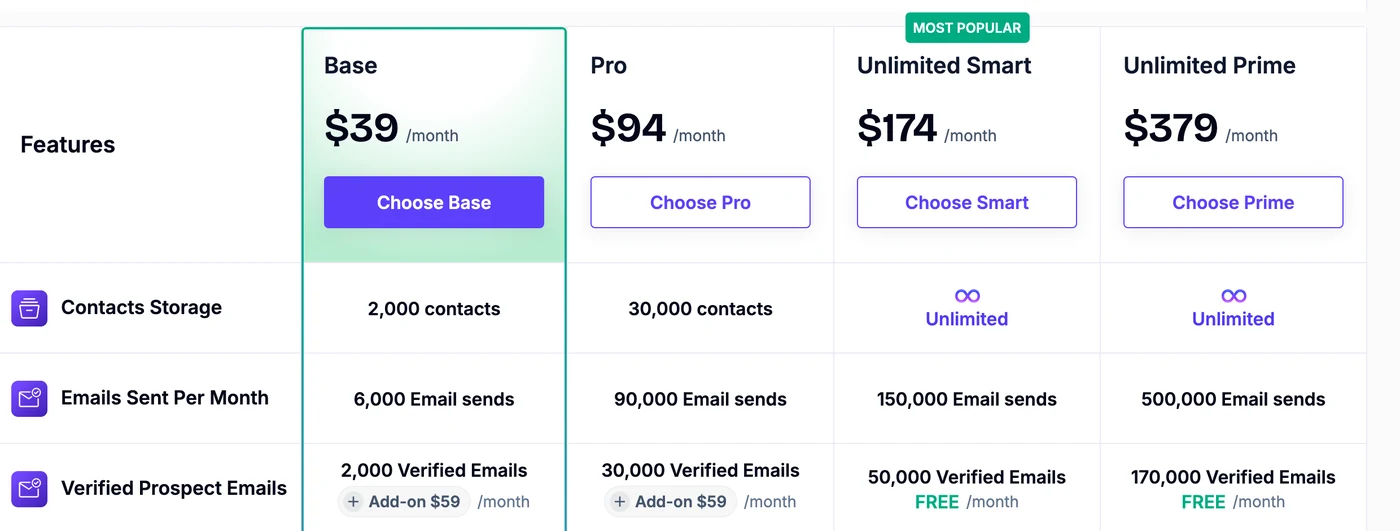
Short answer: Smartlead costs $39, $94, $174 or $379 a month billed monthly, in US dollars excluding tax, for one account with unlimited mailboxes. Each step up raises the emails you can send and the verified emails you get; stored contacts are capped on Base and Pro, unlimited from Unlimited Smart.
Base
$39/month
$32.50/month billed yearly
- 6,000 emails sent a month
- 2,000 contacts stored
- Warm-up pool: Foundation
- No API, webhooks or CRM access
- Verified emails: $59/month option
Pro
$94/month
$78.30/month billed yearly
- 90,000 emails sent a month
- 30,000 contacts stored
- Warm-up pool: Growth
- API, webhooks, CRM, unlimited team members
- Verified emails: $59/month option
Unlimited Smart
$174/month
$144.50/month billed yearly
- 150,000 emails sent a month
- Unlimited contacts
- 50,000 verified emails a month included
- Warm-up pool: Premium
- A call with a customer success manager
Unlimited Prime
$379/month
$314.60/month billed yearly
- 500,000 emails sent a month
- Unlimited contacts
- 170,000 verified emails a month included
- 3 dedicated servers and 3 client workspaces included
- Dedicated account manager, private Slack channel
None of the four plans caps mailboxes, but Smartlead’s fair use policy still names 100, 300 and 800 mailboxes, next to plan names it has since replaced. Warm-up and sender rotation on every plan. Enterprise, "for volumes above Prime", is on quote. One inconsistency: Unlimited Prime sends 500,000 emails a month according to the pricing table and the help center, 510,000 according to the price slider and Smartlead's llms.txt file.
Smartlead discount code: 50% off the first month, the yearly saving and the affiliate credits
- 50% off the first month. A banner across smartlead.ai offers 50% off the first month on any plan, without a code. It was not there on September 16, 2026: it may not last.
- No official promo code. Smartlead publishes none; codes found on coupon sites are not ones it vouches for.
- Paying yearly. The steadiest saving: 16.7% on Base and Pro, paid upfront.
- The affiliate link. Someone who signs up through a Smartlead affiliate gets 6,000 email verification credits with their first paid plan. Affiliates earn 15% to 35% recurring commission.
- Lifetime deal. None on the pricing page.
Per month or per year: Smartlead shows the yearly price first
The pricing page opens on yearly billing, so the first figure you see for Base is $32.50, not $39. Smartlead announces "17% off" for paying a year upfront; on Base and Pro the real discount is 16.7%.
Yearly means the whole year is charged at once. Moving up a plan costs the prorated difference; moving down turns the unused time into account credit.
One account, by billing period
- Base
- $39/month billed monthly · $32.50/month billed yearly, so $390 upfront
- Pro
- $94/month billed monthly · $78.30/month billed yearly, so $939.60 upfront
- Unlimited Smart
- $174/month billed monthly · $144.50/month billed yearly, so $1,734 upfront
- Unlimited Prime
- $379/month billed monthly · $314.60/month billed yearly, so $3,775.20 upfront
Three meters on every plan: emails sent, contacts stored, verified emails
Smartlead does not count users or mailboxes. It counts three things, separately, and whichever runs out first sets the plan you need.
Emails sent: reset every month
One email sent uses one email credit, follow-ups included; warm-up emails do not count. The allowance (6,000 on Base, 90,000 on Pro) resets each month on your billing date. When it is used up, campaigns stop until the renewal or an upgrade.
Contacts stored: never reset
Each unique address in the account uses one lead credit, even if it appears in several campaigns. Base holds 2,000 and Pro 30,000; the counter never resets, so you free space by deleting leads. A team that adds 2,000 new contacts a month fills Base in its first month, whatever its sending volume. Unlimited from Unlimited Smart.
Verified emails: a monthly allowance from SmartProspect
SmartProspect, Smartlead's lead database, gives one verified email for every 3 emails your plan can send: 2,000 a month on Base, 30,000 on Pro, 50,000 on Unlimited Smart. On Base and Pro it costs $59 a month extra; it is included from Unlimited Smart.
What other Smartlead pages say
The home page promises to "store unlimited leads", and Smartlead’s comparison with lemlist speaks of verified leads included at the entry price. The pricing table, its pricing file and the help center show the contact caps and the paid option above: we follow those.
The price slider: 33 sending tiers up to 5,100,000 emails a month
The four plans are only the named stops of a price slider. Its data, in the code of the pricing page, holds 33 tiers: the plan’s name changes with the volume, and each tier gives one verified email for every 3 emails. The yearly prices of the slider are rounded to the dollar.
Emails a month: price billed monthly
- Base
- 6,000: $39
- Pro
- 90,000: $94
- Unlimited Smart
- 150,000: $174 · 240,000: $228 · 330,000: $282 · 420,000: $336
- Unlimited Prime, 510,000 to 990,000
- 510,000: $379 · 630,000: $460 · 750,000: $530 · 870,000: $600 · 990,000: $670
- Unlimited Prime, 1,110,000 to 2,010,000
- 1,110,000: $740 · 1,260,000: $826 · 1,410,000: $912 · 1,560,000: $998 · 1,710,000: $1,084 · 1,860,000: $1,170 · 2,010,000: $1,256
- Unlimited Prime, 2,190,000 to 3,090,000
- 2,190,000: $1,356 · 2,370,000: $1,456 · 2,550,000: $1,556 · 2,730,000: $1,656 · 2,910,000: $1,756 · 3,090,000: $1,856
- Unlimited Prime, 3,300,000 to 5,100,000
- 3,300,000: $1,971 · 3,510,000: $2,086 · 3,720,000: $2,201 · 3,930,000: $2,316 · 4,140,000: $2,431 · 4,380,000: $2,559 · 4,620,000: $2,687 · 4,860,000: $2,815 · 5,100,000: $2,943
Add-ons that raise the bill: SmartProspect, client workspaces, servers, mailboxes, tests and calls
None of these is in the Base or Pro price; Unlimited Smart includes SmartProspect and Unlimited Prime adds client workspaces and servers. SmartProspect, servers, mailboxes and domains, tests, verification and calls are never refunded, according to the help center, even when a plan is.
Two of Smartlead’s own pages disagree on some of them: its comparison with lemlist calls SmartDialer "included" and its llms.txt file presents SmartProspect as part of the platform ("not separate subscriptions"), while the pricing page sells both. The prices below are those of the pricing page.
Monthly add-ons
On Base and Pro only; included from Unlimited Smart. 2,000 trial credits before paying.
From Pro. Unlimited Prime comes with 3. Smartlead’s FAQ and its lemlist comparison promise one client free on Pro; the pricing page makes no such exception and bills each workspace.
From Pro, in the US or the EU. Unlimited Prime bundles 3 servers.
Growth: 120 tests a month on 50 accounts; Pro and Expert: unlimited tests on 200 and 500 accounts.
15 credit levels, every feature at each one; US numbers from $1 a month. Smartlead does not say how many minutes a credit buys.
Described as a paid add-on, currently free for mailboxes that meet its criteria.
Mailboxes and domains bought in the app (SmartSenders)
Domain: $13 for one year.
Domain: $18 for one year.
Domain: $13 for one year.
Domain: $18 for one year.
Domain: $16 for one year.
Domain: $19 for one year.
Domain: $13 for one year.
Domains are paid for a year, with no refund. Mailboxes are billed by the month without proration, until you delete them: cancelling the plan does not stop them.
Email verification credits (one credit per address)
$16.50 as a one-off purchase.
$33 as a one-off purchase.
$64.90 as a one-off purchase.
$127 as a one-off purchase.
$242 as a one-off purchase.
$458 as a one-off purchase.
$1,100 as a one-off purchase.
$2,030.60 as a one-off purchase.
The page announces "Save 17%" on the monthly subscription; compared with the one-off price, the real saving is about 9%.
Smartlead cost simulator: your mailboxes in, a plan out
Choose how many mailboxes you send from and how many emails each one sends a day. The simulator works out the monthly volume, the Smartlead tier that covers it and the Emelia plan that covers your mailboxes. Smartlead's help center recommends 15 to 25 emails a day per mailbox; its mailbox store, 20 to 50.
 Pro · 90,000 emails
 Grow
GrowWith this setup, Smartlead is cheaper by $3 per month.
How each tool charges
Smartlead bills by emails sent per month: Base $39 for 6,000, Pro $94 for 90,000, Unlimited Smart $174 for 150,000, then tiers up to 5,100,000. Mailboxes do not change the price; team members are unlimited from Pro. US dollars only.
Emelia charges by plan, not per user: Start $37 (3 mailboxes, 1 LinkedIn), Grow $97 (50 mailboxes, 3 LinkedIn), Scale $297 (unlimited mailboxes, 10 LinkedIn), then $29 per extra LinkedIn account.
Excluding tax, add-ons (SmartProspect on Base and Pro, client workspaces, servers, verification) and the mailboxes themselves (Google, Outlook). The simulator counts working days only; the tables on this page count 30 days of sending a month, which puts some mailbox counts on a higher Smartlead tier. Contact caps are not simulated: past 2,000 stored contacts, Base is no longer enough.
Smartlead vs Emelia at the same number of mailboxes
Cold email only: we count 30 to 50 emails per mailbox per day over 30 days. No exchange rate is involved: Smartlead charges in US dollars alone, Emelia charges the same amount whether you pay in dollars or in euros, and the advantage shown on each row is the one a dollar payer gets.
Cold email, billed monthly
3 mailboxes (≈ 2,700 to 4,500 emails)
6 mailboxes (≈ 5,400 to 9,000 emails)
20 mailboxes (≈ 18,000 to 30,000 emails)
50 mailboxes (≈ 45,000 to 75,000 emails)
100 mailboxes (≈ 90,000 to 150,000 emails)
200 mailboxes (≈ 180,000 to 300,000 emails)
300 mailboxes (≈ 270,000 to 450,000 emails)
500 mailboxes (≈ 450,000 to 750,000 emails)
1,000 mailboxes (≈ 900,000 to 1,500,000 emails)
Cold email, billed yearly (per month)
3 mailboxes
6 mailboxes
20 mailboxes
50 mailboxes
100 mailboxes
200 mailboxes
300 mailboxes
500 mailboxes
1,000 mailboxes
Contact data, billed monthly
50,000 verified emails a month
Verify 24,000 imported addresses a month
Verify 192,000 imported addresses a month
What the price does not show
Contacts stored
API and webhooks
LinkedIn accounts
Free trial
Emelia is cheaper up to 3 mailboxes and again from about 370; Smartlead costs less from 4 to about 220 mailboxes, and in between it depends on the pace. At 15 to 25 emails a day per mailbox, the pace Smartlead recommends, or 14 a day, the median its own benchmarks report across "850M+" emails, each tier covers more mailboxes and Smartlead stays cheaper for longer. Smartlead's verified emails come from a search in its own database; Emelia's credits find and verify the address of a lead you already have. All amounts exclude tax and were last checked on October 6, 2026.
Smartlead free trial: 14 days, 2,500 emails, no card
The trial lasts 14 days, without a credit card, with unlimited mailboxes and every feature except white label. It stops at 2,500 emails sent and 1,250 contacts.
Follow-ups and emails that bounce count toward the trial allowance; replies, unsubscribes and warm-up emails do not. To keep going, you pick a plan in Settings, then Subscription, and enter a card. There is no permanent free plan.
Emelia’s trial lasts 7 days, also without a card, and signing up with a work email adds 20 free credits to find emails and phone numbers.
Smartlead’s help center offers a refund, its terms do not: what applies when you cancel
Smartlead's help center promises a full refund within 7 days of a new subscription (3 days after a renewal, if the account was not used), while its terms of service state that fees are non-refundable. Neither version covers the add-ons: SmartProspect, servers, mailboxes and domains, placement tests, verification and calls stay non-refundable in every case.
The help center adds that the request must give a valid reason, and lists the ones it turns down, such as disappointing results or a suspended mailbox. A refund is paid within 3 to 5 business days.
Plans renew automatically. You cancel Base and Pro yourself (Settings, then Subscription, then Cancel), and the plan runs until the end of the period; custom plans are cancelled through support. SmartSenders mailboxes must be deleted separately. Your data is kept 2 weeks after cancelling, then deleted.
Smartlead can raise its prices with 30 days’ notice, at most once a year.
From Basic, Pro and Custom to today's plans: what changed since 2025
On November 8, 2025, Smartlead sold three plans: Basic at $39 (2,000 contacts, 6,000 emails), Pro at $94 (30,000 contacts, 150,000 emails a month) and Custom "from $174", for up to 12,000,000 contacts and 60,000,000 emails.
- Between December 21, 2025 and February 7, 2026, the grid switched to today's names, with the verified-email counter, warm-up pools by plan and the new Unlimited Prime. Pro dropped to 90,000 emails a month at the same $94.
- Early 2026: the slider showed $390 ($324 yearly) for Prime's tier while the table said $379; fixed by April 14, 2026.
- Between June 22, 2026 and July 28, 2026: an "API & Webhooks" row appeared, excluding Base, together with the SmartDialer block.
- Between August 7, 2026 and September 30, 2026: the "CSM Call Access" row became "Call Access" (still a call with a customer success manager, not SmartDialer), a "Your Email Network (Private OAuth)" row appeared for Unlimited Smart and Unlimited Prime, and the 50% first-month banner went up (first seen on September 21, 2026).
- Over the summer, Smartlead also published machine-readable pricing files for AI assistants (pricing.md, llms.txt).
Smartlead pricing: frequently asked questions
No. There is no free plan, only a 14-day trial without a card, limited to 2,500 emails and 1,250 contacts.
Not on its pricing page: Smartlead sells monthly and yearly plans only.
Neither. Mailboxes are unlimited on every plan and team members are unlimited from Pro: the price depends on emails sent, contacts stored and verified emails.
No. Warm-up emails are not deducted from your monthly email credits, according to Smartlead’s help center.
Smartlead bills in US dollars only, with taxes added on top. Payment is by card through Stripe; PayPal is possible on request to support.
Campaigns stop sending until the credits reset on your next billing date, or until you move to a higher tier. Stored contacts are a separate limit that never resets.
Emelia features: Cold email · Email finder · Email warm-up · Emelia pricing
Emelia is a Smartlead competitor. We have tried to stay fair: every figure about Smartlead comes from its own website or public review sites.


