Woodpecker advertises a starting price of $35 per month. That number is accurate, and it is the least useful figure on the pricing page. That $35 doesn't buy a seat, an email allowance or a sending mailbox: it buys five hundred prospects contacted within the month, and nothing else.
That billing unit is what makes Woodpecker unusual, and it changes the whole budgeting exercise. Two teams sending the same number of emails can pay three times what the other does, depending on how they structure their campaigns. Conversely, a team of fifteen reps pays exactly what a solo founder pays at the same volume.
This article walks through the twenty-three slider tiers and details the most representative ones, spells out the counting rules the pricing page keeps in the background, puts a number on what the add-ons really cost, and compares seven alternatives that bill on entirely different units.
The contacted prospect: the unit that drives every calculation
A contacted prospect is anyone the system has taken at least one action on inside a campaign: an address verification, a first email, a LinkedIn action used as a first step, a conditional branch or a manual task. The moment one of those actions fires, the counter goes up by one.
Everything that comes next is free. A Woodpecker campaign supports up to sixteen steps, and follow-ups are not counted. Writing to the same person once or sixteen times, within the same sequence, burns a single contacted prospect. That is where the model is genuinely generous, and it rewards long sequences.
The three rules that inflate the bill
The generosity stops there. Three rules, all of them official, turn a usage-based model into one you have to watch closely.
The same prospect placed in two campaigns counts as two contacted prospects. Testing two angles on one segment automatically doubles your usage, and running a new sequence against a list you worked last quarter doubles it again.
The counter resets at every billing cycle, with no rollover. Run one thousand prospects on a four-thousand tier and you throw three thousand away. The rule applies to monthly and annual billing alike.
There is no automatic upgrade to the next tier. Once you hit the ceiling, campaigns simply stop reaching new prospects. You either move up a tier manually or wait for the next cycle.
A fourth counter runs in parallel: stored prospects, set at four times the number of contacted prospects. That one is cumulative: the database grows month after month until you delete records by hand. It becomes a blocker the day you want to move back down a tier, because the system refuses the downgrade as long as your database exceeds the quota of the target plan.
One gray area remains, and the vendor never settles it: what happens to a prospect already enrolled in a campaign that runs past the cycle renewal. Read the two published rules together and they suggest that follow-ups stay free and that only a first touch consumes quota. Woodpecker never states it in black and white, so confirm it before you build a capacity plan on top of it.
How much does Woodpecker cost in 2026? The full grid
Woodpecker's pricing page doesn't show plans; it shows a slider. There is no Starter, no Pro, no Enterprise: only twenty-three volume tiers, from smallest to largest, with identical features across all of them. Comparison articles that reference named Woodpecker plans are inventing labels that do not exist.
Here are the most representative of the twenty-three tiers, recorded in August 2026. The annual column gives the equivalent monthly cost when you pay yearly: eight months paid for twelve, a 33% discount.
Contacted prospects per month | Stored prospects | Emails per month | Monthly price | Monthly price on annual billing | Cost per 100 contacts |
|---|---|---|---|---|---|
500 | 2,000 | 8,000 | $35 | $23 | $7.00 |
2,000 | 8,000 | 32,000 | $67 | $45 | $3.35 |
4,000 | 16,000 | 64,000 | $99 | $66 | $2.48 |
8,000 | 32,000 | 128,000 | $159 | $106 | $1.99 |
10,000 | 40,000 | 160,000 | $188 | $125 | $1.88 |
20,000 | 80,000 | 320,000 | $329 | $219 | $1.65 |
30,000 | 120,000 | 480,000 | $459 | $306 | $1.53 |
40,000 | 160,000 | 640,000 | $587 | $391 | $1.47 |
100,000 | 400,000 | 1,600,000 | $1,354 | $903 | $1.35 |
250,000 | 1,000,000 | 4,000,000 | $2,932 | $1,955 | $1.17 |
1,000,000 | 4,000,000 | 16,000,000 | $10,312 | $6,875 | $1.03 |
Unlimited | Unlimited | Unlimited | $9,999 | $6,666 | Not applicable |
Two formulas govern the whole grid, and both are worth remembering. The email quota equals sixteen times the number of contacted prospects, which matches the maximum number of steps in a campaign. The stored prospects quota equals four times that same number. Neither ceiling can be negotiated separately.
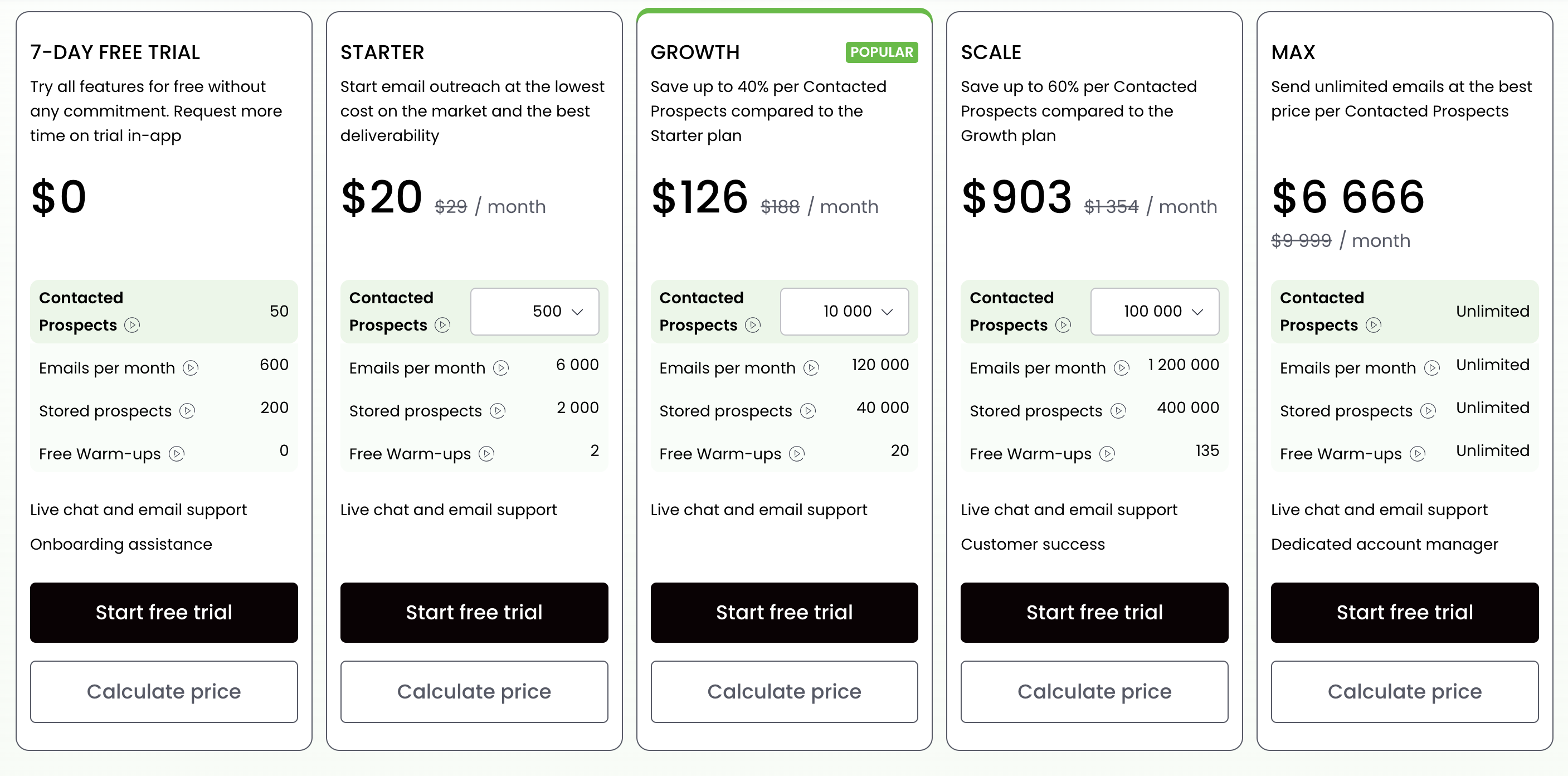
The free trial: fourteen days or one hundred emails
The trial runs for fourteen days, or stops at one hundred cold emails sent, whichever comes first. No credit card is required and every feature is unlocked, except LinkedIn connections. When it expires, Woodpecker pauses your campaigns and deletes the account automatically if you don't subscribe.
There is no permanent free plan. The only way to keep an account alive without sending is pause mode at $10 per month, which freezes activity but preserves your data.
$35 for five hundred prospects: the real entry ticket
The first tier is the most expensive per contact in the entire grid: $7.00 per hundred prospects, against $1.03 on the top tier. That is a sevenfold gap. That is not an anomaly but the standard mechanics of a volume grid, and it has a direct consequence: Woodpecker only becomes worthwhile once you actually fill your tier.
In practice, a team that genuinely contacts five hundred people a month pays $420 a year. The same team contacting only one hundred and fifty still pays $420, which works out to $2.80 per prospect reached. The model rewards consistency, not occasional use.
The anomaly on the top tier
One detail in the grid deserves a flag, because it is expensive for anyone who misses it. The one-million contacted prospects tier is billed at $10,312 per month. The unlimited tier, immediately above it, is billed at $9,999. Unlimited is therefore cheaper than the last numbered tier, and it comes with a ceiling one hundred times higher.
The 33% annual discount and what it leaves out
The annual commitment amounts to paying eight months for twelve. It is a real discount and one of the most generous in the cold email market, where the norm sits between 17% and 20%.
It applies to the base subscription only. Every add-on is billed twelve months out of twelve, at full price, whether or not you are on an annual plan. The more your setup relies on add-ons, the thinner that headline discount gets. In an agency setup, it can end up covering just a few percent of the bill.
Emelia publishes its price: €37 per month
Unlimited contacts, unlimited follow-ups, warmup included.
What Woodpecker includes at no extra cost
The list is short, but it contains two items competitors routinely charge for.
Mailboxes are unlimited. You connect as many sending addresses as you want and the price does not move.
Team members are unlimited, and the vendor explicitly uses this as an argument against seat-based tools.
Warm-up is included, within a quota tied to your tier, from two mailboxes on the entry plan to eight hundred on the largest volumes.
Address verification, including catch-all addresses, is unlimited and runs through a specialist provider.
Mailbox rotation, adaptive sending, the unified inbox, domain auditing and conditional campaigns all sit in the core product.
Two absences belong in the same place: LinkedIn automation and API access are not included. Both are paid add-ons, detailed just below.
Add-ons: where the bill is actually built
This is where the gap opens between the advertised price and the price you pay. Here are the add-ons and their monthly cost, recorded in August 2026.
Add-on | Monthly price | Unit |
|---|---|---|
LinkedIn automation | $29 | per connected LinkedIn account |
Integrations, API, webhooks, CLI | $20 | flat fee |
Additional warm-up | $5 | per mailbox beyond the included quota |
Google or Microsoft mailbox | $6 | per address |
Mailbox on third-party infrastructure | $4 | per address |
Dedicated server | $59 | per server |
Agency panel | $27 | per active client |
White label | $5 | per active client |
Lead Finder credits | $10 | per 500 credits, or $0.02 each |
Pause mode | $10 | flat fee, account frozen |
Lead Finder credits power the built-in database. A found address consumes one and a half credits, or three cents. A verification consumes a quarter of a credit; a query against the company database consumes five. The grid is linear: the price per credit does not drop with volume, unlike the subscription.
The real cost of an agency setup
Take an agency on the entry tier that runs ten clients, connects ten LinkedIn accounts, uses the API and operates fifty Google mailboxes.
Line item | Calculation | Monthly cost |
|---|---|---|
Subscription, 500-prospect tier | $35 | $35 |
Agency panel | $27 x 10 clients | $270 |
White label | $5 x 10 clients | $50 |
LinkedIn automation | $29 x 10 accounts | $290 |
Integrations and API | flat fee | $20 |
Fifty Google mailboxes | $6 x 50 | $300 |
Total | $965 |
The subscription accounts for 3.6% of the bill. The rest, $930 per month, is add-ons that get no annual discount at all. And that calculation assumes the lowest tier: ten clients contacting five hundred people each burn five thousand prospects a month, which already forces a move up to a $99 or $159 subscription.
One structural point comes with this setup: the contacted prospects quota is shared across every sub-account. A hungry client can drain everyone else's quota before month end, and campaigns stop without warning.
Prospects are not metered, capacity is
Cold email, LinkedIn and warmup in a single subscription, from €37 per month.
The euro price is the dollar price
The pricing page offers about a dozen currencies. The amount itself does not change by a single digit. The entry tier reads $35 for a US buyer, and a European buyer sees the same number, 35, with the currency symbol swapped for euros. This is not a conversion but a nominal equivalence, and it represents an 8% to 15% markup for the European buyer depending on the exchange rate of the day.
On top of that sits a discreet footnote: prices exclude tax. In Europe, VAT adds twenty percent in most markets. The advertised $99 tier ends up at $118.80 including tax, close to a 35% gap from the naive reading of the US price.
The limits to know before you sign
Mailboxes bought through Woodpecker stay tied to the platform. Migrating them to another tool means buying new ones elsewhere and rebuilding sender reputation, an exit cost the vendor never quantifies.
Warm-up runs through a third-party provider, and users report little visibility into which messages go out from their addresses.
Some users describe the API as flaky, and it is a paid add-on anyway.
Support is chat and email only, with no phone line.
Reviews are mixed depending on the platform. Woodpecker scores 4.5 out of 5 on the two major software review sites, though its value-for-money score sits markedly lower. Consumer review platforms give it a far lower average, and reports of charges continuing after a cancellation request keep coming up.
Who Woodpecker pays off for, and who it does not
The contacted prospect model makes Woodpecker unbeatable in exactly one scenario: a large team working a moderate prospect volume with long sequences. Five reps, fifteen sending mailboxes, two thousand prospects a month and eight-step sequences cost $67 per month. The same setup billed per seat runs well past $200 with most competitors.
It gets expensive in the opposite situation, and that one is common: one or two users, a lot of new prospects every month, short sequences, and the need to test several angles on the same segments. Every test counts twice, every unused month is lost, and the options pile up as soon as LinkedIn or the API enter the picture.
Seven Woodpecker alternatives and their prices
Here are seven tools covering all or part of the same ground, with pricing recorded in August 2026. The billing unit is spelled out in every case: that unit, far more than the entry price, determines what you will actually pay.
Lemlist

Lemlist is the closest alternative on feature scope, with one philosophical difference: the entry plan is a flat fee with unlimited users, and only the multichannel plan switches to per-seat billing.
Lemlist pricing
Email: $69 per month, $55 on annual billing, unlimited users and sending addresses, 50,000 emails per month, built-in lead database and warm-up included
Multichannel: $109 per month, $87 annual, per user, with five sending addresses per user, LinkedIn, SMS and a phone dialer
Enterprise: custom quote, from five users
Pay-per-success credits: $0.05 per verified email, $0.20 per phone number
Instantly

Instantly bills on sending volume and uploaded contacts, and sells data credits separately. It is the mirror image of the Woodpecker model: mailboxes and warm-up are unlimited, but every email counts.
Instantly pricing
Growth: $47 per month, $37.60 annual, 1,000 uploaded contacts and 5,000 emails per month
Hypergrowth: $97 per month, $77.60 annual, 25,000 contacts and 125,000 emails
Light Speed: $358 per month, $286.30 annual, 100,000 contacts and 500,000 emails
Data credits sold separately, from $47 per month
Smartlead

Smartlead combines an active leads ceiling with an email ceiling, with unlimited mailboxes and unlimited warm-up across the whole range. It is the most aggressive offer in this lineup on volume per dollar.
Smartlead pricing
Basic: $39 per month, $32.50 annual, 2,000 contacts and 6,000 emails per month
Pro: $94 per month, $78.30 annual, 30,000 contacts and 90,000 emails
Unlimited Smart: $174 per month, $144.50 annual, unlimited contacts and 150,000 emails
Client workspace for agencies: $29 per month per client
Reply.io

Reply applies exactly the same definition as Woodpecker, a first touch billed and follow-ups free, with one decisive difference: the price multiplies by the number of seats. It is the most instructive comparison in the lineup.
Reply.io pricing
Email Volume: $59 per user per month, $49 annual, for 1,000 active contacts
The price climbs with active contact volume, up to $999 per user beyond 100,000 contacts
Multichannel: from $99 per user per month, $89 annual, unlimited active contacts
Add-ons: $69 per month per LinkedIn account, $29 for calls and SMS
Mailshake

Mailshake is the simplest and most basic tool in the lineup. It bills per user, and each user unlocks a limited number of sending addresses. There is no free trial.
Mailshake pricing
Starter: $29 per month, $25 annual, one sending address and 1,500 sends per month
Email Outreach: $49 per month, $45 annual, two addresses and unlimited sends
Sales Engagement: $99 per month, $85 annual, ten addresses, five numbers and a dialer
No free trial, payment is required upfront
Snov.io

Snov.io is the only other tool in the lineup that bills strictly on first touch, email or LinkedIn, with free follow-ups over the period. It adds a database and enrichment credits, and does not bill for seats.
Snov.io pricing
Starter: about $39 per month, $29.25 annual, 1,000 credits and 5,000 recipients
Pro S: about $99 per month, $74.25 annual, 5,000 credits and 25,000 recipients
Pro M: about $189 per month, $141.75 annual, 20,000 credits and 50,000 recipients
Unlimited seats on every plan, optional LinkedIn slot at $69 per month
Apollo.io

Apollo plays a different game: a searchable database of more than 240 million contacts, paired with sequences and a dialer. That is broader than Woodpecker, but seat-based billing changes the equation completely from the third user onward.
Apollo.io pricing
Free: free, limited credits and two sequences only
Basic: $59 per seat per month, $49 annual
Professional: $99 per seat per month, $79 annual, five mailboxes
Organization: $149 per seat per month, $119 annual, three-seat minimum
Billing units side by side
Tool | Monthly entry price, no commitment | Billing unit | Mailboxes included | Trial |
|---|---|---|---|---|
Woodpecker | $35 per month | Contacted prospect | Unlimited | 14 days or 100 emails |
Lemlist | $69 per month | Flat fee, then seat on multichannel | Unlimited | 14 days |
Instantly | $47 per month | Emails sent and contacts | Unlimited | No card |
Smartlead | $39 per month | Emails and active leads | Unlimited | No card |
Reply.io | $59 per seat per month | Active contact multiplied by seat | Unlimited | 14 days |
Mailshake | $29 per month | User, equals one mailbox | 1 to 10 depending on plan | None |
Snov.io | $39 per month | Recipient on first touch | Unlimited | 50 credits |
Apollo.io | $59 per seat per month | Seat and credits | 5 to 15 depending on plan | Free plan |
Emelia | $37 per month | Subscription | 3 to unlimited depending on plan | 7 days |
Woodpecker or Emelia: what actually compares

Both tools answer the same need, sending cold sequences without burning domain reputation, but they count different things. Woodpecker counts the people you reach. Emelia counts the capacity you open: the number of sending mailboxes and connected LinkedIn accounts, with no ceiling on contacts, emails or scraping.
The consequence is direct. With Woodpecker, doubling your prospect count doubles the invoice. With Emelia, as long as the plan capacity holds, the third, tenth and hundredth thousand contacts cost nothing extra.
Emelia pricing
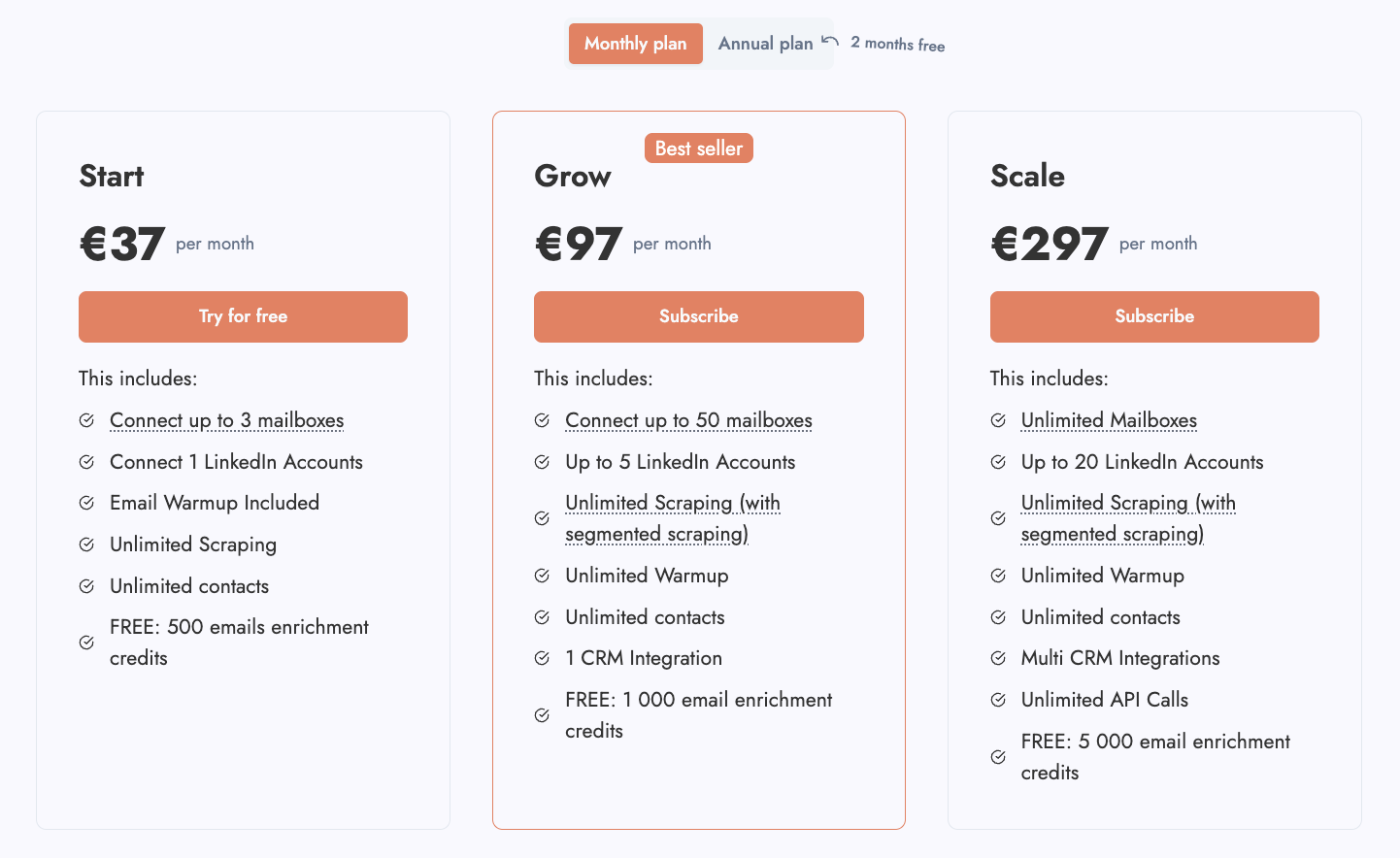
Emelia publishes its grid, three tiers at $37, $97 and $297 per month, with two months free on annual billing. Contacts, emails, LinkedIn actions and scraping are unlimited across the range, and warm-up is included from the first tier.
The Start plan opens 3 sending mailboxes and 1 LinkedIn account
The Grow plan moves up to 50 mailboxes and 3 LinkedIn accounts
The Scale plan offers unlimited mailboxes and 10 LinkedIn accounts
Email finder and phone lookup credits top up on demand, from $19 per thousand, and you are charged only when a data point is actually found. Sending and enrichment stay two separate counters: hitting a credit limit does not pause your campaigns.
Criterion | Woodpecker | Emelia |
|---|---|---|
Billing unit | Contacted prospect per month | Subscription |
Entry ticket | $35 per month | $37 per month |
Addressable contacts | Capped by the tier | Unlimited |
Follow-ups | Free within the same campaign | Unlimited |
Same prospect in two campaigns | Billed twice | No impact |
Unused quota rollover | None | Not applicable |
Sending mailboxes | Unlimited | 3, 50 or unlimited depending on plan |
Warm-up | Included within a quota | Included and unlimited |
$29 per month per account | Included, 1 to 20 accounts depending on plan | |
API | $20 per month | Included |
Email finder | Credits, $0.03 per address | Credits, pay per success |
Commitment | None | None |
One point of honesty to close this comparison: Emelia does not offer a team mode yet. One subscription equals one user account. The model works when a single person drives prospecting for several reps, which is the most common setup in growth and sales ops, but it does not fit if every rep needs to log in and run their own campaigns.
Contact as many prospects as you need
Unlimited sending, unlimited warmup, native LinkedIn, from €37 per month.
How to bring the Woodpecker bill down
Lengthen sequences rather than multiplying campaigns. Sixteen steps in a single campaign cost one contacted prospect; two eight-step campaigns cost two.
Set your tier on the volume you actually consume, not the volume you hope for. With no rollover, an oversized tier is money lost every month.
Clean out stored prospects regularly. That quota is cumulative and blocks any move back down a tier as long as it is exceeded.
Commit annually only if add-ons are a small share of the bill, since the discount covers the subscription alone.
Before signing, confirm that you can connect sending mailboxes bought elsewhere, so you avoid lock-in on the vendor's infrastructure.
Is Woodpecker worth paying for in 2026?
Yes in one case, and it is a clear one: a multi-person team working long sequences on a stable, predictable prospect volume, with no need for LinkedIn or the API. In that setup, the absence of seat-based billing and the free follow-ups make Woodpecker one of the cheapest tools on the market, and the 33% annual discount widens the advantage.
No in most other cases. As soon as new prospect volume swings from one month to the next, as soon as the strategy relies on several parallel sequences, or as soon as LinkedIn, the API and managed mailboxes enter the scope, the advertised price stops being a useful indicator. The add-ons then decide the real bill, and they carry no discount.
The question to ask before subscribing is therefore not what Woodpecker costs, but how many genuinely new prospects you contact each month, and how many times you need to speak to the same ones. The answer to those two questions gives you the budget within a tier or two, and it often tells you whether a flat-rate model would be simpler.
A public price list, cancel any month
€37, €97 or €297 per month, two months free on annual billing.
How much does Woodpecker cost per month?+
The first tier is $35 per month for 500 contacted prospects, with unlimited mailboxes and unlimited team members. The grid has twenty-three volume tiers: $67 for 2,000 prospects, $99 for 4,000, $188 for 10,000, $1,354 for 100,000. The annual commitment amounts to paying eight months for twelve, a 33% discount on the subscription.
What counts as a contacted prospect in Woodpecker?+
It is a contact on which the system has performed at least one action: address verification, first email, first-step LinkedIn action or manual task. Subsequent follow-ups are free within the same campaign, up to sixteen steps. The same prospect placed in two different campaigns, however, is billed twice.
Do unused prospects roll over to the next month?+
No. The counter resets at every billing cycle renewal, whether you are on monthly or annual billing, and unused quota is lost. Stored prospects, on the other hand, are cumulative and persist until manual deletion, with a quota equal to four times the number of contacted prospects.
Does Woodpecker offer a free trial?+
Yes, fourteen days or one hundred cold emails sent, whichever comes first, with no credit card. Every feature is available except LinkedIn connections. There is no permanent free plan: when the trial ends, the account is deleted if no subscription is taken.
What are the hidden costs of a Woodpecker subscription?+
Mostly the add-ons: $29 per month per LinkedIn account, $20 for the API and integrations, $4 to $6 per managed mailbox, $27 per active client for the agency panel and $5 more for white label. None of those amounts benefit from the annual discount. Add VAT, absent from displayed prices, and the fact that the euro price mirrors the dollar amount digit for digit.
Which Woodpecker alternative works for a small team?+
Tools with public pricing start between $25 and $55 per month. If prospect volume swings a lot from month to month, a flat-rate model avoids the double trap of lost quota and emergency tier upgrades. Emelia covers flat-rate prospecting from $37 per month, with unlimited sending, included warm-up and native LinkedIn, and no contact ceiling.