

Prices that look attractive: let’s see what they hide
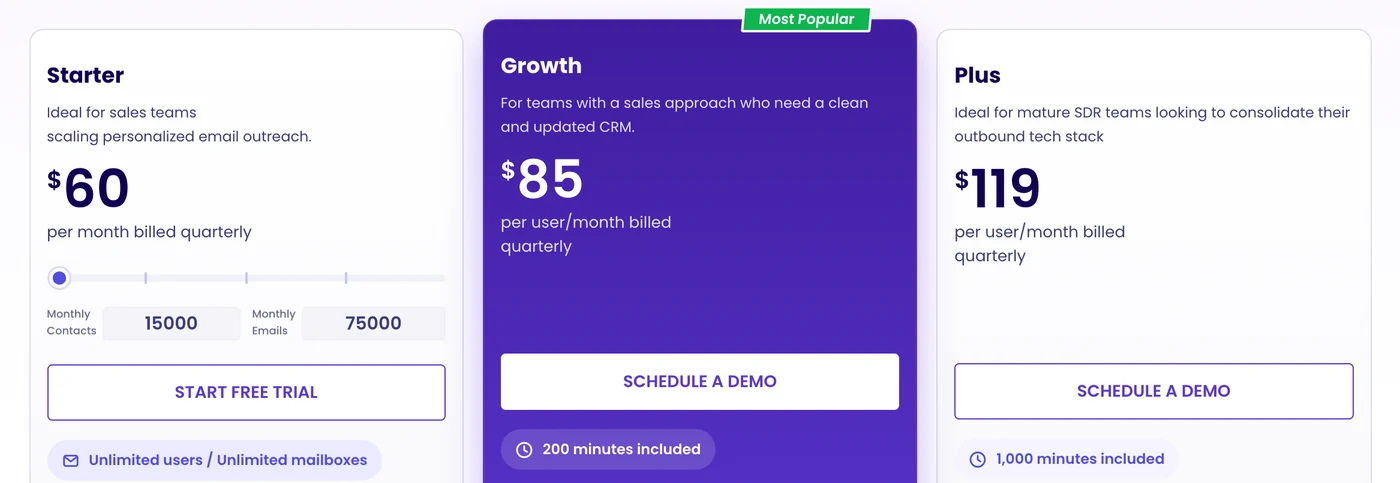
Klenty promises unlimited mailboxes from $60 a month, billed quarterly, three months upfront. The trap: connecting your mailboxes is the most tedious step, and only once they are plugged in do you discover the caps on contacts and emails. With 100 mailboxes connected, the Starter 25K plan really runs only about 32, barely a third. The Starter 15K plan, barely 19.
The yardstick: a mailbox normally sends to 35 new contacts a day, and 100 emails a day in all, follow-ups included. Over a month of 22 working days, one mailbox is therefore about 770 new contacts and 2,200 emails.
The Starter 25K plan caps at 25,000 contacts and 125,000 emails a month: enough to run about 32 mailboxes. Beyond that, the next tier is the only way on: $150 a month for 50,000 contacts, so $450 paid in one go for the quarter.
At Emelia, Grow at $97 a month connects 50 mailboxes, with no limit on contacts or on emails sent. Scale, at $297 a month, goes up to 1,000 mailboxes.
What unlimited pricing hides
15,000 contacts ÷ 770 per mailbox ≈ 19.5; 75,000 emails ÷ 2,200 per mailbox ≈ 34.1: about 19 mailboxes before a cap stops you.
25,000 contacts ÷ 770 per mailbox ≈ 32.5; 125,000 emails ÷ 2,200 per mailbox ≈ 56.8: about 32 mailboxes before a cap stops you.
50,000 contacts ÷ 770 per mailbox ≈ 64.9; 250,000 emails ÷ 2,200 per mailbox ≈ 113.6: about 65 mailboxes before a cap stops you.
100,000 contacts ÷ 770 per mailbox ≈ 129.9; 500,000 emails ÷ 2,200 per mailbox ≈ 227.3: about 130 mailboxes before a cap stops you.
How we count
Contact cap ÷ 770 and email cap ÷ 2,200 per mailbox: the lower result wins. Klenty does not say whether a monthly contact is a new one, an active one or one stored in the account; the count here takes the reading most favourable to Klenty, new contacts only.
Quarterly prices on Klenty’s pricing page (https://www.klenty.com/sales-engagement-platform/pricing/), shown per month; Klenty has no monthly billing. Checked on November 3, 2026.
When the cap is reached
Klenty does not publish what happens once the monthly contact tier is used up. What its grid does show: going further means the next tier, paid for a whole quarter or a year, even if the extra contacts are only needed for one campaign.
At Emelia
50 mailboxes for $97 a month on Grow, with no cap on contacts or on emails sent. Scale goes up to 1,000 mailboxes (fair use).
No month-to-month option: Klenty bills every quarter or every year, upfront
The pricing page has two switches, “Annually” and “Quarterly”, and Klenty’s help centre says of its billing: “Upfront payment to be done for the billing cycle”. The shortest commitment is therefore three months, paid on day one: $180 for the smallest Starter tier, $255 for one Growth user.
The yearly switch cuts the monthly figure by 17% or 20% depending on the tier (“Save up to 20%” on the page): Starter then starts at $50 a month, so $600 at once, Growth at $70 and Plus at $99 per user a month. Those yearly figures are the ones the page shows first; every comparison on this page uses the quarterly price, the shortest way to buy Klenty.
One line of the same pricing page calls Klenty “a pay as you go service”, next to a cancellation promise that you will not be charged for the next billing period. Both stay true only at the scale of a quarter: there is no shorter period to stop after.
Starter tiers from 15,000 to 100,000 contacts, mailboxes unlimited
Short answer: Klenty Starter costs $60, $90, $150 or $400 a month on quarterly billing, set by a slider of monthly contacts and emails, for the whole team: the page promises unlimited users and unlimited mailboxes. Above 100,000 contacts, the slider reads “Contact Sales”.
Starter 15K
$60/month
billed quarterly: $180 upfront
- 15,000 contacts a month
- 75,000 emails a month
- Yearly: $50 a month, $600 at once (−17%)
- Unlimited users and mailboxes, per the pricing page
Starter 25K
$90/month
billed quarterly: $270 upfront
- 25,000 contacts a month
- 125,000 emails a month
- Yearly: $72 a month, $864 at once (−20%)
- Unlimited users and mailboxes, per the pricing page
Starter 50K
$150/month
billed quarterly: $450 upfront
- 50,000 contacts a month
- 250,000 emails a month
- Yearly: $125 a month, $1,500 at once (−17%)
- Unlimited users and mailboxes, per the pricing page
Starter 100K
$400/month
billed quarterly: $1,200 upfront
- 100,000 contacts a month
- 500,000 emails a month
- Yearly: $320 a month, $3,840 at once (−20%)
- Unlimited users and mailboxes, per the pricing page
Starter was priced per user until August 2024 and became this team plan by October 2024 (Wayback Machine captures); the “Unlimited users / Unlimited mailboxes” line appeared in October 2026. Klenty’s help centre still describes the older rules: Starter “per seat”, 3 email accounts on it, 500 emails a day whatever the plan. Starter has no LinkedIn steps, no calls and no native CRM.
From mailboxes to a Starter tier: the Klenty calculator
Set the number of mailboxes you send from. Each one counts at Emelia’s quotas, 35 new contacts and 100 emails a working day, over 22 days; the calculator picks the Starter tier that holds both monthly totals and stops at “Contact Sales” above 100,000 contacts. On the other side, the Emelia plan that connects the same mailboxes.
 Starter · up to 50,000 contacts and 250,000 emails a monthPaid 3 months upfront: $450
 Grow
You save $53 per month with Emelia ($636 per year).
How each tool charges
Klenty Starter is one team plan priced by a monthly contact and email tier: $60 for 15,000 contacts, $90 for 25,000 contacts, $150 for 50,000 contacts and $400 for 100,000 contacts, then Contact Sales. These are monthly figures of quarterly billing, three months paid upfront; Klenty sells no single month. LinkedIn steps only exist on the per-user Growth and Plus plans, as semi-automated tasks approved one by one.
Emelia charges by plan, not per user: Start $37 (3 mailboxes, 1 LinkedIn), Grow $97 (50 mailboxes, 3 LinkedIn), Scale $297 (unlimited mailboxes, 10 LinkedIn), then $29 per extra LinkedIn account.
Mailboxes count at Emelia’s per-mailbox quotas (35 new contacts and 100 emails a day) over 22 working days, and every contact counts as new, the reading most favourable to Klenty. Yearly prices are left out on both sides. Excluding tax.
Emelia’s Start, Grow and Scale next to the Starter tier that covers the same mailboxes
Start connects 3 mailboxes, Grow 50, and Scale anything above that within its fair use of 1,000. Each row runs those mailboxes flat out and finds the Starter tier Klenty would charge for the month, at its quarterly price shown per month. Emelia’s side covers more than sending: 1, 3 or 10 LinkedIn accounts, warm-up for each mailbox, and 500, 1,000 or 5,000 credits given once at subscription, on top of 20 credits at sign-up.
Monthly price for the same mailboxes
Start’s 3 mailboxes at full pace (2,310 contacts · 6,600 emails)
Grow’s 50 mailboxes at full pace (38,500 contacts · 110,000 emails)
Scale’s 100 mailboxes at full pace (77,000 contacts · 220,000 emails)
Scale’s 200 mailboxes at full pace (154,000 contacts · 440,000 emails)
Klenty’s amounts are in US dollars, Emelia’s follow your currency; no gap is worked out between the two. Klenty prices as of November 3, 2026, excluding tax.
50 mailboxes at full pace: what each tool charges per month for the same sending.
$150/month- Starter 50K ($450 paid for the quarter) · $150
$97/month- Grow, paid monthly · $97
Growth and Plus seats: CRM sync, LinkedIn tasks and call minutes per user
The two other plans are not volume tiers: each user pays a seat, and the seat brings the calling, CRM and LinkedIn features Starter lacks. Klenty sells them after a demo, with no self-serve trial button.
Growth, “Most Popular”
$85 per user a month on quarterly billing ($255 per user per quarter), $70 on yearly billing. It adds 200 calling minutes per user a month, 2,000 data credits for emails and phone numbers, AI voicemail and IVR detection, SMS, LinkedIn tasks (“Social Selling”) and the native CRM integrations.
Plus
$119 per user a month on quarterly billing, $99 on yearly billing: 1,000 minutes, 4,000 data credits, account-based selling, call coaching (live transcription, battlecards, scorecards), WhatsApp tasks and team goals.
What the page leaves out
Whether the 2,000 and 4,000 credits are per user or per account, and per month, is not written anywhere on the page. Mailboxes are not listed either; a help article allows 5 per Growth user and 10 per Plus user. An Enterprise plan appears in the help centre, on quote.
What Klenty sells on top: dialers, local presence, data and validation credits
Sales engagement plans; the billing rhythm is not stated next to it.
Billed annually, no quarterly price shown; 350+ local numbers per seat across 335 US area codes.
On the standalone Sales Dialer, quarterly billing ($25 yearly).
1,000 to 5,000 credits a month on quarterly billing; one credit per email revealed.
200 to 1,000 credits a month, a separate price list from email credits.
Up to $2,500 for 500,000; the credits expire a month after purchase.
500 more emails a day and one more address, 2 at most per account, switched on by support.
US outbound call with recording; $0.0079 per SMS, and $1.15 a month per extra US number.
Also prospecting on LinkedIn: a task to approve per step, or campaigns that run alone
Starter has no LinkedIn at all. From Growth, Klenty adds 4 LinkedIn tasks (Send connection request, View profile, Send message and Send In-mail) that a rep approves one by one, the Chrome extension acting in their own browser. Emelia includes LinkedIn accounts in each plan and runs the steps in the cloud. The rows below describe what each side does; Klenty publishes no LinkedIn price that could sit in a cost row.
What a LinkedIn account needs
One more account
Who presses the button
Browser left open
Prospect IQ credits: one per email, one per number, gone at the end of each month
Prospect IQ charges 1 credit per email revealed, 1 per phone number and 2 for both, after 20 free email credits and 250 searches at activation. Credits reset every month (“Unused credits are not carried over to the next month”, says the help centre), and validation credits expire a month after purchase. Emelia’s credits stay valid for a year after purchase, even after you cancel. Klenty does not say whether its packs can be bought without a plan, nor whether a reveal that finds nothing still costs a credit; Emelia only charges when it finds. Email packs stop at 5,000 credits a month.
Emails found each month, price per month
1,000 emails found
5,000 emails found
Emelia’s credit packs need no plan. Klenty’s pack prices read on November 3, 2026, before tax.
Klenty pricing FAQ
No. The pricing page offers 14 days with no card and up to 200 emails to prospects, for the whole team; the account is deactivated if you do not upgrade. The page speaks of “full access to all features”, the help centre of “the features that match the Growth plan”. Emelia gives 7 days without a card, plus 20 credits when you sign up with a work email.
The pricing page says one per team: “Unlimited users” sits under the Starter price. Two help articles (one updated in October 2026) and a Klenty blog post still give $50 “per seat” or “per user”, the way Starter was sold until 2024. The figures on this page follow the pricing page.
Klenty’s pricing FAQ says you can cancel at any time with no cancellation fee and will not be charged for the next billing period, which means the quarter already paid runs to its end. Deleting the account from the team settings keeps prospects, cadences and emails recoverable for 30 days.
Basic $50, Pro $100 and Scale $170 per user a month on quarterly billing ($40, $80 and $140 yearly), with 1, 2 or 5 US numbers. Its 14-day trial comes after a demo call. Emelia does not make calls, so there is nothing to set against it.
No. The pricing page shows US dollars only, visitors in France included. Emelia’s prices follow the visitor’s currency, with the same figure in euros and in dollars.
Klenty does not publish it: the help centre says the price of an email add-on “varies for each plan”. Each one adds an address and 500 emails a day, 2 at most per account, and support switches it on.
Emelia features: Cold email · Email finder · Email warm-up · Emelia pricing
Emelia is a Klenty competitor. We have tried to stay fair: every figure about Klenty comes from its own website or public review sites.


