Apollo.io pricing plans: what one licence includes, Free to Organization
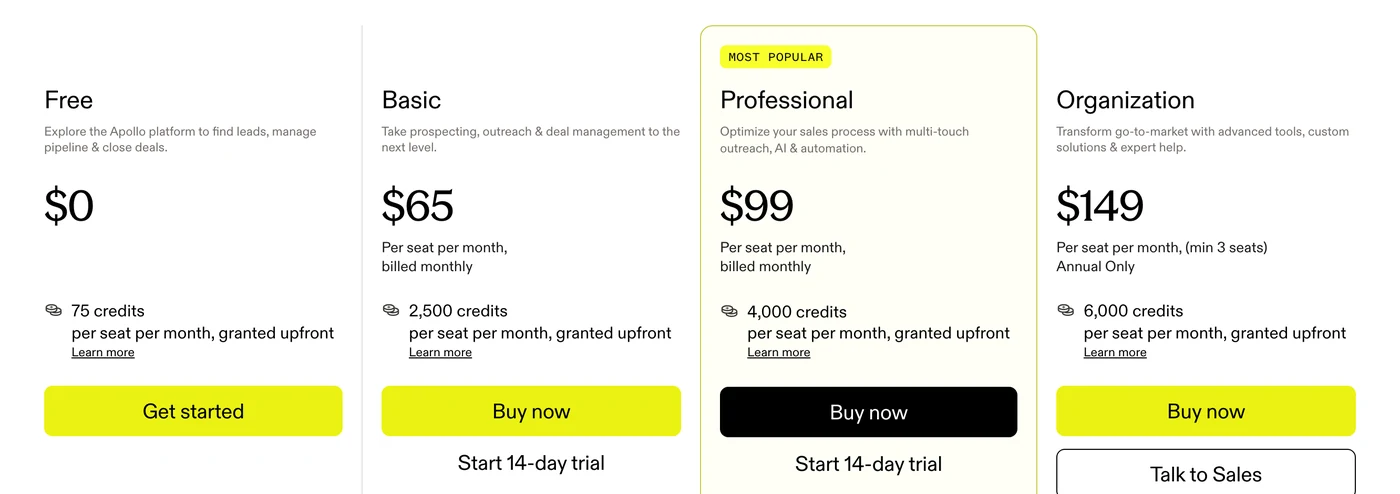
Per licence per month, in US dollars, excluding taxes. Every licence on an account must be on the same plan, and each person who logs in needs one. Organization is sold yearly only, from 3 licences.
Free
$0/month
per licence
- 75 credits a month
- 2 sequences per team, 250 emails a day
- 1 mailbox per user, warm-up not in the table
- Select 25 records at a time
Basic
$65/month
$49/month billed yearly ($588)
- 2,500 credits per licence a month
- Unlimited sequences, 250 emails a day
- 1 mailbox per user, warm-up, waterfall
- Select 1,000 records, 5 workflows
Professional
$99/month
$79/month billed yearly ($948)
- 4,000 credits per licence a month
- Unlimited Google and Microsoft mailboxes, 5 SMTP per user
- “Unlimited” daily sending, A/Z tests, AI agents
- Select 2,500 records, 50 workflows
Organization
$119/month
billed yearly ($1,428), 3 licences minimum
- 6,000 credits per licence a month
- 15 SMTP mailboxes per user
- SSO, custom reports, Salesforce custom objects
- Select 10,000 records, 500 workflows
The pricing page shows $149 as Organization’s monthly price but only sells it yearly. Elsewhere, Apollo’s pricing FAQ speaks of “Custom” plans and the page’s structured data of an “Enterprise” plan. Apollo subjects the “unlimited” daily sending of Professional and Organization to a Fair Use Policy, which its terms of August 10, 2026 do not include.
Basic up to $65, free credits down to 75: a year of Apollo price changes
Apollo’s pricing page reads its figures from a public API, archived by the Wayback Machine. Over the year, Professional and Organization prices, the credits per licence (2,500, 4,000, 6,000), the cost of an email (1 credit) and of a phone number (8) and the extra credit tiers did not move. These lines did, between October 14, 2025 and October 12, 2026:
- Basic, billed monthly: $59 → $65 per licence (between June 3, 2026 and July 11, 2026). The yearly price stayed at $49.
- Free plan credits: 100 → 75 a month (between December 8, 2025 and January 19, 2026).
- Basic daily sending: unlimited → 250 emails a day, and A/Z tests removed from Basic (before December 8, 2025).
- Records selected at once: 10,000 on Basic and Professional → 1,000 and 2,500 (between December 8, 2025 and April 13, 2026).
- Parallel and power dialer: included in Professional and Organization → the paid Advanced Dialer add-on (between December 8, 2025 and January 19, 2026).
- Organization: no minimum → 3 licences minimum (between August 3, 2026 and September 3, 2026).
- Inbound add-on: one option at $149 a month became Inbound Essentials and Inbound Max (between October 3, 2026 and October 6, 2026).
- Earlier still, on March 19, 2025: Basic gave 5,000 credits a month, Professional 10,000, Organization 15,000, and a phone number cost 5 credits. Reviews written before these dates quote other prices.
Where the credits go: emails, phone numbers, warm-up, domains and mailboxes
Since Apollo moved to a single type of credit, every licence adds its monthly allowance to one pot shared by the team, granted at the start of each cycle (the whole year at once on yearly billing). The pot resets at the end of the cycle: unused credits do not roll over, bought ones included. Older plans still have separate email, mobile and export credits.
Two lines weigh most on an outbound team: phone numbers, at 8 credits each, and warm-up, which the plan cards present as included while the help centre covers just 1 mailbox per licence and bills every other one 200 credits a month. Domains and mailboxes bought inside Apollo are paid in credits too and cannot be refunded; a bought mailbox is switched off when the pot runs dry.
How many credits each Apollo action uses
Only when found, one at most per contact; refunded if it bounces within 30 days
Never refunded; the office number comes with the email
Apollo calculator’s assumption; providers bill even for unverified results
Connected calls only, billed by 30-second slices
Europe and APAC 10, South America 14, Middle East 28, Africa 36
Beyond 1 mailbox per licence on paid plans
SMTP 300, Google Workspace 800, Microsoft 365 1,500
One found email, one phone number: Apollo and Emelia at the same credit volume
Both tools charge 1 credit for a verified email. Below, the same number of credits bought each month on top of a plan: Apollo’s extra credits against Emelia’s monthly packs. The credits included in the plans are left out on both sides, never added to bought ones.


Emails found a month (price, then price per email)
1,000 emails
5,000 emails
10,000 emails
50,000 emails
100,000 emails
Phone numbers at the same credit volume
Phone numbers for 10,000 credits
Each Apollo row is a range because Apollo prices extra credits by volume tier without saying whether a tier applies to the whole amount (the low figure) or only to the slice inside it (the high figure). Apollo charges in US dollars only and Emelia shows one figure in both currencies, so the winner of each row is given for payment in dollars, with no exchange rate applied. Apollo’s extra credits require a paid plan.
Buying extra credits: from $0.025 down to $0.015 per credit
Extra credits are for paid plans only. You set a monthly amount in the app; it is charged at once and renewed automatically every cycle until you set it back to zero, and, like the included credits, it does not roll over. The price per credit falls with the amount: $0.025 up to 1,000 credits, $0.015 above 100,000.
What Apollo leaves unsaid is how the tiers combine. If the whole monthly amount takes the price of the tier it reaches, you pay the lower of the two figures given on this page; if each slice keeps the price of its own tier, you pay the higher one.
Price per extra credit, by monthly amount
- Up to 400 credits
- $0.025
- 401 to 1,000
- $0.025
- 1,001 to 2,500
- $0.020
- 2,501 to 5,000
- $0.020
- 5,001 to 10,000
- $0.018
- 10,001 to 20,000
- $0.016
- 20,001 to 50,000
- $0.016
- 50,001 to 100,000
- $0.016
- 100,001 to 250,000
- $0.015
Many mailboxes on one Professional licence, and what warm-up adds
One Professional licence connects unlimited Google and Microsoft mailboxes (5 SMTP), where Basic takes 1 per user. Warm-up is what sets the bill: Apollo’s help centre covers 1 mailbox per licence and charges 200 credits a month for each other one, while Emelia’s plans include warm-up. Lines billed monthly, every mailbox warmed up, no email found.
3 mailboxes warmed up
20 mailboxes warmed up
50 mailboxes warmed up
100 mailboxes warmed up
Warm-up is priced here from Apollo’s help centre (1 mailbox included per licence, 200 credits a month for each other one), not from its plan cards, which simply say “included”. Credits spent on warm-up are no longer there for emails or phone numbers. Basic suits one mailbox per person but caps sending at 250 emails a day. Amounts are in dollars, the only currency Apollo bills in; Emelia’s price is the same figure in euros, and the advantage is marked for a dollar payment.
50 mailboxes warmed up and 1,000 emails found a month, billed monthly
$221.40/month- Professional licence · $99
- Extra credits (6,800) · $122.40
$116/month- Grow plan · $97
- 1,000-credit pack · $19
Apollo pricing calculator: your mailboxes, your credits, both bills
Set your mailboxes, the emails you need to find each month and whether every mailbox is warmed up: the calculator picks the cheapest Apollo plan and the Emelia plan that cover it.
Professional × 1 ($99)Start+ 1,000-credit pack ($19)You save $43 per month with Emelia ($516 per year).
How each tool charges
Apollo bills per licence: $65 for Basic, $99 for Professional ($49 and $79 billed yearly), with 2,500 and 4,000 credits per licence each month. Basic connects 1 mailbox per licence, Professional unlimited Google and Microsoft mailboxes. Extra credits cost $0.025 to $0.015 each.
Emelia charges by plan, not per user: Start $37 (3 mailboxes, 1 LinkedIn), Grow $97 (50 mailboxes, 3 LinkedIn), Scale $297 (unlimited mailboxes, 10 LinkedIn), then $29 per extra LinkedIn account. Emails found are paid with monthly credit packs, from $19 for 1,000 credits; the credits given once at signup are not counted.
Fewest licences: one Basic licence per mailbox, or one Professional licence for all of them; each person who logs in to Apollo needs their own. Extra credits at the lowest price Apollo’s tiers allow (the range is shown), bought monthly on both billing options. Excluding taxes and add-ons. Free is only counted for 1 mailbox with warm-up off: its column in Apollo’s pricing table shows no warm-up, and the help centre’s rate of 200 credits per mailbox a month exceeds the 75 credits it grants.
Team add-ons billed on top: Inbound and Advanced Dialer
Two add-ons are billed per team, not per licence, on paid plans only. Inbound Essentials ($119 a month billed yearly, $149 monthly) identifies up to 5,000 companies visiting your website each month, on 100 domains, against 100 without it; Inbound Max costs $639 ($799). Apollo calls these prices introductory, and its comparison table still describes the add-on with 50,000 companies a month.
Advanced Dialer ($119 billed yearly, $149 monthly) adds international calls, parallel and power dialing and local presence; international minutes are then paid in credits. Emelia sells neither, so there is no price to put against them.
Apollo’s free plan, the 14-day trial and the startup discount
Three ways to pay less than Apollo’s list price. Emelia starts free too: 20 free credits at sign-up with a work email, and a 7-day free trial without a card.
The free plan
75 credits a month, 2 sequences per team, 250 emails a day from 1 mailbox, and no extra credits for sale. For warm-up, Free has nothing in the pricing table; the help centre does list a price, 200 credits per mailbox a month, which is more than the plan’s 75 monthly credits. After 100 days of active use, a free account keeps a single licence.
The 14-day trial
Of Basic or Professional, once, started from a free account; there is no Organization trial. Phone data during the trial depends on the source: the help centre allows 20 numbers in total, while the data behind the pricing page says a Professional trial includes no mobile numbers. Calls are capped at 60 minutes (10 per call). The pricing page says no credit card is needed; on the trial’s credits, its FAQ says 75 and its pricing data 50 per user. Paying during the trial ends it, and unused trial credits are lost. Emelia’s trial lasts 7 days, without a card, on top of the 20 free credits given at sign-up with a work email.
Apollo for Startups
Companies of fewer than 20 employees, backed by a partner (investor, accelerator) and without an Apollo subscription get 50% off Basic or Professional for 12 months, on up to 5 licences. A former startup promotion page now says the offer has ended.
What the yearly contract commits you to: plan, notice and refunds
The pricing page promises “save 24%” on yearly billing. That is true for Basic ($65 → $49); Professional and Organization save 20% ($99 → $79, $149 → $119).
The year is paid upfront by card, in dollars. You can switch back to monthly only at renewal, and you cannot move to a smaller plan during the year. Leaving and shrinking are where Apollo’s pages disagree: its FAQ has you cancel in the app, with effect at the end of the billing cycle, and lets you remove licences at once, without a refund; its terms require written notice of non-renewal at least 30 days before renewal and forbid lowering the number of licences during the term. The terms (August 10, 2026) state that fees are non-cancellable and non-refundable, partly used services included.
What people ask about Apollo’s price: rollover, phone credits, euros, startups
No. Included credits are granted at the start of each cycle and reset at its end; extra credits bought in the app reset too. On yearly billing, the whole year’s credits arrive at once and expire at the end of the year.
8 credits for a mobile or direct number, never refunded, against 1 for a verified email. At Emelia, a phone number costs 50 credits, found by a waterfall across several providers, and the credits are refunded when no number is found; with the credit subscription alone, that is $0.95 a number with the 1,000-credit pack, down to $0.25 with the 100,000-credit pack.
No. Even the French pricing page shows dollars, and Apollo’s terms say payments are made in US dollars unless an order form says otherwise. Taxes come on top, payment is by card.
Yes, on conditions. The two levers are the yearly price (24% off Basic, 20% off Professional) and Apollo for Startups (50% off for 12 months, on conditions).
Apollo’s own pages disagree. The pricing table and the help centre list the API on all plans; the pricing FAQ says it is available on “Custom plans”. Rate limits rise with the plan, from 600 requests a day on Free to 6,000 on Organization, and some endpoints spend credits.
It depends which Apollo page you read. The cards of the paid plans say included; the help centre narrows that to 1 mailbox per licence, then 200 credits per additional mailbox each month. On Free, the pricing table shows no warm-up at all, and the help centre’s price for one mailbox is above the 75 credits Free gives a month. At Emelia, warm-up is included on Start and unlimited on Grow and Scale.
Emelia features: Email finder · Cold email · Email warm-up · Emelia pricing
Emelia is an Apollo.io competitor. We have tried to stay fair: every figure about Apollo.io comes from its own website or public review sites.


