Back to hub
Blog
Software

Lusha Pricing 2026: Plans, Credits and Real Cost Per Contact

Niels
Niels Co-founder
Published on Aug 10, 2026Updated on Aug 12, 2026
Lusha logo

If you have tried to budget for Lusha this year, you already know the problem: the number on the pricing page and the number on your invoice are rarely the same. Lusha reshuffled its tiers in 2026. A new entry-level plan appeared, the top self-serve tier jumped by roughly six times, and billing is still calculated per seat rather than per workspace.

This breakdown covers the grid as observed in August 2026, how the credit system actually drains your balance, what a single email and a single phone number really cost, and what a team of three, five or ten reps ends up paying. It also flags the places where Lusha's own materials contradict each other, because those gaps hit your consumption directly.

One framing point before the numbers: Lusha is a contact database, not a prospecting platform. It hands you the email and the phone number, it does not send anything. This article therefore compares on two distinct bases and never mixes them. First the real cost of a contact obtained, which is the only ground where both tools do the same job. Then the cost of the whole chain from raw data to booked meeting, once you add the sending tool, the LinkedIn automation and the address verification.

How much does Lusha cost in 2026? The full pricing grid

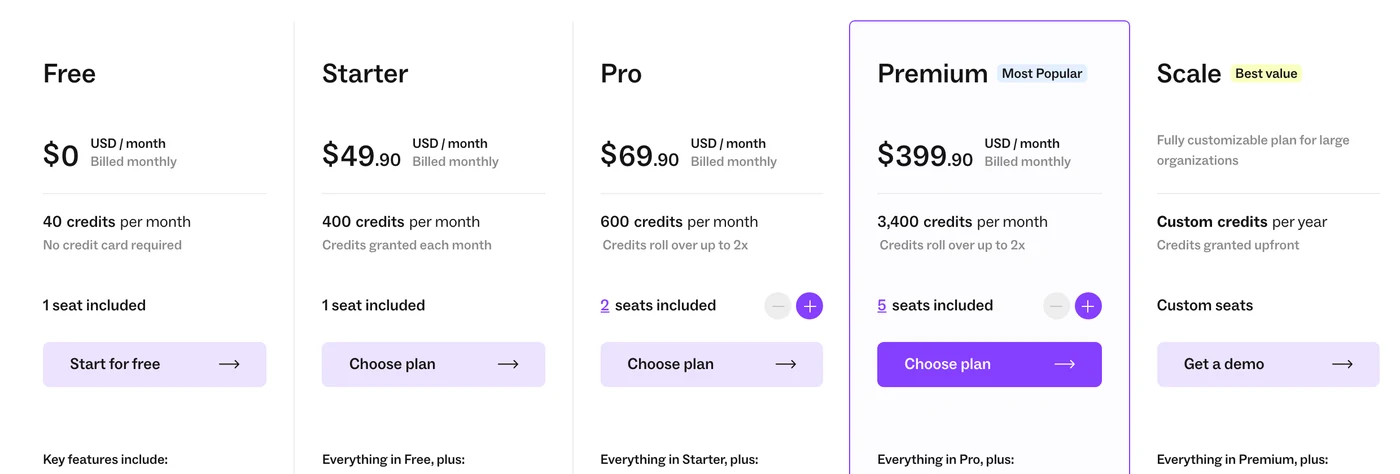
Lusha runs five tiers: a free plan, three self-serve plans and a quote-only Scale plan. The figures below are in US dollars, on monthly billing, with the credit slider set to 2,000 per month.

Plan

Monthly price

Credits per month

Seats included

Credit rollover

Free

$0

40

1

No

Starter

$49.90

400

1

No, credits granted each month

Pro

$69.90 to $227.40 depending on the slider

600 to 2,000 depending on the slider

2

Up to 2x the allowance (monthly billing)

Premium

$399.90

3,400

5

Up to 2x the allowance (monthly billing)

Scale

Custom quote

Custom

Custom

Credits granted upfront

The first thing to understand changes everything: on Lusha, the price is attached to a credit volume, not to a user. The pricing page runs a slider from 40 to over 10,000 credits a month, and every plan recalculates its price as you move it. The figures above correspond to the slider set at 2,000 monthly credits. Each plan also ships with a fixed number of seats, one on Free and Starter, two on Pro, five on Premium, with extra seats available at additional cost.

The free plan: 40 credits, gone before lunch

Free gives you 40 credits a month on one seat with no card required. That is enough to sanity-check data quality in your territory and nothing more. Forty credits buys forty email addresses, or four phone numbers at the published ten-credit rate. A rep working a real list burns through that in a single session, and unused free credits do not carry over.

Starter: the tier that did not exist last year

Starter did not exist in the previous grid. At $49.90 a month it opens 400 monthly credits on a single seat, with no rollover from one month to the next. It suits the independent rep or the founder still doing their own prospecting. Its constraint is less about volume than features: the API, webhooks and buying signals stay locked behind higher tiers.

Pro: the most popular tier, and the murkiest

Pro is the pivot of the range. It starts at $69.90 a month for 600 credits and two seats, and climbs to $227.40 a month once the slider is set to 2,000 monthly credits. It is the first tier to unlock the API, CSV enrichment, buying signals and webhooks, and the first where unused credits roll over up to twice the allowance. Since its price tracks the slider directly, there is no single Pro price, there is a Pro price curve.

Premium: the jump that catches teams off guard

Premium lands at $399.90 a month for 3,400 credits and five seats, and Lusha flags it as its most popular tier. The jump from Pro looks dramatic until you convert it into credits: 1,400 more credits for $172.50 more. You are not buying a better rate, you are buying more volume at the same rate, with three extra seats along the way.

Scale: quote-only, and what companies actually pay

Past five users, Lusha moves accounts onto Scale, which publishes no pricing at all. Aggregated contract data from software negotiation platforms puts the median somewhere around $15,000 to $16,000 a year, with observed deals ranging from roughly $6,000 to nearly $69,000. A spread that wide tells you the price is negotiable and driven mainly by credit volume and contract length.

Move from raw data to complete prospecting

Cold email, LinkedIn, email finder and warmup in one subscription, from $37/month.

Try it free →

What changed compared to Lusha's previous pricing

Under the previous grid, Pro sat at around $29.90 for 250 monthly credits and three seats, while Premium was around $69.90 for 600 credits and five seats. The price per credit already worked out near $0.12, almost exactly where it sits today. What actually changed is not the unit rate but the entry ticket: the five seats that used to cost $69.90 a month now live on a Premium plan listed at $399.90.

Precio de Lusha

How Lusha credits work, and where your budget actually goes

You are not buying contacts on Lusha, you are buying credits, and not every action costs the same. This is where the real price hides.

An email costs 1 credit, a phone number costs 10

Revealing an email address costs one credit. For a phone number, Lusha's pricing page states ten credits, as recorded in August 2026, while several older vendor pages still mention five. The difference is not a detail: depending on which value applies to your account, the cost of your most strategic data doubles. Ask for written confirmation before you commit, especially if your prospecting relies on calling.

Revealing both the email and the phone number for the same contact costs up to six credits on the lower reading. Viewing data you have already revealed costs nothing, which is a genuine plus: you never pay twice for the same contact.

The consumption nobody warns you about

Several peripheral actions quietly draw down the same credit balance:

  • CSV export: 1 credit per 25 rows exported

  • AI-powered enrichment: 1 credit per enriched cell

  • AI assistant prompts: 1 credit per 5 prompts

  • Detected intent signal: 1 credit per signal

  • API call returning no result: still billed 1 credit

  • Full company profile via API: 1 credit

That second-to-last line deserves attention from any team running automation. An API request that finds nothing is still charged a minimum of one credit. Across a pipeline of several thousand calls, the share of budget spent on empty responses stops being trivial.

Credit rollover: monthly is more forgiving than annual

The rules diverge sharply by billing cycle. On monthly billing, unused credits roll into the following month up to a ceiling of twice your allowance. On annual billing, the entire pool lands upfront and does not reset monthly, but whatever remains when the contract ends simply disappears, with no rollover and no refund.

The consequence is direct: on monthly billing, a slow month is not lost, since the balance carries into the next one up to twice the allowance. That is a real safety net for uneven prospecting. An annual commitment, by contrast, forces you to burn the pool before the term ends, or whatever remains simply disappears with no refund and no rollover.

All-in-one

Switch to Emelia

Find, contact and follow up with your prospects from a single tool, from $37/month.

Try Emelia →

What a contact really costs on Lusha

Converting plan prices into unit costs is the only way to compare Lusha against anything else. The table below uses monthly billing, the slider set to 2,000 credits and the published ten-credit rate for phone numbers.

Plan (monthly)

Cost per credit

One email

One phone

Email + phone

Starter ($49.90)

$0.125

$0.125

$1.25

$1.38

Pro ($227.40)

$0.114

$0.114

$1.14

$1.25

Premium ($399.90)

$0.118

$0.118

$1.18

$1.30

The result is striking, and it runs against every pricing instinct.

Not only does the price per credit fail to drop as you move up the range, it climbs back. A credit costs $0.114 on Pro and $0.118 on Premium: past the entry tier, the most expensive plan is also the one where each credit costs the most. There is simply no economy of scale in the self-serve range. Lusha effectively concedes the point, since the only discount on credit price, advertised at more than 50 percent, is reserved for the Scale plan, which means a sales call.

How many contacts do you actually get each month

Translated into prospecting volume, the credit allocations read very differently.

Plan

Credits per month

Emails only

Phones only

Complete contacts

Free

40

40

4

3

Starter

400

400

40

36

Pro

2,000

2,000

200

181

Premium

3,400

3,400

340

309

A rep running a multichannel motion needs the email and the phone number on the same record. On Pro that works out to roughly 333 complete contacts a month, about fifteen per working day, shared across the two included seats. On Premium, the 566 complete contacts spread across five seats, which brings each rep back to around 113 contacts a month. That is where the budget is actually decided, far more than the headline price.

An email costs 1 credit, a phone number costs 10

Credit-volume billing changes how you have to reason about team cost. You do not multiply a rate by headcount: you pick a plan whose included seats cover your team, then check that the credit allowance keeps up. The table below uses monthly billing with the slider at 2,000 credits.

Team size

Matching plan

Monthly cost

Credits per month

Credits per person

1 rep

Starter

$49.90

400

400

2 reps

Pro

$227.40

2,000

1,000

5 reps

Premium

$399.90

3,400

680

More than 5

Scale

Custom quote

Custom

Negotiated

Two observations. First, the constraint is almost never the seat count but the credit volume: five reps on Premium get 680 credits each, roughly 113 complete contacts per person per month, which is thin for sustained prospecting. Second, once that ceiling bites, you have exactly two options, push the credit slider up and pay the same unit rate, or move to a Scale quote where pricing becomes negotiable and opaque again.

Recommended

All your prospecting in one tool

Email finder, cold email, LinkedIn and warmup included, from $37/month.

Discover Emelia →

The hidden costs in a Lusha contract

Beyond the sticker price, several contract terms shape what you actually spend:

  • Automatic renewal: cancellation has to land before the period closes, otherwise the contract rolls into a full new cycle.

  • Mid-cycle additions: adding a seat or a credit pack outside renewal triggers an immediate prorated charge.

  • Forfeited annual credits: any balance left when the contract ends is written off, with no rollover and no credit note.

  • Two-way CRM sync: mid-tier plans often stop at export, with full bidirectional sync reserved for the top tier.

  • The credit slider: Pro and Premium let you raise your allocation, which raises the price above the advertised base rate.

One more line item escapes most spreadsheets: the cost of data that turns out to be wrong. No B2B database is accurate everywhere, and every bounced email or disconnected number was still paid for in credits. If your bounce rate sits in the double digits, your effective cost per usable contact is meaningfully higher than the unit prices calculated above, and no pricing page will tell you that.

Is Lusha worth the money? Strengths and limits

Lusha remains genuinely good at what it does. The browser extension is fast, European mobile number coverage is solid, and GDPR compliance is a real argument for European teams operating in a market dominated by US-based databases.

The limits are equally clear. It is a database, not a prospecting platform: Lusha hands you the contact but does not reach out to it. You still need a sequencing tool, a LinkedIn automation tool and usually an email verifier, each with its own subscription. Add the flat per-credit pricing and the total opacity beyond five seats, and building a multi-year budget becomes guesswork.

Who Lusha pays off for, and who should look elsewhere

Lusha pays off if European mobile numbers are your priority, your team is under five people, and you already run a sending stack you have no intention of replacing. In that setup, Pro strikes a reasonable balance between coverage and cost.

It gets hard to justify once your volume passes a few hundred complete contacts a month, once your team grows past five reps, or once you are already paying separately for cold email, LinkedIn automation and verification. In that last case, the combined subscriptions routinely exceed what a single platform covering both data and outreach would cost.

You need more than a database

Find, verify and contact your prospects in one place, from $37/month.

Try Emelia →

Emelia, the alternative that does not bill your data twice

Logo Emelia

Emelia approaches the problem from the opposite end. Instead of selling data you then export into other tools, it bundles email finding, verification, cold email, LinkedIn automation and inbox warmup into a single subscription. Email sending is unlimited and warmup runs on every connected mailbox, two line items you pay for separately in any stack built around Lusha.

Building lists instead of revealing contacts one at a time

This is the most structural difference between the two tools. Lusha works contact by contact: you open a profile, you reveal, you spend credits, you repeat. Emelia starts from the list. Its LinkedIn Sales Navigator scraper takes an entire search, with its job title, industry, headcount and geography filters, and pulls every matching profile in a single run before chaining into email lookup and verification. Measured against the volumes discussed earlier, the gap becomes very concrete: where Lusha's 2,000 Pro credits amount to 333 complete contacts shared between the two included seats, one exported Sales Navigator search feeds an entire campaign without a single manual reveal.

Scraper Emelia

In practice the whole operation fits in two fields: a name for the extraction and the URL of your Sales Navigator search. Emelia then pulls the full list, shows how many profiles came back, and runs email lookup across the batch in one click.

Emelia pricing and how its credits work

Emelia also bills per seat, with a credit system covering enrichment and AI features. The plan breakdown is shown below.

Prix de Emelia

Email finder and phone lookup credits can be topped up independently of the subscription, so a one-off spike in volume does not force you up an entire tier.

In practice the range breaks down into three tiers at $37, $97 and $297 per month, separated by the number of connected mailboxes, the volume of enrichment credits and access to team features. Email sending stays unlimited across the whole range and warmup runs from the entry tier upward, which shifts the comparison against a standalone database: where Lusha leaves you with a file to export, the entry plan already covers the full chain through to sending.

Discover Emelia email finder prices to find qualified professional emails and reach your future customers.

One decisive point against a database: the LinkedIn Sales Navigator scraper is included in all three plans, with no cap, and consumes no credits. That is how a team builds its lists without buying access to a stock of records: you run a Sales Navigator search with its filters and it feeds a campaign directly. Credits are only used for the email finder, the phone lookup, AI actions and address verification.

Lusha vs Emelia: what each one actually includes

A note on method before reading this table: the point is not to pit two equivalent products against each other, but to show what each one actually covers. A feature-by-feature comparison would be meaningless, since the two tools do not sit at the same place in the chain. What can be compared is the scope covered for the same outcome.

Criterion

Lusha

Emelia

Type of tool

B2B contact database

Full prospecting platform

List building

Contact-by-contact reveal via the extension

LinkedIn Sales Navigator scraper, whole list in one run

Email finding

Included (credits)

Included (credits), top-up available

Phone numbers

10 credits per number

Dedicated credits

Cold email sending

No, third-party tool required

Included and unlimited

LinkedIn automation

No, third-party tool required

Included

Mailbox warmup

Not offered

Included on every mailbox

Email verification

Not offered

Included

Volume discount on credits

None, a credit costs more on Premium than on Pro

On-demand top-up

Pricing beyond 5 seats

Quote-only, not public

Published grid

The maths is straightforward: add your Lusha subscription, your sequencing tool, your LinkedIn tool and your verifier, then compare that total against a single platform. For a team of three to five reps, the separate-tools stack rarely wins.

How to choose your Lusha plan in 2026

Work through it in three steps rather than comparing headline prices. Start by estimating your monthly volume in complete contacts, not in credits, because that is what determines your tier. Then multiply the rate by your exact headcount, since billing is per seat. Finally, choose between monthly and annual based on your forecast consumption rate, remembering that unused annual credits are gone for good.

Three points belong in writing before you sign: how many credits a phone number costs on your account, how many seats your plan genuinely includes, and whether API access is part of it. Those are exactly the three questions Lusha's own public materials currently answer inconsistently.

The question worth asking in 2026 is no longer what a Lusha seat costs, but what the whole chain from raw data to booked meeting costs. Once you add the database, the sending tool, the LinkedIn automation and the verification layer, cost per meeting booked becomes a far more honest metric than the monthly figure printed on a pricing page.

All-in-one

One subscription for all your prospecting

Email finder, unlimited sending, LinkedIn and warmup, from $37/month.

Create my account →

Frequently asked questions about Lusha pricing in 2026

Does Lusha really have a free plan?+

Yes, with no card required, giving 40 credits a month on a single seat. Treat it as an evaluation tier for checking data quality in your market rather than a production plan.

Is Lusha priced per user or per plan?+

Per plan. Each tier includes a set number of seats, one on Free and Starter, two on Pro, five on Premium, with extra seats billed on top. The amount depends mainly on the credit volume you select on the slider, not on your headcount.

What happens to unused credits?+

On monthly billing they roll over up to twice your allowance. On annual billing, whatever is left when the contract ends is forfeited.

How much does the Lusha Scale plan cost?+

It is not published. Observed contracts cluster around a $15,000 to $16,000 annual median, within a range running from roughly $6,000 to nearly $69,000 depending on volume and commitment length.

Can you buy extra credits without changing plan?+

Pro and Premium include a slider that raises your monthly allocation, but it raises the price along with it, so the effective unit rate stays flat. There is no genuinely discounted top-up pack, which is why heavy users end up negotiating a Scale contract rather than stacking add-ons.

Does Lusha charge for data that turns out to be invalid?+

Yes. Credits are spent at the moment of reveal, not on the basis of whether the email lands or the number connects. Budget for a margin of error on top of the headline unit cost, and verify addresses before sending at volume.

Is annual billing worth it?+

Lusha offers annual billing alongside monthly. The exact amount depends on the credit volume you choose and is not shown on the monthly grid. Ask for it in writing for your specific volume, bearing in mind that unused credits on an annual contract are forfeited at the end of the term.

logo emelia

Discover Emelia, your all-in-one prospecting tool.

logo emelia

Clear, transparent prices without hidden fees

No commitment, prices to help you increase your prospecting.

Start

€37

/month

Unlimited email sending

Connect 1 LinkedIn Accounts

Unlimited LinkedIn Actions

Email Warmup Included

Unlimited Scraping

Unlimited contacts

Grow

Best seller
arrow-right
€97

/month

Unlimited email sending

Up to 5 LinkedIn Accounts

Unlimited LinkedIn Actions

Unlimited Warmup

Unlimited contacts

1 CRM Integration

Scale

€297

/month

Unlimited email sending

Up to 20 LinkedIn Accounts

Unlimited LinkedIn Actions

Unlimited Warmup

Unlimited contacts

Multi CRM Integrations

Unlimited API Calls

Credits(optional)

You don't need credits if you just want to send emails or do actions on LinkedIn

May use it for :

Find Emails

AI Action

Phone Finder

Verify Emails

1,000
5,000
10,000
50,000
100,000
1,000 Emails found
1,000 AI Actions
20 Number
4,000 Verify
19per month

Discover other articles that might interest you !

See all articles
NielsNiels Co-founder
Read more
MathieuMathieu Co-founder
Read more
MarieMarie Head Of Sales
Read more
Software
Published on May 8, 2024

2026 Complete Guide: Top 7 Best Lix Alternatives

MarieMarie Head Of Sales
Read more
Tips and training
Published on Dec 5, 2022

Few things to avoid in your campaigns

NielsNiels Co-founder
Read more
MarieMarie Head Of Sales
Read more
Made with ❤ for Growth Marketers by Growth Marketers
Copyright © 2026 Emelia All Rights Reserved