Claygent pricing: what one research run costs
Claygent is Clay’s AI research agent: it reads websites and answers a question about a person or a company, one row at a time. Every run takes 1 action, plus data credits that depend on the model behind it.
Clay’s own research models are priced per task: Helium at 1 credit and Argon at 3 credits. At the entry tier price ($0.05 a credit, $0.004 an action on Launch), that is about $0.054 and $0.154 a run. The pricing calculator budgets an AI research step on a person or a company at 3 credits and 1 action.
Since the March 2026 grid, about 80% of the models have a fixed price and reasoning models are billed at their real cost, which Clay says carries a “0% markup”. For those, Clay holds credits up front at the 75th percentile of your past runs, then settles the difference. Clay claims that 85% of its customers using AI spend less under this model.
With your own OpenAI, Anthropic or Google key, a run costs 1 action and no data credit; the provider bills you directly. Clay’s pricing table adds that runs are 2× faster on Clay’s keys. Through Clay’s MCP server, an AI assistant’s request usually uses 20 to 100 credits.
Data credits per AI task (text generation · web research)
Clay’s own model, research only
Clay’s own model, research only
Web research billed at the model’s cost, credits held then settled
Web research billed at the model’s cost, credits held then settled
Web research billed at the model’s cost, credits held then settled
Web research billed at the model’s cost, credits held then settled
Web research billed at the model’s cost, credits held then settled
Web research billed at the model’s cost, credits held then settled
Extract of the help-centre table, read on October 16, 2026. Each run also takes 1 action. A third Clay model, Neon, is listed without a price.
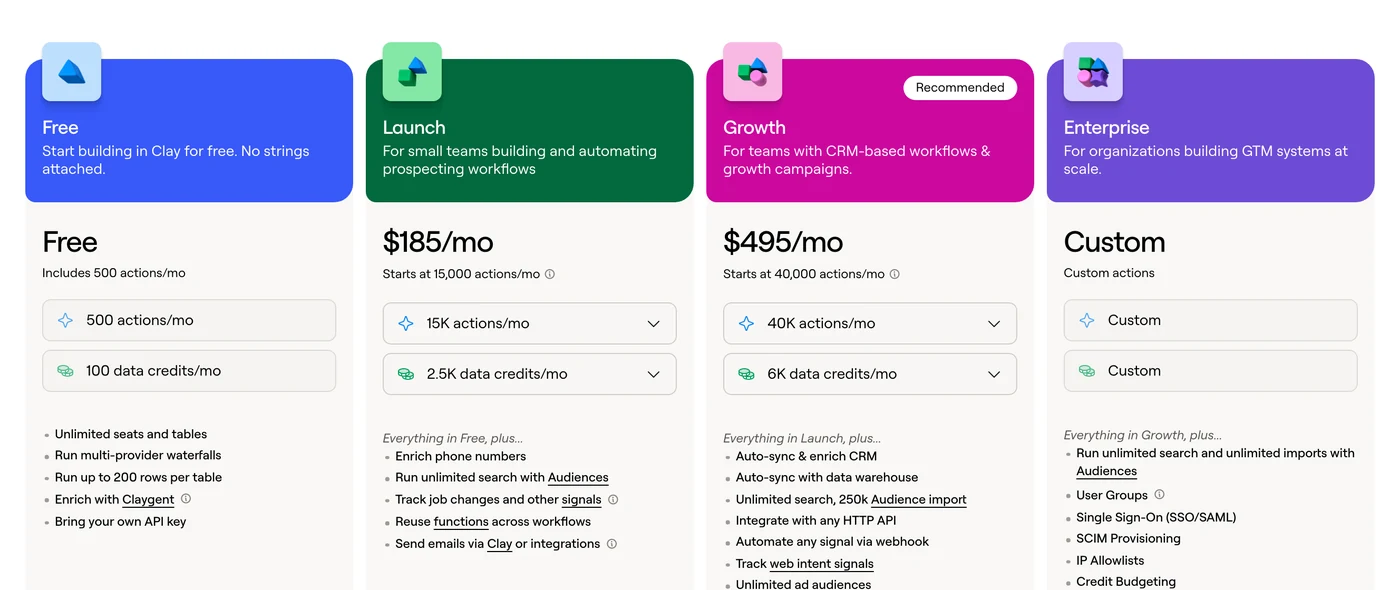
The grid since March 11, 2026: an actions tier plus a data-credits tier
Each card shows the entry price, which is the smallest actions tier plus the smallest credits tier: Launch = $60 for 15,000 actions + $125 for 2,500 credits. Two menus on the pricing page then raise either meter on its own. Yearly billing takes 10% off and gives you the whole year’s credits up front; Clay shows the yearly price first.
Free
$0/month
No credit card
- 500 actions and 100 data credits a month
- 200 rows per table (50 in one FAQ answer)
- Waterfalls, Claygent and your own API keys
- No phone numbers
Launch
$185/month
$167/month billed yearly
- 15,000 actions + 2,500 data credits a month
- Phone numbers and job-change, news and social signals
- Emails sent through Clay’s Sequencer or an integration
- 50,000 rows per table
Growth
$495/month
$446/month billed yearly
- 40,000 actions + 6,000 data credits a month
- Two-way CRM sync, outbound HTTP API, inbound webhooks, web intent
- Inboxes and domains bought inside Clay for the Sequencer
- 250,000 Audience imports, priority support
Enterprise
Custom
Yearly commitment
- From 100,000 data credits and 200,000 actions a month (100,000 in the help centre)
- SSO, roles, credit budgets per workbook
- A growth strategist and a shared Slack channel
- Sources synced every 15 minutes, bulk enrichment above 50,000 records
US dollars, before tax. Clay labels Growth “Recommended”. Seats are unlimited on every plan. The yearly amount is never shown, only its monthly equivalent: $1,998 a year for Launch and $5,346 for Growth at the entry tiers (monthly price less 10%, over a year, before Clay’s rounding; our calculation).
Data-credit tiers, the same on Launch and Growth
$0.05 a credit · $113/month billed yearly · Launch only
$0.048 a credit · $261/month billed yearly
$0.046 a credit · $414/month billed yearly ($413 on Growth)
$0.044 a credit · $792/month billed yearly
$0.0425 a credit · $1,913/month billed yearly
Above 50,000 credits a month, Clay’s calculator switches to Enterprise. The help centre gives other ranges (2,500 to 10,000 on Launch, up to 100,000 on Growth); we use the menus of the pricing page.
Action tiers: the same tier costs more on Growth
Launch only · yearly $54
$205 on Growth · yearly $135 and $185
$290 on Growth · yearly $180 and $261
$450 on Growth · yearly $261 and $405
$850 on Growth · yearly $486 and $765
Actions never roll over and cannot be topped up: more actions means a higher tier or plan. $0.004 an action at Launch’s entry tier, $0.0051 at Growth’s.
One email found: 1 credit and 3 actions, or 0.5 credit and 1 action
Clay publishes two prices for the same result, and both are on its own site. The pricing calculator counts a work email at 1 data credit and 3 actions. The help-centre example counts 0.5 credit per email found and 1 action per enrichment. Nothing is charged when no email comes back, under either reading.
At entry-tier unit prices, that is $0.062 or $0.029 an email. In practice you pay whole tiers, so a small volume costs far more per email: 1,000 emails found take Launch’s entry tiers, $185, which is $0.185 an email.
The waterfall itself adds uncertainty. It opens with a free “Infer Email” step that guesses the address from the company’s pattern (about 31% success in a Clay test), then tries paid providers one after another. Clay’s guide says you only pay the provider that finds a match; a FAQ answer says every step that returns data, and every validation step, takes credits and an action. Validation is free with some validators according to the help centre, and charged according to the waterfall guide. A fully enriched record typically costs 6 to 20 credits.
Exporting a table to CSV costs nothing. Running an enrichment with your own provider key takes 1 action and no credit (you then pay the provider). One trap: when actions go past 15,000 on Launch, Clay’s calculator keeps the entry actions tier in its total and only says “Expand anytime”, so it shows less than the pricing page would charge. Our tables use the pricing page’s tiers.
10,000 emails found a month, at 0.5 credit + 1 action each on Clay
 $350/month
- 6,000 data credits · $290
- 15,000 actions · $60
 $99/month
- 10,000-credit pack, no plan · $99
Clay against Emelia from 1,000 to 100,000 emails a month
Same need on both sides: emails found each month, nothing sent yet. Clay at the cheapest Launch tiers that cover the month (or Free while it is enough), under each of its two readings; Emelia at the smallest monthly credit pack that covers the volume, and nothing else, because its credits are sold without a plan. Clay’s Free plan covers about 100 or 200 emails a month, and Emelia gives 20 free credits at sign-up with a work email; from the first paid tier, Emelia costs less on every line where Clay publishes a price, under both readings.
Clay at 1 credit + 3 actions per email (pricing calculator)
100 emails found a month
1,000 emails found a month
1,100 emails found a month
5,000 emails found a month
10,000 emails found a month
10,500 emails found a month
50,000 emails found a month
100,000 emails found a month
Clay at 0.5 credit + 1 action per email (help-centre example)
200 emails found a month
1,000 emails found a month
1,100 emails found a month
5,000 emails found a month
10,000 emails found a month
10,500 emails found a month
50,000 emails found a month
100,000 emails found a month
Clay’s figures are in US dollars, its only billing currency; Emelia’s are in yours, the same number in euros or dollars. Monthly billing, before tax. The volumes sit on Emelia’s pack thresholds and just above two of them, so the lines do not favour Emelia. Emelia’s credits given once at signup are not counted; whatever a pack leaves unused stays valid 12 months after purchase.
Put your own monthly volume through both grids
Choose how many emails you need to find each month. The calculator takes Clay’s help-centre reading (0.5 credit + 1 action per email), the cheaper of its two published costs, and the smallest pair of Launch tiers that covers it.
Launch · 2,500 data credits + 15,000 actions a month1,000-credit pack ($19)Credits subscription alone, no plan neededYou save $166 per month with Emelia.
How each tool charges
Clay’s Launch plan is a data-credits tier plus an actions tier, each bought from a menu ($125 for 2,500 credits, $60 for 15,000 actions at the bottom). The calculator picks the cheapest pair that covers your emails; with the calculator’s own reading (1 credit + 3 actions), Clay costs more.
Emelia charges 1 credit per email found, nothing when none is found, and 0.25 credit per verified address. Its credits are sold on their own, as a subscription with no sending plan: from $19 a month for 1,000 credits, valid for 12 months. To send your campaigns as well, Start ($37) adds 3 mailboxes and 1 LinkedIn account.
Monthly billing, before tax. Clay’s Free plan (up to 200 emails here) and top-ups are left out; so are validation steps, whose cost Clay’s pages describe differently. Emelia’s credits given once at signup are not counted.
Phone numbers at the same monthly volume
Clay’s calculator budgets a phone number at 5 data credits and 3 actions, from Launch (not on Free or the trial); the real price depends on the provider and only shows inside the app. Emelia charges 50 credits per number, only when one is found. Because both sides jump from tier to tier, the winner changes with the volume: Clay is cheaper from 300 to 500 and 1,100 to 1,200 numbers a month, Emelia from 100 to 200, 600 to 1,000 and 1,300 to 2,000. Above 2,000 numbers, Emelia’s largest monthly pack no longer covers the month.
200 phone numbers a month
500 phone numbers a month
1,000 phone numbers a month
1,100 phone numbers a month
2,000 phone numbers a month
4,000 phone numbers a month
Monthly, before tax, Clay in US dollars and Emelia in your currency; on Emelia’s side, the smallest monthly credit pack that covers the numbers, with no plan on top. Clay warns that coverage outside the United States is 15 to 25% lower, phone numbers especially.
Sequencer costs: 1 action per lead, inboxes from Growth
Clay’s Sequencer, built on Smartlead, sends cold email on the paid plans, from Launch: 1 action per lead enrolled, not per email, on top of finding the email. Each line below fills N inboxes at 20 emails a day (Clay’s advice) over 22 working days, with 4-step sequences (Clay’s maximum), and finds the email of every new lead. The check marks show which tool is cheaper on each line.
Clay at 1 credit + 4 actions per lead
3 inboxes, 330 new leads a month
10 inboxes, 1,100 new leads a month
50 inboxes, 5,500 new leads a month
100 inboxes, 11,000 new leads a month
200 inboxes, 22,000 new leads a month
Clay at 0.5 credit + 2 actions per lead
3 inboxes, 330 new leads a month
10 inboxes, 1,100 new leads a month
50 inboxes, 5,500 new leads a month
100 inboxes, 11,000 new leads a month
200 inboxes, 22,000 new leads a month
Monthly and before tax, with Clay’s amounts in US dollars and Emelia’s in the currency you pay in. Clay with inboxes you connect yourself (Google, Microsoft or SMTP); the number you can connect is not published. Emelia’s plan follows the inboxes (3, 50, unlimited under fair use) and already includes 1, 3 or 10 LinkedIn accounts, which Clay does not automate. Buying inboxes inside Clay needs Growth: $4.50 per inbox a month and $15 per domain a year, paid in credits, up to 5 inboxes per domain, supplied by Smartlead (Zapmail) and not warmed up on delivery.
Free plan, 14-day trial, rollover and the 25% non-profit discount
The Free plan never expires: 500 actions and 100 data credits a month, no card. Clay’s pages disagree on two points: the table limit (200 rows per table on the pricing page, 50 in a FAQ answer) and sending (the pricing FAQ still lists the Sequencer for Free, while the comparison table has said “Not included” since late September 2026).
The 14-day trial works on every plan, without phone numbers. Its size depends on the page: 1,000 data credits in the help centre, or 2,000 credits, 10,000 actions and 50 rows per table with Growth features in a FAQ answer. Whether a card is required is not stated.
What happens to unused actions and credits
Actions never roll over. On monthly plans, data credits carry over up to 2× the monthly amount. On yearly plans, 15% of the year’s credits carry over if you renew at the same level or higher, according to the help centre and the comparison table; the pricing FAQ keeps that for Enterprise. Extra data credits cost 30% more than in a plan (250 at least); the help centre caps a top-up at $1,000 and $5,000 per rolling week, while the March 2026 announcement says the limits were removed.
Discounts, referral and cancellation
- 10% off on yearly billing, with the year’s credits up front; 25% for non-profits, on proof of 501(c)(3) status. No promo code was shown on October 16, 2026.
- Referral: 3,000 credits each for you and the person you refer, once they start a paid workspace.
- Cancel from Billing at any time: the plan runs to the end of the period, then the workspace drops to Free. Clay’s terms make fees non-refundable; credits come back when a provider refunds Clay for invalid data.
- Moving up mid-cycle turns unused credits and actions into a credit on the upgrade invoice, according to the help centre; a FAQ answer says the new allowance is added to your balance instead.
Clay pricing: questions buyers ask
Yes, on every plan, Free included: with your own key for a data provider (Hunter, Apollo…) or an AI model, each run costs 1 action and no data credit. You then pay that provider under your own contract; Apollo, for instance, requires its own account for all 14 of its actions in Clay. Actions still count, and they are the meter that cannot be topped up.
US dollars only, including on clay.com/fr/pricing. Clay adds US sales tax depending on the state; how VAT is handled for a European business is not documented. Payment is by card. Emelia shows the same figure in euros or dollars: $37 a month for Start.
A downgrade takes effect at the end of the cycle, and the data-credit balance is cut back to 2× the new plan’s monthly amount. A cancellation keeps paid features until the next renewal, then moves the workspace to Free; Clay keeps your tables but says long-term retention is not guaranteed after a long inactivity, and suggests downgrading rather than cancelling. The old Starter, Explorer and Pro plans stay as they are until you change them; any change since April 10, 2026 moves you to the new grid.
Emelia features: Email finder · Cold email · Email warm-up · Emelia pricing
Emelia is a Clay competitor. We have tried to stay fair: every figure about Clay comes from its own website or public review sites.


