Clay vs Emelia at a glance

- Email finderYesYes
- Phone number finderYesYes
- Credits valid for 1 year, even after cancellingNoYes
- Email verificationYesYes
- Built-in B2B contact databaseYesNo
- Cold email from your own mailboxesYesYes
- LinkedIn automationNoYes
- Native CRM integrationYesYes
- APIYesYes
Checked on October 18, 2026 on Clay’s own pages and on Emelia’s pricing page.
Clay GTM: the “GTM engineer” job Clay says it invented, and the free courses that go with it
Clay presents itself as go-to-market infrastructure, and the person it builds for has a title of its own: the GTM engineer, someone who builds automated revenue systems out of data, AI and sending tools; one of them, Clay says, can amplify 100 sellers. Clay writes that it “coined the term in 2023”.
Clay puts the job at the centre of its communication. It announced its $100M Series C (August 5, 2025, at $3.1B) under the banner “The GTM engineering era begins now”, quoting Pave data: 400+ GTM engineer openings posted in spring 2025, at a median salary of $160,000, 20% above sales and marketing operations roles. In 2026, Clay counts about 100 new listings with the title every month. Its annual conference, Sculpt, billed as a GTM engineering event, drew 2,000 people from 30 countries to San Francisco on October 8, 2026.
Help pages are a reminder of who the product targets: the Sequencer, for instance, is described as aimed at marketing and sales operations rather than individual reps. G2 reviewers list the learning curve among Clay’s weak points, which is the other side of a tool designed to be configured.
Clay University: courses, cohorts and paused certifications
Clay’s help centre lives inside Clay University, which also hosts 16 free courses. The entry course, “Clay 101: GTM Automation”, follows a Find, Enrich, Transform, Export framework in short videos, about 2 hours in total by our count. Other courses cover outbound, inbound, CRM enrichment, signals, ads, the MCP server and the email Sequencer.
- Cohorts: free, on application, run over 1 week according to the cohort page (which also mentions 2 weeks); Clay counted 2,500 alumni in August 2025.
- Certifications: 4 free tracks, earned by submitting a working Clay table, valid 12 months. New submissions have been paused since March 17, 2026, except for partner-programme applicants; about 1,000 people were certified by then.
- Partners: a directory of agencies ranked from Artisan to Elite Studio, with 20% of revenue shared and grants of $500 to $15,000. Clay runs no school of its own; it lists third-party ones and commits $1M in scholarships at GTM programmes.
What is Clay AI, and who makes it? Clay Labs, founded in Brooklyn in 2017, valued at $7.1B
“Clay AI” is how most people search for Clay, sold by Clay Labs Inc. at clay.com. The AI part is real: models research and write inside the tables. But the product is a data workspace: rows of accounts or contacts, columns that fetch data from 150+ providers (200+ on other pages, 250+ in the October 2026 conference recap), its own search of 900M people, 70M companies and 300M jobs, and exports to a CRM, an ad platform or a sending tool.
Kareem Amin and Varun Anand founded the company in Brooklyn in 2017. It now has 500+ employees and offices in New York, San Francisco and London; its published postal address is 119 N 11th Street, 3C, Brooklyn, NY 11249. Clay says it went from $1M to $100M of annual recurring revenue in 2 years, a milestone it announced on December 8, 2025, with 4× revenue growth in 2025 and net revenue retention above 200% among enterprise customers.
Funding announced on Clay’s blog adds up to $317M over 6 rounds, the undisclosed pre-seed aside. The latest, on September 9, 2026, raised $115M at a $7.1B valuation, led by Wellington. Employees were also able to sell shares twice: at $1.5B in May 2025, then up to $55M at $5B in January 2026.
On customers, Clay’s figures do not agree: 17,000+ in the Series D announcement (after 2,500 in June 2024 and 5,000 in January 2025), but “100,000+” on the partner page and “500K+” on the press page. We keep the Series D number. Its own help pages are just as split on data: one presents “Clay’s data” of 900M people, while a FAQ answer says Clay does not have any native data.
Clay data enrichment: a waterfall that asks one provider after another
Enrichment is what Clay was first used for: you bring a list (CSV, CRM, a table built in Clay) and add columns. For a work email, a waterfall queries providers one after another and stops at the first valid answer; when no provider finds anything, neither credits nor actions are charged.
Clay’s email waterfall page names Prospeo, Dropcontact, Datagma, Hunter, People Data Labs, Nimbler, Apollo, Lusha and Snov.io among its providers. Apollo’s presence is odd: each of its 14 actions in Clay requires your own Apollo account. A free “Infer Email” step can run first, guessing the address from the company’s naming pattern (about 31% success in a Clay test), and a validation step can be set to Conservative, Balanced, Aggressive or Advanced. The help centre warns that coverage outside the United States is 15 to 25% lower, phone numbers especially.
Lead enrichment goes well beyond email: profile and company data, headcount, funding, revenue, technologies, job changes and web intent, each with its own price in Clay’s calculator (below). A fully enriched record typically costs 6 to 20 data credits. Running a provider with your own API key costs 1 action and no credit. Emelia’s finder covers a narrower job: 1 credit per email found and already verified, 50 per phone number, nothing when the search fails.
What Clay’s calculator charges per record (data credits + actions)
The help centre’s example counts 0.5 credit + 1 action
From Launch
From Launch
From Growth
Assumptions of the calculator on clay.com/pricing-calculator; the exact price of each provider only shows inside the app. Finding people or companies in Clay’s own search costs nothing in the calculator and in a help-centre example, although a table of the same help centre says sourcing can use data credits.
Clay API, CLI and MCP, 14 sending integrations, and no Emelia among them
Clay’s developer tools are open on every plan, Free and trial included, according to its API documentation: a public API, a CLI (Mac, Linux, Windows through WSL) and a plugin for coding agents, which read tables but do not create them and use the same credits and actions as the app. The pricing FAQ, though, lists “Clay API access” among the Enterprise extras. An MCP server (OAuth) lets AI assistants query Clay, usually for 20 to 100 credits a request.
The documentation sits in Clay University (docs.clay.com redirects there). Two connections need Growth: the outbound HTTP API column, which calls any service, and inbound webhooks. The same plan syncs a CRM both ways (HubSpot, Salesforce, Pipedrive and Close), and Clay’s pages place data warehouses (Snowflake, Fivetran, Postgres, Databricks and BigQuery) on Growth or Enterprise depending on the page. HubSpot users get both the CRM sync and a separate HubSpot Sequencer integration.
For sending, Clay has an integration page for 14 tools: Instantly, Smartlead, lemlist, HeyReach, La Growth Machine, Reply.io, Outreach, Salesloft, Saleshandy, Woodpecker, EmailBison, ReachInbox, Salesforge and HubSpot Sequencer. Each needs your account with that tool and a campaign created there first; Clay then pushes leads at 1 action per record. Emelia is not on the list, and clay.com does not mention it. Emelia has its own API, from 100 requests a minute on Start to 1,000 on Scale.
Outbound from Clay: the Sequencer for email, HeyReach or La Growth Machine for LinkedIn
Clay’s Sequencer, “built on Smartlead” according to its FAQ, sends cold email on the paid plans, from Launch (the pricing FAQ also lists it for Free, the comparison table does not): up to 4 emails per sequence, 2 copy variants, at most 10 days between steps, warm-up, and a reply inbox. You connect your own inboxes (Google, Microsoft and SMTP) or, on Growth, buy them inside Clay. Clay advises about 20 emails per inbox a day, and it bills 1 action per lead enrolled. An older FAQ answer still says Clay does not replace your email sequencer.
LinkedIn is the gap. The help centre calls the Sequencer “a cold email product today”, and Clay sends no invitation or message itself: it can add a lead to a HeyReach campaign or to La Growth Machine, both with your account and a campaign set up with them, or sync an advertising audience to LinkedIn on Growth, which is not outreach. Prospect lists come from Clay’s own search, a snapshot rather than a live LinkedIn search; importing a Sales Navigator search is not documented.
Emelia runs both channels in the same sequence: invitations and messages from 1, 3 or 10 LinkedIn accounts included in its plans ($29 per extra account), from its own servers, and cold email from 3, 50 or unlimited mailboxes.
Claygent: the agent that researches the web for each row
Claygent is the AI column of a Clay table: you write a question, it searches the web for each company or person and writes the answer back, ready for the next column. It is included on the Free plan. Clay runs it on its own research models, Helium and Argon, or on models from OpenAI, Anthropic or Google, from nano versions to the largest reasoning models.
Each run uses 1 action plus data credits set by the model: 1 for Helium, 3 for Argon, the real cost for reasoning models, with “0% markup” according to Clay. With your own model key, a run takes no data credit. A table of models and what a run costs in dollars are on our Clay pricing page.
Clay Chrome extension: Clay for Chrome and Clip to Clay
Clay has 2 Chrome extensions. Clay for Chrome (10,000 users, 4.4 stars from 9 ratings, last updated April 10, 2025) scrapes a list or a single page into a Clay table using ready-made “recipes”, or into a CSV file or the clipboard. Clip to Clay (1,000 users, no rating yet, updated April 9, 2025) saves the person or company of the page you are on to a table you pick. Neither listing nor the help pages mention anything specific to LinkedIn or Sales Navigator.
Emelia’s Chrome extension works on LinkedIn directly: on a profile, a floating Emelia button finds the person’s email and phone number, paid in credits only when found, and adds the person to an Emelia campaign; inside a Sales Navigator search, an “Export with Emelia” button hands the search to Emelia, which extracts the leads; and it connects your LinkedIn account to your campaigns (Emelia’s Chrome extension, Sales Navigator export guide).
Clay reviews: 4.7 on G2, 2.8 on a Trustpilot page Clay has not claimed
G2 blocks automated reading, so its score comes from search results: 4.7 from 218 reviews on the review page, 4.6 from 234 on other G2 pages. Clay displays no G2 rating on its own site. There is no reliable Capterra score: the listings that come up belong to namesakes.
What users praise
- Automation and enrichment are the strengths G2 reviewers name most; 84% of them give five stars.
- One recent five-star review on Trustpilot calls it the best tool for lead generation.
- Another five-star review comes from a Clay partner.
What users criticise
- Price, the learning curve and the credit system come back in G2’s weak points.
- On Trustpilot, 61% of reviews give one star; one describes credits gone in minutes with no explanation from support.
- Another finds it too complicated for simply looking up a contact.
Clay or Emelia: 1,000, 10,000 and 100,000 emails found a month, side by side
The first comparable need is finding emails: Clay at the cheapest Launch tiers that cover the month, under the help-centre reading (0.5 credit + 1 action per email), which is the cheaper of its two published costs; Emelia at the smallest monthly credit pack that covers it, bought without any plan, since finding emails does not require one. Clay’s Free plan covers about 200 emails a month, and Emelia gives 20 free credits at sign-up with a work email; with the calculator’s reading (1 credit + 3 actions), Clay would cost $610 at 10,000 emails.
Emails found a month, nothing sent
200 emails
1,000 emails
10,000 emails
100,000 emails
Beyond the price per email
LinkedIn invitations and messages
Where the leads come from
Meters on the bill
Clay’s side is priced in US dollars, the only currency it bills in, and Emelia’s in yours, at the same number in euros or dollars; a euro row only gets a check mark when the gap holds at any exchange rate. Monthly billing, before tax; Emelia’s credits given once at signup are not counted. Phone numbers and cold email volumes, where Clay wins at some volumes, are on the pricing page.
Actions plus data credits: what a Clay plan costs
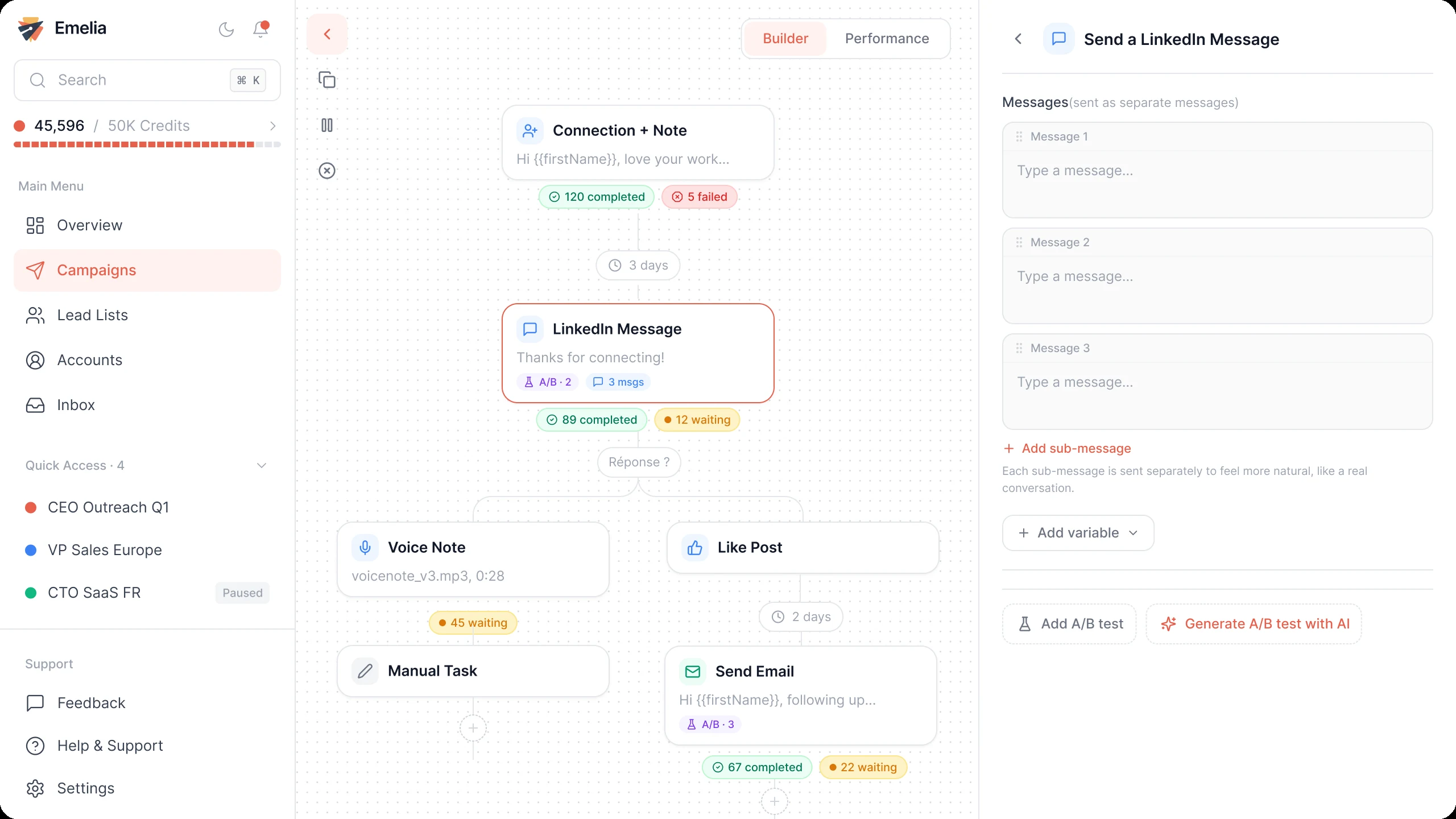
Each paid plan is priced from two menus, one for actions (the work Clay does) and one for data credits (what providers and AI models charge). The entry points: Free at $0 (500 actions, 100 credits a month), Launch at $185 a month or $167 a month billed yearly (15,000 actions, 2,500 credits), Growth at $495 or $446 (40,000 and 6,000), and Enterprise on quote with a yearly commitment. Seats are unlimited everywhere.
This grid replaced the single-credit plans (Starter, Explorer, Pro) on March 11, 2026. Tiers, what Claygent costs per run, phone numbers, the Sequencer and a calculator are on the Clay pricing page.
Other tools for the same job, and Clay against Apollo or ZoomInfo
Each answers a different reason for leaving Clay or for not starting with it.
for referenceEmails found and sent, LinkedIn included A database with sequences built in
 An enterprise database on quote
 Only the email finder
Monthly prices, billed monthly unless stated, excluding VAT, read on each publisher’s site (checked between October 12, 2026 and October 16, 2026). Emelia’s prices follow your currency; tools billed in dollars only stay in dollars, and those billed in euros only stay in euros. –: not offered, or not checked for this need.
- 1
Best for: Emails found and sent, LinkedIn included1 credit per email found, in monthly packs from $19 that work without a plan; campaigns that mix LinkedIn and email start at $37 a month.
- YesCredits valid for 1 year, even after cancelling
- NoBuilt-in B2B contact database
- YesEmail finder
- Price
- $19/month (credit subscription, no plan needed · 1,000 credits)
- 2
Best for: A database with sequences built inIts own contact database, paid per licence, with email sequences; we compare the two on cost per enriched email.
- YesEmail finder
- YesPhone number finder
- YesBuilt-in B2B contact database
- Price
- Free plan, then $65/month per licence (Basic plan · 2,500 credits)
- 3
Best for: An enterprise database on quoteA large B2B contact database, and a rival Clay compares itself with on its blog.
- YesEmail finder
- YesPhone number finder
- YesBuilt-in B2B contact database
- Price
- On quote
- 4
Best for: Only the email finderA finder and verifier sold by the credit, also available inside Clay’s marketplace.
- NoPhone number finder
- YesEmail finder
- NoCold email from your own mailboxes
- Price
- $19/month (Basic plan · 1,000 credits)
Clay: common questions
At app.clay.com, through the “Log in” link at the top of clay.com. Sign-up is at app.clay.com/signup, and you can start on the Free plan without a card.
This page is about clay.com, the data and outbound platform made by Clay Labs. The personal relationship manager that used to be called Clay, at clay.earth, is now called Mesh, and clay.earth sends visitors to me.sh. ClayHR is unrelated HR software.
Each month you get 500 actions and 100 data credits, waterfalls, Claygent and your own API keys, on tables of up to 200 rows (a FAQ answer says 50). That is about 100 to 200 emails found a month, depending on which of Clay’s two costs applies. Phone numbers need Launch, and Clay’s pages disagree on whether the Sequencer is included.
To go further: the alternatives to Clay.
Emelia features: Email finder · Cold email · Email warm-up · Emelia pricing
Emelia is a Clay competitor. We have tried to stay fair: every figure about Clay comes from its own website or public review sites.


