How to actually test your email deliverability
The method everyone uses, sending yourself an email, is precisely the one that proves nothing. Here's what each indicator really measures: the real open rate, placement tests and the warm-up score, with their limits.
Why a test email measures nothing
When the sender and recipient addresses are identical or close (same domain, a variant like .fr and .com, a test to yourself), Gmail and Outlook see a spoofing attempt and file the message as spam, or silently block it. It's neither a bug nor an indicator: your real prospects aren't in that situation.
The Test your email button is there to check rendering (variables, spintax, signature, links), not deliverability. See Testing before you launch.
| Your test doesn't arrive… | Likely cause | What to do |
|---|---|---|
| …at your own address or a close one | Gmail or Outlook anti-spoofing filter | Nothing. Test to an address unrelated to your domain. |
| …at several unrelated external recipients (Gmail, Hotmail…) | DMARC too strict or misconfigured, signature with too much HTML | Run a test on mail-tester.com from your usual email client, switch the signature back to plain text. |
| …and the message asks you to reconnect the mailbox | An authentication problem with the mailbox | Reconnect it from Accounts. |
Some providers, and especially consumer internet provider mailboxes (SFR, Orange…), end up blocking a mailbox that sends repeated tests. We've seen a block escalate live, from refusing message by message to refusing any connection. To check your variables, use the preview.
The only reliable indicator: the real open rate
The open rate of a real campaign, on a varied audience, remains the best thermometer. Provided three conditions are met: Track opens switched on in the campaign, a custom tracking domain that resolves, and a list that doesn't target a single company.
Read it step by step in the Performance tab, and compare your campaigns with each other: if one campaign, sent from a given domain, clearly lags behind the others, that domain or those mailboxes are where to look.
The open rate relies on an invisible image. Company security filters open emails to scan them, and a blind copy to your CRM also counts as an open: the rate is then inflated. Conversely, an email client that blocks images doesn't count the open. So read trends, never a single open, and cross-check with replies.
Placement tests (seed lists)
A placement test sends your message to a panel of test addresses spread across Gmail, Outlook, Yahoo and others, then tells you where it landed: inbox, spam, Promotions tab. Services such as MailReach offer this. Emelia doesn't provide one.
mail-tester.com does something else: it scores the authentication (SPF, DKIM, DMARC) and content of a message you send to it. It's the simplest tool to check a DMARC record.
- Testing a mailbox that's already warmed up, with a real campaign message
- Comparing a domain with itself over time
- Checking authentication and content with mail-tester
- Cross-checking with the real open rate
- Testing a mailbox and domain only a few days old: the result almost always comes out bad
- Comparing a tool's score with Emelia's warm-up score: they don't measure the same thing
- Drawing conclusions from a single test
- Treating test addresses like real prospects: they don't have a company's filters
Warm-up as an indicator
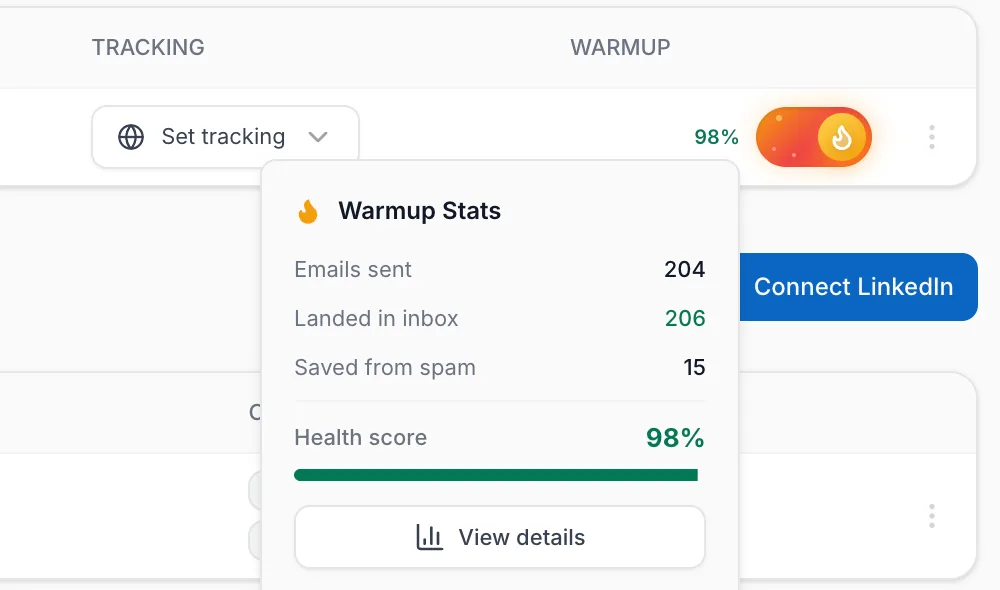
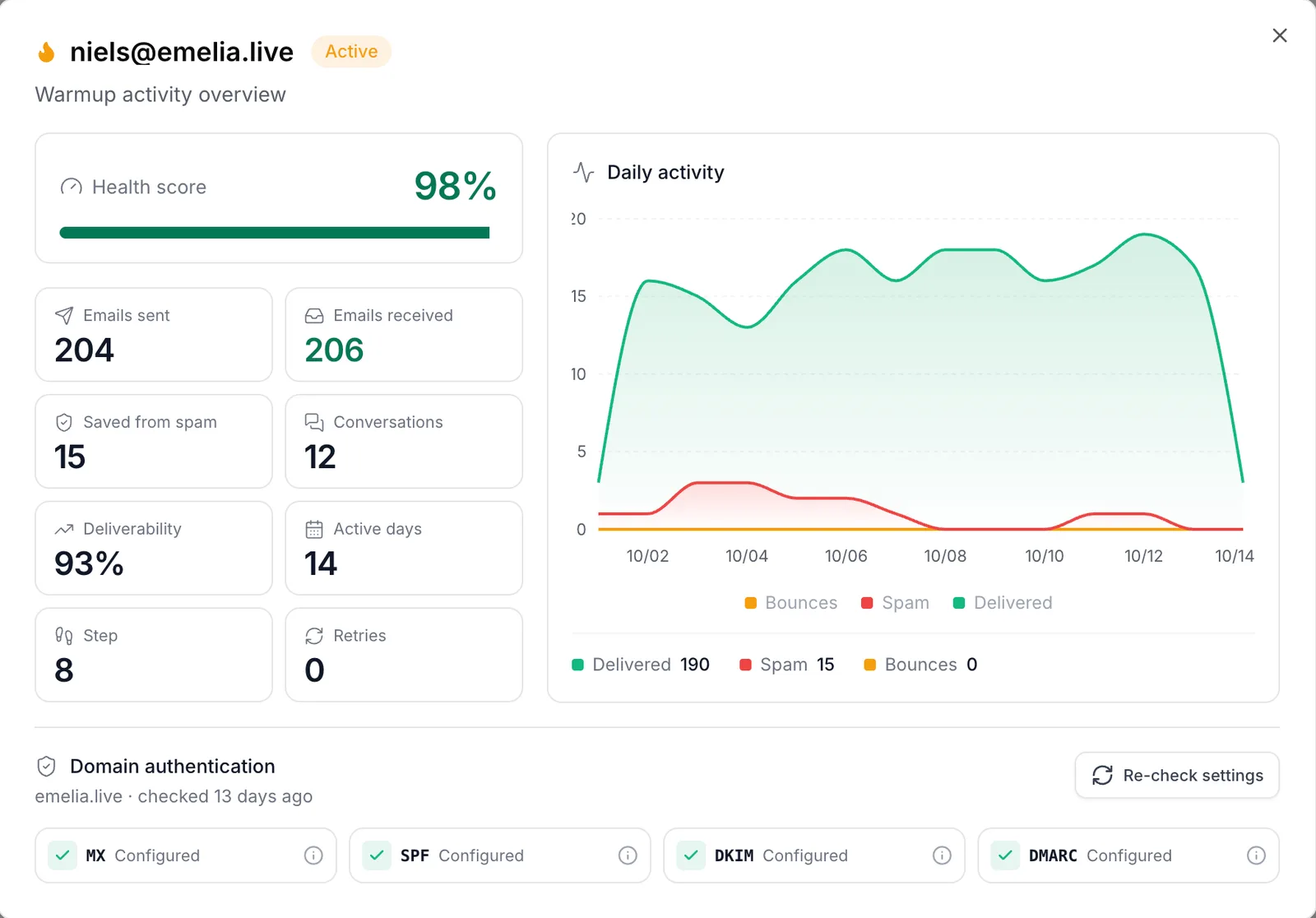
The warm-up score tells you whether the mailbox's warm-up emails reach the inbox. To read it in detail: Accounts page, hover the mailbox's score, then View details.
 123
123- 1In Accounts, hover the score in the Warmup column.
- 2The Warmup Stats tooltip shows the Health score.
- 3Click View details.
 12345
12345- 1Health score: share of warm-up emails that landed in the inbox over the last 7 days.
- 2Deliverability: the same measure, over the whole period shown.
- 3Daily activity: emails delivered, in spam and bounced, day by day. A rising red line is the first warning sign.
- 4Retries: how many times warm-up was switched back on after an automatic cut. At 3, only support can restart it.
- 5Domain authentication: MX, SPF, DKIM and DMARC status.
Reading the health score
| Health score | What it means |
|---|---|
| Above 90 | All good. |
| 80 to 90 | Fine: you can send. |
| 60 to 80 | Lower the campaign cadence on this mailbox. |
| Under 60 | Something is wrong (provider, DNS, reputation) and needs fixing before you send. |
| No score | Normal in the first days: it takes about 4 days of data. |
The limits of the warm-up score
- It only measures warm-up emails, which are short and have no links. A real campaign, longer, with links, to a cold audience, can land in spam with a 100% score.
- On a mailbox a few days old, it relies on a few dozen messages: a drop from 100 to 66 can come from one email in spam out of three.
- Score and age are two different things: a score of 100 after 4 days doesn't replace the 2 to 3 weeks of warm-up.
- It can't be compared with scores from other tools, which are calculated differently.
Keep warm-up running (switching it off doesn't bring the score back up), lighten the mailbox's campaigns (about 50 emails a day, 35 new contacts at most), clean your lists and check your provider. If warm-up switched itself off: Warm-up turns itself off.
Our method, in five steps
- 1. Check authentication: the Domain authentication section of the warm-up, plus one run through mail-tester.
- 2. Wait until the mailbox is warmed up (2 to 3 weeks for a new one).
- 3. Launch a real campaign, open tracking on, with a tracking domain.
- 4. Read the open rate step by step, then cross-check it with replies, the bounce rate and the warm-up score.
- 5. Under 30%: move on to the spam diagnosis.
Frequently asked questions
The questions we get asked on this topic, answered briefly.
My test email lands in spam: will my prospects get it in spam too?
Not necessarily, often quite the opposite. A test sent to yourself or to a close address is filtered as a spoofing attempt. Only the open rate of a real campaign tells you what your prospects see.
A placement testing tool gives me a terrible score while my Emelia score is good. Which one should I trust?
Neither on its own. They don't measure the same thing. First check the age of the mailbox and the domain: on mailboxes only a few days old, a placement test almost always comes out bad. Then check DMARC (p=none) and switch on open tracking to measure on a real campaign.
How long before my open rate is reliable?
You need enough sends that a handful of prospects doesn't swing the rate. Read it over the first days of sending, step by step, and compare it with your other campaigns rather than judging on the very first emails.
Should I switch open tracking off once the campaign is running?
Keep it on at the start, it's your only measurement. You can switch it off later if you wish. Click tracking, however, is unreliable (security filters click links): leave it off unless you have a specific need.