The tracking domain: what it does and how to set it up
A single CNAME record to add on your domain, then declare in Emelia. It routes your links, your open pixel and your unsubscribe link through your own domain, and for the time it costs, it is one of the settings that weighs the most on deliverability.
The first half happens at your host, in your domain name's DNS zone; the second in Emelia, in the Tracking column of the Accounts page. The two fields to fill in at your host are the same everywhere.
| Record type | CNAME |
| Name, or subdomain | tracking |
| Target | emelia.link. |
| TTL | leave the default value |
| In Emelia | Accounts, Tracking column, Set tracking button |
| Verification | a few minutes, once the CNAME is in place |
What it really does
To count clicks, an emailing tool rewrites the links in your messages: instead of pointing straight to your site, they first go through an intermediate domain that records the click, then redirect. Opens are counted by an invisible image loaded from that same domain. And your unsubscribe link goes through it too.
Without a tracking domain, that intermediate domain is shared between all the users of the tool. Your links then carry an address that has nothing to do with you, and whose reputation depends on what other people do. A spam filter that sees a link to an unknown domain inside a message coming from your domain sees an inconsistency, and that is exactly the kind of detail that tips a message into the junk folder.
With a tracking domain, those links go out from tracking.yourdomain.com. The sender and the links finally talk about the same company, and the reputation you build belongs to you.
Emelia lets you launch a campaign without a tracking domain: your links then go through the shared domain. We still advise adding it as soon as you create your mailboxes, while you are in your host's interface anyway, and in any case before you turn on open or click tracking.
The two values to enter
In your domain's DNS zone, create a CNAME entry. A CNAME is an alias: it says “this subdomain actually corresponds to that other domain”. There are only two fields to fill in.
Subdomain, or name, or host : The exact word, in lowercase. Your host adds your domain name after it, so do not type it again: you would end up with tracking.yourdomain.com.yourdomain.com.
trackingTarget, or destination, or value : At most hosts the trailing dot is part of the value: it means the address is complete and that nothing should be appended. Some interfaces, Cloudflare among them, add it themselves: you do not need to type it.
emelia.link.Leave the TTL field on its default value. It only sets how long DNS servers cache the answer, and has no effect on whether the record is valid.
At your host
Look for “DNS zone”, “DNS records” or “DNS management”, then “Add record”, and pick the CNAME type. The two fields sometimes go by other names: “Name” or “Host” for the subdomain, “Target”, “Points to” or “Value” for the target.
On Cloudflare, turn off the proxy on this line: the little cloud must be grey (DNS only), not orange. Otherwise, Emelia cannot see the CNAME.
Declare it in Emelia
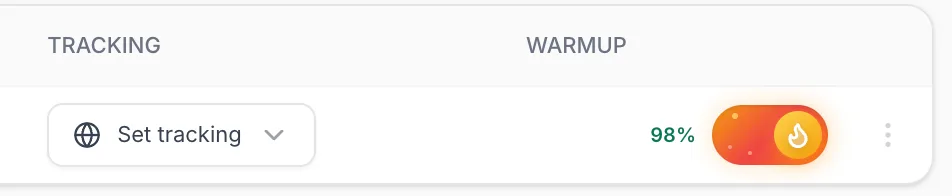
The DNS record is not enough: you then have to tell Emelia which mailboxes use it. In Accounts, on the mailbox's row, click Set tracking in the Tracking column, then New tracking.
 1
1- 1Click Set tracking, then New tracking.
In the Tracking domain field, enter the full domain, for example tracking.yourdomain.com. Click Test DNS: if Emelia answers “The CNAME record doesn't point to emelia.link yet”, do not save yet, wait for propagation. Once the test passes, click Save: the domain is created and applied to the mailbox.
Emelia then verifies the domain and sets up its security certificate (HTTPS): allow a few minutes. In the Set tracking list, an icon shows each domain's status: a spinning circle during verification, a green tick once validated, a red alert if it has been disabled.
As soon as you save the domain in Emelia, verification starts: a first attempt after one minute, then every 15 minutes. After six failures, about an hour and a half, the domain is disabled and you get an email. The Test DNS button is there precisely so you save nothing until the CNAME answers.
One domain for all the mailboxes on a domain
- The same tracking domain serves all the mailboxes on a given domain name, with no conflict between them.
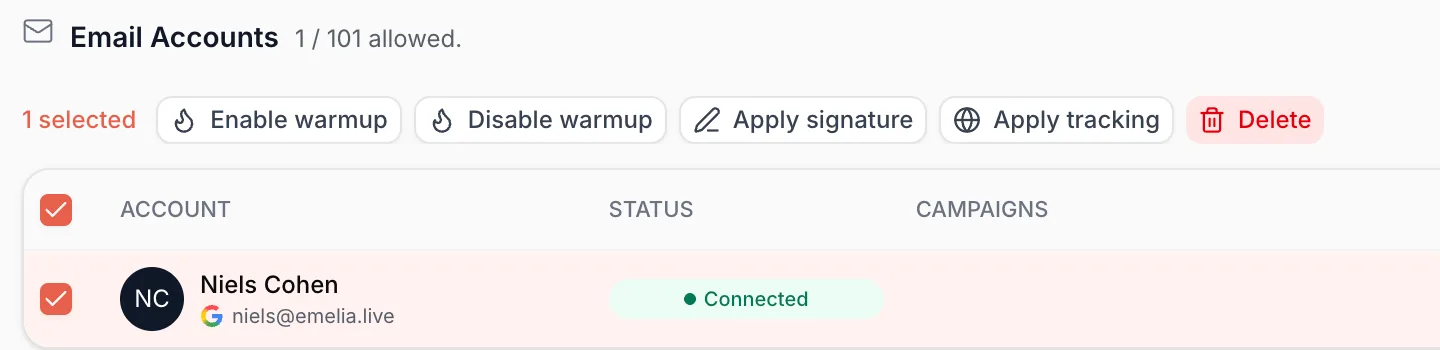
- The setting belongs to each mailbox: it has to be applied to each one. Not one by one, though: tick the mailboxes in the left-hand column, click Apply tracking and pick the domain. When importing mailboxes from a file, a column also lets you fill it in directly (import several mailboxes from a CSV).
- Another sending domain name needs its own tracking domain, created in its own DNS zone.
 123
123- 1Tick the mailboxes on the same domain.
- 2The header box selects them all.
- 3Click Apply tracking and pick the domain.
The most common mistakes
That is the typical sign of a dead tracking domain. Emelia verifies the domain only once, when it is created: if it later disappears from your DNS, it still shows as validated, but the open pixel no longer answers, the links in your emails lead nowhere, and the unsubscribe link is broken. Look up tracking.yourdomain.com as a CNAME on dnschecker.org. If it returns nothing, pause your campaigns, recreate the CNAME, wait one to two hours and check with Test DNS.
- A typo in the name: “traking” instead of “tracking”. The record exists and points to emelia.link, but under a different name from the one declared in Emelia.
- The domain name typed again in the subdomain field, giving
tracking.yourdomain.com.yourdomain.com. - An extra value in the target, such as a “3600” pasted after it, or a record created as type A or TXT instead of CNAME.
- The wrong domain entered in Emelia: you need your subdomain,
tracking.yourdomain.com, nevertracking.emelia.linknor your bare domain. - The Cloudflare proxy turned on (orange cloud) on the CNAME line: Emelia can no longer see the record.
- A CAA record on the domain that does not allow Let's Encrypt: Emelia cannot create the HTTPS certificate. Add a CAA entry authorizing
letsencrypt.org. - The domain declared in Emelia before the CNAME existed: six failed checks, and the domain is disabled.
- The CNAME gone from the DNS weeks later: zone rebuilt, DNS host changed, domain not renewed, or a contractor who deleted a line without knowing what it was for.
Stuck in verification, or domain disabled
First check the DNS answer on dnschecker.org, looking up tracking.yourdomain.com as a CNAME: it should return emelia.link. If it is right and the domain is still being verified (spinning circle), wait: Emelia tries again on its own.
If the domain is disabled (red alert), it can no longer be applied to a mailbox. Fix the CNAME, then write to us from Help & Support to restart the verification. Immediate workaround in the meantime: create a CNAME under another name, for example track, pointing to emelia.link., and declare that new domain.
Frequently asked questions
The questions we get asked on this topic, answered briefly.
Is the tracking domain mandatory?
No: without it, Emelia routes your links through its shared domain, and your campaigns still go out. But it is one of the most worthwhile settings for deliverability, since it makes the links in your emails go out from your own domain rather than from a domain whose reputation is out of your hands.
Do you need one tracking domain per mailbox?
No, one per domain name. All the mailboxes on the same domain share the same CNAME record. The domain is applied mailbox by mailbox in Emelia, though, which you can do in one go with “Apply tracking”.
Should you put the trailing dot after emelia.link?
At most hosts yes: the trailing dot signals a complete address. Some interfaces, Cloudflare among them, add it themselves. When in doubt, look at the record preview the interface generates before you confirm.
How long before the domain is verified?
A few minutes once the CNAME has propagated. Emelia makes a first attempt one minute after you save, then every 15 minutes; after six failures, the domain is disabled. Hence the point of clicking “Test DNS” before saving.
Emelia says this domain is already used by another user
A tracking domain can only belong to one Emelia account. If it is still attached to a former account, write to us with the full domain and that account's address. Otherwise, create a CNAME under another name, for example track.
I track neither opens nor clicks, do I need a tracking domain?
It is still useful: the unsubscribe link always goes through this domain. With your own tracking domain, that link talks about your company too.
Does it change anything about the open rate shown?
Open tracking relies on an invisible image, and click tracking on rewritten links. Moving to a dedicated tracking domain does not change the way they are counted, only the domain those elements travel through. What blurs open counting is mailbox protection, not the tracking domain.
Read next