
AI Teammates Are Here: Face, Voice and Memory in Your Next Meeting
Published on Mar 25, 2026Updated on May 27, 2026
Nine People on the Call. One of Them Isn't Human.
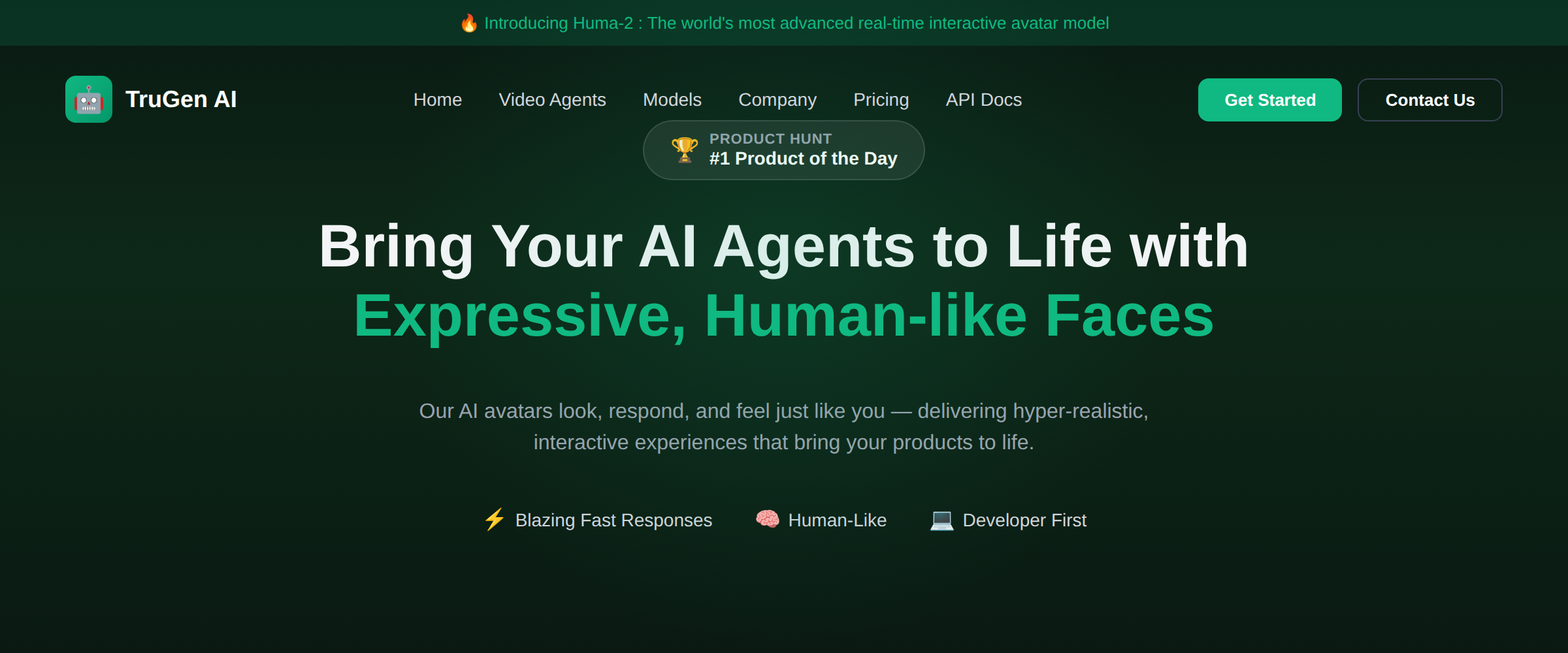
The scene is becoming increasingly common in 2026: a Zoom call starts, faces appear on screen, introductions are made. Except one participant has never existed in the flesh. It has a realistic face, a natural voice, responds to questions in real time, and most importantly, it remembers everything discussed in the last five meetings. This is not a chatbot, a voice assistant, or a transcription bot. TruGen AI calls it an "AI Teammate" : a full-fledged artificial colleague.
On March 23, 2026, New York-based startup TruGen AI officially launched the general availability of its AI Teammates platform : enterprise AI agents equipped with a face, a voice, camera-based vision, and persistent memory. That same day, AI podcaster Steve Atwal captured the concept in a phrase that quickly gained traction in tech circles: "Stop calling them 'tools.'"
The launch comes at a moment when the entire industry is shifting. Microsoft deployed Copilot Wave 3 on March 9, Salesforce is pushing AgentForce across CRM, and Zoom itself announced AI avatars for meetings. But TruGen occupies a niche that nobody else truly fills: autonomous AI entities with their own identity that participate in meetings as colleagues and execute tasks across enterprise systems.
Here is what you need to know about this technology : how it works, what it promises, and the serious risks it introduces.
TruGen AI and "AI Teammates": What Are We Actually Talking About
TruGen AI was founded in June 2023 by Hemanth Vijay, a former director at J.P. Morgan Private Bank, and was joined in late 2025 by Sunny Shah as co-founder and CMO. Based in New York City, the company claims more than 1,000 enterprise clients and holds SOC 2, HIPAA, ISO, and GDPR certifications.
TruGen's core product looks nothing like conventional AI tools. An AI Teammate is not a chatbot that answers questions. It is not an assistant that summarizes your meetings after the fact. It is an AI agent that:
Has a realistic face generated in real time and a natural voice
Joins your Zoom calls as a visible video participant
Reads visual context through the webcam using an action recognition model
Executes end-to-end tasks across enterprise systems (CRM, HR, sales)
Builds persistent organizational memory that grows richer with every interaction
Hemanth Vijay's vision is explicit: "The future of AI in enterprise isn't another AI tool or copilot. Enterprises need AI teammates that participate in meetings, collaborate with teams, execute work inside real systems, and continuously learn how the organization operates." The goal is not to add another tool to the software stack, but to create a permanent digital team member.
How It Works: The Huma-1 and Hawkeye-1 Models
The technology behind AI Teammates relies on two proprietary models developed by TruGen.
Huma-1 is the avatar model. It generates the agent's face and expressions in real time during video calls. TruGen claims a speech-to-avatar response time of under 80 milliseconds : roughly ten times faster than traditional video generation methods. The end-to-end latency, from the moment a question is asked to the moment the avatar begins responding, is under one second.
Hawkeye-1 is the vision model. It allows the agent to "see" what is happening through the webcam: detecting actions, reading on-screen documents, and interpreting the visual context of a meeting. The agent does not just listen : it observes.
Technical Specification | Claimed Performance |
End-to-end latency | Under 1 second |
Speech-to-avatar response | Under 80 ms |
Video generation | Under 100 ms |
Service uptime | Over 99.9% |
Concurrent sessions | Unlimited |
The Zoom integration likely runs through LiveKit, an open-source real-time communication framework that TruGen lists among its available integrations. LiveKit enables AI agents to join video rooms as full participants with bidirectional audio and video streams.
Organizational Memory: The Real Differentiator
The most distinctive technical feature is what TruGen calls the "Organizational Memory Graph." Unlike standard conversational AI where context resets with each session, an AI Teammate continuously captures and enriches its knowledge of the organization: workflows, internal terminology, team relationships, past decisions, and company culture.
TruGen uses the term "Organizational General Intelligence" : AI that does not merely perform tasks but understands the context, culture, and complexity of the organization it operates within. The architecture likely combines graph databases for relationship modeling with vector stores for semantic search.
This persistent memory is what fundamentally separates an AI Teammate from a copilot or chatbot. Your AI colleague remembers what was decided last quarter, knows each team member's preferences, and accumulates institutional intelligence that compounds in value over time.
From Tool to Colleague: What This Actually Changes in Enterprise
The shift from "AI tool" to "AI colleague" is not just a marketing exercise. It implies a fundamental change in how teams operate.
Concrete Use Cases
In sales, an AI Teammate can conduct live product demos on Zoom, qualify prospects in real time, share slides and documents during calls, and book meetings on the spot. Picture a sales rep who can be in two places at once: while working a strategic deal, their AI colleague handles initial qualification demos.
In human resources, the platform enables screening interviews at scale. The agent conducts the first round with every candidate, consistently and potentially with less bias than a time-pressed recruiter.
In customer success, the AI Teammate can onboard new accounts, guide customers through product setup, complete forms on their behalf, and provide 24/7 multilingual support with zero wait time.
In operations, the agent participates in cross-functional meetings, tracks workflows across systems, and most critically, surfaces institutional memory on demand. No more digging through three-month-old meeting notes: the AI Teammate knows what was decided and by whom.
The Industry Context
This movement is not happening in isolation. Forrester predicts that 40% of enterprise applications will include task-specific AI agents by the end of 2026, up from less than 5% in 2025. IDC projects 1.3 billion AI agents in operation by 2028. The top five HCM (human capital management) platforms are expected to offer digital employee management capabilities this year.
The semantic evolution is itself revealing. Salesforce chose "agents" with AgentForce. Microsoft went with "copilot." TruGen pushes the dial further with "teammates." Each term carries an increasing social charge: you use a tool; you collaborate with a copilot; you trust a teammate.
The Serious Risks: Deepfakes, Privacy, and Compliance
It would be naive to present AI Teammates without examining the considerable risks they pose. Normalizing artificial faces in professional meetings opens a Pandora's box of security and ethical concerns.
The Deepfake Problem
A study of 500 IT security leaders found that 85% of organizations had experienced at least one deepfake incident, with average losses of $280,000 per incident. The most dramatic case remains Arup, a multinational engineering firm where employees participated in a video conference with what they believed to be their CFO and other executives. The result: $25.6 million stolen.
When platforms like Zoom and TruGen normalize the presence of AI faces in meetings, the ability of employees to distinguish real from fake diminishes mechanically. Zoom implicitly acknowledged this by simultaneously launching its AI avatars and a deepfake detection system : the technology creates the threat at the same time it attempts to contain it.
Cybersecurity researchers demonstrated that Zoom's "CREATED WITH ZOOM AI COMPANION" badge designed to identify artificial avatars can be reproduced in 30 seconds. The visible watermark then becomes a social engineering weapon: it trains employees to trust a badge that any attacker can copy.
The Privacy and Biometric Data Problem
Every AI avatar involves collecting and processing facial and voice data. As cybersecurity researchers have emphasized, facial data is biometric data. Unlike a password, you cannot reset your face. Uploaded images may be retained, used to create deepfakes, or included in training datasets.
The issue extends to organizational memory itself. An AI Teammate that accumulates a company's institutional knowledge creates an extremely sensitive data asset. Who owns that memory? What happens when an employee leaves while the AI has encoded their expertise? Research from Stanford has shown that AI companies routinely mine user conversations for model training. An employee interacting with an AI Teammate is potentially contributing to a dataset that extends far beyond their control.
The Surveillance Question
A Wall Street Journal investigation raised a disturbing point: AI systems that capture employee knowledge and work processes can make those workers more replaceable, as their expertise is extracted and encoded. Organizational memory, presented as an asset, can equally be viewed as a surveillance and knowledge-extraction instrument.
TruGen addresses these concerns through its VPC (Virtual Private Cloud) deployment architecture: the platform deploys within the customer's own private AWS environment, data never leaves the controlled perimeter, and role-based access control with complete action traceability is built in. It is a strong selling point, but it does not resolve the fundamental ethical questions.
TruGen AI vs. the Competition: Zoom, Microsoft Copilot, Otter, and the Rest
To understand where TruGen sits, you need to grasp that no competitor occupies exactly the same space. The market divides into three categories that, until now, did not overlap.
Meeting Transcription and Note-Taking Tools
Otter.ai, Fireflies.ai, and Zoom AI Companion are passive tools. They listen, transcribe, summarize, and generate meeting notes. Otter has launched a "Meeting Agent" that can speak up during meetings, but it remains fundamentally an audio-first tool with no face, no workflow execution, and no institutional memory.
Video Avatar Platforms
HeyGen, Synthesia, and D-ID create convincing AI avatars, but for pre-recorded or asynchronous content. Synthesia excels at training videos with its 240+ avatars; HeyGen offers digital twins and real-time translation in over 175 languages. But none of these tools creates a live conversational agent that joins your meetings and executes tasks in your systems.
Zoom's own AI avatars, announced in March 2026, allow users to be represented by their own avatar when they cannot attend a meeting. This is a clone of you, not a new AI colleague. The distinction is fundamental: Zoom creates a stand-in; TruGen creates an entity.
Enterprise AI Agent Platforms
Microsoft Copilot Wave 3, launched March 9, 2026, represents the most massive offensive. Copilot Cowork executes long-running tasks over minutes or hours, coordinating actions and producing results : powered by Anthropic's Claude. Agent 365, available in May at $15 per user per month, offers a control plane for governing all AI agents across an organization.
Salesforce AgentForce uses its Atlas Reasoning Engine to create autonomous agents within CRM workflows. But neither Microsoft nor Salesforce offers an agent with a face-to-face video presence and cross-functional institutional memory.
Category | Key Players | Video Presence | Persistent Memory | Task Execution |
Transcription | Otter, Fireflies, Zoom AI Companion | No | No | No |
Video Avatars | HeyGen, Synthesia, D-ID, Zoom Avatars | Yes (pre-recorded or clone) | No | No |
Enterprise AI Agents | Copilot, AgentForce | No | Partial | Yes |
AI Teammates | TruGen AI | Yes (real-time, own identity) | Yes (organizational memory) | Yes |
TruGen is attempting to create a fourth category by combining all three: an AI agent with a face that joins your meetings, executes work, and remembers everything.
Should You Start Preparing Now
The question is no longer whether AI colleagues will show up in your meetings. The real debate is about when and how your organization will adapt.
What Will Change Quickly
Companies that already embrace remote and asynchronous work will be the first to integrate AI Teammates. In these organizations, the concept of "presence" is already abstract: whether the face on screen belongs to a human in Tokyo or an AI agent in New York changes less than you might think.
Analysts converge on one point: the adoption gap is not technical : it is human. The companies seeing real returns from AI are not the ones with the best models. They are the ones that redesigned their workflows, retrained their people, and built cultures where experimentation is safe.
What Organizations Need to Put in Place
New roles are emerging: AI operations leaders to manage hybrid human-AI teams, agent supervisors to oversee AI Teammate quality and output, and workflow architects to design the processes that agents execute.
Half of enterprise ERP vendors are expected to launch autonomous governance modules in 2026, driven by AI failures in financial services and increasing regulation. Governance is the real bottleneck: an AI agent with memory and action capability demands audit trails, access controls, and validation processes that many organizations have not yet built.
The Bottom Line
TruGen AI is not the only company betting on this vision. But it is, as of today, the one pushing the concept furthest in its most literal form: a colleague with a face, a voice, and a memory. Whether you find that fascinating or unsettling, it is probably both.
Co-founder Sunny Shah put it this way in late 2025: "Every technology follows the same pattern: Text to Video. Newspapers to Television. Textbooks to Video courses. Texting to FaceTime. Facebook to TikTok. We always start with text because it's cheap and scalable. But we're not going to be typing at AI forever. The future is video agents."
Text-based AI was the beginning. AI with a face is what comes next. The remaining question is whether companies, regulators, and employees are ready to welcome this new kind of colleague into their Monday morning meetings.
FAQ
What is an 'AI colleague' on Zoom?+
A Zoom 'AI colleague' is an intelligent agent that participates in your meetings with a face, synthesized voice, and persistent memory. It can take notes, summarize, answer questions, and even contribute as a full participant.
Do AI colleagues on Zoom replace real coworkers?+
No, they complement the team by automating repetitive tasks (summaries, action tracking, transcription). They replace neither creativity, human judgment, nor interpersonal relationships. Think of them as augmented assistants.
What are the privacy risks with Zoom AI colleagues?+
Data management is central: transcription, persistent memory, and voice synthesis involve cloud storage. Check Zoom's terms, GDPR compliance, and enable encryption and limited retention options if handling sensitive topics.
How do you enable or disable an AI colleague in Zoom?+
Activation is done via Zoom admin settings: AI Companion section or equivalent. Administrators can restrict usage by user, meeting, or content type. Check official Zoom documentation, options evolve rapidly.
Clear, transparent prices without hidden fees
No commitment, prices to help you increase your prospecting.

Credits(optional)
You don't need credits if you just want to send emails or do actions on LinkedIn
May use it for :
Find Emails
AI Action
Phone Finder
Verify Emails
€19per month
1,000
5,000
10,000
50,000
100,000
1,000 Emails found
1,000 AI Actions
20 Number
4,000 Verify
€19per month
Discover other articles that might interest you !
See all articlesSoftware
Published on May 14, 2024
7 alternatives to Folderly to Boost your Deliverability in 2026
 Marie Head Of Sales
Read more
Software
Published on May 27, 2025
CRM Software in 2026: Top 10 Best Tools (Free and Paid)
 Mathieu Co-founder
Read more
Software
Published on Jun 30, 2024
Waalaxy : Reviews, Pricing, Alternatives (2026)
Marie Head Of SalesRead more
Software
Published on Apr 5, 2025
SignalHire Alternatives: The Ultimate Guide to Finding the Best B2B Data Tool for Your Business
 Niels Co-founder
Read more
Software
Published on Jul 14, 2024
6 Skylead alternatives to spend less and generate more leads
Marie Head Of SalesRead more
B2B Prospecting
Published on May 28, 2025
B2B Marketing 2026: Definition, Strategies and Examples
Niels Co-founderRead more
 Maylee
Made with ❤ for Growth Marketers by Growth Marketers
Copyright © 2026 Emelia All Rights Reserved