Cold email templates can make or break your outreach. Here are the ones that actually convert.
Introduction to the topic
"The best cold email templates", the title may sound rather catchy and in reality it's because it truly is.
There is no "best template" for cold email, since every industry is different, every business is different, every prospect list is different, and every copywriter is different.
For example, you can't apply a cold email template from the car industry to the jewelry industry, it goes without saying.
Depending on your prospect, whether they are an individual or a professional, a salesperson or a manager, a decision-maker or an individual contributor, you shouldn't write your email the same way.
Logically, when you're doing cold emailing, your prospect list shares more or less the same characteristics. For example, your list might contain all the salespeople from tourism offices in the United States. Their characteristics are similar, they're all salespeople, they all work in a tourism office, and they're all American. This list would be coherent for cold email.
If on the contrary you want to target as many people as possible without any common characteristics, that's more like mass mailing. If that's what you'd like to do, unfortunately this article will only cover the best cold email templates. But it can still be useful to you, the two have some things in common.
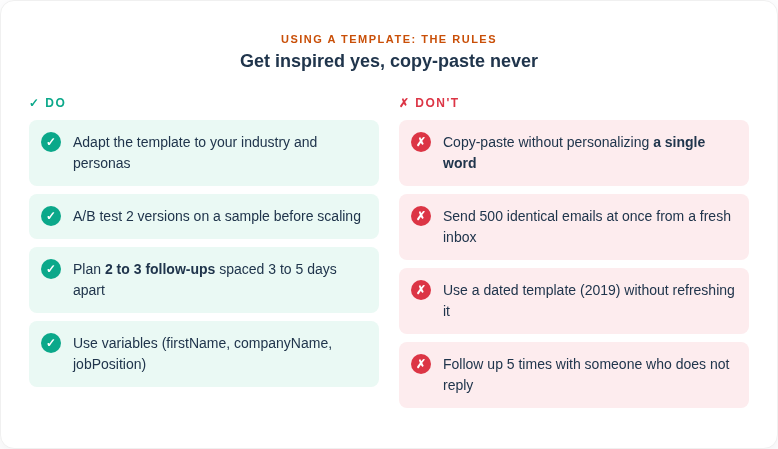
So you'll have understood that a cold email template cannot be applied everywhere and at all times. You can, however, "draw inspiration" from one to craft your own personalized emails. The structure of an email will generally remain the same.
The key to success is to test as many of your ideas as possible and only keep the ones that work.
That's why we'll start this article with a guide to the "essentials" to have in a cold emailing campaign via Emelia, followed by some of the best templates you can draw inspiration from.
Emelia, the all-in-one B2B prospecting tool
Cold email + LinkedIn + Email Finder.
The basics
The email content
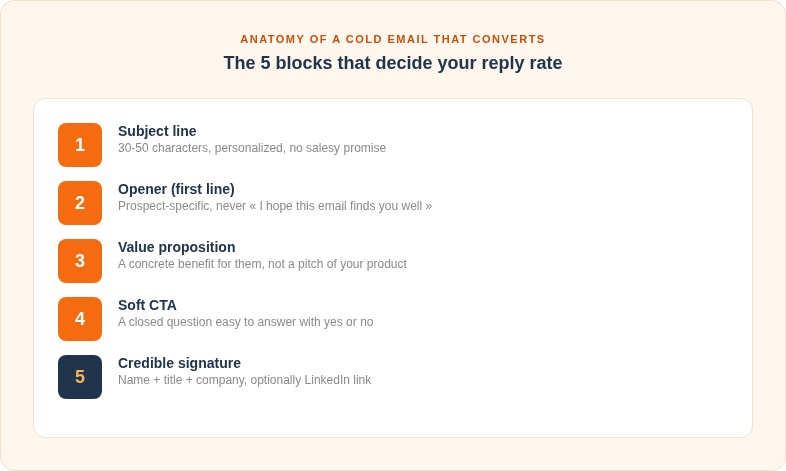
You need to start with a powerful hook. This hook is the most important element of your entire email, it must grab attention and spark your prospect's curiosity. It's what determines whether they want to keep reading. Without a full read of your email, there is no chance of conversion or of a click on a link. Before even thinking about converting, think about a persuasive and effective hook. You can perfectly start with a problem your prospect is facing, a relevant and intriguing question (intriguing doesn't mean mysterious but attention-grabbing), an upcoming event, or a connection you have with the prospect.
Your message must feel authentic. Personalization is the key in your cold email campaigns. Each of your emails must look unique in your prospect's eyes, they must feel that you took the time to write to them personally. That's why at Emelia we offer you the ability to create Variables (link) and Spintext (link). With these features, every email will be personalized and you'll be able to automatically choose to mention your prospect's name, their role, their company or any other (professional) piece of information you have about them.
Don't drag things out. Your message must be effective and quick to read. Don't paraphrase just to hit a minimum word count, and don't use overly complicated or pretentious terms. Your email should include a brief introduction of who you are, what you have to offer the prospect, and the action you want from them. That's it.
Emphasize the benefits you'll bring them. Many sellers make the mistake of talking about their products and services by listing their technical features. That's something you absolutely must not do, you need to focus on the value of your offer, you must emphasize the benefits your prospects will gain if they agree to move forward with you.
You absolutely need to include a Call-To-Action. Without one, the prospect won't think to contact you on their own or click on a link. The CTA must give a direct "order" to your reader's brain. It can be a word or a short sentence, like for example "Book your free slot" or "Click here". It's simply about giving your reader something to do, guiding them.
The subject line
The subject line is to your reader's inbox what the hook is to the content of your email.
It's essential to write it well if you want any chance of your prospect clicking on your email rather than sending it straight to the trash or to SPAM.
There are 5 key points to writing it well:
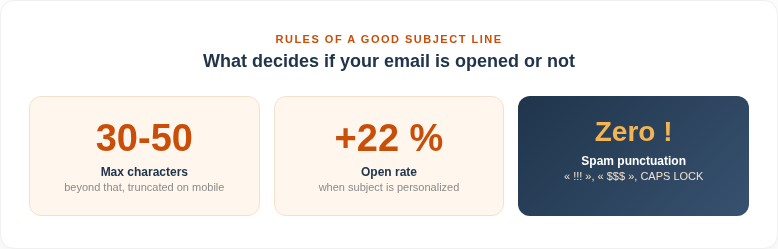
Use variables. At Emelia, just like for your content, you can also use variables in your subject line. Putting information about your reader, like for example their first name, in the subject will immediately grab their attention. Your conversion rate will be directly correlated to your open rate, so think about personalizing the subject.
A subject line must be simple and easy to read. Don't forget there's a character limit on email clients and that many people today use their smartphone to read their emails. If you want to avoid your subject being truncated, keep it short.
The words in your subject must be punchy. There are words that have a direct effect on our brains, words like "best", "simple", "free", "official", "secret", "results", "proven", etc., will tempt your readers more and will boost your open rate.
A question can be a good way to interest the prospect. If it's well written, they'll likely click on it to get the answer to their question.
Don't lie. One of the temptations when you start in email marketing is to "lie" or exaggerate in the subject to boost your open rate. Reading the advice we've given you above, you've probably been tempted yourself, and that's a normal reaction. However, we advise against it, since when opening your email and reading its content, the prospect will realize they've been tricked and this is likely to frustrate them more than anything else. Don't lose sight of the fact that your primary goal is to get as many conversions as possible, not opens. There's no point in having a campaign where 100% of emails were opened but where none of the prospects took action.
Launch your B2B prospecting
Starts at €37/month, no commitment.
The templates
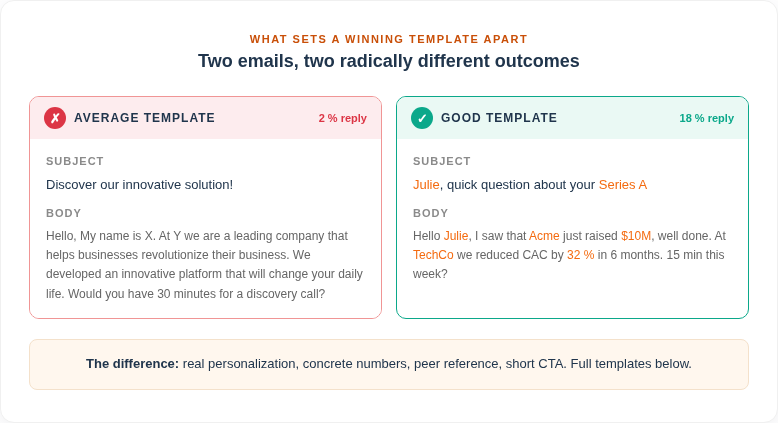
Here are two templates built on the five components that drive performance in 2026: short subject (5 to 7 words), prospect-specific opener, quantified value, low-friction soft ask, credible signature. Each template stays under 125 words, the threshold above which reply rates drop significantly.
Template 1: three-step sequence based on a signal
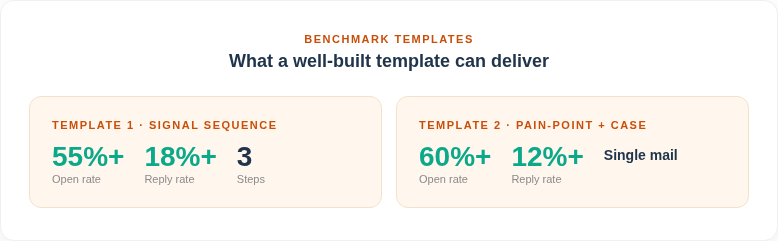
This sequence is triggered by an identifiable recent signal at the prospect (funding round, product launch, key hire, growth announcement, results publication). It chains three messages spaced over time, each with a distinct role.
The first message establishes a link with the identified signal, positions your expertise without lengthy self-introduction, and offers a measurable result achieved with a comparable client. The call-to-action is deliberately low-friction: a question that can be answered yes or no easily.
Without a reply at D+4, the second step takes over with a different angle. Rather than simply asking whether your first email was read, this follow-up brings concrete value (a resource, case study or sector insight) that the prospect can use even if they don't reply.
This approach creates a reciprocity effect and repositions your outreach. It also gives the prospect an explicit exit door ("just let me know"), which paradoxically improves reply rates.
If no reply comes at D+10, the third step closes the cycle with a break-up email. This last step often generates the best reply rate of the sequence, leveraging the loss-aversion bias.
The break-up email works for two reasons. First, it relieves the prospect of the mental load of an unresolved commercial relationship. Second, it explicitly opens a return door, which reassures those who weren't ready initially but might be later.
Template 2: single email pain-point with quantified social proof
This short format hits hard by concentrating in a single message the pain-point observation, peer social proof and a dual-option CTA. It works particularly well for very busy targets who will never read a three-message sequence.
The subject line highlights a concrete number rather than a generic hook. Subject lines containing a number show a 113% improvement in open rates according to 2026 benchmarks. The body stays under 100 words, structured in three blocks: prospect context, comparable client result, dual-option CTA.
The dual-option call-to-action (receive the case study or schedule a call) gives the prospect a low-friction engagement path, while collecting a clear signal about their maturity level.
Conclusion
In short, draw heavily on the 2 templates we've offered, since in our opinion they are among the best on the market. We chose to offer you 2 and not 10 because that would risk misleading you and confusing the information in your brain. We took 2 very different cases, with different ways of working, so that you can gauge what's best for your business and adapt these examples to your own needs.
We hope this guide will have been useful to you. If you have any questions, feel free to browse the blog, and if you have more specific questions, to contact us.
We recommend the article "Launch my first cold email campaign with Emelia.io" (link) to learn more about how the software works. It's very simple to use and you can start using it for free today to run your first tests.
Frequently asked questions about The best cold-mailing templates in 2026
What makes a good cold-mailing template?+
A good template is short (80 to 120 words), opens with a personalized hook, offers clear value, and ends with a single CTA. Avoid long introductions and sales jargon.
Should you personalize each email manually?+
No, that's the whole point of tools like Emelia. You write a template with variables ({{firstName}}, {{company}}, etc.) and personalization becomes automatic while remaining authentic.
How many follow-up emails should you plan?+
An effective sequence contains 3 to 5 emails spaced 3 to 5 days apart on average. Beyond that, you risk being perceived as pushy. Vary the format: value, social proof, breakup.
How do you avoid spam filters with a cold-mailing template?+
Avoid trigger words (free, promo, urgent), master deliverability (SPF, DKIM, DMARC), warm up your sending mailboxes, and limit links in the first email. Emelia handles automatic warm-up.