
A Cognism contract usually lands somewhere between $22,000 and $40,000 per year, and the median deal actually signed sits at $36,000 annually, or $3,000 a month. That is the real order of magnitude, and it is higher than ZoomInfo's. Cognism publishes no prices at all: the pricing page shows two packages, Standard and Pro, and a button to talk to sales.
This article rebuilds the full price list as it can be established in 2026: the actual structure of the price, with an annual platform fee on top of which per-user licences are billed, exactly how credits work, what Diamond Data really adds to the bill, the line items that never show up in the first quote, then the alternatives and their published rates. Every figure is tied to where it comes from, and when a number simply does not exist in public, that is stated plainly.
One framing point before the numbers, because it changes how you read everything below. Cognism is a contact and company database with a European specialty, mobile numbers verified by an actual human phone call, and a serious compliance story. Emelia, which we compare it to further down, is not a database: it is an execution platform that finds addresses on demand, verifies them, warms up sending inboxes and runs email and LinkedIn sequences. The two overlap on exactly two building blocks, finding contact data and launching the sequence. That shared perimeter is the only place where the comparison means anything.
How much does Cognism cost in 2026? The reconstructed price list
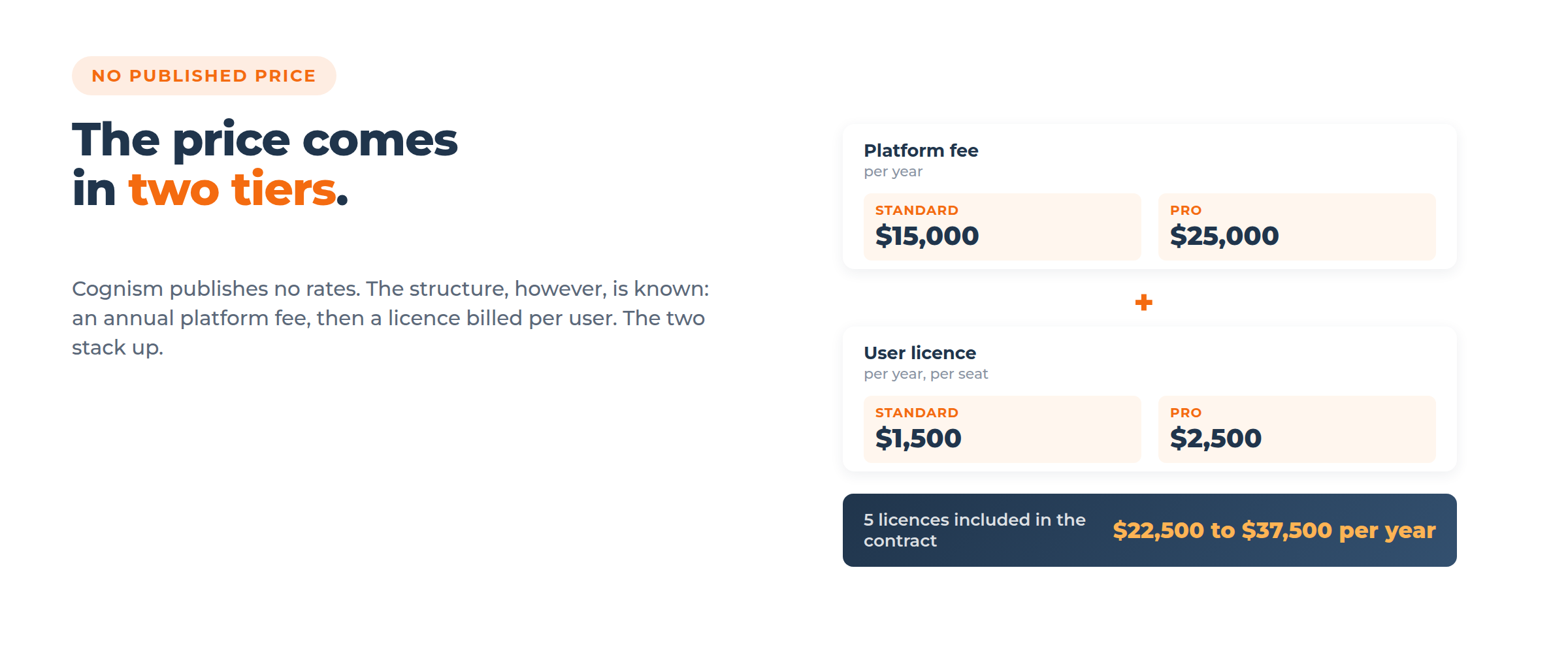
Here are the numbers as they emerge from quotes shared by buyers and from platforms that index signed contracts. The structure has two floors: an annual platform fee, then a licence billed per user. The two stack.
Item | Standard | Pro |
|---|---|---|
Annual platform fee | around $15,000 | around $25,000 |
Licence per user per year | around $1,500 | around $2,500 |
Licences included in the contract | 5 | 5 |
Total for 5 users | around $22,500 | around $37,500 |
Total for 10 users | around $30,000 | around $50,000 |
Total for 25 users | around $52,500 | around $87,500 |
Price shown on the website | No | No |
These amounts do not come from a pricing page, because there isn't one. They come from three families of sources that converge: quotes reported by buyers on G2 and Reddit, specialist aggregators that compile those reports, and software buying platforms that index the contracts they negotiate. Treat them as solid orders of magnitude, not as an official rate card, and note that they reflect the most recent quotes available.
Two clarifications are needed before going any further. The first: these amounts move, and yours will move too, because a negotiated price is never a reference point. The second matters more, because it changes the way you read a quote. The two-floor structure, platform fee on one side and licences on the other, is the one described by the majority of buyer reports, but it is not universal: some of them still report purely per-seat billing, with no separate platform fee. Everything suggests Cognism adjusts its billing mode to the size of the account. So check from the very first conversation whether the quote you are handed separates platform and licences, or rolls everything into a per-user price. At an identical final amount, the second form is far easier to compare against the rest of the market, and it is the one to ask for.
What Cognism actually publishes: Standard, Pro, and nothing else
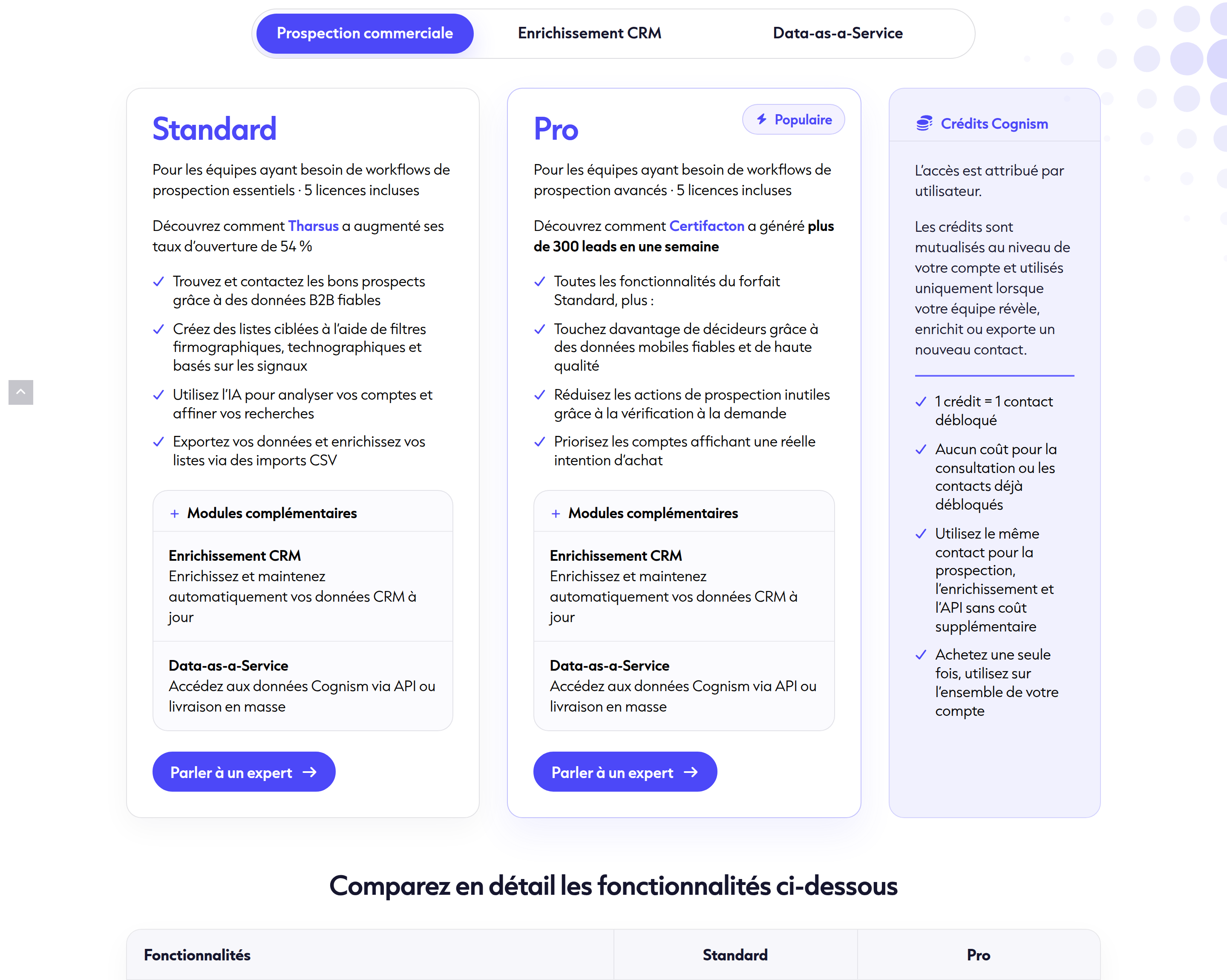
Cognism's pricing page promises transparent pricing and publishes none. It lays out three product families: sales prospecting, CRM enrichment and Data-as-a-Service. Only the first is packaged into plans, and there are two of them.
Standard targets teams that need the essential prospecting workflows. Pro targets teams that want advanced targeting. Both include five licences. That is the single most important detail on the whole page, and it is easy to miss: the contract starts at five users. A solo rep who wants Cognism is therefore paying for a structure sized for a team.
The real difference between Standard and Pro
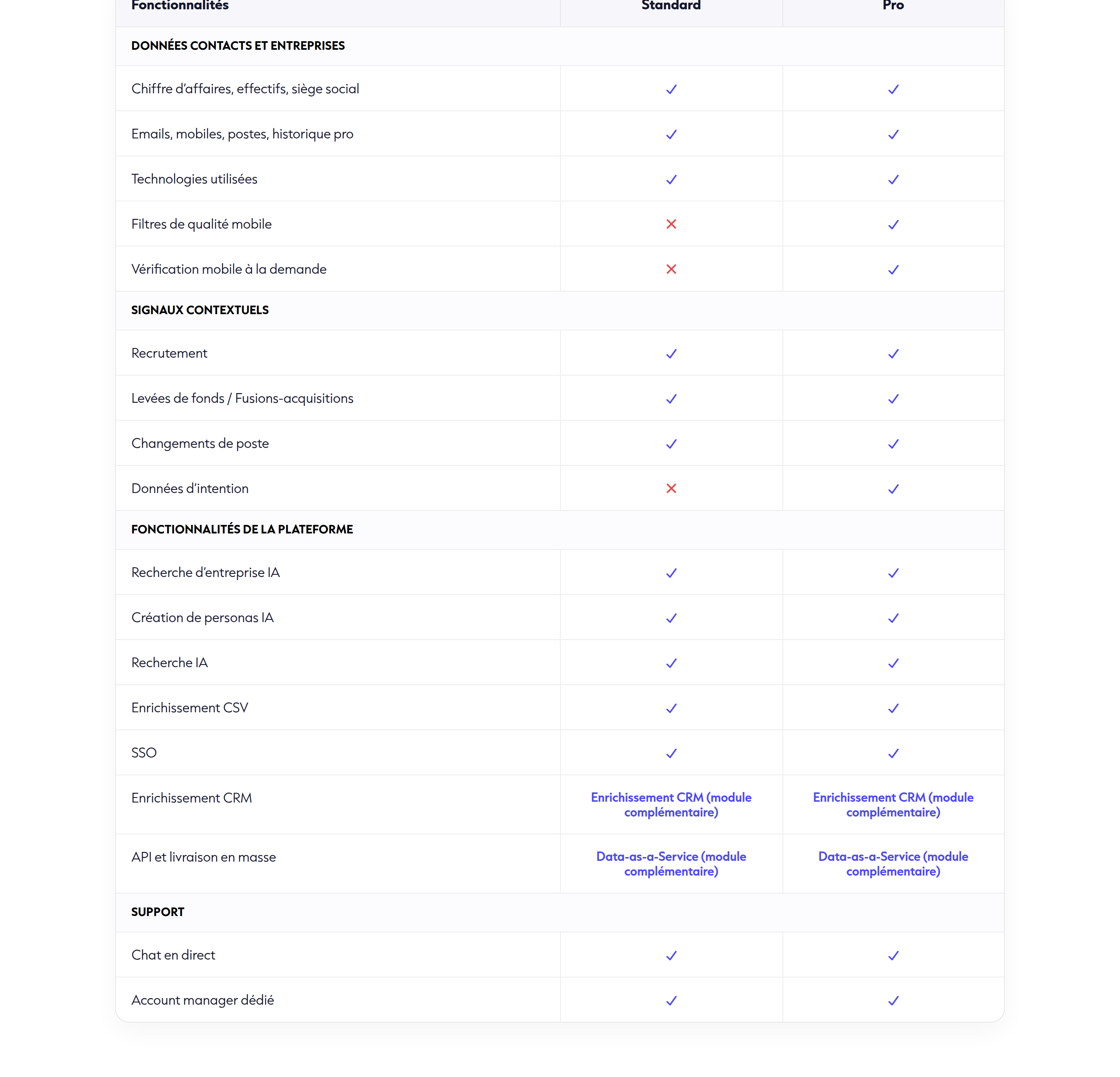
The official feature comparison finally tells you what you are buying when you move up a tier, which is rare for a vendor that hides its prices. Only three lines change, and all three concern phone data and signals.
Standard gives you company data, emails, mobile numbers, job titles and work history, technologies used, hiring, funding and job change signals, AI search, persona building, CSV enrichment, SSO and live chat.
Pro adds exactly four things: mobile quality filters, on-demand mobile verification, buying intent data and the dedicated account manager. That is the entire delta. You pay roughly 67% more, at the same headcount, for those four blocks.
The math gets concrete on a typical team. Ten reps on Standard is about $30,000 a year. The same ten reps on Pro is about $50,000. That $20,000 annual gap buys verified mobile numbers and intent signals. If your team is on the phone every single day, the question is worth asking seriously. If your team runs cold email, the answer is no.
The median signed contract: $36,000 a year
This is the most solid number in the article, because it does not come from a theoretical tier but from real contracts. The software buying platform Vendr, which negotiates and indexes software deals, publishes a median value of $36,000 per year for Cognism, within a range running from $18,350 to $93,886, calculated across 108 verified purchases. The average saving obtained through negotiation there is 25.91%.
A second source, which tracks software spend across more than 1,300 companies, breaks the market down by company size: $29,004 per year on average for small and mid-market businesses, and $92,679 for enterprise accounts. The same dataset puts Cognism roughly 40% cheaper than ZoomInfo in the SMB segment, but three times more expensive than Apollo and seven times more expensive than Lusha.
So remember the range rather than a single price: a Cognism contract most often falls between $22,000 and $40,000 per year, with a median around $36,000. One European buyer reported roughly $20,000 for twelve months and ten users, which is what the bottom of the range looks like once the negotiation has actually been fought.
Public pricing, not a five-figure quote
Emelia shows its prices: email finder, cold email, LinkedIn and warmup from €37/month.
How Cognism credits work
This is the part of the model Cognism documents best, and it deserves to be understood before you sit down with the quote, because it is more generous than most people assume.
One credit equals one unlocked contact. Credits are pooled at the account level, not handed out seat by seat: what is named is the platform access, not the stock of credits. A credit is only burned when someone on your team reveals, enriches or exports a new contact.
The genuinely interesting part comes next. Once a contact is unlocked, you can view it and reuse it for the entire duration of the contract without paying again. A credit is only re-spent on that contact if the person changes company. And the same pool serves the prospecting platform, the enrichment module and the API interchangeably, at no extra cost.
That is a far healthier model than the pay-per-view billing you find elsewhere. It comes with a catch: the credit allocation is never published. It is negotiated into the contract, and it is what actually determines the unit cost of your data. Additional credits can be bought at any time, also at a negotiated rate.
What a contact really costs at Cognism
Since neither the price nor the allocation is public, the only honest calculation is to start from the median contract and vary the allocation. Here is what a $36,000 per year contract looks like depending on the credit volume you negotiate.
Credits negotiated per year | Cost per unlocked contact | What it means |
|---|---|---|
5,000 | $7.20 | Tight allocation, very high unit cost |
10,000 | $3.60 | Roughly an entry-level ZoomInfo contract |
25,000 | $1.44 | Reasonable territory for a team prospecting daily |
50,000 | $0.72 | Best case, reserved for negotiated high volumes |
100,000 | $0.36 | Rare, in practice limited to enterprise deals |
The conclusion is unambiguous: at Cognism, the line that decides your cost per contact is not the contract price, it is the credit allocation. Two companies signing for the same amount can end up paying ten times more per record than each other. That is the first thing to work on in negotiation, before you even touch the discount on the headline figure.
A market benchmark helps you place yourself. An Apollo credit works out to roughly $0.02. A Lusha email credit costs about $0.12 on the entry plan and falls toward $0.08 at high volume. At Kaspr, an extra phone credit is published between $0.36 and $0.21 depending on volume, and works out to about $0.49 if you charge the whole entry subscription to the phone quota alone, bearing in mind that it also includes unlimited B2B email. A RocketReach export runs around $0.25. Cognism is clearly not playing in that category, and does not claim to be: the data is verified differently, which brings us to Diamond Data.
Diamond Data: what a verified number actually costs
This is Cognism's central sales argument and the reason teams accept the price. A Diamond contact is a contact whose mobile number has been verified by a real phone call, not by an algorithm. Cognism claims up to three times the connect rate on those numbers. That figure is self-reported. The vendor does publish supporting data, notably 45% of calls reaching the right person versus 18% on an unverified number, but the vendor credits it to a study whose methodology is not published. Treat it as a sales promise to be verified on your own accounts during the first weeks of the contract, not as an established fact.
The mechanism is called Diamonds-on-Demand. You select your priority prospects, submit them to the verification engine, and the request comes back with one of three verdicts: verified, improved when new data was found without reaching the Diamond standard, or no improvement. Success rates communicated by the vendor hover around 10 to 15% in the United Kingdom and 15 to 20% in the United States.
Those two numbers are worth pausing on, because they tell you more than the marketing promise does. Submitting a hundred contacts to on-demand verification statistically gets you between ten and twenty Diamond records back. That is not a product flaw, it is the reality of phone verification, but it does mean Diamond Data is sized around your priority accounts, not around a list of several thousand rows.
On the invoice side, two things matter. The feature is Pro-only, so its cost of entry is the gap between Standard and Pro, roughly $10,000 of platform fee plus $1,000 per licence per year. Buyers also report a monthly request cap in the region of fifty contacts, a turnaround time of about 48 hours, and Diamond contacts counted as two credits rather than one. Those last points are not published by the vendor and vary from contract to contract.
Why Cognism doesn't publish its prices
This is not an oversight, it is a commercial mechanism. A hidden price lets the vendor tune the quote to whatever the buyer looks able to pay, and turns the first number quoted into an anchor rather than a rate. The first amount proposed is almost never the final amount.
The negotiation data backs that up. The average discount recorded by Vendr is 25.91%. Ranges reported by buyers climb to 28 to 43% on the entry plan and 36 to 52% on the higher plan, especially at quarter end, when the vendor's own sales targets weigh more than the margin on any single deal, and when a competing quote is sitting on the table.
The consequence is direct: at Cognism, what you end up paying depends as much on your preparation as on your actual needs. The table above is a negotiating starting point, not an invoice.
The costs that don't show up in the first quote
The platform and licence figures are only part of the bill. Several other line items get added on top, documented consistently across buyer reports.
Onboarding and training fees, generally $500 to $1,500, with amounts of $2,000 to $5,000 reported on some structured contracts.
Additional intent topics, beyond the bundle included in Pro, billed in the region of $200 to $400 per topic per year. A full expansion runs between $1,600 and $6,000 annually.
Credits consumed beyond the allocation, repurchasable at any time at a negotiated and unpublished rate.
CRM enrichment and Data-as-a-Service, which are add-on modules billed outside the prospecting plan, including on Pro.
Renewal increases, typically 10 to 15%. The observed spend data is harsher: plus 14.1% on average for SMBs and plus 57.3% for enterprise accounts year over year.
On top of that come contractual terms that weigh as much as the price. The commitment is annual and paid up front, there is no monthly option. Renewal is automatic, with a written cancellation notice of 60 to 90 days depending on the contract. There is no free trial, only a data sample. And the scope cannot be reduced mid-term: if you oversize at signature, you pay for the oversizing for twelve months.
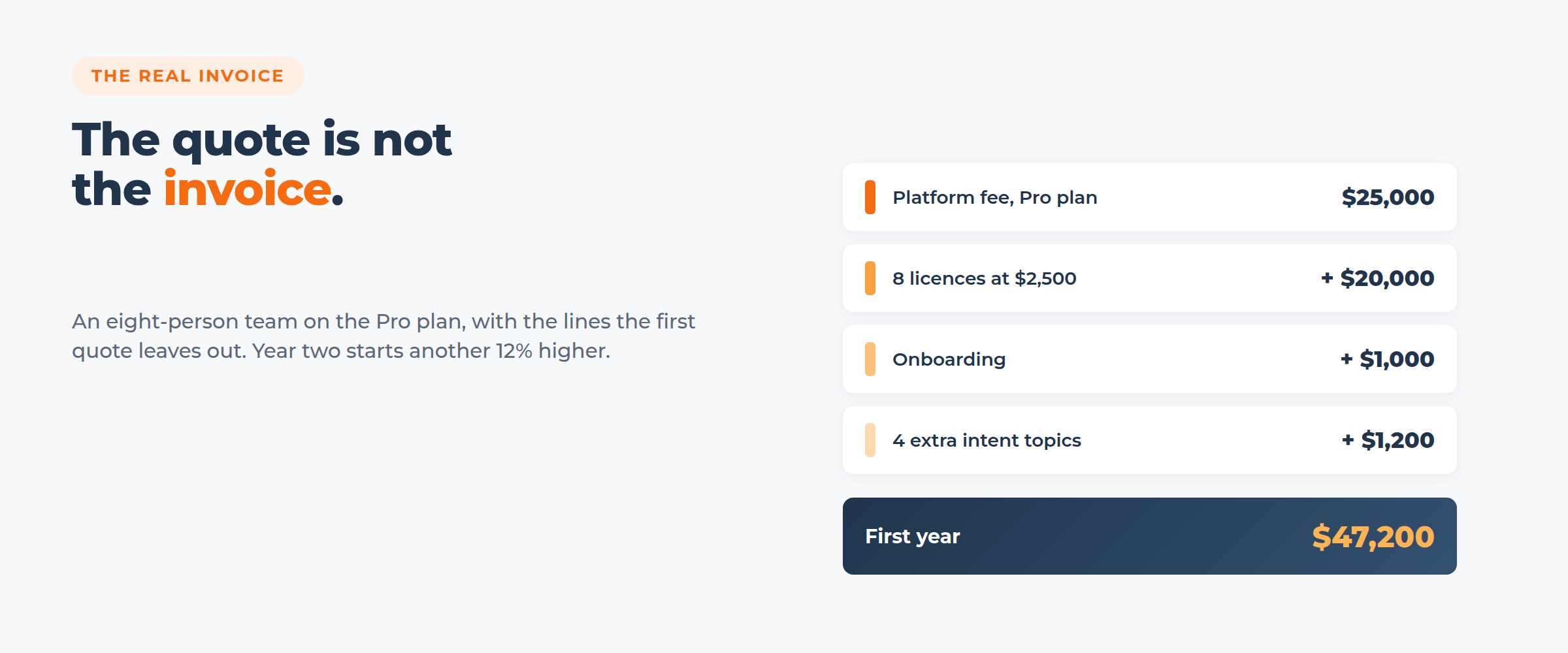
A worked example makes it tangible. An eight-person team on Pro lands at roughly $25,000 of platform fee plus eight licences at $2,500, so $45,000 a year. Add $1,000 of onboarding and four extra intent topics at $300, and you are at $47,200 in year one, before any credit overage. In year two, the onboarding fee does not recur: the recurring base is $46,200, and with a 12% increase the bill moves to about $51,700.
No annual contract, no cancellation notice
Monthly subscription, cancel anytime, free trial. From €37/month.
What Cognism delivers for that price
The question is unavoidable when competing tools start at $45 per month. The answer fits in one sentence: Cognism is not selling an email finder, it is selling a compliant European database and phone data verified by hand. Here is what the contract actually covers.
A contact and company database with claimed depth across Europe, in a market where most US competitors are excellent in the United States and approximate everywhere else.
Mobile numbers verified by phone call, the famous Diamond Data, with a promise of connect rates multiplied by three on the relevant segments.
A compliance foundation rarely matched in this market: GDPR alignment, compliance with US state privacy laws, automatic suppression against do-not-call lists worldwide, ISO 27001 and 27701 certifications, SOC 2 Type II.
Decision-maker data advertised as refreshed every 30 days.
Contextual signals included from Standard: hiring, funding rounds and merger and acquisition activity, job changes. Buying intent data, on the other hand, is Pro-only.
Firmographic, technographic and signal-based filters, with AI-assisted search, a persona generator and automated company analysis.
CSV enrichment, SSO, CRM integrations and API access, the last two through add-on modules.
Live chat on both plans, and a dedicated account manager reserved for Pro, which is not nothing when you are signing a five-figure deal.
It is the combination of compliance plus European data plus verified numbers that justifies the positioning, and that is what you are buying. User ratings follow: 4.5 out of 5 on G2 and 4.7 out of 5 on Capterra, with more than 4,000 client companies claimed.
Which leaves the question that decides whether it pays off: are you actually using those blocks? A team calling European decision-makers every day in a regulated sector will earn the contract back. A team using Cognism as a directory to export addresses is paying for compliance and phone verification it never touches.
Cognism's limitations to know before you sign
The exercise would be dishonest without the list of weak points, and they are real.
Pricing opacity is the complaint users raise most. You cannot budget without going through a full sales cycle, you cannot compare without spending several weeks on it, and you cannot tell whether the quote you received is in line with the market. That is precisely what this article exists to fix.
The absence of a free trial and of monthly billing closes the door on any progressive validation. You commit to twelve months paid up front on the strength of a demo and a data sample.
Coverage is excellent in Europe and good in North America, patchier elsewhere. In Asian or Latin American markets, the depth of the database no longer justifies the same price.
The functional scope stops at data and targeting. Cognism does not warm up sending inboxes, does not automate LinkedIn and does not replace a sending platform. Those blocks have to be bought elsewhere, and they weigh heavily on an outbound team's total budget.
Finally, a piece of context every buyer signing a twelve-month deal should know: the company's leadership has changed twice recently. Co-founder James Isilay stepped down as chief executive in February 2025, Pete Daffern served as interim, and Dominic Allon, formerly of Pipedrive, was appointed chief executive in September 2025, alongside Chris Evans as chief revenue officer. A transition of that scale is often followed by revisions to packaging and pricing policy, which the plan renaming already illustrates.
Platinum, Diamond, Grow, Elevate, Standard, Pro: decoding the old names
A quick word to avoid confusion, because half the quotes and comparisons in circulation still use the old naming. The plans used to be called Platinum and Diamond, were renamed Grow and Elevate, and today go by Standard and Pro. Diamond Data, on the other hand, is still the name of the verified phone data: it is a feature, no longer a plan.
Old name | Interim name | Current name | Positioning |
|---|---|---|---|
Platinum | Grow | Standard | Contact and company data, base signals |
Diamond | Elevate | Pro | Adds mobile quality, on-demand verification and intent |
If a quote or a comparison still talks to you about Platinum and Diamond, it predates the renaming. The orders of magnitude still hold, the plan contents have shifted at the margins.
Who Cognism pays off for, and who it doesn't
Cognism defends itself very well in one precise case: a structured sales team of at least five people, a European or UK market, a sales cycle built on the phone call, a high average deal size, and a strong compliance requirement, typically in finance, healthcare or enterprise services. In that context, $36,000 a year is earned back with a handful of deals, and verified phone data makes a measurable difference to connect rates.
It becomes hard to justify in the opposite case, which also happens to be the most common one. A small team, one or two reps, an average deal size of a few thousand euros, prospecting that runs 90% through email: the five-licence minimum, the prepaid annual commitment and the automatic renewal turn a tool into a fixed cost that is difficult to get out of the budget. You are paying the phone premium without ever picking up the phone.
The middle case is the most frequent and the worst served: a team that needs a database for targeting and an execution platform for sending. Cognism covers only the first half, and on its own costs more than the entire set of tools that cover the second.
Six Cognism alternatives and their prices
Here are six tools that address all or part of Cognism's scope, with rates checked in August 2026. A word on method: the billing mode is stated every time, because half of these vendors display a monthly price by default that in fact assumes an annual commitment. These price lists move fast, check the vendor's page before you sign.
ZoomInfo
ZoomInfo is the head-on competitor, and the only one playing in the same price and depth category. Its database is broader, its org charts and website visitor identification have no equivalent at Cognism, but its European data has a reputation for being less reliable and its compliance story is less convincing in a GDPR market.
ZoomInfo pricing
ZoomInfo Lite: free, 10 credits per month, 25 through the Community Edition
Professional: around $14,995 per year, 5,000 credits, 3-seat minimum
Advanced: around $24,995 per year, adds intent and signals
Elite: from $39,995 per year
ZoomInfo has since renamed its sales tiers to ZoomInfo Professional, Copilot Advanced and Copilot Enterprise: the orders of magnitude still hold, the names circulating in comparisons are outdated
Additional user licence: $1,500 to $2,500 per year
Median signed contract recorded by Vendr: $33,500 per year, below Cognism's
Apollo.io

Apollo.io is the head-on alternative on volume for money: a database of more than 275 million contacts, sequences, a dialer and enrichment in the same tool, with a public price list and a free plan. The model is the exact opposite of Cognism's, since Apollo bills per seat at a few tens of dollars per month.
Apollo.io pricing
Free: free, 900 credits per seat per year
Basic: $49 per seat per month billed annually, $65 monthly, 30,000 credits per seat per year
Professional: $79 per seat per month billed annually, $99 monthly, 48,000 credits per seat per year
Organization: $119 per seat per month billed annually, three-seat minimum, 72,000 credits per seat per year
That works out to roughly $0.02 per credit across the whole paid range
Lusha

Lusha is the self-service entry point of the B2B data market, with a browser extension and a public price list. Against Cognism, its appeal is budgetary and immediate, but the consumption model deserves attention: a phone number costs ten credits where an email costs only one.
Lusha pricing
Free: free, 40 credits per month, 1 seat
Starter: $49.90 per month at list price, roughly 25% less on annual billing, 4,800 credits per year, 1 seat
Pro: $69.90 per month at list price, 7,200 credits per year, 2 seats
Premium: $399.90 per month at list price, 40,800 credits per year, 5 seats
Scale: quote only, custom credits and seats
Kaspr

Kaspr is the clearest European answer to Cognism: prices displayed in euros, unlimited B2B email from the first paid plan, and credit billing reserved for phone numbers and personal emails. It is the exact counter-model to the negotiated annual contract, with one limit to keep in mind, the annual export quota.
Kaspr pricing
Free: free, 15 B2B email credits, 5 phone credits, 5 personal email credits
Starter: $49 per user per month billed annually, $65 monthly, unlimited B2B email and 1,200 phone credits per year
Business: $79 per user per month billed annually, $99 monthly, unlimited B2B email and 2,400 phone credits per year
Enterprise: quote only, annual commitment and five-user minimum
Published additional phone credits, from $0.36 down to $0.21 per unit depending on volume
RocketReach

RocketReach switches to unlimited lookups as soon as you pay annually, which makes it the best fit for a solo researcher or a small cell. The constraint then moves from the number of lookups to the number of annual exports, and that is the line to watch.
RocketReach pricing
Free account: 5 lookups, no credit card
Essentials: emails only, around $39 to $69 per month, or $229 to $399 per year, with 1,200 annual exports
Pro: emails and phone numbers, around $79 to $119 per month, or $619 to $899 per year, with 3,600 annual exports
Ultimate: around $209 per month, or $1,379 to $2,099 per year, with 10,000 to 20,000 annual exports depending on the source
Enterprise: from $6,000 per year
On annual billing lookups become unlimited: the export quota is the real limit
RocketReach is the only vendor in this comparison whose public price list moved several times in 2026 and whose page does not display its rates readably. The ranges above cover the most recent readings, check the page before signing
Wiza

Wiza approaches the problem from the other end: instead of buying access to a database, you extract and enrich your own lists from LinkedIn and Sales Navigator. Like RocketReach, it switches to unlimited reveals on the annual commitment and moves the limit onto a monthly export quota.
Wiza pricing
Free: free, 20 valid emails and 5 phone numbers
Starter: $49 per user per month, monthly billing only, 100 emails and 100 numbers per month
Email: $99 per user per month, or $990 per year with unlimited email reveals and 2,500 exports per month
Email + Phone: $199 per user per month, or $1,990 per year with unlimited emails and numbers
Team: quote only, from three users, annual billing only
Entry price comparison
Tool | Entry ticket | What it includes | Price shown |
|---|---|---|---|
Cognism | Quote, 5 licences included, annual commitment | European database, verified numbers on Pro, compliance | No |
ZoomInfo | Quote, 3-seat minimum, annual commitment | Global database, org charts, intent depending on tier | No |
Apollo.io | $49 per seat per month with annual commitment | 30,000 credits per seat per year, sequences, dialer | Yes |
Lusha | $49.90 per month at list price | 4,800 credits per year, 1 seat | Yes |
Kaspr | $45 per user per month with annual commitment | Unlimited B2B email, 1,200 phone credits per year | Yes |
RocketReach | around $19 to $33 per month on annual billing, $229 to $399 per year | Unlimited lookups, 1,200 exports per year | Yes |
Wiza | $49 per user per month, monthly only | 100 emails and 100 numbers per month | Yes |
The reading is clear. Of the seven tools compared, only two hide their prices, and they are precisely the two selling a five-figure annual contract. The other five publish a price list and start between $45 and $100 per month. The budget gap between those two families is not marginal, it spans two orders of magnitude.
One detail runs against intuition and deserves to be flagged: the median Cognism contract, $36,000 a year, is higher than ZoomInfo's, $33,500. The gap is modest, around 7%, but it runs against intuition: the European premium option is therefore not the economical choice against the American one, it is simply the compliant one.
Cognism or Emelia: what actually compares
Let's say it upfront to avoid a dishonest comparison: Emelia is not a database and does not claim to replace Cognism's catalogue. There are no intent signals, no manual phone verification, no compliance foundation designed for an enterprise procurement department. The perimeter shared by the two tools comes down to two blocks, finding contact data and starting the conversation.
On that perimeter, the approaches are opposites. Cognism sells you access to a stock you query, with an annual allocation fixed at signature and lost if you don't consume it. Emelia sells you a flow: on-demand address lookup, built-in email verification, phone number lookup, then everything Cognism doesn't do, inbox warmup, cold emailing with no sending cap and LinkedIn automation with Sales Navigator scraping.
The no-quote alternative to Cognism
Address lookup, verification, cold email and LinkedIn in one subscription, from €37/month.
Emelia pricing
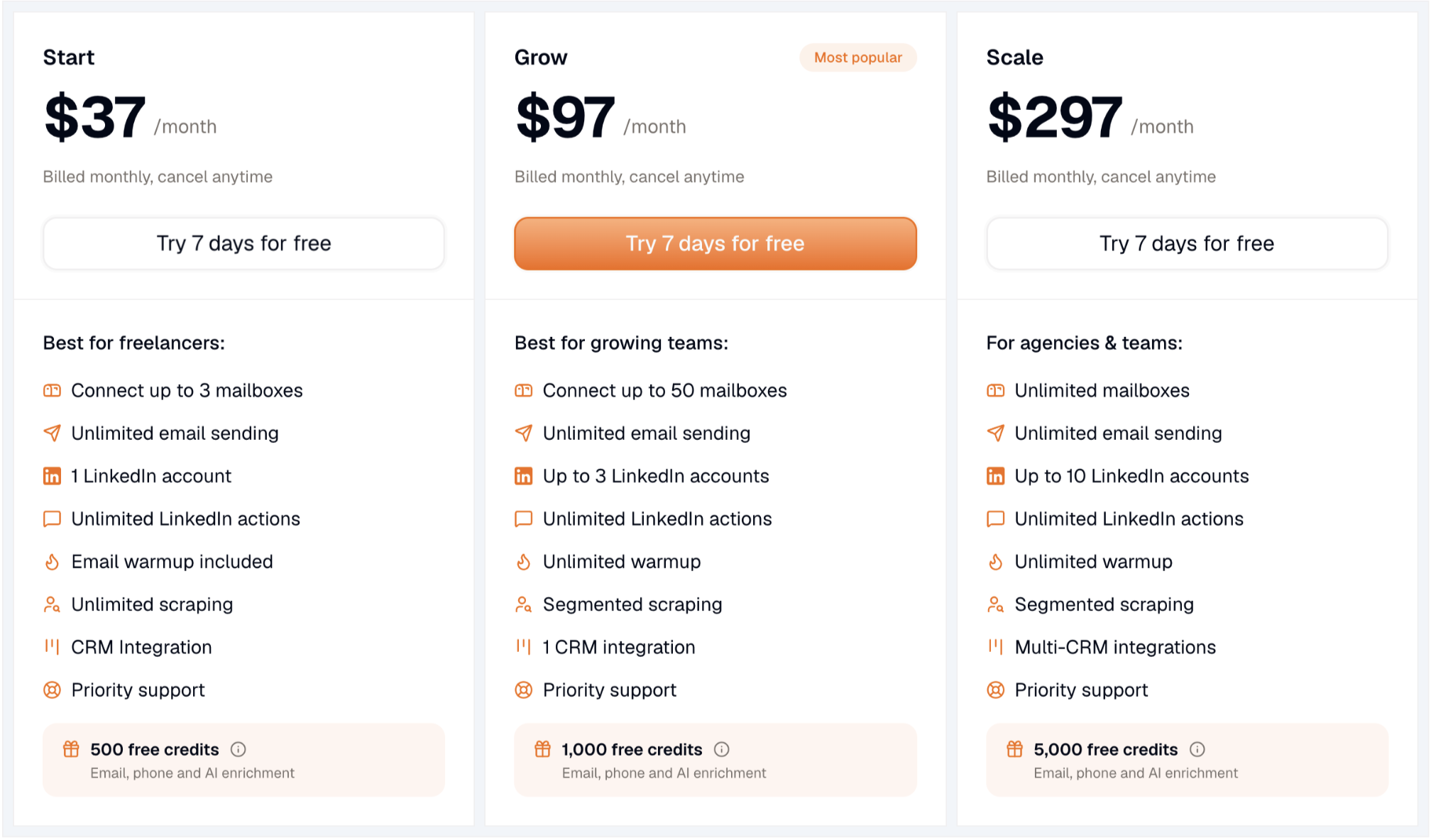
Emelia publishes its price list, in three tiers at $37, $97 and $297 per month, with no commitment and two months free on annual billing. The tiers differ by the number of connected sending inboxes, the number of LinkedIn accounts and the volume of credits included. Email sending is unlimited across the whole range, warmup is active from the first tier, and contacts are unlimited. These tiers describe sending capacity, not headcount: a connected mailbox is not a user, and Emelia does not offer a team mode yet.
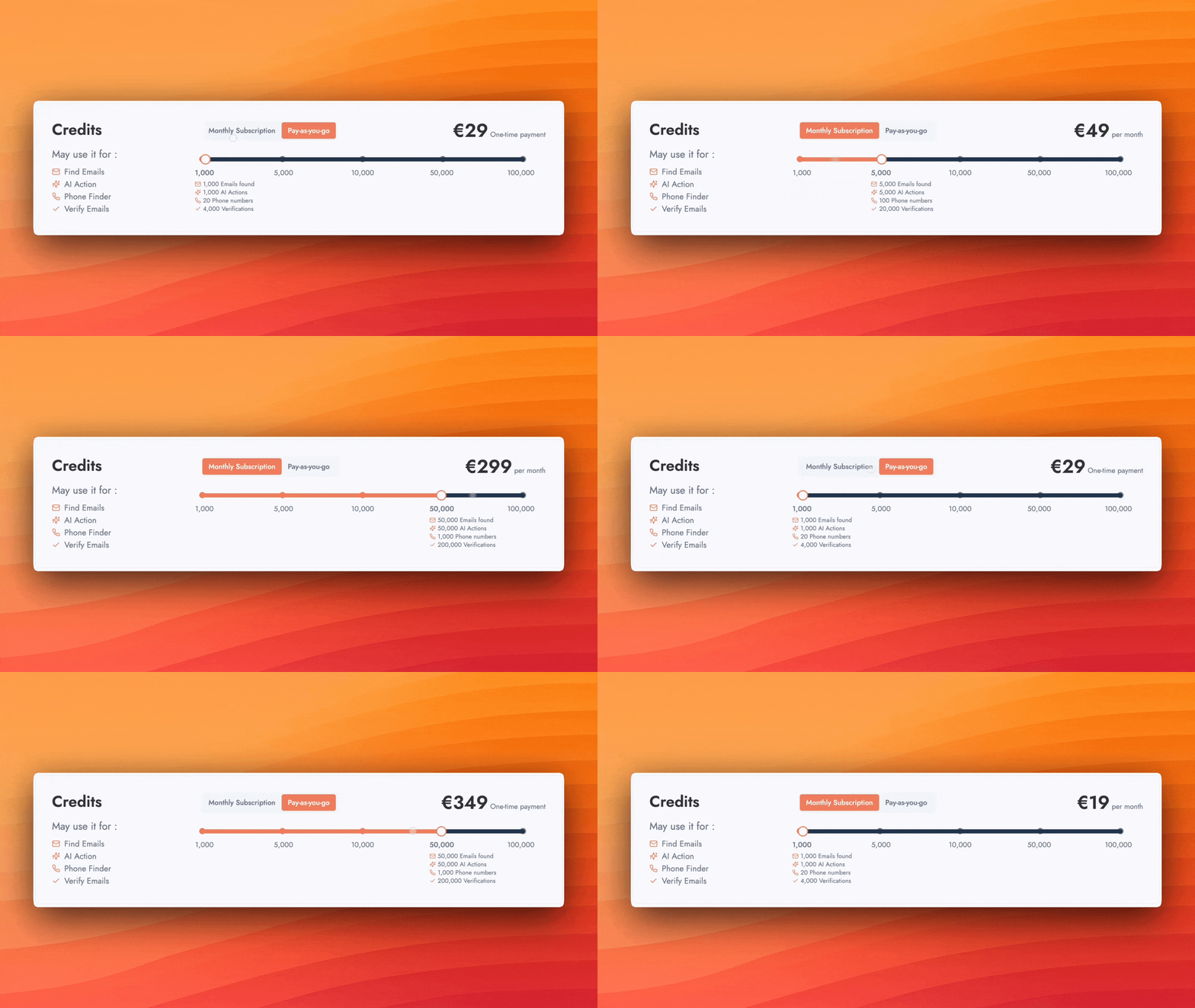
Credits are used only for the email finder, phone number lookup, AI actions and address verification. They are optional: if all you do is send emails and run LinkedIn actions, you don't need any. The first tier works out to $19 per month for 1,000 credits, which covers 1,000 emails found, 1,000 AI actions, 20 phone numbers or 4,000 verifications.
One decisive point against a database: the LinkedIn Sales Navigator scraper is included in all three plans, with no cap, and consumes no credits. That is how a team builds its lists without buying access to a stock of records: you run a Sales Navigator search with its filters and it feeds a campaign directly. Credits are only used for the email finder, the phone lookup, AI actions and address verification.
Criterion | Cognism | Emelia |
|---|---|---|
Model | Quote, prepaid annual contract, automatic renewal | Monthly subscription, public pricing, no commitment |
Entry ticket | Around $22,500 per year, 5 licences included | $37 per month with no commitment, about $31 on annual billing, a single subscription with no seat concept |
Database | Queryable European database, credit allocation | No database: on-demand lookup |
Call-verified numbers | Yes, Diamond Data on the Pro plan | No, phone lookup on credits |
Intent signals | Yes, on the Pro plan | No |
Address verification | Included, on credits | Included, on credits |
Cold email sending | Not offered | Included, unlimited sending |
Inbox warmup | Not offered | Included on every inbox |
LinkedIn automation | Not offered | Included, Sales Navigator scraping |
Trial | Data sample only | Free trial |
Cognism wins on the depth of its European data, on phone verification and on everything that falls under contractual compliance. Emelia wins on execution and on cost of entry. If your bottleneck is reaching hard-to-find European decision-makers by phone, no $37 tool is going to solve it. If your bottleneck is sending cleanly to addresses you already know how to find, a $36,000 contract is a wildly disproportionate answer.
How to negotiate Cognism if you go ahead anyway
If Cognism is still the right call for your team, here are the levers that come out of buyer feedback, ranked by effectiveness.
Negotiate the credit allocation before the price. This is the point made above: at an equal contract value, doubling the allocation halves your cost per contact. Sales reps concede data volume far more easily than headline dollars, because the second one is what counts for them.
Show up with a competing quote. ZoomInfo, Apollo and Lusha are the three names that move the needle. The steepest discounts reported, up to half the initial price on the higher plan, are consistently tied to a documented competitive process.
Sign at quarter end. It is a classic of enterprise software and it works here as well as anywhere. The last month of a fiscal quarter changes your counterpart's disposition.
Cap the renewal increase in the initial contract. This is the most profitable and most forgotten clause. Without a written cap, year two starts 10 to 15% higher, and considerably more on accounts that have grown. Negotiating a 5% cap costs one sentence and saves several thousand euros.
Check the cancellation notice and put a reminder in your calendar. A 60 to 90 day notice period means you have to decide not to renew before you have even finished exploiting year one.
Start with Standard. Moving up to Pro can be negotiated along the way, the reverse is never possible. If you are not certain you will use mobile verification and intent, don't pay for them in advance.
Should you pay for Cognism in 2026?
The answer hinges on a single question: do you call European decision-makers every day? If yes, Cognism remains the best product in its category for that specific use case, and the Diamond Data premium is amortized by the connect rate. The compliance foundation, with automatic do-not-call suppression and security certifications, adds real value for any organization whose legal team reviews vendor contracts.
If the answer is no, the math becomes hard to defend. Five licences minimum, a prepaid annual commitment, automatic renewal, no free trial, and a cost per contact that depends on an allocation you won't know until you sign: that is a lot of constraints for a team whose need boils down to finding valid addresses and contacting them cleanly.
The market has moved in a direction that does not favor opaque models, either. Buyers now compare cost per credit, aggregators publish median contract values, and pricing transparency has become a selling point in its own right. The plan renaming and the leadership change at Cognism suggest the vendor knows it. The real question for the coming months is not whether Cognism is worth its price, but whether it will ever show it.
Frequently asked questions about Cognism pricing
How much does Cognism cost per year?+
A Cognism contract most often lands between $22,000 and $40,000 per year, and the median signed contract sits at $36,000 annually, measured across 108 verified purchases within a range running from $18,350 to $93,886. The price is built on two floors: an annual platform fee of around $15,000 on Standard or $25,000 on Pro, then a licence billed at around $1,500 or $2,500 per user per year. Five licences are included in both plans, so a five person team pays roughly $22,500 a year on Standard and $37,500 on Pro. None of this appears on the pricing page, which shows only the two packages and a button to contact sales. Negotiation moves the number substantially: the average discount obtained is around 26%, with cases reported up to half the initial price on the higher plan.
Does Cognism offer a free trial?+
No. There is no free trial, no free plan and no monthly billing at Cognism. The most you can obtain before signing is a sample of data and a demo with a sales rep. The commitment is annual and paid up front, it renews automatically, and cancelling requires written notice of 60 to 90 days depending on the contract. That absence of progressive validation is the main friction point for teams asked to commit $22,500 or more for twelve months on the strength of a demo.
Is there a minimum number of users at Cognism?+
Yes, five. Both Standard and Pro include five licences in the contract, which sets a billing floor even for a single sales rep. That puts the entry ticket at roughly $22,500 a year on Standard and $37,500 on Pro, since the annual platform fee of around $15,000 or $25,000 already covers those five seats. Additional licences are then billed on top at around $1,500 per user per year on Standard and $2,500 on Pro. It is one of the least visible details of the offer and one of the most structural for a small team.
Can you cancel Cognism mid-year?+
No. The contract is annual and prepaid, with no monthly option, so there is no way to stop paying partway through the twelve months. Renewal is automatic and cancelling requires written notice of 60 to 90 days depending on the contract, which means the decision not to renew has to be taken before you have finished exploiting year one. The scope cannot be reduced mid contract either: if you sign for ten licences and only use four, you pay for ten until the term ends. With a median contract at $36,000 a year and licences at $1,500 to $2,500 each, oversizing at signature is an expensive mistake.
Why doesn't Cognism show its pricing?+
Because a hidden price is a commercial mechanism rather than an oversight. It lets the vendor adjust each quote to what the buyer looks able to pay, and turns the first number quoted into an anchor instead of a rate. The evidence is that the first amount is almost never the final one: the average negotiated discount is around 26%, and buyers report reaching half the initial price on the higher plan, especially at quarter end with a competing quote on the table. The result is a median of $36,000 a year but a spread from $18,350 to $93,886 across 108 verified contracts for the same product, and a published price list that shows only Standard, Pro and a contact button.
What is the cheapest alternative to Cognism?+
It depends on what you are actually replacing. For a database of comparable depth, ZoomInfo is the only direct competitor, with a slightly lower median signed contract, but it sits in the same five figure annual bracket. To cut the contact finding budget drastically, Apollo.io, Lusha, Kaspr, RocketReach and Wiza all publish their price lists and start between $45 and $100 per month. For campaign execution, which Cognism does not cover at all, Emelia starts at $37 per month with no commitment. Against a median Cognism contract of $36,000 a year, those published options sit roughly two orders of magnitude lower.