Dropcontact starts at $79 per month for 500 credits, and rises to $120 for the same volume on the Growth plan. The grid is public, displayed in euros, with no quote and no user minimum. On paper, it is simple.
The maths are a little less so, and for a reason that has nothing to do with the advertised figure. Dropcontact does not belong to the same family of tools as most of those it gets compared to. It does not sell access to a contact database: it does not own one. It recomputes the data on every request, and only bills you when it finds it.
That difference in nature governs everything else in this article. So we will start there, then work through the grid, the lines that do not appear on the pricing page, the real cost per contact, and finally the alternatives, sorted by that same logic.
A word on Emelia, which we compare Dropcontact to further down: it belongs to exactly the same family, and shares two precise building blocks with it, finding a business email address and verifying it. Those two blocks, and only those, are where a comparison makes sense.
Stock or flow: the distinction that governs the whole calculation
The B2B data market splits into two families, and nobody says it clearly enough when the time comes to compare prices.
On one side, the stocks. ZoomInfo, Cognism, Apollo and Lusha sell access to a database of records already built. You query a warehouse. The credit is spent per request, whether the record is fresh, stale or wrong, so you have to correct the advertised price by the share of genuinely usable data to know your real cost.
On the other side, the flows. Dropcontact and Emelia store nothing. On every request, the engine starts from a name and a company, searches, cross-checks and verifies, then returns a result or nothing at all. The credit is only deducted on a result.
The implication is simple but decisive: with a flow tool, the advertised price per credit is also the effective price per contact obtained. With a stock tool, it almost never is.
An example puts a number on the gap. A file of 1,000 rows sent to a stock tool that returns 55% usable results costs you 1,000 credits for 550 contacts, meaning a real cost per contact nearly double the advertised rate. At Dropcontact, 550 contacts found cost 550 credits, and the 450 failures are credited back to you.
This is also what underpins Dropcontact's GDPR argument: no database of individuals, therefore no stock of personal data to justify. The data is rebuilt on demand from public sources and algorithmic cross-checks.
The trade-off is just as structural, and worth knowing before you reach for the card: a flow tool cannot build a list. You cannot ask Dropcontact for every CFO at a mid-sized company in Lyon, because it has nothing to query. It completes what you bring it, it does not find it for you.
How much does Dropcontact cost in 2026? The full grid
Here are the three offers, at the entry volume. The advertised price corresponds to 500 credits per month, or 6,000 credits per year, and it rises with the volume you select.
Plan | Per month | Billed annually | Credits included | Credit rollover |
|---|---|---|---|---|
Trial | Free | Free | 50 credits on signup | - |
Starter | $79 | around $63 per month | 500 per month, 6,000 per year | No |
Growth | $120 | around $96 per month | 500 per month, 6,000 per year | Yes |
Enterprise | On quote | On quote | from 200,000 per month | On quote |
Two important clarifications. First, annual billing gives a 20% discount, which brings Starter to around $63 and Growth to around $96 per month. Second, the volume is not fixed: the pricing page offers a selector with ten steps, from 500 to 150,000 credits per month, and the price follows the volume chosen. So $79 and $120 are an entry point, not a single rate.
The free trial: 50 credits, no card
Dropcontact gives 50 credits on signup. That is small in volume, but enough for what actually matters here: measuring the hit rate on your own files. Upload a hundred rows representative of your target, see how many come back enriched, and you will have the one figure that lets you calculate your real cost. No pricing comparison replaces that test.
Starter at $79: enrichment and verification
The Starter plan covers the core of the product: business email lookup, B2B enrichment, native address verification with catch-all detection, enrichment of CSV, XLS or TXT files, access to the API and the MCP server, the Google Sheets add-on and email support.
At 500 credits per month, that puts a credit at $0.158 monthly and around $0.126 annually. Unused credits are lost at the end of the month on this plan.
Growth at $120: LinkedIn and data cleaning
The Growth plan adds the functions that save time on an existing base: enrichment from LinkedIn without having to log in, LinkedIn URL enrichment, AI-powered job title cleaning and classification, company change detection, matching a company name to its domain, and company data enrichment.
Above all it brings credit rollover from one month to the next, which matters a great deal for irregular activity.
The point to understand: at equal volume, Growth costs around 52% more than Starter. You are not paying for more credits, you are paying for features. The credit goes to $0.24 monthly and around $0.192 annually.
Enterprise: from 200,000 credits per month
Above that, Dropcontact moves to a quote, from 200,000 monthly credits, with priority enrichment, real-time enrichment notifications and dedicated support. No figure is published, and the volume jump from the public tier is considerable.
Find and verify your prospects' addresses
Email finder and email verifier included, credits deducted only when the address is found.
What Dropcontact delivers for that price
Dropcontact is neither a database nor a prospecting extension. It is an engine you plug into files or a CRM. Here is what the subscription covers.
Business email lookup from a name and a company, with no pre-existing stock of records.
Native address verification, with catch-all detection, included in the same credit as the enrichment.
Enrichment of CSV, XLS and TXT files, straight from the app.
A Google Sheets add-on to enrich a spreadsheet without going through an export.
An API and an MCP server available from the Starter plan, which is rare at this price point.
Company data delivered in the same credit as the address: domain, legal identifiers, headcount, sector.
Data cleaning from the Growth plan: job titles normalised and classified by AI, company-name-to-domain matching, job change detection.
It is worth noting what Dropcontact does not do, because it determines what you will still have to buy: no phone numbers, at any tier. No LinkedIn reveal extension, no email sequences, no warmup, no LinkedIn automation. And, as covered above, no ability to build a list from criteria.
The costs that do not show up in the advertised price
The grid is honest, but three elements weigh on the real bill and do not appear on it.
The monthly floor. At $79 for 500 credits, you pay for the whole tier even if you only enrich 100 contacts in the month. The cost per contact then goes from $0.158 to $0.79. On the Starter plan, where credits do not roll over, a quiet month is a lost month.
The CRM subscription, billed separately. This is the point most often discovered after the fact. The HubSpot, Pipedrive and Salesforce integrations are subscriptions distinct from the Email Finder offer, priced on quote, and credits cannot be pooled between the two. If your need is to enrich your CRM continuously, the price on the pricing page does not apply to you.
The price jump to Growth. Going from $79 to $120 does not give you a single extra credit. It is a feature subscription, not a volume subscription, and you have to decide whether it is justified on the cleaning functions and credit rollover alone.
Several genuinely good points deserve mention on the other side, because they are rare. No seat minimum, no documented onboarding fees, the API from the entry plan, and the option to stay monthly with no commitment if you accept giving up the 20% annual discount.
What an enriched contact really costs
Since failures are credited back, the calculation is direct: the cost per contact obtained equals the cost of the credit, provided you use up your whole tier.
Situation | Cost per enriched contact | Basis of calculation |
|---|---|---|
Starter annual, tier fully used | around $0.126 | around $63 per month for 500 credits |
Starter monthly, tier fully used | $0.158 | $79 for 500 credits |
Growth annual, tier fully used | around $0.192 | around $96 per month for 500 credits |
Growth monthly, tier fully used | $0.24 | $120 for 500 credits |
Starter monthly, 100 contacts enriched | $0.79 | $79 paid, 400 credits lost |
That last row is the one that matters for most teams. Dropcontact's unit price is not expensive in absolute terms, but it only becomes real if you consume the tier. Below that, it is the monthly floor that sets your cost per contact, and it climbs very fast. That is the model's real weakness, and it has nothing to do with the price of a credit.
Which leaves the classic comparison trap, and here you have to be firm. Apollo advertises around $0.02 per credit, eight times less than Dropcontact, and the conclusion looks obvious. It is wrong, because it compares an advertised price to an effective one: an Apollo credit queries a stock and is spent even on a stale record, a Dropcontact credit is only spent on a result. For the comparison to mean anything, you either correct the stock's rate by its share of usable data, or you compare Dropcontact to another flow tool. That is exactly what we do below with Emelia.
After the enrichment, the campaign
Emelia finds the address, verifies it, warms up your inbox and sends the sequence. From €37/month.
Who Dropcontact pays off for, and who it does not
Dropcontact is built for one specific case: a team that already has its lists or its CRM and wants to keep them clean. Enriching a sign-up file, completing rows from a form, cleaning job titles, spotting contacts who have changed company. On that ground, pay-on-success billing and the absence of a database make it hard to argue against, particularly for a European company that has to be able to justify where its data comes from.
It becomes debatable in three situations. If you are trying to build lists rather than enrich them, that is a problem of nature, not of price: no flow tool will help, you need a stock or a scraper. If you need phone numbers, Dropcontact supplies none at any tier. And if your monthly volume is low or irregular, the $79 floor makes the cost per contact unattractive, unless you take Growth for the rollover, which costs even more upfront.
One methodological point, finally, which holds for any flow tool. The hit rate depends enormously on your market: a target of French SMEs gives very different results from a US target or a poorly digitised sector. The 50 free credits exist for exactly this: use them on a representative sample before picking a tier.
Six Dropcontact alternatives and their pricing
Here are six tools that cover all or part of Dropcontact's scope, with rates recorded in August 2026, and for each one the family it belongs to. We review five more in our dedicated article on Dropcontact alternatives. These grids move fast: check the vendor's page before signing.
Enrow

Enrow is the closest alternative on the business model: like Dropcontact, it only charges for the results it actually finds, and a single credit counter covers address lookup, verification and phone lookup. It parts ways on two points: it does supply phone numbers, at 40 credits each, and it charges no seat fee beyond the entry plan. Catch-all verification is included at no extra cost. It stops at the data, though: Enrow sends no campaigns, so it has to be paired with a sending platform.
Enrow pricing
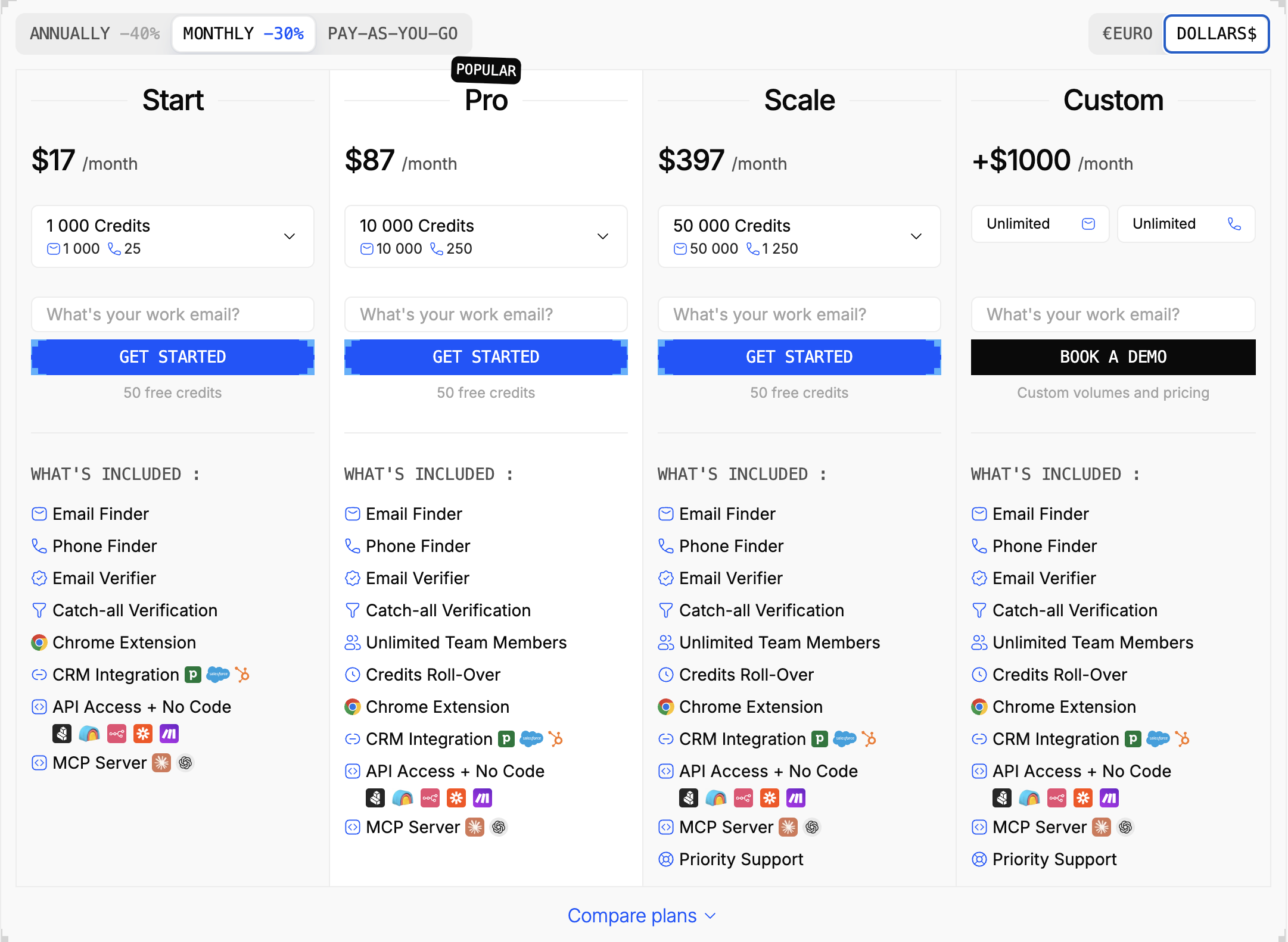
Start: $17 per month, 1,000 credits, a single user, or $0.017 per credit
Pro: $87 per month, 10,000 credits, unlimited users, or $0.0087 per credit
Scale: $397 per month, 50,000 credits, unlimited users, or $0.0079 per credit
Annual billing: $78 per month on Pro, $357 on Scale, with credits released in one go for the year
No commitment: $125 for 10,000 credits, $568 for 50,000, with no expiry date
One email found costs 1 credit, one verification 0.25 credit, one phone number 40 credits
Enrow publishes its grid in euros as well as dollars, and gives 50 credits on sign-up with no card, enough to measure the discovery rate on a sample of your own target before picking a tier.
FullEnrich
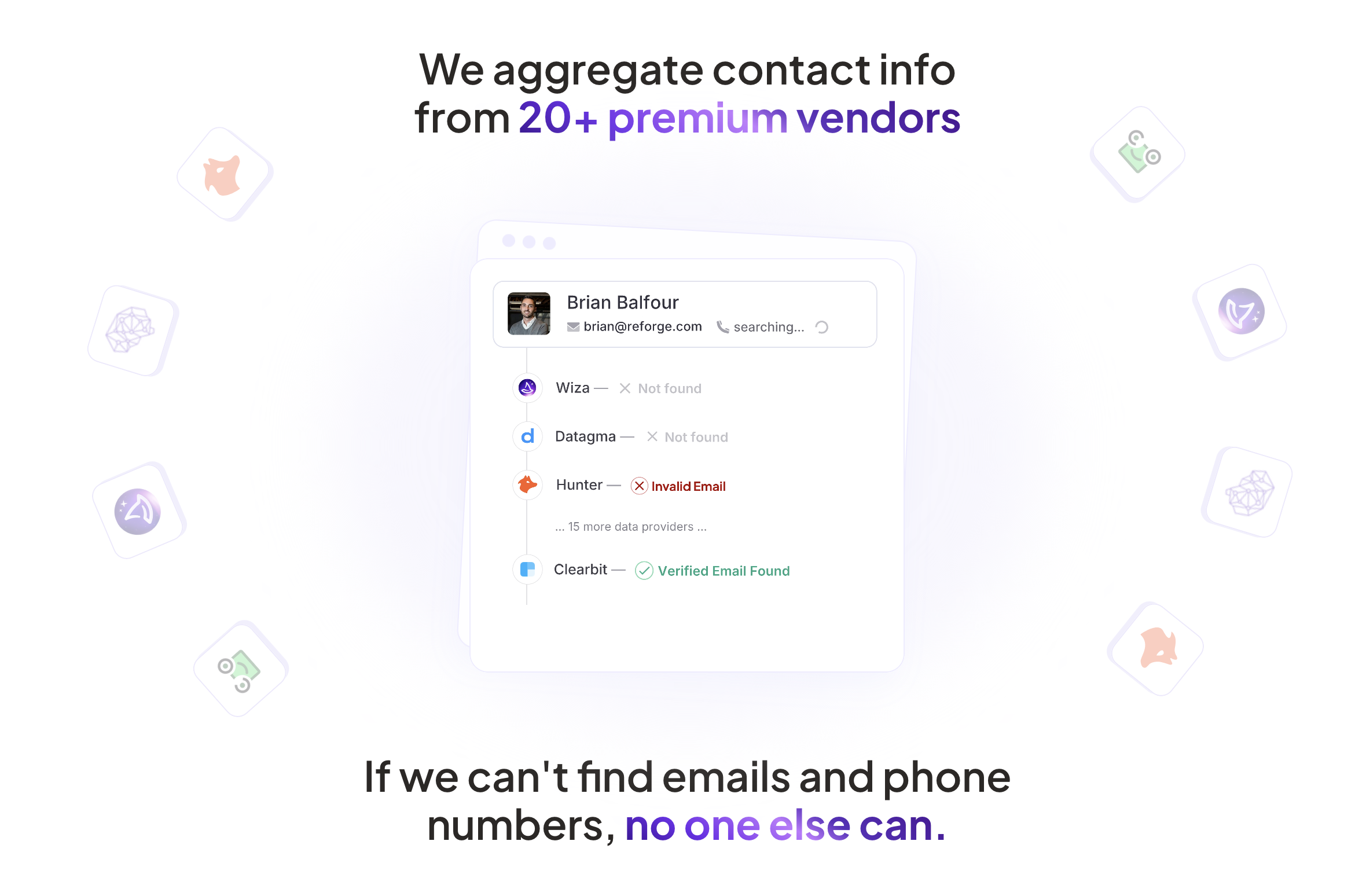
FullEnrich is a flow tool taken to the extreme: it queries fifteen or so providers in sequence until it finds the data, which produces high hit rates, and it supplies phone numbers, unlike Dropcontact. The flip side is a markedly higher unit cost, since it pays each of the providers it queries.
FullEnrich pricing
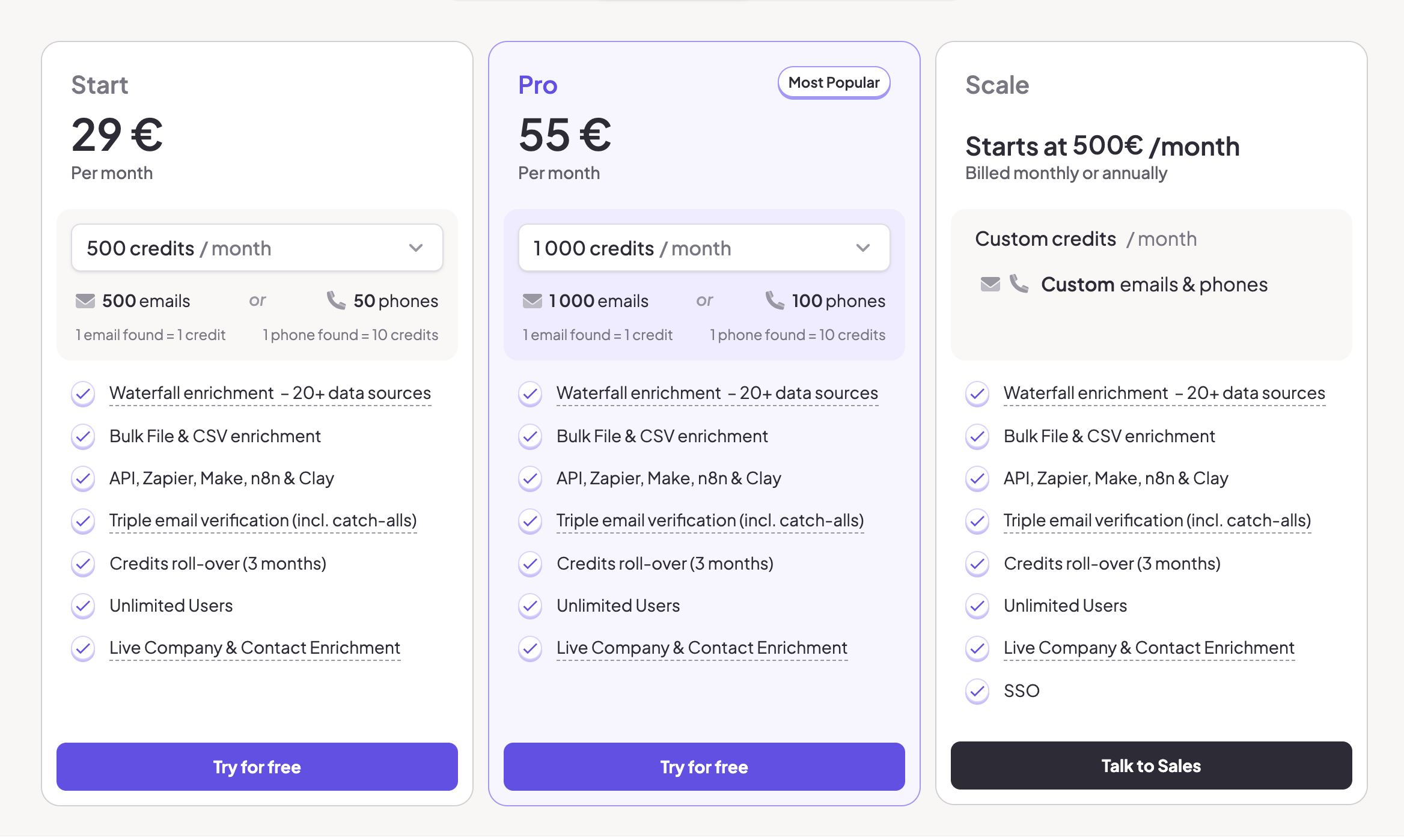
Credit-based billing, with a pay-on-success model on emails
Phone numbers consume more credits than emails
Order of magnitude recorded in our analysis: around $55 for 1,000 emails found
An openly premium positioning, designed for teams that put hit rate ahead of cost
We covered how it works and what it costs in our article on FullEnrich.
Kaspr
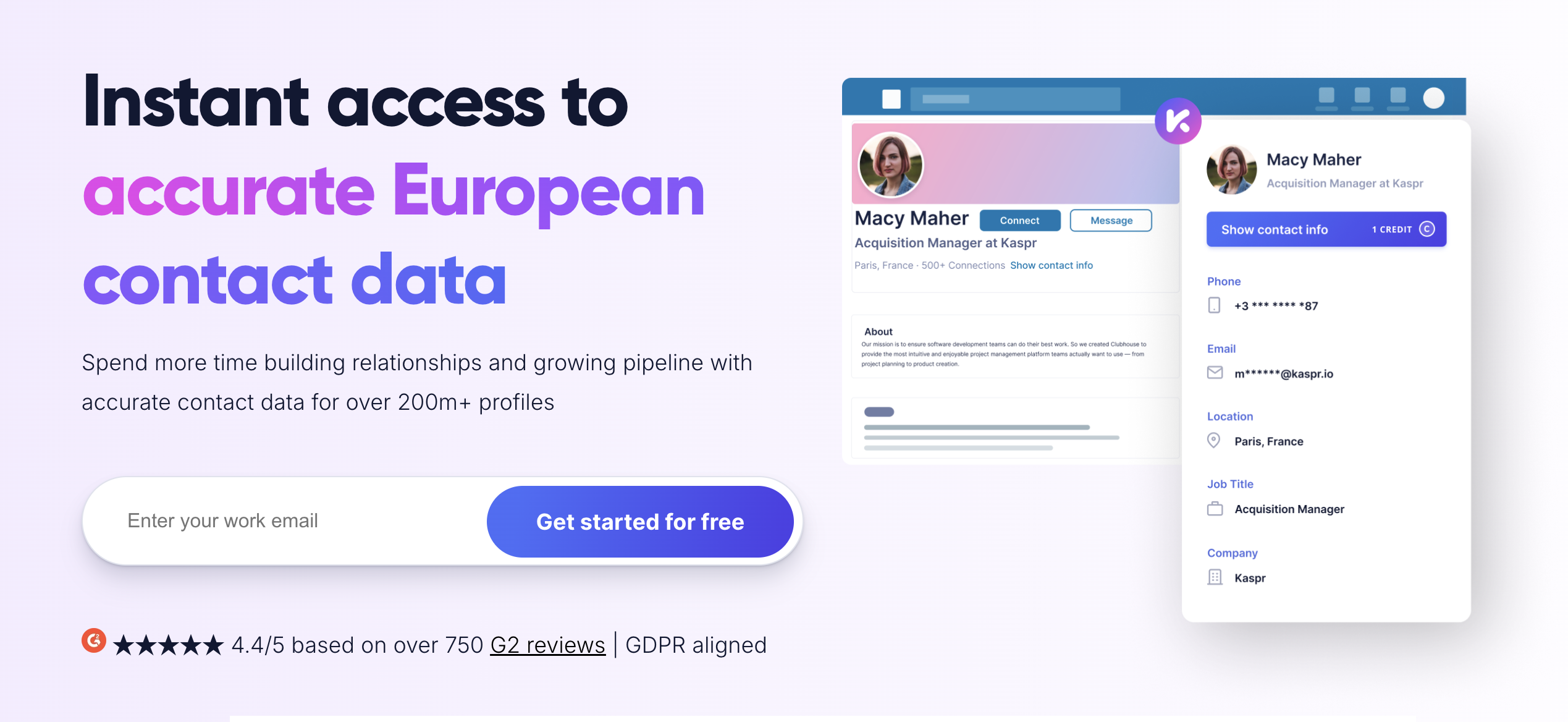
Kaspr is a stock tool paired with an extension: instead of enriching a file, it reveals contact details directly on a LinkedIn profile, and it supplies phone numbers. It is Dropcontact's natural complement more than its competitor, since it operates exactly where Dropcontact cannot: building the list.
Kaspr pricing

Free: free, 15 B2B email credits, 5 phone, 5 direct emails per month
Starter: $45 per user per month with annual commitment, $59 without, unlimited B2B emails and 1,200 phone credits per year
Business: $79 with commitment, $99 without, 2,400 phone credits per year
Annual export quota of 12,000 to 30,000 leads depending on the plan
The detail is covered in our dedicated article on Kaspr pricing.
Lusha

Lusha is a classic stock, steered by a browser extension and a credit slider. The model is the exact inverse of Dropcontact's: a database you query, a credit spent per request, and a phone number worth five of them.
Lusha pricing
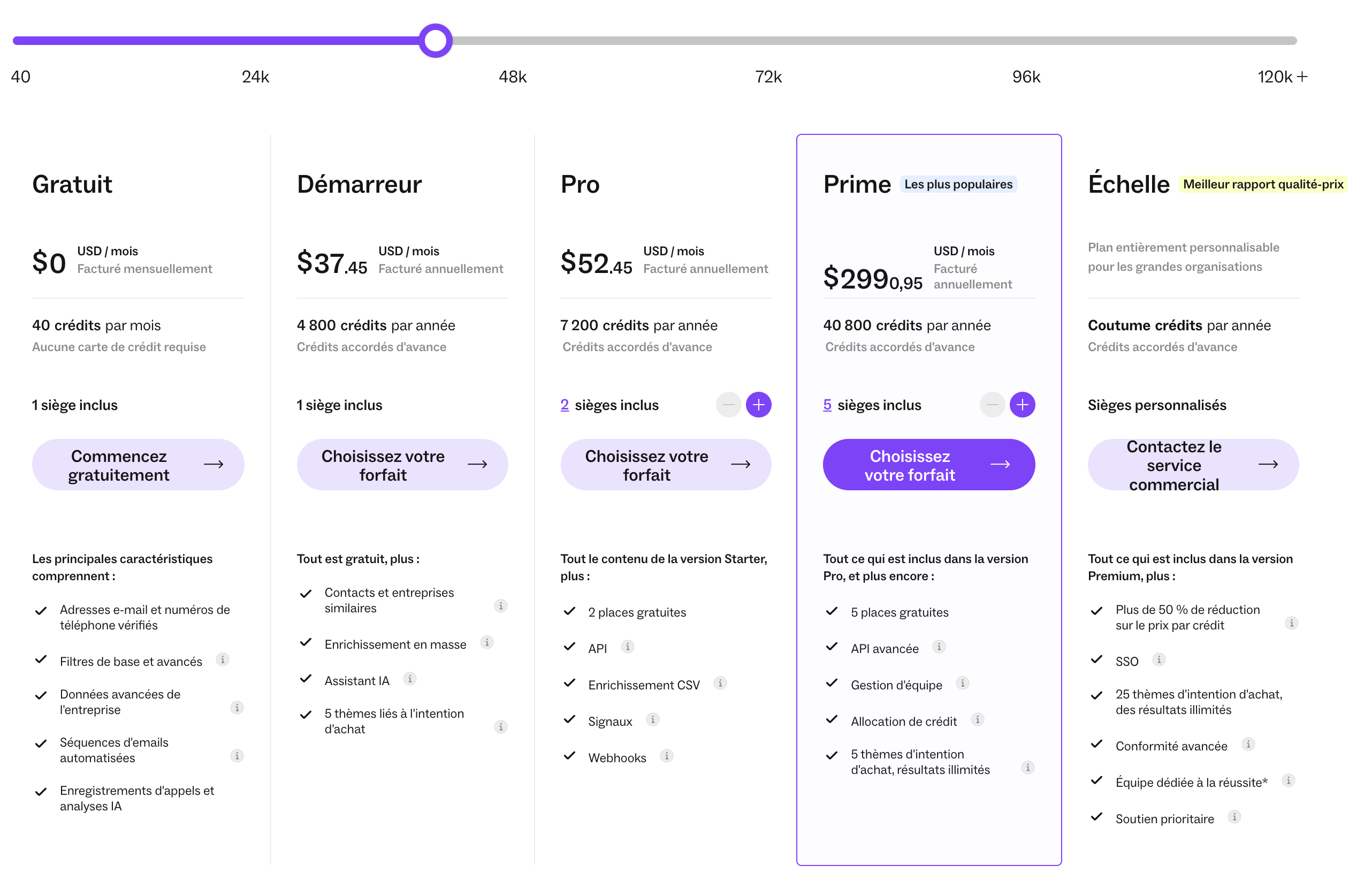
Free: free, 40 credits per month, 1 seat
Starter: $49.90 per month at list price and billed annually, 4,800 credits per year
Pro: $69.90 per month billed annually, 7,200 credits per year, 2 seats
Premium: $399.90 per month billed annually, 40,800 credits per year, 5 seats
Scale: on quote
The detail is covered in our dedicated article on Lusha pricing.
Apollo.io

Apollo.io is the largest stock in the panel: more than 275 million contacts, sequences and a dialler in the same tool, at a per-credit cost in another league entirely. It is the tool to take if your need is building lists. It is also the one whose advertised price diverges most from the effective one, since record freshness on the European market is very uneven.
Apollo.io pricing
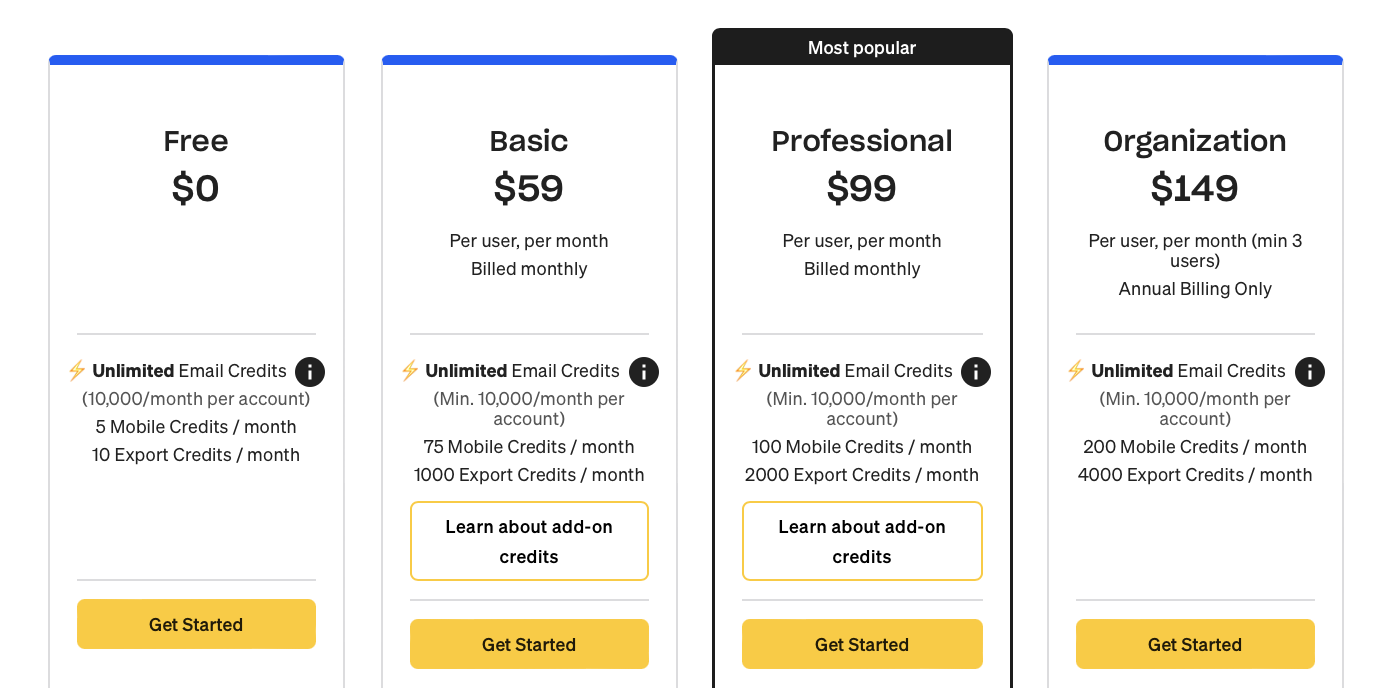
Free: free, 900 credits per seat per year
Basic: $49 per seat per month billed annually, $59 monthly, 30,000 credits per seat per year
Professional: $79 per seat per month billed annually, $99 monthly, 48,000 credits per seat per year
Organization: $119 per seat per month billed annually, $149 monthly, three-seat minimum
Which works out at roughly $0.02 per advertised credit across the whole paid range
The detail is covered in our dedicated article on Apollo.io pricing.
Cognism

Cognism is the European stock at the top of the market, with verified mobile numbers and a compliance story often likened to Dropcontact's. Wrongly, in fact: Cognism does hold a database, and its compliance rests on managing that database rather than on not having one. The commercial model follows, with no public price, an annual contract and a negotiated credit allowance.
Cognism pricing
No published rate: two plans, Standard and Pro, each including five seats
Median contract value recorded by the buying platform Vendr: $36,000 per year, across 108 purchases analysed
We map out the market in our article on Cognism alternatives.
Entry-level pricing compared
Tool | Family | Paid entry plan | Credit spent | Phone numbers |
|---|---|---|---|---|
Dropcontact | Flow | $79 / month, 500 credits | Only if found | No |
Emelia | Flow | $37 / month, packs from $19 per 1,000 | Only if found | Yes, dedicated credits |
FullEnrich | Waterfall flow | Credits, around $55 per 1,000 emails | Only if found, on emails | Yes |
Enrow | Flow | $17 / month, 1,000 credits | Only if found | Yes, 40 credits |
Kaspr | Stock | $45 / user / month with commitment | Unlimited B2B emails, phone credits | Yes |
Lusha | Stock | $49.90 / month with annual commitment | Per request | Yes, 5 credits |
Apollo.io | Stock | $49 / seat / month with commitment | Per request | Yes |
Cognism | Stock | Quote, 5 seats included | Per request, negotiated allowance | Yes |
The reading is clear once the "family" column is in place. On advertised credit price, Dropcontact is far from the cheapest. On effective price, it belongs to the small group where the two figures coincide. And on scope, it is the only one to supply no phone numbers at all.
Dropcontact or Emelia: what actually compares

This is the most legitimate comparison in the whole article, for one specific reason: Dropcontact and Emelia belong to the same family. Neither holds a contact database, both search on demand, and both only deduct a credit when data is actually found. We are comparing two engines that work the same way, not an engine against a warehouse.
The common ground comes down to two blocks: finding a business email address from a name and a company, and verifying that address. Nothing else. On those two blocks the prices compare directly, with no hit-rate correction, which is rare enough to be worth doing properly.
Outside that perimeter, each does a job the other does not. Dropcontact keeps a CRM clean continuously, normalises and classifies job titles, detects company changes: Emelia offers none of that. Emelia carries on into execution, with phone finder, bulk email verifier, unlimited warmup on every inbox, cold email with no sending cap and LinkedIn automation with a Sales Navigator scraper, Dropcontact stops at the enriched file.
Emelia pricing
Emelia publishes its grid, in three tiers at $37, $97 and $297 per month, with two months free on annual billing. The Start plan opens 3 sending inboxes and 1 LinkedIn account, Grow 50 inboxes and 3 LinkedIn accounts, Scale unlimited inboxes and 10 LinkedIn accounts. Contacts, emails, LinkedIn actions and scraping are unlimited across the whole range, and warmup is included from the first tier.
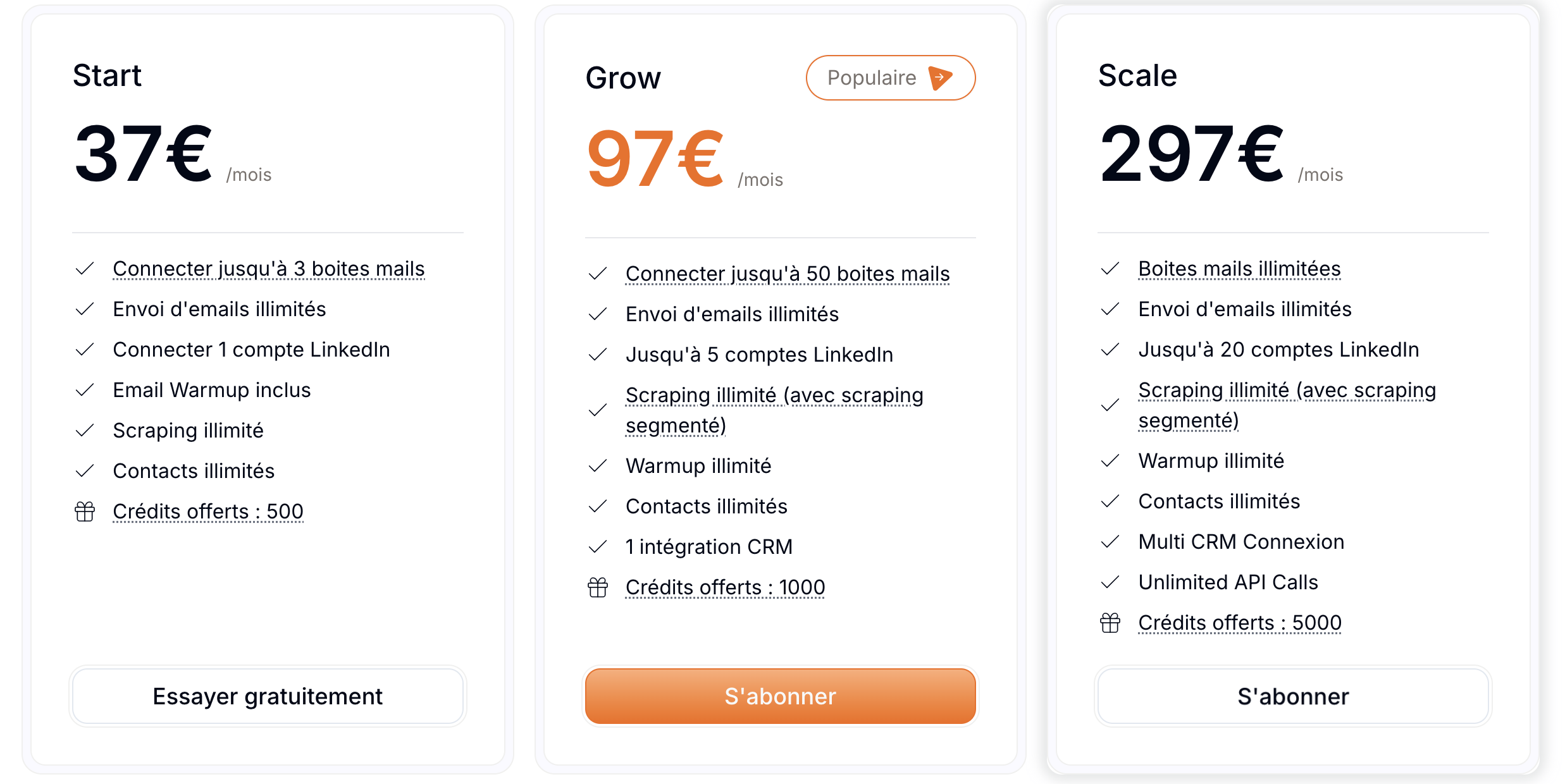
Email finder and phone lookup credits can be topped up on demand, through credit packs, and are only deducted when data is actually found.
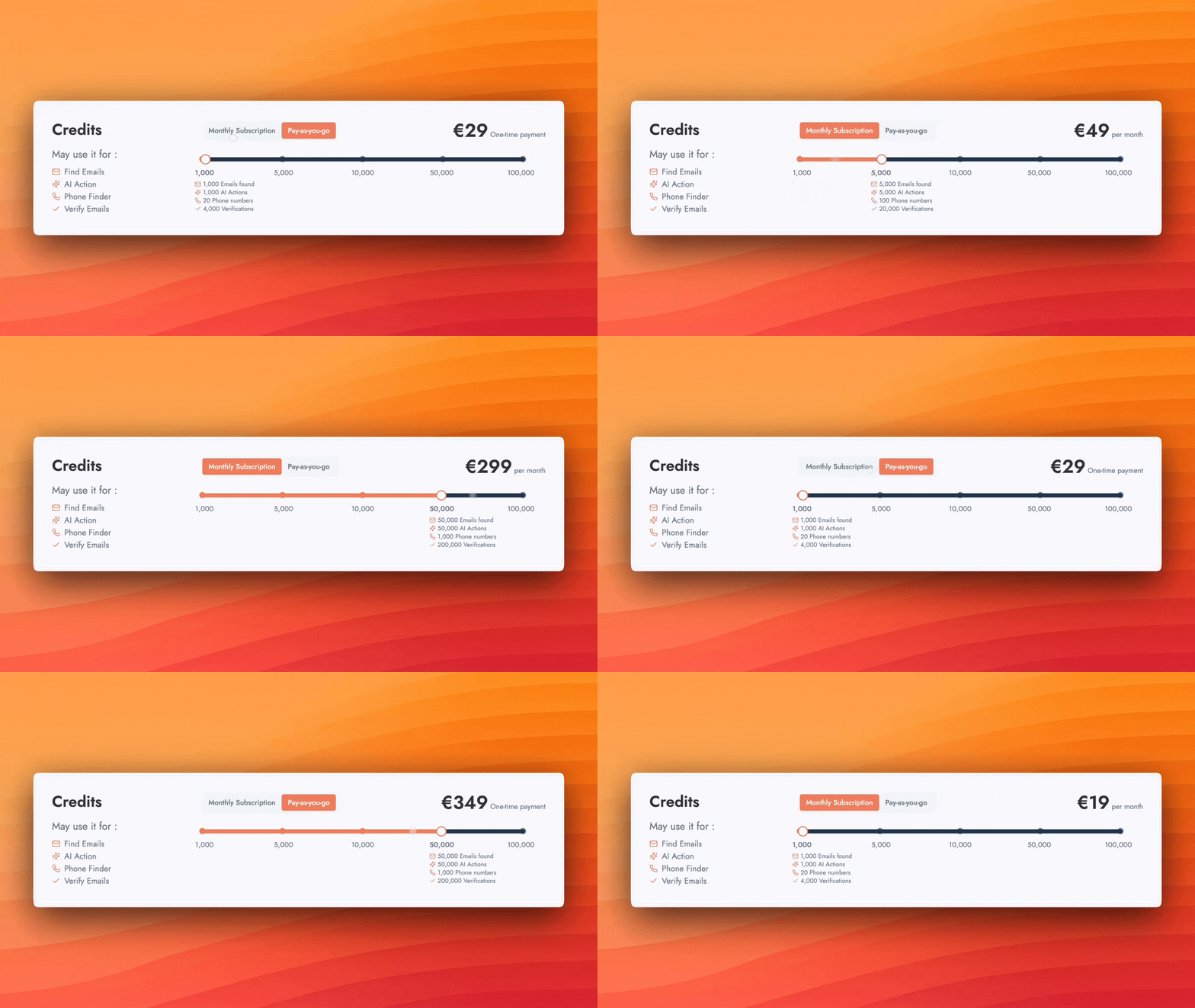
This is where the comparison becomes usable. Emelia's packs start at $19 for 1,000 credits, and come down to $49 for 5,000, $99 for 10,000 and $299 for 50,000. Per unit, an address found works out at around $0.019 against $0.158 at Dropcontact's entry tier, a factor of eight. Numerically it is the same gap as against Apollo earlier, but it does not read the same way at all: Apollo's shrinks as soon as you correct it for unusable records, this one does not move. Since both bill on success, there is no hit rate to apply on one side and not the other.
One caveat on that factor of eight, and it is a real one: the Dropcontact credit does not only return the address, it also delivers company data in the same unit. The payload is therefore not strictly identical. The gap remains considerable, but it reads as a price gap between two close offers, not between two interchangeable products.
One decisive point against a database: the LinkedIn Sales Navigator scraper is included in all three plans, with no cap, and consumes no credits. That is how a team builds its lists without buying access to a stock of records: you run a Sales Navigator search with its filters and it feeds a campaign directly. Credits are only used for the email finder, the phone lookup, AI actions and address verification.
Criterion | Dropcontact | Emelia |
|---|---|---|
Family | Flow, no database | Flow, no database |
Entry ticket | $79 per month, 500 credits | $37 per month |
Cost of an address found | around $0.158 at the entry tier | around $0.019 through credit packs |
Credit deducted | Only when data is found | Only when data is found |
Address verification | Included in the credit | Included |
Company data delivered | Yes, in the same credit | No |
Phone numbers | Not offered | Dedicated credits |
Job title cleaning and classification | Yes, from Growth | No |
Native CRM integrations | Yes, separate subscription | HubSpot and Pipedrive, from the Grow plan |
Cold email sending | Not offered | Included, unlimited sending |
Inbox warmup | Not offered | Included on every inbox |
LinkedIn automation | Not offered | Included, Sales Navigator scraper |
So the choice comes down to where you step in, not to the nature of the tool. If your problem is a dirty base or a CRM to keep up to date, Dropcontact does work Emelia does not, and the job title cleaning alone can justify the subscription. If your problem is finding addresses and then running campaigns on them, the question becomes the unit price and what you still have to buy behind it.
A clean file is worth nothing if it never goes out
Go from address found to campaign sent without switching tools. 7-day free trial.
How to bring the Dropcontact bill down
With a public grid and no negotiation, the optimisation happens on usage.
Test the hit rate on your 50 free credits before choosing a tier. It is the only figure that determines your real cost.
Take annual billing if your usage is regular: a 20% discount, or around $190 a year on Starter and $288 on Growth.
Batch your enrichments. On Starter, credits do not roll over: better to process one large file at the end of the month than to let half of them expire.
Only move up to Growth for two specific reasons, credit rollover or job title cleaning. At equal volume, it is 52% more for zero extra credits.
Check the CRM grid before committing if your usage runs through HubSpot, Pipedrive or Salesforce: it is a separate subscription, on quote, whose credits do not mix with the Email Finder ones.
Move up a volume step rather than piling up overages: the selector goes to 150,000 credits per month and the unit cost falls with volume.
Should you pay for Dropcontact in 2026?
Dropcontact sells something few players sell: enrichment with no database behind it, where you only pay for successes, and a compliance argument that holds up in front of a lawyer. For a European team whose issue is the cleanliness of the base rather than building it, it is a solid tool.
The two caveats are simple to check before signing, and neither is about the price of a credit. The $79 monthly floor only pays off if you consume the tier, and the CRM integration is a different subscription, on quote, that the pricing page gives no hint of.
So the right trade-off happens in three steps. First, whether you need a flow or a stock, because that is a question of nature and not of budget. Then, how many contacts you actually enrich each month, which decides your cost per contact. Finally, what you do with the file once it is enriched, which decides everything you still have to buy.
One subscription, from first touch to follow-up
Unlimited sending, native warmup on every inbox, human support on every plan.
Frequently asked questions about Dropcontact pricing
How much does Dropcontact cost per month?+
The Starter plan is $79 per month for 500 credits, the Growth plan $120 for the same volume. Annual billing gives a 20% discount, which brings those to around $63 and $96 per month. The price rises with the credit volume chosen, up to 150,000 monthly credits, and the Enterprise offer starts at 200,000 credits per month on quote.
Is Dropcontact a database?+
No, and that is its founding principle. Dropcontact stores no records of individuals: it recomputes and cross-checks the data on every request, from public sources and verification algorithms. That is what underpins its GDPR argument, and it is also why it cannot build a list from criteria, unlike Apollo, Lusha or Cognism.
Do you pay for emails Dropcontact does not find?+
No. Dropcontact bills on success: if the email is not found, the credit is returned to you. That is the main difference with tools that deduct a credit on every request, where the real cost per contact obtained can be far above the advertised price.
Does Dropcontact supply phone numbers?+
No, at no tier. The product covers business email, verification and company data enrichment. For numbers, you need a complementary tool such as Kaspr, FullEnrich or Lusha.
Is CRM integration included in the subscription?+
No. The HubSpot, Pipedrive and Salesforce integrations are subscriptions distinct from the Email Finder offer, priced on quote, and credits cannot be pooled between the two. It is the cost most often discovered after signing up.
What is the best alternative to Dropcontact?+
It depends first on which family you need. If you want to build lists, you need a stock, and Apollo or Lusha answer that. If you are staying on enrichment, Hunter.io is the closest comparable and FullEnrich the one that maximises hit rate. And if your goal is to send afterwards, Emelia is the only other flow tool in the panel to also cover warmup, cold email and LinkedIn, from $37 per month and $19 per 1,000 credits.