In the unforgiving world of B2B prospecting, having reliable and accurate data is an absolute necessity.
Whether you are a marketing team launching a targeted campaign, a sales rep hunting for new leads or a recruiter looking for talent, the quality of your contact data can be the difference between a resounding success and a painful failure.
Among the tools that promise to meet that need, FullEnrich positions itself as a B2B data enrichment solution built on a distinctive approach: waterfall enrichment.

But does that promise really hold up against high prices and modern expectations? And above all, are there more effective and more affordable alternatives?
In this article we take FullEnrich apart piece by piece: its features, its pricing, its strengths and its weaknesses. We also look at why waterfall enrichment, innovative as it was at the start, now looks outdated next to tools that are more accurate and cheaper.
Finally we put Emelia.io forward as an alternative worth your attention, while covering other competitors such as Snov.io, RocketReach, Lead411 and Lusha so you get a complete view of the market.
What is FullEnrich?
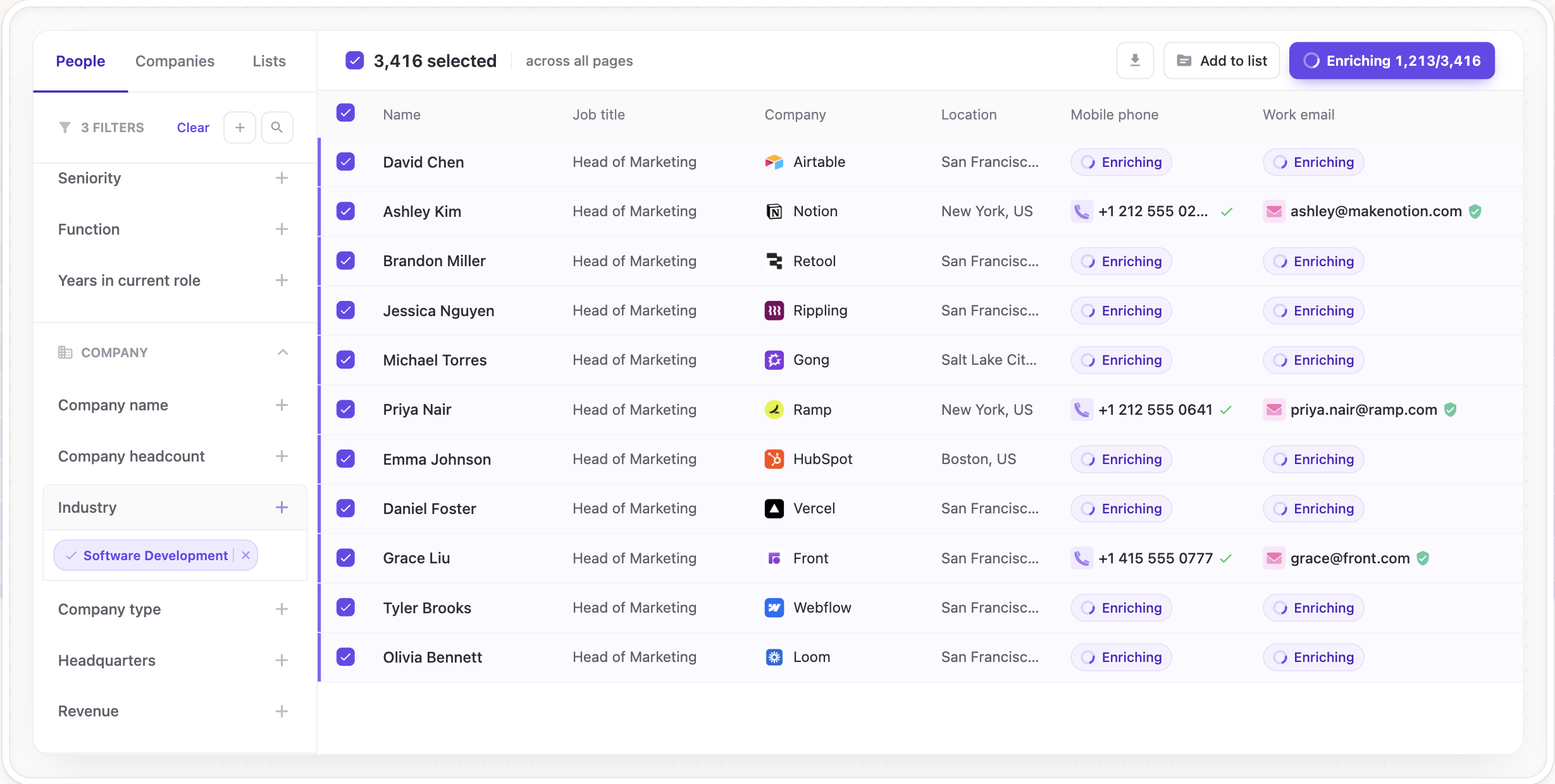
FullEnrich is a SaaS platform built to enrich B2B data, with one mission: to give companies accurate contact information, meaning emails, phone numbers and other professional data. Its headline argument? A so-called "waterfall" method, which queries more than 15 data providers one after another (Hunter, Apollo or Datagma among them) until a result comes back. The goal is clear: maximise the odds of finding something, even for the most elusive prospects.
FullEnrich key features
FullEnrich stands out on several counts that attract users:
Waterfall enrichment: this multi-source approach aims to raise the hit rate by combining data from different providers.
Chrome extension: a handy tool for pulling information straight from LinkedIn or Sales Navigator in one click.
Triple email validation: a three-step check meant to guarantee, in theory, better deliverability for the emails it finds.
CRM integrations: works with tools such as HubSpot, Salesforce or Pipedrive for smooth syncing.
Bulk processing: useful for companies that need to enrich large lists quickly.
On paper FullEnrich looks appealing, particularly for teams that value simplicity and maximum coverage. But as we are about to see, those strengths come with serious drawbacks, cost and relevance chief among them.
FullEnrich pricing: a cost that turns prohibitive fast
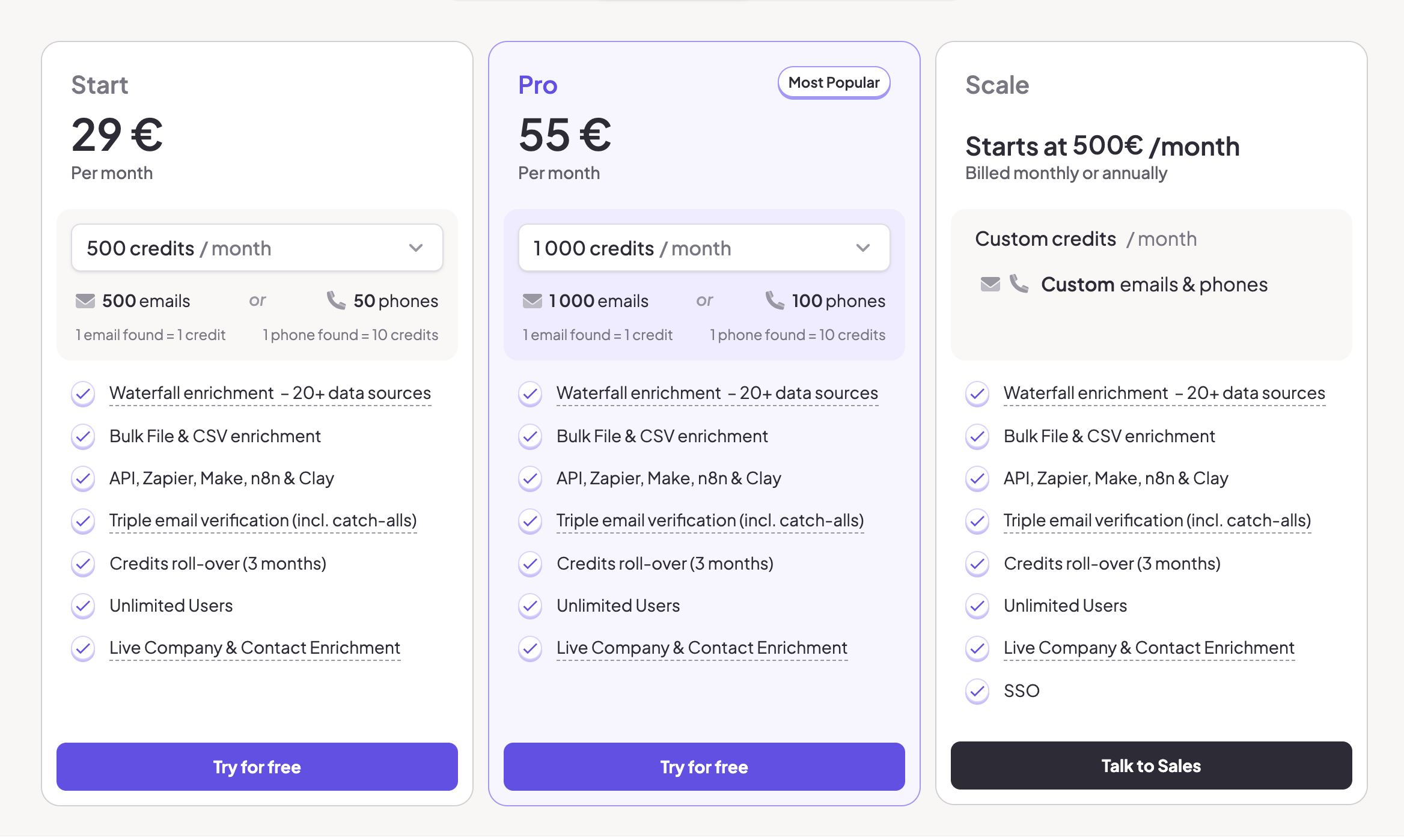
The main complaint levelled at FullEnrich is its pricing. The platform does not always publish its rates transparently on its site, but estimates based on user feedback and discussions on specialist forums give a workable picture:
1,000 emails: roughly 55 €.
50,000 emails: roughly 1,950 €.
Those figures may look acceptable for a small campaign or occasional use, but for companies working at scale the bill climbs quickly. FullEnrich also runs a monthly subscription with no rollover credits. In other words, if you do not use your credits within the month, they are gone, a policy that gets frustrating for anyone whose needs fluctuate.
Why is FullEnrich so expensive?
The high cost comes largely from the waterfall approach. Every query calls on several data providers, which pushes up FullEnrich's operating costs, and those costs are passed on to the user. But does the method really justify that price? That is what we examine further down, by looking at how it actually performs against modern tools.
FullEnrich reviews: a mixed picture
User feedback on FullEnrich is divided. Here is an overview of the positives and negatives that come up most often:
The strengths
Ease of use: the interface is intuitive, and the Chrome extension makes pulling data from LinkedIn straightforward.
High hit rate: thanks to waterfall enrichment, FullEnrich often finds contacts where other tools come up empty.
Practical integrations: CRM compatibility is a genuine plus for organised teams.
The weaknesses
Prohibitive cost: the rates are seen as too high, especially for large campaigns or companies on a tight budget.
Variable accuracy: some users report stale or incorrect data, particularly for prospects outside the main markets (North America and Western Europe).
Compromised deliverability: triple validation does not always guarantee reliable emails, and bounce rates can run higher than expected.
Patchy customer support: feedback on after-sales service varies, with some users complaining about slow or unhelpful replies.
In short, FullEnrich can suit specific needs, or teams willing to invest heavily to maximise coverage. For many others, the drawbacks, value for money above all, outweigh the benefits.
Waterfall enrichment: an approach losing ground
Waterfall enrichment was a small revolution a few years ago. Back when email finders struggled to reach decent accuracy rates, combining data from several sources was a clever way to fill the gaps. But the market has moved on, and the method is starting to show its limits.
Why is waterfall enrichment outdated?
Accuracy of modern tools: platforms such as Emelia.io now report accuracy rates close to 99 % thanks to advanced algorithms and continuously refreshed databases. There is no longer any need to stack sources to get reliable results.
Unnecessary cost: analyses show that 90 % of the data found through waterfall enrichment actually comes from the same 2 or 3 main providers (Enrow or Icypeas among them). Paying to query 15 sources when a handful will do is money wasted.
Risk of lower-quality data: by reaching for information from secondary or less reputable providers, FullEnrich sometimes returns stale or wrong emails, which hurts deliverability.
Put differently, waterfall enrichment has become an expensive luxury that no longer justifies itself in most cases. Modern tools put quality over quantity, a shift FullEnrich seems to be struggling to follow.
FullEnrich enriches. Emelia enriches AND reaches.
Email Finder + Cold Email + LinkedIn, from €37/month.
Emelia.io: a modern and affordable alternative
Against FullEnrich's shortcomings, Emelia.io stands out as a solution that is at once cheaper, more accurate and more complete. Here is why this tool deserves your attention.
Highly competitive pricing
Emelia.io offers a clear and attractive pricing grid:
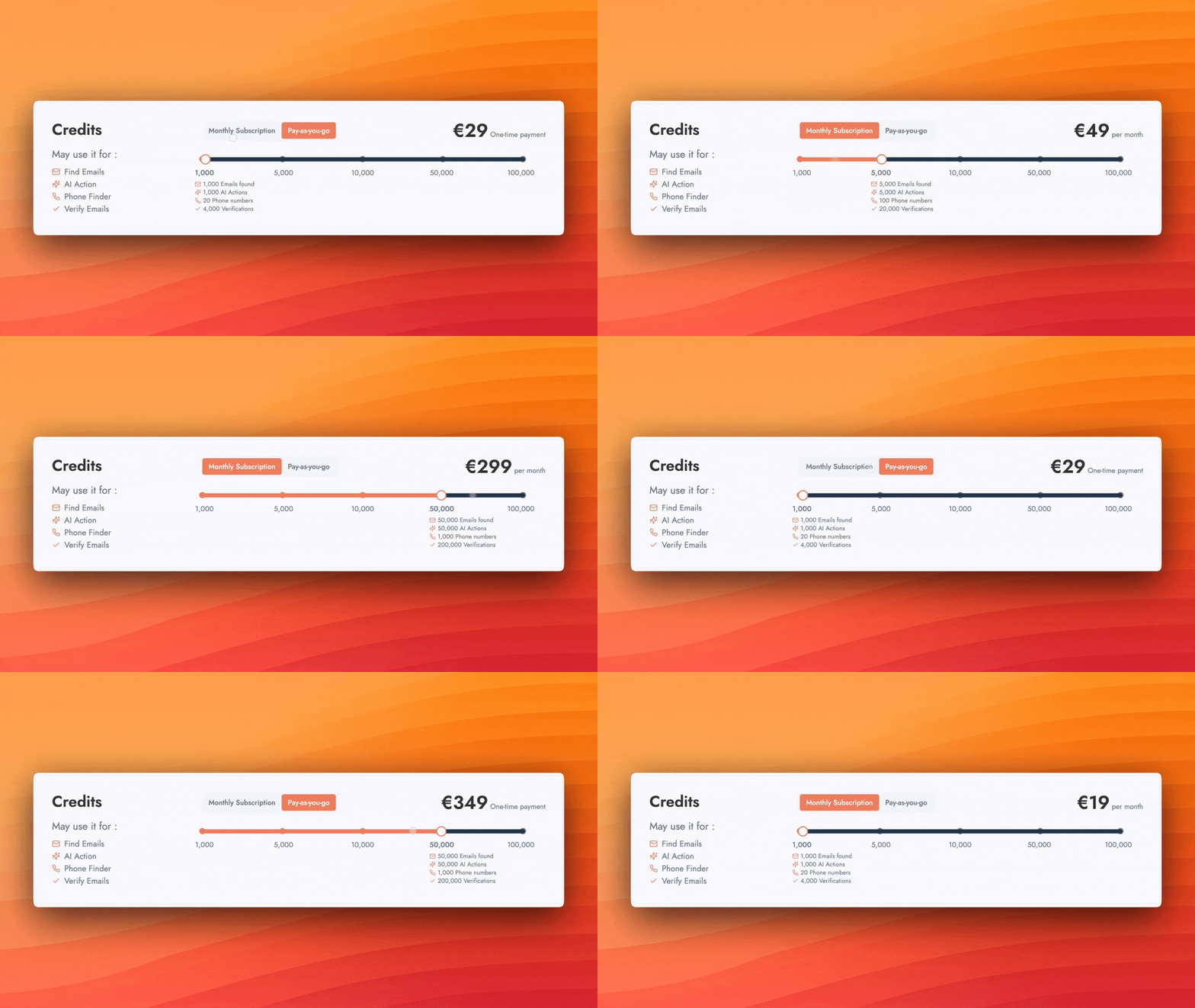
1,000 credits: 19 €
5,000 credits: 49 €
10,000 credits: 99 €
50,000 credits: 299 €
100,000 credits: 499 €
As for how credits are spent:
1 credit = 1 email found
50 credits = 1 phone number
0.25 credit = 1 email verification
Set against FullEnrich:
1,000 emails: 19 € with Emelia.io vs ~55 € with FullEnrich.
50,000 emails: 299 € with Emelia.io vs ~1,950 € with FullEnrich.
On a 50,000-email campaign you save 1,651 € with Emelia.io, a gap that speaks for itself.
Accuracy and reliability
Emelia.io banks on 99 % accuracy for its emails, through a continuously updated database and optimised algorithms. Unlike FullEnrich, which can turn up 5 to 10 % more emails via its waterfall approach, Emelia.io puts quality first: tests show that those "bonus" emails at FullEnrich often carry an error rate of 25 to 30 %, raising the risk of bounces and spam-filter blocks.
An all-in-one platform
Emelia.io does not stop at data enrichment. It is a complete B2B prospecting solution:
LinkedIn scraping: pull data in real time from LinkedIn or Sales Navigator, with no volume cap.
Watch this video to see how it works:
Multichannel automation: run combined LinkedIn and email campaigns straight from the platform.
Email warmup: prepare your inboxes to maximise deliverability.
Everything about warmup and why you should use it, in this video:
CRM integrations: syncing with your favourite tools.
With Emelia.io you centralise your prospecting instead of stacking subscriptions.
Credit flexibility
Where FullEnrich enforces strict monthly usage, Emelia.io gives you more room:
Non-expiring credits: buy a one-off pack (10,000 credits for 99 €, say) and it stays valid indefinitely.
Cumulative subscriptions: on a monthly plan, unused credits pile up for as long as you stay subscribed.
That flexibility is a real advantage for teams whose needs move around.
Emelia.io vs FullEnrich: a detailed comparison
Here is a summary table to make the differences easier to see:
Criterion | Emelia.io | FullEnrich |
|---|---|---|
Price for 1,000 emails | 19 € | ~55 € |
Price for 50,000 emails | 299 € | ~1,950 € |
Email accuracy | 99 % | Variable (risk of false emails) |
LinkedIn scraping | Included in the plans | Chrome extension available |
Automation | LinkedIn + email built in | No |
Non-expiring credits | Yes (one-off purchase) | No |
Email verification | 0.25 credit per email | Triple validation, but pricier |
Phone numbers | 50 credits per number | Included in enrichment, but dearer |
Emelia.io wins hands down on both cost and capability. FullEnrich may appeal on theoretical coverage, but its price and its limits make it a less relevant choice today.
Other FullEnrich alternatives: a closer look
For a complete perspective, let us go through other popular tools on the market. Each has its strengths and weaknesses, and we compare each one briefly to Emelia.io.
1. Enrow

Enrow is the closest alternative on the business model: like Dropcontact it only charges for results found, and a single credit counter covers address lookup, verification and phone lookup. It parts ways on two points: it does supply phone numbers, at 40 credits each, and it charges no seat fees beyond the entry plan. Catch-all verification is included at no extra cost. It stops at the data, though: Enrow sends no campaigns, so it has to be paired with a sending platform.
Enrow pricing
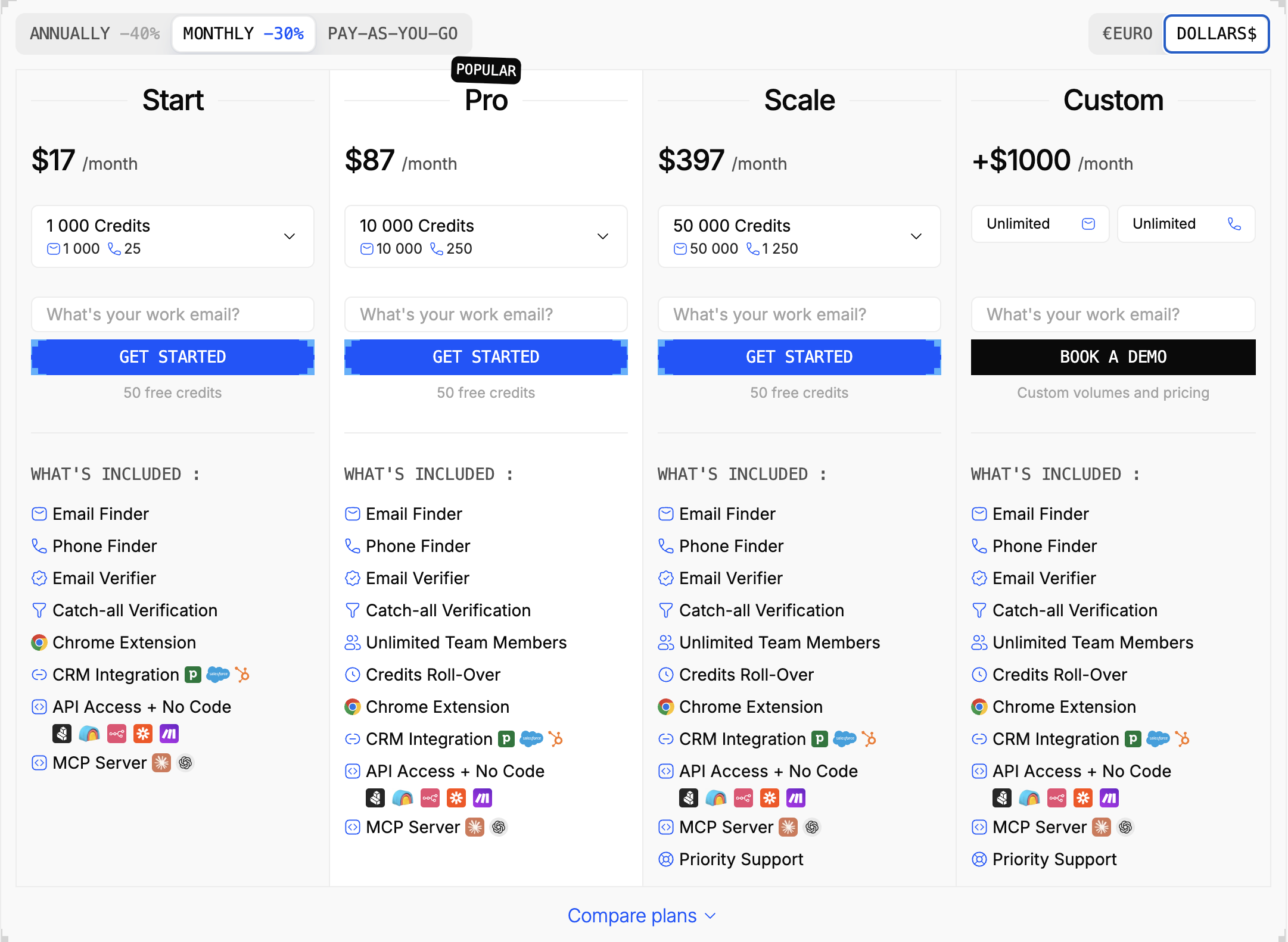
Start: $17 a month, 1,000 credits, a single user, so 0.015 € per credit
Pro: $87 a month, 10,000 credits, unlimited users, so 0.0075 € per credit
Scale: $397 a month, 50,000 credits
An email found costs 1 credit, a verification 0.25 credit, a phone number 40 credits
Enrow shows its grid in euros and in dollars, and gives 50 credits on signup without a card, enough to measure the discovery rate on a sample of your own target before picking a tier.
2. Snov.io

A versatile platform for B2B prospecting, combining email lookup, verification and cold emailing.
Snov.io pricing
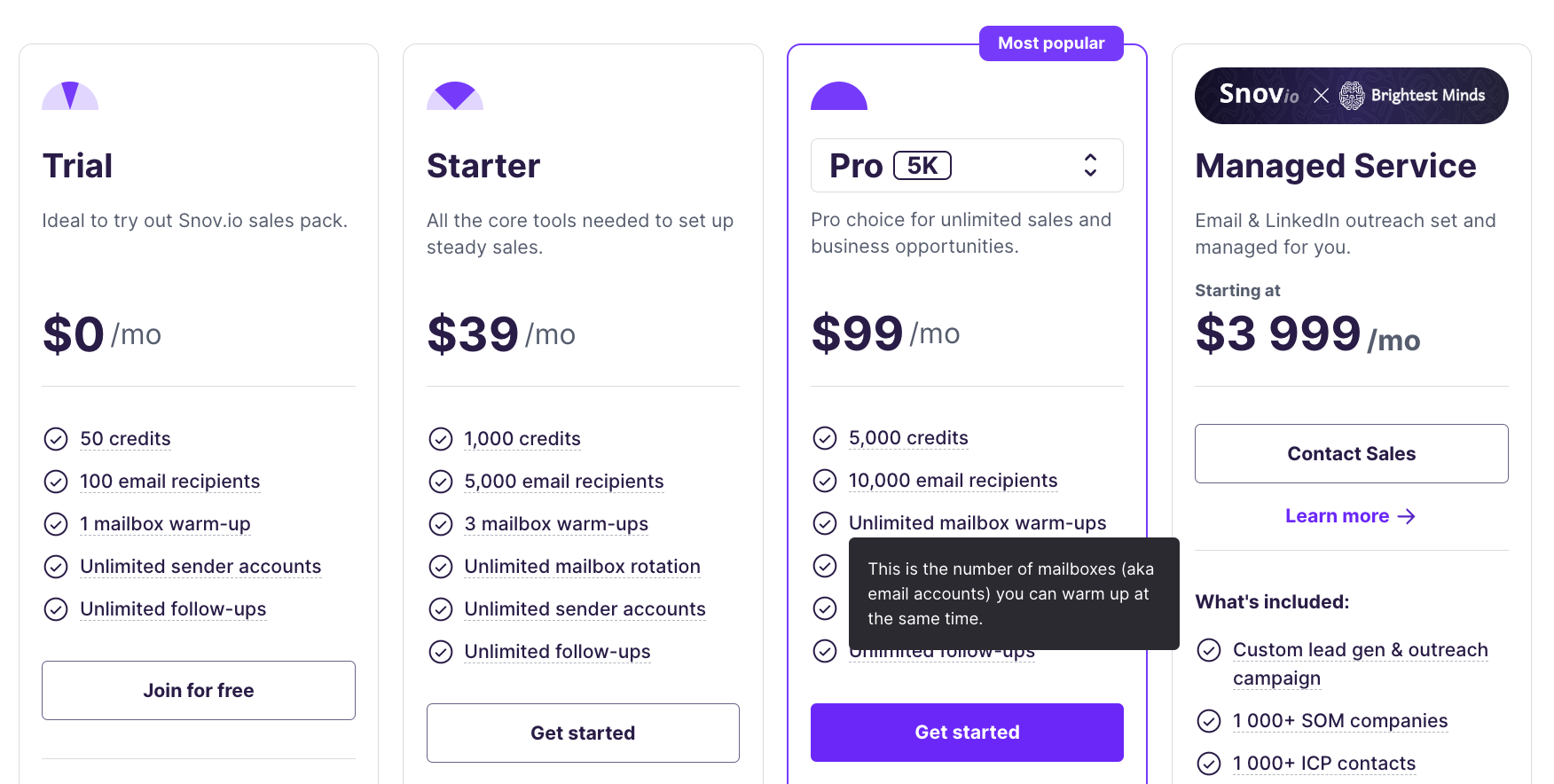
1,000 credits: $39/month.
5,000 credits: $99/month.
10,000 credits: $189/month.
Strengths: built-in automation tools, friendly interface, good value for small teams.
Weaknesses: lower accuracy (around 90-95 %), monthly credits that expire, less competitive at scale.
Compared to Emelia.io: Snov.io is dearer ($39 vs 19 € for 1,000 credits) and less accurate, but its cold emailing features may appeal to anyone after an all-in-one setup.
3. RocketReach

A B2B prospecting platform that quickly surfaces emails, phone numbers and social profiles for over 700 million professionals and 35 million companies. Its Chrome extension makes searching on LinkedIn and other sites easy, while its Salesforce, HubSpot and Zapier integrations streamline workflows.
The tool offers advanced searches with precise filters (industry, location, job title) and an API to automate enrichment. Its database is vast, particularly in the United States, but phone number accuracy can be uneven, and its credit-based pricing gets expensive for heavy users. A limited free plan is available.
A massive database of 700 million contacts, focused on email and phone lookup.
Strengths: exceptional coverage, ideal for large companies or recruiters targeting rare profiles.
Weaknesses: high rates, no built-in automation, an interface that can feel complex.
Compared to Emelia.io: RocketReach is markedly dearer ($249 vs 99 € for 1,000 lookups) and less versatile, but its sheer database size can justify the spend for some.
4. Lead411

Lead411 is a B2B prospecting platform offering verified contact and company data, with an emphasis on accuracy. It includes intent signals and B2B email lists. More affordable than ZoomInfo, it suits growing teams, though its data volume is smaller. A Chrome extension makes prospecting on LinkedIn easier.
A tool built around intent data, with an email finder and phone numbers.
Lead411 pricing
1,200 credits: $75/month.
2,400 credits: $150/month.
Enterprise plans: on request.
Strengths: intent data (companies in growth mode, for instance), good for precise targeting.
Weaknesses: ageing interface, sometimes static data, high cost at volume.
Compared to Emelia.io: Lead411 is dearer at small scale ($75 vs 49 € for ~5,000 credits) and less flexible, but its intent data is a genuinely distinctive asset.
B2B data + outreach in one platform
No need to connect 3 tools.
5. Lusha

Lusha is a simple, intuitive B2B prospecting tool, well suited to small teams. Its Chrome extension pulls emails and phone numbers straight from LinkedIn. It offers intent signals and plugs into CRMs, but data accuracy can be uneven and the search filters are limited. A free plan is available.
A simple, intuitive tool for finding emails and phone numbers, with strong LinkedIn integration.
Lusha pricing
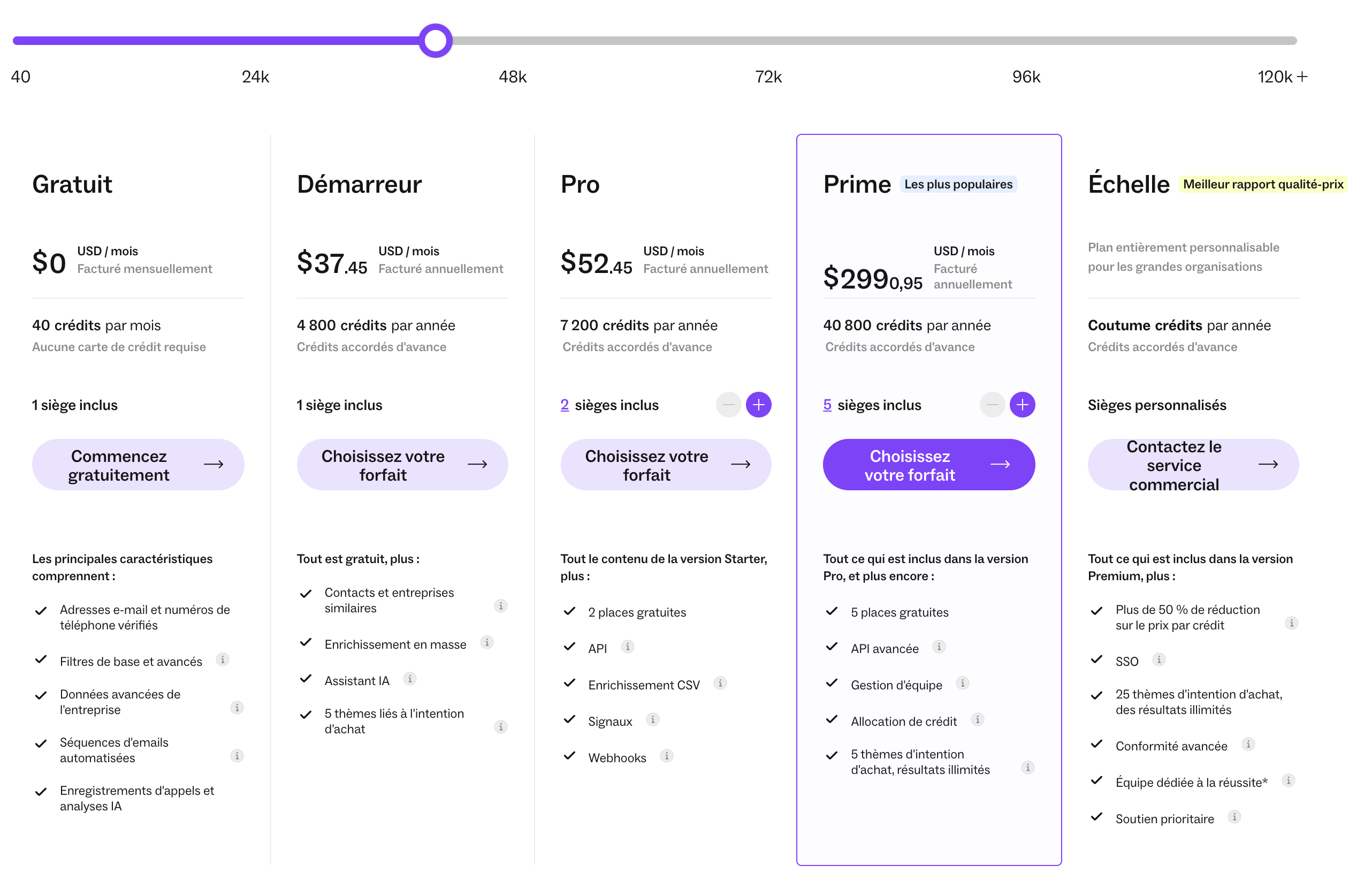
200 credits: $49/month.
1,000 credits: $149/month.
Team plans: on request.
Strengths: high accuracy (around 95 %), ease of use, excellent for small teams.
Weaknesses: limited credits, no advanced automation, costly at scale.
Compared to Emelia.io: Lusha is dearer ($149 vs 19 € for 1,000 credits) and less complete, but its simplicity may suit newcomers.
Click here to compare other [Lusha alternatives!](https://emelia.io/fr/hub/alternatives-lusha)
6. Hunter.io

Hunter.io is a platform specialising in B2B email lookup and verification. It finds public email addresses tied to a domain and offers emailing campaigns. Simple and affordable, it suits targeted campaigns but lacks advanced features such as data enrichment or intent signals.
Description: an email finder known for its accuracy, with verification and domain search features.
Hunter pricing

Free: 0 €/month, 50 credits a month.
Starter: 49 €/month, 2,000 credits.
Growth: 149 €/month, 10,000 credits.
Scale: 299 €/month, 25,000 credits.
Strengths: solid accuracy, highly effective domain search, clear interface.
Weaknesses: no LinkedIn scraping and no automation, monthly credits only.
Compared to Emelia.io: Hunter works out at 0.0245 € per email on its entry plan, against 0.019 € with Emelia.io, and it offers neither LinkedIn scraping nor automation. Its domain search, which returns every known address at a company in one go, remains unmatched, and its free tier is the most generous on the market.
Find the best Hunter.io alternatives in one click!
Conclusion: Emelia.io, the smart choice for B2B prospecting
FullEnrich had its moment of glory with waterfall enrichment, but that once-revolutionary approach is now eclipsed by tools that are more accurate, more affordable and more complete. With steep rates (1,950 € for 50,000 emails) and accuracy that is sometimes questionable, FullEnrich seems aimed at an audience willing to pay dearly for maximum coverage, at the expense of return on investment. Emelia.io, by contrast, resets the standard for B2B prospecting:
Affordable: 19 € for 1,000 emails, against 55 € with FullEnrich.
Accurate: 99 % reliability, with no trade-off on deliverability.
Complete: LinkedIn scraping, automation, integrations, everything you need in one place.
Flexible: non-expiring credits for complete freedom.
Whether you are a startup, an SME or a large company, [Emelia.io](https://emelia.io/fr) lets you prospect intelligently without breaking the bank. Other alternatives such as Snov.io, RocketReach, Lead411, Lusha or Hunter have their merits, but none matches Emelia.io on value for money and versatility.
So, ready to say goodbye to overpriced tools and give your prospecting a lift? Try Emelia.io today and discover a solution that puts your budget and your results first.
FullEnrich reviews pricing FAQ
What exactly is FullEnrich?+
FullEnrich is a cascade B2B data enrichment service: it queries multiple sources (Hunter, Dropcontact, Lusha, etc.) to retrieve the best result for each prospect. Great for maximizing email finder success rate, from $39/month.
How much does FullEnrich cost?+
FullEnrich: $39/month (Starter, 1,000 credits), $99/month (Pro, 5,000 credits), $199/month (Scale, 12,000 credits). Pay-per-result pricing: you only pay for successful enrichments. Competitive vs Emelia ($37/month full features) or Apollo (freemium then $45/user).
What's the alternative to FullEnrich in 2026?+
Top 3: Emelia (live LinkedIn scraping + email finder + cold email at $37/month), Dropcontact (France/Europe focus at $24/month), Apollo (220M contacts in freemium). For pure cascade pay-per-result, FullEnrich stays relevant. For complete prospecting, Emelia is more economical.
FullEnrich or Emelia: which to choose?+
FullEnrich if you want a pure cascade enricher (multiple sources combined). Emelia if you want enrichment + live LinkedIn scraping + cold email + free warm-up in a single tool at similar price. For complete prospecting, Emelia wins.
Does FullEnrich comply with GDPR?+
FullEnrich is GDPR-compliant (based in France, EU hosting). Like any enricher, use must respect B2B legitimate interest (article 6.1.f). Emelia offers the same native GDPR guarantees, also being a French company.