NeverBounce displays ten price tiers. Only five of them lower the unit cost; the other five sell you the same rate per litre in a bigger can.
A thousand credits cost $8. Five thousand cost $40, exactly five times more: no discount at all. Ten thousand cost $50, which is ten dollars more for five thousand extra credits. The tier you pick therefore matters more than the volume you actually need.
Alongside that pay as you go grid sits a monthly subscription, Growth, which divides the unit cost by two and a half above 50,000 emails a month. But it renews every month, whereas credits bought pay as you go stay valid for twelve.
We recorded both grids in full, ten tiers for pay as you go and seven for the subscription, along with the help pages on billing, the guarantee and the result codes, on 7 September 2026.

What NeverBounce actually is

Before talking about money, the tool needs placing, because it does not do the same job as the email finders it is sometimes compared with.
An address verification service, not a directory. The core of the product is to take a list of addresses you already own and tell you which are valid, which will bounce, which are disposable and which cannot be verified. The vendor describes a proprietary process of more than 20 steps, querying each address up to 75 times from different points around the globe, combining MX, DNS, SMTP and social signals.
Three products, one job. *Clean* scrubs a list from an uploaded file. *Verify* checks one address at a time, in the dashboard or through the API, at the moment it is entered. *Sync* connects your CRM and re-cleans automatically, verifying only the new addresses on each run. More than 80 direct integrations are offered, and the API ships libraries for cURL, NodeJS, PHP, Python, Ruby, Go, Java and .NET.
Who it is for. Teams that send at volume and whose sender reputation is an asset: ageing databases to clean before a campaign, signup forms to protect in real time, a CRM to keep clean continuously.
What it is not. NeverBounce does not build lists, does not send campaigns and does not warm up mailboxes. It is a data hygiene component, to be placed upstream of your sending.
One piece of context that matters. NeverBounce belongs to ZoomInfo, which acquired it through DiscoverOrg in 2018. The tool is still sold separately and its grid is public, but the ownership explains the lead generation component that has appeared in the Growth offer.
The pay as you go grid
Ten tiers, recorded one by one. One credit equals one verification.
Credits | Price | Cost per verification |
1,000 | $8 | $0.0080 |
5,000 | $40 | $0.0080 |
10,000 | $50 | $0.0050 |
25,000 | $125 | $0.0050 |
50,000 | $250 | $0.0050 |
100,000 | $400 | $0.0040 |
250,000 | $750 | $0.0030 |
500,000 | $1,500 | $0.0030 |
1,000,000 | $2,500 | $0.0025 |
2,000,000 | $4,000 | $0.0020 |
Credits bought pay as you go are valid for twelve months from the date of purchase. The rule is written in black and white under the grid, which is more honest than the elastic wording common on this market: you know exactly what you are buying.
The grid is not a smooth discount, it is a staircase
This is the point a quick read misses, and it changes the size of your bill.
Out of ten tiers, only five improve the unit cost: 10,000, 100,000, 250,000, 1,000,000 and 2,000,000. The other five charge you exactly the same price per credit as the tier below.
Tier | Unit cost | What it brings |
1,000 | $0.0080 | entry tier |
5,000 | $0.0080 | no discount, five times the price of 1,000 |
10,000 | $0.0050 | -37%, the best step in the grid |
25,000 | $0.0050 | no discount |
50,000 | $0.0050 | no discount |
100,000 | $0.0040 | -20% |
250,000 | $0.0030 | -25% |
500,000 | $0.0030 | no discount |
1,000,000 | $0.0025 | -17% |
2,000,000 | $0.0020 | -20% |
Two practical consequences.
Never buy 5,000 credits. They cost $40 when 10,000 cost $50. For ten dollars more you double the volume and drop the unit cost by 37%. It is the one clear anomaly in the grid, and it works in your favour if you spot it.
Buy at the start of a plateau, never in the middle. If your need is 40,000 verifications, the rate will be the same as for 10,000: $0.005 each. Nothing justifies buying 50,000 credits to use 40,000. Conversely, if your need approaches 100,000, cross the threshold: 100,000 credits at $400 work out cheaper per unit than 50,000 at $250.
A price that never steps back up
19 € for 1,000 credits at Emelia, and the unit price only falls on the larger packs. No minimum order to reach.
The Growth subscription grid
Growth is the subscription offer. It replaced the former Sync plan, whose automation feature is now included.
Emails a month | Monthly price | Cost per verification |
1,000 | $10 | $0.0100 |
10,000 | $49 | $0.0049 |
50,000 | $99 | $0.0020 |
100,000 | $159 | $0.0016 |
250,000 | $249 | $0.0010 |
500,000 | $499 | $0.0010 |
1,000,000 | $999 | $0.0010 |
Above one million emails a month, pricing moves to a quote, the vendor placing its Enterprise offer at around 250,000 emails a month and up.
The subscription does not only buy cheaper credit. It adds 200 new contacts a month selected automatically, a conversion score, bad addresses flagged before they reach the CRM, unlimited parallel list cleaning and automatic CRM synchronisation. On that last point, only new addresses are billed, duplicates are not.
Three billing rules to know before signing. When credits run out mid cycle, verifications stop: with automatic upgrade switched on, NeverBounce moves you to the next tier and charges you immediately, otherwise the service pauses until you change plan. Credits bought pay as you go before the subscription are preserved, under the name of legacy credits, and add to the monthly allowance. And on cancellation, access to Growth features and to the credits is removed at the end of the paid period, the account reverting to pay as you go.
That last point deserves weighing: the credits of a subscription do not survive its cancellation, whereas those bought pay as you go stay with you for twelve months.
Pay as you go or subscription: the calculation almost everyone gets backwards
At identical volume over one month, the subscription crushes pay as you go.
Volume | Pay as you go | Growth monthly | Gap |
1,000 | $8 | $10 | +25% |
10,000 | $50 | $49 | -2% |
50,000 | $250 | $99 | -60% |
100,000 | $400 | $159 | -60% |
250,000 | $750 | $249 | -67% |
500,000 | $1,500 | $499 | -67% |
1,000,000 | $2,500 | $999 | -60% |
Except that this table compares a single purchase with one month of subscription. It is the comparison the pricing page puts forward, and it is the one that leads to bad decisions.
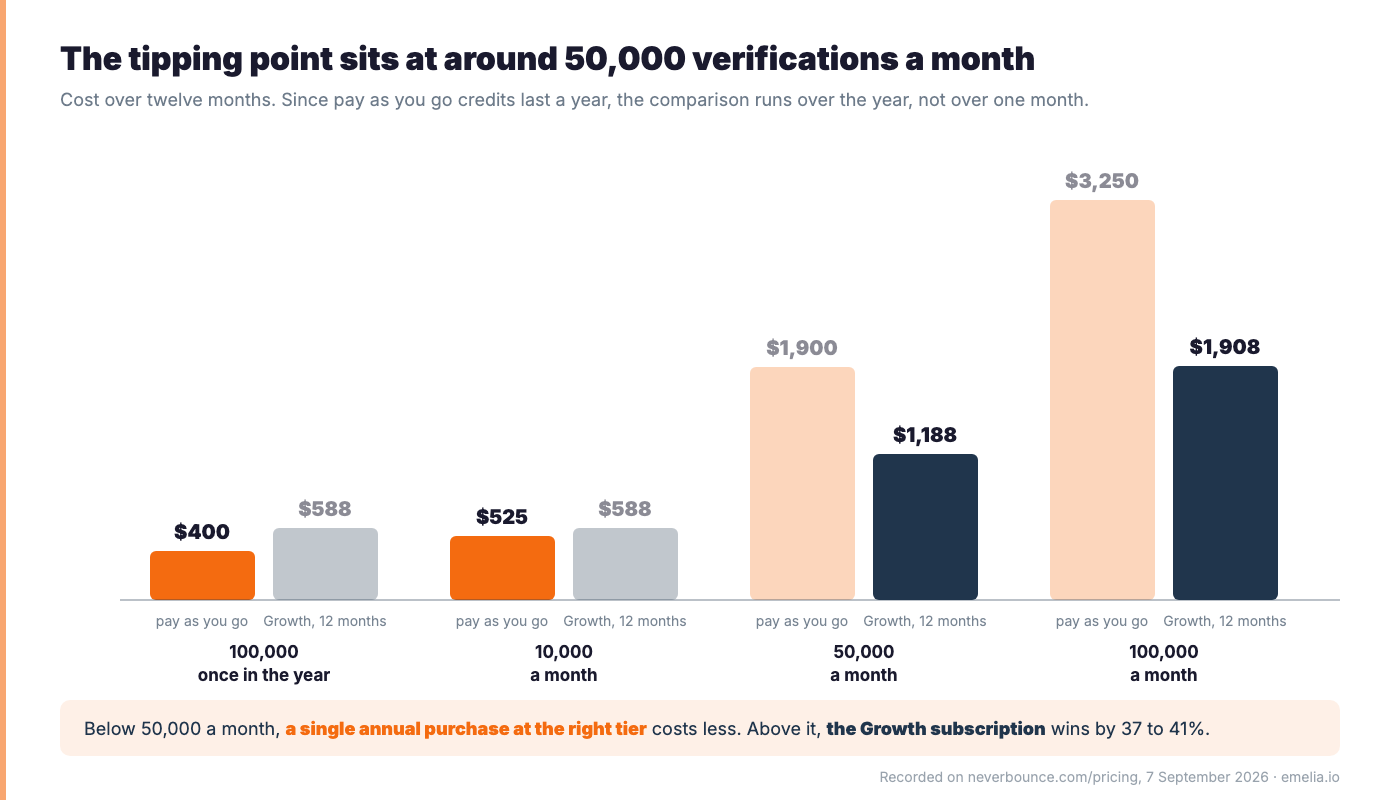
The right comparison takes two things into account: the subscription is paid twelve times a year, and pay as you go credits are valid for twelve months, which allows one large annual purchase at the best tier rather than twelve small ones.
Let us take three real needs, over a full year.
Real need | Best pay as you go purchase | Growth over twelve months | Cheaper |
100,000 verifications once in the year | 100,000 credits, $400 | $49 × 12 = $588 | pay as you go, -32% |
10,000 a month, so 120,000 in the year | 100,000 + 25,000, $525 | $49 × 12 = $588 | pay as you go, -11% |
50,000 a month, so 600,000 in the year | 500,000 + 100,000, $1,900 | $99 × 12 = $1,188 | Growth, -37% |
100,000 a month, so 1,200,000 in the year | 1,000,000 + 250,000, $3,250 | $159 × 12 = $1,908 | Growth, -41% |
The tipping point therefore sits at around 50,000 verifications a month. Below it, a single annual purchase at the right tier costs less than the subscription, because the twelve month validity lets you spread consumption without paying twelve times. Above it, the subscription wins clearly, and the gap widens with volume.
Worth noting for the smallest volumes: at 1,000 emails the subscription is more expensive than the one off purchase, $10 against $8. It is the only tier where the subscription loses on its own ground.
Verification included in the plan
At Emelia, verifying an address costs 0.25 credit, about 0.005 €, with no trade-off between usage and package.
What the 3% guarantee is worth
NeverBounce guarantees that no more than 3% of your emails will bounce after passing through its service, and refunds the difference if the threshold is exceeded.
Unlike many promises on this market, this one has a public mechanism and written conditions. That is a real strength, provided you read the conditions, because they are restrictive.
- The list must have been cleaned within 72 hours of being mailed to.
- It must contain at least 500 unique addresses.
- The guarantee only covers addresses classified as valid. The *invalid*, *accept all*, *unknown* and *disposable* categories are excluded.
- Freemail addresses are excluded, with Gmail, Hotmail, Outlook, AOL and Yahoo named explicitly.
- Bounces caused by an internal technical issue or by your sender reputation do not count.
The fourth condition is the one that changes everything depending on your business. On a B2B list of company addresses, excluding freemail is marginal. On a consumer list, where Gmail dominates, it empties the guarantee of much of its substance. Check it against the real composition of your database before making it a reason to buy.
To claim, you have to supply the job identifier, the date and time of the send, the categories sent to and a full export of the mailing with the bounce responses.
The five result codes, and the one that costs you
NeverBounce returns five verdicts, and two of them are not answers.
Result | Code | What it means | Send? |
Valid | 0 | real address currently accepting mail | yes |
Invalid | 1 | non existent address, certain bounce | no |
Disposable | 2 | temporary, throwaway address | no |
Accept all | 3 | a server setting, not a verdict on the address | with caution |
Unknown | 4 | the server did not answer in time | re verify |
The vendor gives a useful rule of thumb on *accept all* results: they bounce at roughly half your list's invalid rate. A list at 8% invalid will therefore see about 4% of its catch alls bounce.
*Unknown* results are not a negative verdict, the vendor says so explicitly: it is the remote server that failed to answer in time, often through greylisting or a security gateway. Re verifying later usually returns a firm answer.
The point to check before buying. NeverBounce explicitly publishes that deduplication and syntax cleaning are free, and performed before the job is priced. It publishes no exemption, however, for *unknown* and *accept all* results. Where ZeroBounce states in writing that it does not bill indeterminate results, NeverBounce stays silent. On an ageing list, where those two categories can be 15 to 20% of the volume, the question is not theoretical: it is a line to get clarified in writing, all the more so since re verifying the *unknowns* will be paid for a second time.
The free plan comes to ten credits
It has to be said plainly: registration gives 10 free credits, not a thousand. The figure is written in the vendor's own billing page, and the address of its help page on free credits, which still mentions a thousand, has simply not been updated.
Ten verifications are not enough to evaluate a tool. What NeverBounce actually offers to form an opinion is something else: a free list analysis, which returns an estimate of the bounce rate before any payment. That is the right evaluation tool, and it consumes no credit.
More substantial free credits are offered to anyone who books a sales demonstration, with a valid payment card required on file to access them.
One detail to know for the API: without a default payment method, the account is rate limited and access to the bulk endpoints is restricted. Beyond the ten credits, the API returns an error until a card is registered.
What NeverBounce does not do
No list building. NeverBounce verifies what you bring it. The Growth subscription adds 200 contacts a month, which is a complement, not a directory.
No sending. No sequences, no campaigns.
No mailbox warmup. The tool measures and cleans, it does not build your sending reputation.
No deliverability diagnostics. No inbox placement tests, no DMARC monitoring, no blacklist watch. On that ground NeverBounce is narrower than some of its direct competitors.
No phone numbers.
On a complete chain, NeverBounce is therefore a hygiene component, sitting next to the tool that builds the list and the one that sends.
Cleaning does not fill a list
Emelia finds the contacts, verifies the addresses and sends the campaign, from 37 € per month and with no second tool.
NeverBounce against five alternatives that include verification
What the five tools below have in common is that they do not sell verification as a standalone product: it comes with address search, enrichment or sending, inside a broader offer.
The scope used: the cost of one address verification, from each vendor's entry tier to its best public tier, with no team commitment.
Tool | Verification from | Cost per verification | What that price covers | Expiry |
NeverBounce | 1,000 credits, $8 | $0.0080, down to $0.0020 at 2 million | verification alone, real time, CRM sync | 12 months |
Emelia | 1,000 credits, $19 | $0.0048, down to $0.0012 at 100,000 credits | verification, search, sending, warmup, LinkedIn | rollover, no expiry |
GetProspect | 10,000 verifications, $29 | $0.0029, down to $0.00037 at one million | verification bought on its own, outside any plan | none |
Hunter | Starter, €34 / month | about €0.0085 | verification, search, campaign sending | monthly credits |
Findymail | Basic, $49 / month | not sold separately, given at parity with search | verified search, bounce guarantee | rollover up to 2× the plan |
Dropcontact | Starter, €79 / month | not sold separately, folded into enrichment | enrichment and validation, €0.020 per credit | rollover on Growth |
Prices taken from each vendor's official pages, in their billing currency. Hunter and Dropcontact bill in euros, NeverBounce, Emelia, GetProspect and Findymail in dollars. These amounts do not convert: the one you will be charged is the one in the vendor's own currency.
A word of candour before the detail, and it is not in our favour. If your need is strictly to verify addresses at volume, the cheapest on this list is neither NeverBounce nor Emelia, it is GetProspect, which sells verification credits outside any subscription, with no expiry, at $29 per 10,000 and $119 per 100,000. None of the others goes that low on this precise use.
The real dividing line is elsewhere: is verification your need, or a step? Two tools on this list do not sell it separately. Findymail verifies at the moment it finds, and gives as many verification credits as search credits, which makes it free as long as you stay within the plan. Dropcontact folds it into enrichment, with no separate line. With those two, the question of a unit cost for verification does not arise, because you are buying something else.
Emelia

Emelia has its own address verifier, usable three ways: one at a time, in bulk by CSV import, and through the API. It spots stale addresses and qualifies what is safe to send before the campaign goes out. The vendor advertises from €0.0048 per verified email.
Watch how to verify your emails in video:
The arithmetic is simple because there is only one internal currency: a verification costs 0.25 credit, a quarter of a found email. On the first tier, $19 per 1,000 credits, that puts the unit at $0.0048, and it falls to $0.0012 on the 100,000-credit tier. Credits roll over from one month to the next and never expire.
Credits | Monthly subscription, with rollover | Verifications this buys |
1,000 | $19 | 4,000 |
5,000 | $49 | 20,000 |
10,000 | $99 | 40,000 |
50,000 | $299 | 200,000 |
100,000 | $499 | 400,000 |
The subscription that comes with these credits starts at $37 a month, then $97 and $297 depending on the number of LinkedIn accounts and mailboxes you can connect.
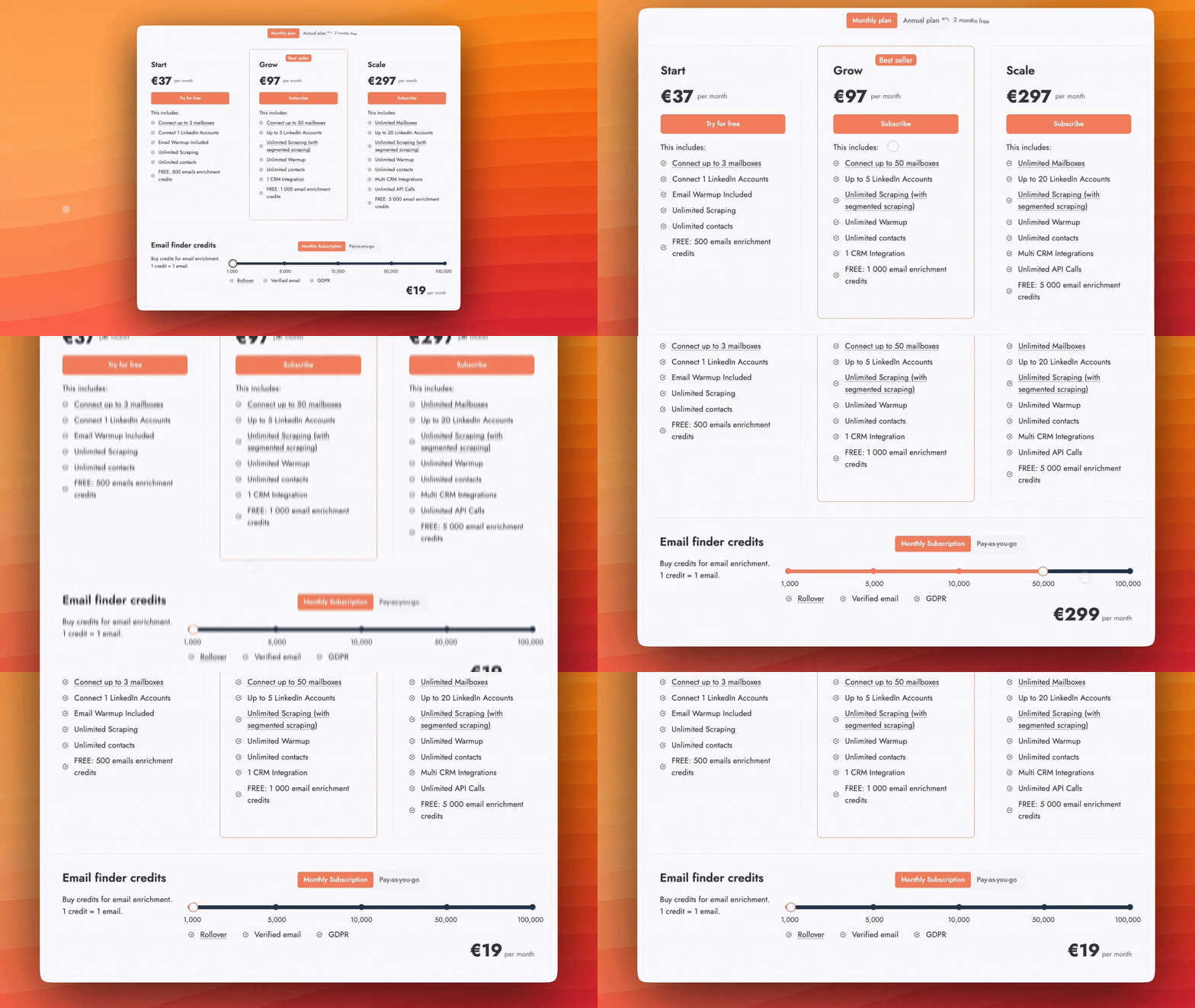
The difference with a pure verifier is that those same credits also find an address, at 1 credit, or a phone number, at 50 credits, and that the subscription covers cold email and mailbox warmup without limit. Credits stay optional: they are needed neither to send nor to act on LinkedIn.
GetProspect

GetProspect sells verification two ways, and it is the second that matters here. Every subscription includes a verification quota worth twice the quota of found emails: 2,000 verifications for 1,000 addresses on Starter, 10,000 for 5,000 on Growth 5k. But the vendor also sells verification credits on their own, with no subscription, no entry fee and no expiry.
Verifications | Price | Unit cost |
10,000 | $29 | $0.0029 |
100,000 | $119 | $0.0012 |
500,000 | $249 | $0.0005 |
1,000,000 | $369 | $0.00037 |
10,000,000 | $2,499 | $0.00025 |
It is the lowest grid in this comparison. The base holds 780 million contacts, catch-all domain verification is done in house, duplicates are not billed and team accounts are included on every plan.
Plan | Monthly | Annual | Valid emails | Verifications included |
Free | $0 | $0 | 50 / month | 100 / month |
Starter | $49 | $34 | 1,000 / month | 2,000 / month |
Growth 5k | $99 | $69 | 5,000 / month | 10,000 / month |
Two reservations. The phone side is thin, five numbers a month whatever the plan. And the vendor publishes two figures that should not be confused: 98% accuracy on the addresses delivered, but 84 valid addresses found per 100 contacts submitted in its own tests.
Hunter

Hunter verifies through its Email Verifier, one at a time or in bulk, and a verification costs half a credit where a found email costs one. The allowance therefore stretches twice as far if you only use it to verify. On the Starter plan at €34 annually, with 2,000 monthly credits, that is 4,000 verifications a month and puts the unit around €0.0085.
Plan | Annual per month | Monthly | Credits per month | Mailboxes |
Free | €0 | €0 | 50 | 1 |
Starter | €34 | €49 | 2,000 | 3 |
Growth | €104 | €149 | 10,000 | 10 |
Scale | €209 | €299 | 25,000 | 20 |
Credits are advertised per year on the vendor's page, so divide by twelve to think in monthly volume: the 24,000 annual credits of the Starter plan are indeed 2,000 a month. Team members are unlimited on every plan, so there is no per-user cost: a whole team stays at €34 on Starter. Added to that: address search, real campaign sending with 3 to 20 connectable mailboxes, and a Discover module to explore a company base by filters. The annual discount reaches 30%. Two gaps: no phone numbers, and no deliverability diagnostics.
Findymail

Findymail does not sell verification separately, it does it at the moment it finds: every address that comes out of the tool is already verified, and the vendor guarantees under 5% bounce, refunding credits if the threshold is passed. It is the only contractual commitment on quality in this list.
For contacts coming from elsewhere, each tier comes with an equal volume of Verifier credits, free. A plan with 5,000 searches therefore gives 5,000 verifications on top, at no extra cost. An email costs 1 credit, a mobile number 10, and nothing is charged if the address cannot be found.
Plan | Finder credits per month | Monthly | Annual |
Basic | 1,000 | $49 | $41 |
Starter | 5,000 | $99 | $83 |
Business | 15,000 | $249 | $208 |
Scale 50K | 50,000 | $549 | $458 |
Scale 100K | 100,000 | $849 | $708 |
Annual billing gives two months free. Credits roll over up to twice the monthly allowance, which caps accumulation: an oversized plan is therefore paid for twice, in subscription and in lost credits. No sending and no warmup, and hosting is European with SOC 2 Type 2 certification.
Dropcontact
Dropcontact does not bill verification, it folds it into enrichment: native address validation and advanced catch-all domain verification, with validity advertised at 99% on the data delivered. You are not paying for a verification, you are paying for an enriched contact.
Plan | Monthly price | Monthly credits used here | Cost per credit |
Starter | €79 | 4,000 | €0.020 |
Growth | €120 | 4,000 | €0.030 |
Enterprise | On quote | from 200,000 | negotiated |
Both plans rest on a slider running from 500 to 150,000 monthly credits, worth working on before you choose: it goes low enough for an occasional need, and the Enterprise plan takes over beyond 200,000. Annual billing gives a 20% discount and the model is pay on success, contacts that cannot be enriched not being billed. Fifty free credits let you test without a bank card. The main argument is compliance: processing claimed as GDPR-compliant, data rebuilt by algorithm rather than bought. Against that: no searchable base, no phone numbers, no sending. The tool enriches a list you supply.
To dig into each of these tiers you can read our article on Hunter pricing, our article on GetProspect pricing, our article on Dropcontact pricing and our article on Apollo pricing.
The email warmup a verifier lacks
Included and unlimited on all three Emelia plans: measuring bounces is not enough, you still have to build reputation.
Which tier to choose
You want to judge quality before paying. Do not count on the 10 free credits. Go through the free list analysis, which gives an estimate of the bounce rate without consuming a credit.
You clean once a year. Pay as you go, at the tier immediately above your need. Credits last twelve months, which covers exactly that interval.
Your need is below 10,000 verifications. Buy 10,000 credits at $50 anyway. That is ten dollars more than 5,000 and 37% less per unit.
You verify between 10,000 and 50,000 a month. A single annual purchase at the right tier stays cheaper than the subscription. At 10,000 a month, $525 of purchases against $588 of subscription.
You go above 50,000 a month. Growth subscription, without hesitation. At 100,000 monthly the gap reaches 41% over the year, and the CRM sync only bills new addresses.
Your volume is approaching a threshold. Always check the tier above: 100,000 credits at $400 work out cheaper per unit than 50,000 at $250.
Your list is old. Get the treatment of *unknown* and *accept all* results clarified in writing before buying. On a database that has been dormant, those two categories can be 15 to 20% of the volume.
Your list is mostly freemail. The 3% guarantee will not cover you, Gmail, Outlook and Yahoo being explicitly excluded.
You are also looking for addresses, or you send. NeverBounce does neither. A tool that folds verification into a broader offer will cost you less overall.
Conclusion
NeverBounce is a good verification product, with two qualities its competitors do not always have: a bounce guarantee backed by a real refund, and pay as you go credits valid for twelve months, stated in black and white.
The price, on the other hand, demands method. The grid is not a smooth discount in the usual sense, it advances in steps, and five of its ten tiers lower nothing. Buying 5,000 credits rather than 10,000 means paying 37% more per unit to save ten dollars, which is the kind of mistake the pricing page will not help you avoid.
The real trap is elsewhere. The table comparing a single purchase with one month of subscription systematically favours the subscription, and it is misleading, because the subscription is paid twelve times while the credits last twelve months. Redone over a year, the comparison flips: below 50,000 verifications a month, one annual purchase at the right tier costs less.
So ask yourself two questions before choosing, in this order: which tier does my annual volume fall into, and will I still be verifying next month. The first sets your unit price, the second the mode. Both can be answered without a sales call.
Frequently asked questions about NeverBounce pricing in 2026
How much does NeverBounce cost in 2026?+
Pay as you go, from $8 for 1,000 credits to $4,000 for two million. On a Growth subscription, from $10 a month for 1,000 emails to $999 for one million a month. Beyond that, pricing moves to a quote.
How much does one verification cost at NeverBounce?+
From $0.008 on the two smallest purchases to $0.002 on the two million credit tier. On subscription, from $0.010 to $0.001. The unit cost only changes, however, on five of the ten tiers.
Do NeverBounce credits expire?+
Yes. Credits bought pay as you go are valid for twelve months from the date of purchase, and the rule is published under the pricing grid. The credits of a Growth subscription, on the other hand, are removed at the end of the paid period if you cancel, the account reverting to pay as you go.
Should I choose the subscription or pay as you go?+
It depends on your monthly volume, and the tipping point sits at around 50,000 verifications a month. Below it, a single annual purchase at the right tier costs less, since credits last twelve months. Above it, Growth wins clearly: at 100,000 a month, $1,908 over the year against $3,250 of purchases.
Which tier is the best value?+
The 10,000 credit tier, at $50. It costs ten dollars more than 5,000 credits and drops the unit cost by 37%, from $0.008 to $0.005. It is the only genuinely rewarding step in the lower grid.
How many free credits does registration give?+
Ten. The figure appears in the vendor's billing page. The address of its help page still mentions a thousand credits, but the content of that page says ten. To evaluate the tool, the free list analysis is a better route, since it estimates the bounce rate without consuming a credit.
Are indeterminate results billed?+
The vendor does not say. It publishes that deduplication and syntax cleaning are free, performed before the job is priced, but no exemption for *unknown* and *accept all* results. On an ageing list, where those categories weigh heavily, it is a line to get clarified in writing.
What is the 3% bounce guarantee worth?+
It has a real mechanism, with a refund of the difference, which is rare. But its conditions are restrictive: cleaning within 72 hours of the send, at least 500 unique addresses, sending only to valid addresses, and exclusion of freemail providers such as Gmail, Outlook and Yahoo. On a consumer list it covers almost nothing.
Does NeverBounce belong to ZoomInfo?+
Yes. The tool was acquired by DiscoverOrg, which became ZoomInfo, in 2018. It continues to be sold separately with its own public grid.
Which cheaper alternative to NeverBounce is there for verification?+
Tools that fold verification into a broader offer come out cheaper as soon as volume rises: Emelia charges 0.25 credit for a verification, so $0.00475 to $0.0011 depending on the tier, and Hunter half a credit. The cheapest on this single use is GetProspect, which sells verification credits outside any subscription and with no expiry, at $29 per 10,000 and $119 per 100,000. None of them, however, offers the continuous CRM synchronisation of NeverBounce.