ZeroBounce sells the same thing two ways, and the gap between them reaches 30%.
Ten thousand verifications cost $129 pay as you go, and $99 a month on a subscription. A hundred thousand cost $649 one way, $449 the other. The subscription is cheaper per credit right across the range.
Except that it renews every month, while a pay as you go purchase is paid once. The whole decision sits in that sentence: if you clean a list twice a year, the plan with the cheaper credit will cost you more in total.
We recorded both price lists in full, nine tiers for pay as you go and seven for the subscription, along with the pricing FAQ, on 7 September 2026.

What ZeroBounce actually is
Before talking about money, the tool needs placing, because it does not do the same job as the email finders it is sometimes compared with.
An address verification service, not a directory. The core of the product is to take a list of addresses you already own and tell you which ones are valid, which will bounce, which are spam traps or disposable accounts. The vendor claims 18 validation tools and a guaranteed accuracy of 99.6%.
What it covers. Bulk validation by file or in real time through the API, AI scoring of addresses, inbox placement tests, blacklist monitoring, DMARC monitoring, mail server tests, warmup addresses, IP geolocation and detailed status codes. On top of that sit an Email Finder and a domain search, which fall outside the verification business.
How you use it. You upload a file, or you wire the real time API into your signup form or your sending tool. The result comes back with a status per address. Several API keys are available and support is advertised around the clock.
Who it is for. Teams that send at volume and whose sender reputation is an asset: ageing lists to clean before a campaign, databases imported from another tool, signup forms to protect in real time.
What it is not. ZeroBounce does not build lists, does not send campaigns and does not replace a prospecting tool. It is a data hygiene component, to be placed upstream of your sending.
Two models, two logics
The whole reading of this price list rests on the comparison between the two ways it is sold.
Pay as you go | ZeroBounce ONE subscription | |
Commitment | None, one off purchase | Monthly or annual |
Minimum volume | 2,000 credits | 10,000 credits a month |
Credit expiry | Expiry rules may apply, not published | Never, as long as the subscription is active |
Rollover from month to month | - | Yes |
Annual discount | - | 20% |
Extra tools included | No | Yes, warmup, placement tests, DMARC, blacklists |
Discount on pay as you go credits | - | 15% for subscribers |
The ONE subscription is not just cheaper credit, and that is exactly what a comparison of unit prices makes disappear. The $99 a month also buys a deliverability suite: warmup addresses, inbox placement tests, blacklist monitoring, DMARC monitoring, mail server tests, activity data, higher API limits, faster file processing and priority support. Those volumes are configurable, which makes the final price move.
The practical consequence matters for the decision. If you are never going to use DMARC monitoring or placement tests, part of that $99 is doing nothing for you. Comparing the ONE credit with the pay as you go credit then amounts to comparing an all inclusive subscription with a bare purchase, which tilts the reading in favour of the first. Conversely, a team that would pay for those tools separately elsewhere recovers value that the price per credit does not reflect.

The pay as you go price list
Nine tiers, recorded one by one. The unit cost is the one the vendor itself displays under the slider.
Credits | Price | Cost per verification |
2,000 | $39 | $0.0195 |
5,000 | $69 | $0.0138 |
10,000 | $129 | $0.0129 |
25,000 | $274 | $0.0110 |
50,000 | $499 | $0.0100 |
100,000 | $649 | $0.0065 |
250,000 | $1,299 | $0.0052 |
500,000 | $2,199 | $0.0044 |
1,000,000 | $3,199 | $0.0032 |
Above that | On quote | - |
The volume discount is steep: the credit is divided by six between the first and the last tier. It is not regular, though. The most rewarding jump sits between 50,000 and 100,000 credits, where the unit cost drops 35% for a price that rises only 30%. In other words, 100,000 credits at $649 are a better deal than 50,000 at $499, and it is worth checking whether your real need does not sit just below that threshold.
The strength of this mode is the absence of commitment: you buy a reserve, you consume it at your own pace, and you pay nothing between two campaigns.
One important reservation on how long those credits live. ZeroBounce writes that credits never expire as long as you have an active ZeroBounce ONE subscription. Without a subscription, meaning in the pay as you go case on its own, the vendor states that « expiration rules may apply » depending on the account creation date and the date the credits were purchased or granted, and points to the applicable terms without publishing them on that page. The non expiry guarantee is therefore tied to the subscription, not to the purchase. It is worth getting in writing before building a large reserve meant to last.
Verification is not a separate line
At Emelia it costs 0.25 credit, about 0.005 €, inside the same plan as finding contacts and sending them.
The subscription price list
Seven tiers, beyond which pricing moves to a quote. The prices below are monthly; the annual commitment takes 20% off.
Credits a month | Monthly price | Cost per verification |
10,000 | $99 | $0.0099 |
25,000 | $199 | $0.0080 |
50,000 | $379 | $0.0076 |
100,000 | $449 | $0.0045 |
250,000 | $999 | $0.0040 |
500,000 | $1,699 | $0.0034 |
1,000,000 | $2,499 | $0.0025 |
The subscription is cheaper per credit across the entire range. At 100,000 credits the gap reaches 31%; at a million, 22%. With the 20% annual discount it widens further.
Note that the minimum is 10,000 credits a month. There is no subscription below $99 a month, which rules this mode out for a modest need.
Two rules, on the other hand, argue strongly for the subscription, and both are written in the pricing FAQ. Unused credits roll over from one month to the next, so there is no monthly reset. And credits do not expire as long as the subscription stays active. The subscription can be cancelled at any time, but the protection against expiry stops with it.
Subscription or pay as you go: the only calculation that matters
Here is the direct comparison, at identical volume.
Volume | Pay as you go | Monthly subscription | Gap |
10,000 | $129 | $99 | -23% |
25,000 | $274 | $199 | -27% |
50,000 | $499 | $379 | -24% |
100,000 | $649 | $449 | -31% |
250,000 | $1,299 | $999 | -23% |
500,000 | $2,199 | $1,699 | -23% |
1,000,000 | $3,199 | $2,499 | -22% |
The subscription wins everywhere, but this table compares a single purchase with one month of subscription. The real question is not the price of the credit, it is how often you clean.
Take a need of 100,000 verifications a year. Nobody in their right mind would subscribe to the 100,000 credits a month tier for that: the right point of comparison is the entry tier of the subscription, 10,000 credits a month at $99, which delivers 120,000 credits over the year and therefore covers the need comfortably.
For 100,000 verifications a year | Annual cost |
Pay as you go, single purchase of 100,000 credits | $649 |
Entry ONE subscription, 10,000 credits a month | $99 × 12 = $1,188 |
Entry ONE subscription on annual commitment, 20% off | about $950 |
The one off purchase is therefore still the cheapest, but the gap is 1.5 to 1.8 times, not a factor of eight. And in exchange the subscription brings credit rollover, non expiry and the deliverability suite.
The ratio flips as soon as the need becomes monthly. At 100,000 verifications every month, the subscription at the matching tier costs $449 a month, so $5,388 over the year, against twelve purchases at $649, so $7,788.
The practical rule: if you verify every month, take the subscription and the annual commitment. If you clean occasionally, before a campaign or after an import, stay on pay as you go. The tipping point sits at around nine months of use out of twelve.
One detail that matters for mixed cases: subscribers get 15% off credits bought pay as you go. A team with a regular need and occasional peaks is therefore better off taking a modest subscription and topping it up with discounted one off purchases.
No 10,000 credit minimum tier
19 € for 1,000 credits at Emelia, topped up whenever you want, with no volume floor and no monthly commitment.
What a credit really costs depending on what you do with it
The ZeroBounce credit is not only used for verification, and its yield varies sharply with the use.
Use | Cost in credits |
Verify an address, by file or by API | 1 credit |
Score an address with AI scoring | 1 credit |
One successful Email Finder request | 20 credits |
The Email Finder therefore consumes twenty times more than a verification. At $0.0129 per credit on the 10,000 tier, one address found comes to $0.26, which is expensive for a business email. On the largest tier it drops to $0.064.
The conclusion is clear: ZeroBounce is competitive at verifying, it is not at finding. Its address search is a handy extra once you are already a customer, not a reason to choose it.
Two rules, on the other hand, work in your favour, and both are written in the pricing FAQ. « Unknown » results are not billed, which avoids paying for an answer that teaches you nothing, and duplicates are not billed either. Credit non expiry, however, only holds as long as a subscription stays active: see above.
The free plan and the accuracy guarantee
The Freemium plan gives 100 validation credits a month, topped up automatically, plus one inbox placement test, one mail server test, blacklist monitoring analysed every 24 hours and 10 Email Finder requests.
This is not a time limited trial: the credits refill every month and do not expire. Activity data, warmup and DMARC monitoring are excluded.
A hundred verifications a month is enough to judge quality on a sample, not to clean a list. That is exactly the right sizing for a free plan: enough to check the promise, not enough to settle for it.
That promise, precisely, is a validation accuracy guaranteed at 99.6%. The figure is put forward on the pricing page and in the FAQ, where the vendor cites it among the things that set it apart from its competitors.
But that guarantee has no public mechanism. ZeroBounce publishes neither the measurement method, nor the threshold below which it would be considered unmet, nor the remedy you would be entitled to in that case. The word guarantee there denotes a claim of quality, not an enforceable commitment.
The comparison with Findymail makes the gap legible. Findymail announces a bounce rate below 5%, which is something you observe yourself on your own campaigns, and refunds your credits if the threshold is exceeded. There is a figure, a measure the customer can verify and a remedy. At ZeroBounce there is a figure. That is worth getting in writing before an annual commitment.
What ZeroBounce does not do
No list building. ZeroBounce verifies what you bring it. Its Email Finder exists but costs 20 credits per request, which makes it a stopgap rather than a prospecting tool.
No sending. No sequences, no campaigns. Placement tests measure where your emails land, they do not send them for you.
No LinkedIn automation.
No subscription below 10,000 credits a month, which shuts small regular volumes out of the cheapest mode.
On a complete chain, ZeroBounce is therefore a hygiene component, sitting next to the tool that builds the list and the one that sends.
Build the list, verify it, send it
Emelia covers all three in one plan: Sales Navigator scraping included, credits at 19 € for 1,000, unlimited sending.
ZeroBounce against five alternatives
What the five tools below have in common is that they do not sell verification as a standalone product: it comes with address search, enrichment or sending, inside a broader offer.
The scope used: the cost of one address verification, from each vendor's entry tier to its best public tier, with no team commitment.
Tool | Verification from | Cost per verification | What that price covers | Expiry |
ZeroBounce | 2,000 credits, $39 | $0.0195, down to $0.0032 at one million | verification, placement tests, DMARC, blacklists | never |
Emelia | 1,000 credits, $19 | $0.0048, down to $0.0012 at 100,000 credits | verification, search, sending, warmup, LinkedIn | rollover, no expiry |
GetProspect | 10,000 verifications, $29 | $0.0029, down to $0.00037 at one million | verification bought on its own, outside any plan | none |
Hunter | Starter, €34 / month | about €0.0085 | verification, search, campaign sending | monthly credits |
Findymail | Basic, $49 / month | not sold separately, given at parity with search | verified search, bounce guarantee | rollover up to 2× the plan |
Dropcontact | Starter, €79 / month | not sold separately, folded into enrichment | enrichment and validation, €0.020 per credit | rollover on Growth |
Prices taken from each vendor's official pages, in their billing currency. Hunter, Emelia and Dropcontact bill in euros, ZeroBounce, GetProspect and Findymail in dollars. These amounts do not convert: the one you will be charged is the one in the vendor's own currency.
On unit cost, ZeroBounce is the most expensive on this list, and the gap is not slight. At 10,000 credits a verification costs $0.0129 there, against $0.0029 at GetProspect and €0.0048 at Emelia. You have to reach a million credits to come down to $0.0032, which is still above several competitors' entry price.
That price does not buy verification alone, and this is the tool's serious argument. A ZeroBounce credit also opens inbox placement tests, DMARC monitoring, blacklist monitors and warmup seeds, that is a complete deliverability suite none of the other five offers. Two rare commitments come with it: *unknown* results are not billed, and credits never expire.
So the question to settle is this: do you want to verify, or to monitor your deliverability? If the answer is verify, this list is cheaper, by a factor of two to four depending on the tier. If it is monitor, the comparison no longer turns on unit cost, and ZeroBounce has no equivalent among these five.
Emelia

Emelia has its own address verifier, usable three ways: one at a time, in bulk by CSV import, and through the API. It spots stale addresses and qualifies what is safe to send before the campaign goes out. The vendor advertises from €0.0048 per verified email.
The arithmetic is simple because there is only one internal currency: a verification costs 0.25 credit, a quarter of a found email. On the first tier, $19 per 1,000 credits, that puts the unit at $0.0048, and it falls to $0.0012 on the 100,000-credit tier. Credits roll over from one month to the next and never expire.
Credits | Monthly subscription, with rollover | Verifications this buys |
1,000 | $19 | 4,000 |
5,000 | $49 | 20,000 |
10,000 | $99 | 40,000 |
50,000 | $299 | 200,000 |
100,000 | $499 | 400,000 |
The subscription that comes with these credits starts at $37 a month, then $97 and $297 depending on the number of LinkedIn accounts and mailboxes you can connect.
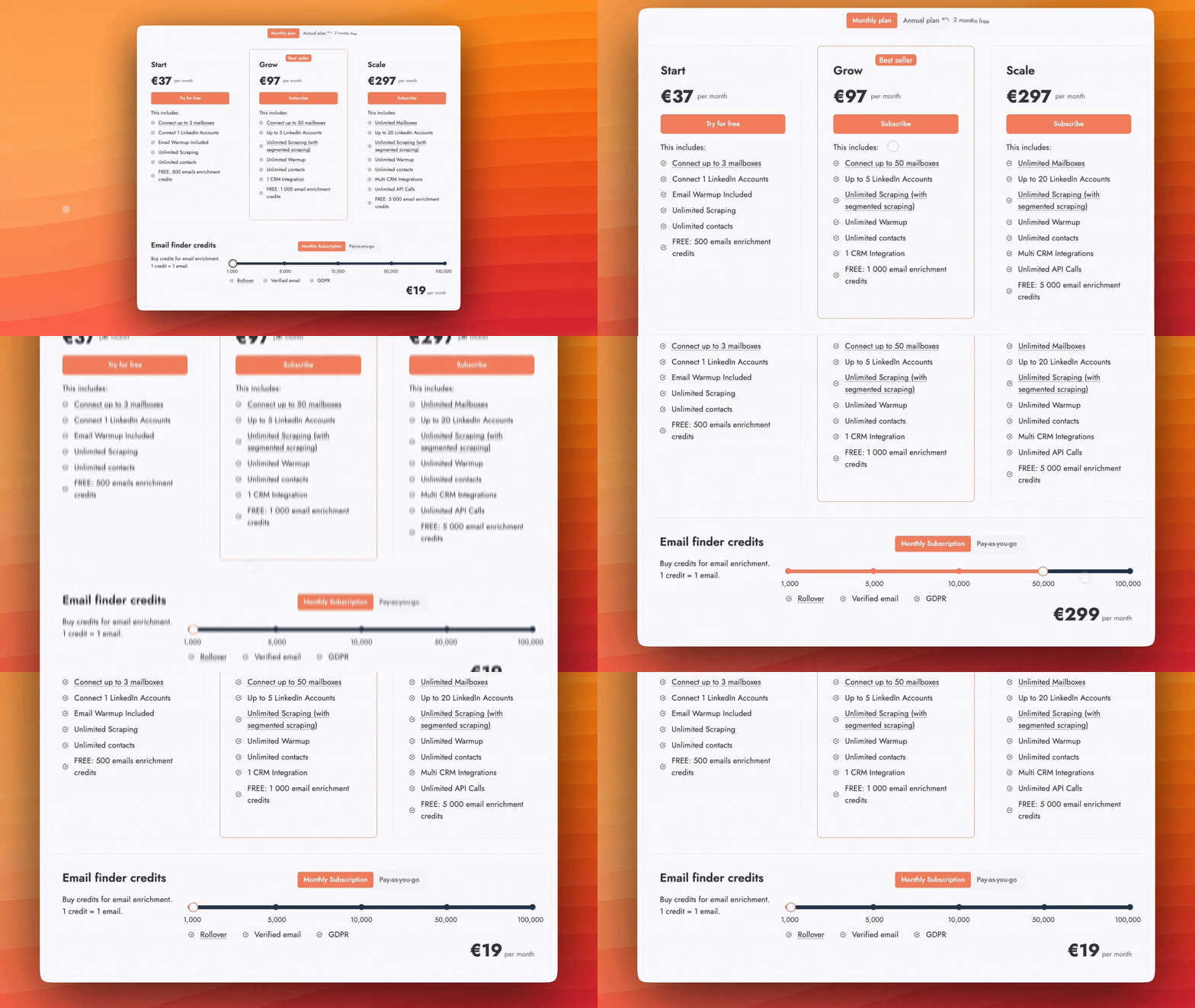
The difference with a pure verifier is that those same credits also find an address, at 1 credit, or a phone number, at 50 credits, and that the subscription covers cold email and mailbox warmup without limit. Credits stay optional: they are needed neither to send nor to act on LinkedIn.
GetProspect

GetProspect sells verification two ways, and it is the second that matters here. Every subscription includes a verification quota worth twice the quota of found emails: 2,000 verifications for 1,000 addresses on Starter, 10,000 for 5,000 on Growth 5k. But the vendor also sells verification credits on their own, with no subscription, no entry fee and no expiry.
Verifications | Price | Unit cost |
10,000 | $29 | $0.0029 |
100,000 | $119 | $0.0012 |
500,000 | $249 | $0.0005 |
1,000,000 | $369 | $0.00037 |
10,000,000 | $2,499 | $0.00025 |
It is the lowest grid in this comparison. The base holds 780 million contacts, catch-all domain verification is done in house, duplicates are not billed and team accounts are included on every plan.
Plan | Monthly | Annual | Valid emails | Verifications included |
Free | $0 | $0 | 50 / month | 100 / month |
Starter | $49 | $34 | 1,000 / month | 2,000 / month |
Growth 5k | $99 | $69 | 5,000 / month | 10,000 / month |
Two reservations. The phone side is thin, five numbers a month whatever the plan. And the vendor publishes two figures that should not be confused: 98% accuracy on the addresses delivered, but 84 valid addresses found per 100 contacts submitted in its own tests.
Hunter

Hunter verifies through its Email Verifier, one at a time or in bulk, and a verification costs half a credit where a found email costs one. The allowance therefore stretches twice as far if you only use it to verify. On the Starter plan at €34 annually, with 2,000 monthly credits, that is 4,000 verifications a month and puts the unit around €0.0085.
Plan | Annual per month | Monthly | Credits per month | Mailboxes |
Free | €0 | €0 | 50 | 1 |
Starter | €34 | €49 | 2,000 | 3 |
Growth | €104 | €149 | 10,000 | 10 |
Scale | €209 | €299 | 25,000 | 20 |
Credits are advertised per year on the vendor's page, so divide by twelve to think in monthly volume: the 24,000 annual credits of the Starter plan are indeed 2,000 a month. Team members are unlimited on every plan, so there is no per-user cost: a whole team stays at €34 on Starter. Added to that: address search, real campaign sending with 3 to 20 connectable mailboxes, and a Discover module to explore a company base by filters. The annual discount reaches 30%. Two gaps: no phone numbers, and no deliverability diagnostics.
Findymail

Findymail does not sell verification separately, it does it at the moment it finds: every address that comes out of the tool is already verified, and the vendor guarantees under 5% bounce, refunding credits if the threshold is passed. It is the only contractual commitment on quality in this list.
For contacts coming from elsewhere, each tier comes with an equal volume of Verifier credits, free. A plan with 5,000 searches therefore gives 5,000 verifications on top, at no extra cost. An email costs 1 credit, a mobile number 10, and nothing is charged if the address cannot be found.
Plan | Finder credits per month | Monthly | Annual |
Basic | 1,000 | $49 | $41 |
Starter | 5,000 | $99 | $83 |
Business | 15,000 | $249 | $208 |
Scale 50K | 50,000 | $549 | $458 |
Scale 100K | 100,000 | $849 | $708 |
Annual billing gives two months free. Credits roll over up to twice the monthly allowance, which caps accumulation: an oversized plan is therefore paid for twice, in subscription and in lost credits. No sending and no warmup, and hosting is European with SOC 2 Type 2 certification.
Dropcontact
Dropcontact does not bill verification, it folds it into enrichment: native address validation and advanced catch-all domain verification, with validity advertised at 99% on the data delivered. You are not paying for a verification, you are paying for an enriched contact.
Plan | Monthly price | Monthly credits used here | Cost per credit |
Starter | €79 | 4,000 | €0.020 |
Growth | €120 | 4,000 | €0.030 |
Enterprise | On quote | from 200,000 | negotiated |
Both plans rest on a slider running from 500 to 150,000 monthly credits, worth working on before you choose: it goes low enough for an occasional need, and the Enterprise plan takes over beyond 200,000. Annual billing gives a 20% discount and the model is pay on success, contacts that cannot be enriched not being billed. Fifty free credits let you test without a bank card. The main argument is compliance: processing claimed as GDPR-compliant, data rebuilt by algorithm rather than bought. Against that: no searchable base, no phone numbers, no sending. The tool enriches a list you supply.
To dig into each of these tiers you can read our article on Hunter pricing, our article on GetProspect pricing, our article on Dropcontact pricing and our article on Apollo pricing.
37 € a month, cancel this month
Unlimited emails and contacts, email warmup included, and no minimum volume to reach before you start.
Which mode and which tier to choose
You are testing quality. The Freemium plan and its 100 refilled verifications a month are enough to measure accuracy on a sample you already know.
You clean occasionally, one to four times a year. Pay as you go: you pay nothing between two campaigns, and for 100,000 verifications a year the gap stays in your favour. Do get the lifetime of the credits clarified, though, since non expiry is only guaranteed with an active subscription.
You verify every month. ZeroBounce ONE subscription, with the annual commitment that takes 20% off. The tipping point sits at around nine months of use out of twelve.
Your need is irregular with peaks. Take the entry subscription and top it up with pay as you go purchases, discounted 15% for subscribers.
Your volume is approaching 100,000 verifications. Check the tier just above: pay as you go, 100,000 credits at $649 work out cheaper per unit than 50,000 at $499.
You are mainly looking for addresses. The Email Finder at 20 credits a request is not competitive. Take a tool whose actual business that is.
Your need is below 10,000 regular monthly verifications. The subscription does not go any lower. Stay on pay as you go, or look at a tool that folds verification into a broader offer.
Conclusion
ZeroBounce is a good verification product, equipped with a diagnostic suite that few competitors offer: inbox placement tests, blacklist monitoring, DMARC monitoring, server tests. For a team whose deliverability is a subject in its own right, that toolkit has a value the cost of verification alone does not reflect.
On price, the list is legible and two rules work squarely in your favour: unknown results are not billed, and neither are duplicates. Credit non expiry, on the other hand, is only acquired with an active subscription.
The real trap is therefore not the price, it is the choice of mode. The subscription shows a credit 22 to 31% cheaper, which makes it irresistible on paper. But it renews every month, and an annual need of 100,000 verifications costs it $950 or $1,188 depending on the commitment, against $649 for the same volume bought once. To which is added a deliverability suite included in the price, valuable if you use it, purely decorative if you do not.
So ask yourself a single question before choosing: will I still be verifying next month? If the answer is no, the offer with the most expensive credit is the cheapest in total.
Frequently asked questions about ZeroBounce pricing in 2026
How much does ZeroBounce cost in 2026?+
Pay as you go, from $39 for 2,000 credits to $3,199 for one million. On subscription, from $99 a month for 10,000 monthly credits to $2,499 for one million, with 20% off on the annual commitment. Beyond one million, pricing moves to a quote.
How much does one verification cost at ZeroBounce?+
From $0.0195 on the smallest pay as you go purchase to $0.0032 on the largest. On subscription, from $0.0099 to $0.0025. The subscription is cheaper per credit across the whole range.
Should I choose the subscription or pay as you go?+
It depends on how often you verify. The subscription is 22 to 31% cheaper per credit, but it renews every month and its entry tier costs $99 a month, so $1,188 over the year. For an annual need of 100,000 verifications, pay as you go comes to $649 and therefore stays cheaper. The subscription takes the lead as soon as the need becomes monthly, and it also brings credit rollover, non expiry and the deliverability suite.
Do ZeroBounce credits expire?+
It depends on the mode. As long as a ZeroBounce ONE subscription is active, no: credits do not expire and they roll over from month to month. Without a subscription, meaning pay as you go on its own, the vendor states that expiration rules may apply depending on the account creation date and the purchase date, without publishing those rules. Non expiry is therefore tied to the subscription, not to the purchase, and it is worth getting in writing before building a large reserve.
Am I billed for an unknown result?+
No. Indeterminate results do not consume a credit, and neither do duplicates.
What does the free plan include?+
One hundred validation credits a month, refilled automatically and with no expiry, one inbox placement test, one mail server test, blacklist monitoring analysed every 24 hours and 10 Email Finder requests. Activity data, warmup and DMARC monitoring are excluded.
How many credits does the Email Finder use?+
Twenty credits per successful request, twenty times the cost of a verification. That puts an address found at about $0.26 on a 10,000 credit purchase.
What is the minimum volume at ZeroBounce?+
Two thousand credits on pay as you go, and 10,000 credits a month on subscription. There is therefore no subscription below $99 a month.
What is the 99.6% accuracy guarantee worth?+
It is the figure the vendor displays on its pricing page and in its FAQ, but it has no public mechanism. ZeroBounce publishes neither the measurement method, nor the threshold for non compliance, nor the remedy you would be entitled to. Findymail, by comparison, announces a bounce rate below 5% and refunds credits if the threshold is exceeded: there is a verifiable measure and a remedy. At ZeroBounce there is a figure. That is worth clarifying before an annual commitment.
Which cheaper alternative to ZeroBounce is there for verification?+
Tools that fold verification into a broader offer come out clearly cheaper per unit: Emelia charges 0.25 credit for a verification, so $0.00475 to $0.0011 depending on the tier, and Hunter half a credit. The cheapest on this single use is GetProspect, which sells verification credits outside any subscription and with no expiry, at $29 per 10,000 and $119 per 100,000. None of them, however, offers the placement tests and DMARC monitoring of ZeroBounce.