GetProspect lists $49 per month for 1,000 verified emails. That works out to $0.049 per address, and it is already one of the best prices on the market. On its largest plan, the address drops to $0.008.
So the subject of this article is not whether GetProspect is expensive, it is not. The subject is to understand what that price buys exactly, and above all what it does not buy. Because behind a very aggressive grid on email sits a product that gives 5 phone numbers per month, whatever the plan, including on the $399 tier.
GetProspect is an email finder backed by a database of 780 million contacts, with a built-in cold email sending module. It is not a full prospecting platform, and it is not a phone data provider either.
We recorded the official pricing on August 31, 2026, unfolded the three tiers of the Growth plan, read the publisher's full pricing FAQ and checked its coverage figures.
Disclosure. This article is published by the company behind Emelia and Basile, two of the tools cited below. The other publishers' pricing was recorded on their official pages and the calculations are given so they can be redone.

GetProspect plans in 2026: the official pricing
GetProspect offers four plans: a permanent free plan, a Starter plan and a Growth plan split into three volumes. Beyond that, pricing moves to a custom quote.
Free | Starter | Growth 5k | Growth 20k | Growth 50k | |
|---|---|---|---|---|---|
Monthly price | $0 | $49 | $99 | $199 | $399 |
Annual price | $0 | $34 | about $69 | about $139 | about $279 |
Valid emails | 50 / month | 1,000 / month | 5,000 / month | 20,000 / month | 50,000 / month |
Email verifications | 100 / month | 2,000 / month | 10,000 / month | 40,000 / month | 100,000 / month |
Phone numbers | 0 | 5 / month | 5 / month | 5 / month | 5 / month |
Credit card at signup | No | Not applicable | Not applicable | Not applicable | Not applicable |
The $34 annual rate for the Starter plan is the one GetProspect states itself in its FAQ, and it does match the announced 30% discount: 49 times 0.70 gives 34.3. The annual amounts of the Growth tiers are calculated the same way, 99 times 0.70 gives 69.3, and they are therefore not displayed by the publisher. One warning is needed: the only annual totals the pricing page shows, $588 for Starter and $1,188 for Growth 5k, match twelve times the monthly price and contradict the discount announced in the FAQ. That is the real risk at payment time: have the amount actually charged confirmed.
Three observations up front.
Verifications are always worth double the valid emails. One thousand emails found come with two thousand verifications, five thousand with ten thousand, and so on. The rule is constant across the whole grid.
Phone does not follow. Five numbers per month on the $49 plan, and still five on the $399 one. Phone is sold separately, as an option: five credits are included, then purchases are made in tiers of 300, up to 3,000 monthly credits. This is the most important limit of this product and we come back to it.
The Growth plan stacks. The FAQ states that the Growth 50k tier can be stacked up to ten times, which brings the theoretical ceiling to 500,000 emails per month.
The real cost of a verified email, plan by plan
This is the table that places GetProspect on the market, and it is flattering.
Plan | Monthly price | Valid emails | Cost per email | Annual |
|---|---|---|---|---|
Starter | $49 | 1,000 | $0.049 | $0.034 |
Growth 5k | $99 | 5,000 | $0.020 | about $0.014 |
Growth 20k | $199 | 20,000 | $0.010 | about $0.007 |
Growth 50k | $399 | 50,000 | $0.008 | about $0.006 |
Moving from Starter to Growth 5k divides the unit cost by two and a half for only twice the price. The tipping point is therefore the Starter ceiling: as soon as you approach 1,000 addresses per month, Growth 5k costs twice as much for five times the volume, and the address falls below two cents.
One figure to keep in mind to read this table honestly: GetProspect states that its own tests find 84 valid addresses per 100 contacts submitted. Since the platform does not bill emails it fails to find, the counter only moves on successes. If that rate holds on your target, a package of 1,000 valid emails therefore lets you submit about 1,190 contacts. That is a publisher assumption, not a market constant: measure your own rate on the free plan before building a budget on it.
Two cents an email, at Emelia too
19 € for 1,000 credits, and a found email costs one. The difference is what the subscription covers around it.
The GetProspect credit: four rules that work in your favor
The billing model is one of the clearest on the market, and that has to be acknowledged.
You do not pay for failures. The FAQ is explicit: you are not billed for emails that are not found. An unsuccessful search consumes nothing.
Duplicates are not billed. It is written in the list of features included on all plans, including the free plan. Landing again on a contact you already bought costs nothing, which is not the case everywhere.
Unused credits roll over. The FAQ confirms it, with two details that count: unconsumed credits are available in the following billing month, and the rollover is capped at one monthly allocation. It is a one month rollover, not unlimited accumulation. A slow month is therefore not entirely lost, but two consecutive slow months partly are.
Only B2B emails are provided. GetProspect states that it serves professional addresses only, never personal ones. That is a choice of address type, which reduces the risk, and not a compliance certification: not to be confused with the positioning of a Dropcontact, which claims GDPR compliant processing and refers to CNIL standards.
On top of that comes an in-house verification of catch-all addresses, included on all plans, which the publisher presents as proprietary.
The free plan: 50 emails per month, permanently
The GetProspect free plan is one of the most generous in its category, and it deserves a precise description.
What the free plan gives |
|---|
50 valid emails per month, renewed every month |
100 email verifications per month |
No credit card required |
LinkedIn extension, bulk search, CSV enrichment |
Advanced filters, native CRM integrations, API access |
Team accounts |
Credit rollover, no billing for duplicates |
One cold email sequence |
This is not a trial: the publisher describes a permanent free plan, with 50 new addresses every month, as long as that plan exists. And above all, the list of included features is almost identical to that of the paid plans. Advanced filters, the API, CRM integrations and team accounts are available from the free plan on.
Its real limit is volume, not features. Fifty addresses per month is one or two prospecting sessions. No phone number is included. One detail on team accounts, often read as a gift: the page talks about inviting members and managing shared credits from a single dashboard. The pot is therefore common, with no documented cap per member, which means a colleague can drain your allocation for the month.
Five direct dials a month runs out fast
At Emelia, a direct dial costs 50 credits, about 0,95 €, with no monthly quota to stall your prospecting.
Phone: five numbers per month, whatever the plan
Here is the point that should decide your purchase, and it does not show up in comparisons.
Plan | Monthly price | Phone numbers included |
|---|---|---|
Free | $0 | 0 |
Starter | $49 | 5 |
Growth 5k | $99 | 5 |
Growth 20k | $199 | 5 |
Growth 50k | $399 | 5 |
Five numbers per month on the $399 plan. This is not a misreading, it is a product choice: GetProspect sells email, and phone is treated as a separate option in its own right.
This option exists and is configured separately. Five credits are included, at zero dollars, then the slider moves in tiers of 300, up to 3,000 credits per month, billed on top of the subscription. No full grid is displayed on the pricing page, but the help center publishes one price point: 300 phone credits for $49, or about $0.16 per number at that tier. Beyond that, the rate is read on the configurator.
The database also announces 130 million mobile numbers, so the data exists. It really is a billing choice, not a coverage gap.
The consequence is simple. If your prospecting goes through the phone, GetProspect is not a serious candidate without first studying the cost of the option, and the full grid has to be requested from support. If your prospecting is email only, this limit does not concern you and the product becomes very competitive again.
What GetProspect includes and you would not expect: cold email sending
This is what sets GetProspect apart from most email finders, and the official FAQ is clear about its scope.
Sending is available from the free plan on, with a cold email sequence for your contact list. The FAQ states that you can send 200 emails at once on the Free, Starter and Growth plans, while recommending that you not exceed 100 sends per day from a single domain to preserve its reputation. Beyond that, sending is paid separately: the page announces 10,000 emails starting at $99, and this is a sending module bought on top, not the Growth 5k plan that costs the same amount.
What that changes. You can find and write within the same subscription, which avoids a second bill. For a freelancer starting out, that is a real argument.
What that does not change. There is no address warmup, no blacklist monitoring, no SPF, DKIM and DMARC authentication audit. Yet that is precisely the piece that determines whether your emails land. The publisher's own recommendation, not to exceed 100 daily sends per domain, says as much: reputation stays entirely on you.
GetProspect sending is therefore a convenience, not an outreach platform. It helps out on small volumes. It does not replace a tool that warms inboxes and drives several sending domains.
What the announced 98% accuracy is worth
GetProspect highlights two figures that must not be confused, and the distinction is to its credit since the publisher itself publishes it.
98% is the accuracy of the addresses found. In other words, out of a hundred addresses the platform delivers to you, about ninety-eight are valid at delivery time. The publisher makes it a guarantee and announces a refund in credits if the threshold is not met.
84 out of 100 is the match rate. According to the publisher's tests, GetProspect finds 84 valid addresses per 100 contacts submitted, and it compares favorably to ZoomInfo, Hunter.io, Lusha and ContactOut. It is this second figure that determines how many contacts you will actually be able to process. Do not take it for market data: independent tests published in 2025 and 2026 on different lists come in clearly lower.
Both figures come from the publisher and not from an independent test. They are consistent with the pay per success billing model, which only makes commercial sense if the match rate is high.
The coverage announced on the publisher's homepage is as follows: 780 million B2B contacts, 90 million professional emails, 47 million companies and 130 million mobile numbers. These are marketing figures, displayed on the front page, and not volumes verified by a third party. GetProspect was founded in 2016.
Signup, commitment and cancellation
On this ground, the policy is clear and documented in the official FAQ.
Annual is paid in one go, for twelve months, with 30% off. On what happens to the credits, the publisher's documentation is not consistent: the pricing page FAQ says they are renewed every month, a help center article describes a twelve month pot available until the end of the subscription. We keep the pricing page version, but it is a point to have confirmed at payment time, because it changes everything if your pace is irregular.
Plan changes are immediate. Upgrade, downgrade or reset are possible at any time, and a new monthly billing cycle starts at the change.
Cancellation is free. The subscription renews automatically, but can be canceled or paused at any time and without reason. After cancellation, you keep access to your credits until the end of the current cycle, as well as to all the data already collected.
This last point deserves to be underlined: keeping your data after cancellation is not standard among data vendors, and several competitors cut access as soon as the subscription ends.
Warmup decides if your emails land
Included and unlimited on all three Emelia plans, when most data vendors offer no warmup at all.
GetProspect against the market, on identical scope
Comparing displayed prices makes no sense when the units differ. So we set a single scope and price each tool on it.
The scope we keep holds in three columns, because a single figure cannot compare models this different: the cost of a verified professional email alone, that of a direct mobile alone, and that of a full contact combining both. Each tool is taken at its cheapest plan allowing regular use, brought back to one user.
Tool | Plan used | Email only | Mobile only | Full contact |
|---|---|---|---|---|
GetProspect | Growth 5k annual, about $69 / month, 5,000 emails / month | about $0.014 | Option, 300 credits for $49 | about $0.18 |
Emelia | Start €37 / month + €19 pack for 1,000 credits | €0.019 (1 credit) | €0.95 (50 credits) | €0.97 (51 credits) |
Kaspr | Starter annual, €45 / user, 100 numbers / month | Unlimited, trends toward 0 at volume | about €0.45 | about €0.45 |
Hunter | Starter annual, $34 / month, 2,000 credits / month | $0.017 (1 credit) | Not offered | Not offered |
Dropcontact | Starter, €79 / month, 500 credits at the bottom of the slider | €0.158 (1 credit) | Not offered | Not offered |
UpLead | Plus annual, $149 / month, 400 contacts / month | Not sold separately | Not sold separately | $0.37 |
Apollo | Basic annual, $49 / seat, 30,000 credits / year | Credit varies with the data | Higher credit on mobile | Variable |
Prices recorded on the publishers' official pages on August 31, 2026, in their billing currency and without conversion: dollar and euro amounts are therefore not directly comparable. The annual amounts of the GetProspect Growth tiers are calculated from the announced discount, they are not displayed by the publisher.
On email alone, three tools are close: GetProspect at about $0.014, Hunter at $0.017 and Emelia at €0.019. Dropcontact, often filed in the same group, is far from it once the slider is read correctly: €79 buys 500 credits at the lowest tier, or €0.158 per contact found. UpLead and Apollo do not sell email separately, and comparing them to the cent in this column would make no sense. The battle is therefore fought in the other two columns, and on what the price buys around the data.
What the price buys nowhere in the same way
Searchable database | Address warmup | Sequence sending | Phone | Per seat billing | |
|---|---|---|---|---|---|
GetProspect | Yes, 780M announced on the homepage | No | Basic | 5 / month | No |
Emelia | No | Yes, unlimited on all three plans | Yes, unlimited | 50 credits per number | No |
Kaspr | No, LinkedIn extension | No | No | Monthly credit quota | Yes |
Hunter | Discover, limited | No | Yes, 3 to 20 inboxes | No | No |
Dropcontact | No | No | No | No | No |
UpLead | Yes, coverage announced by the publisher | No | No | Included in the credit | Yes, 1 seat |
Apollo | Yes | Yes, deliverability and warmup suite on paid plans | Yes | Higher credits | Yes |
Three lessons stand out.
Only two tools warm addresses. Emelia announces warmup included and unlimited on its three plans. Apollo shows an “email deliverability and warmup suite” on its three paid plans, recorded on its pricing page on August 31, 2026. The other five, GetProspect included, offer none: yet that is the piece that decides whether your emails land, and an honest budget has to add it.
Phone splits the market into two camps. UpLead includes it in the contact price, Emelia and Apollo bill it in higher credits, Kaspr counts it as a monthly quota, Hunter and Dropcontact do not offer it, and GetProspect gives five per month before switching to an option sold in tiers of 300. Answer this question before all the others: do you call your prospects?
Three tools bill per seat or per user: UpLead, limited to one user on Essentials and Plus, Apollo, which adds a license per rep, and Kaspr, whose price is per user. The other four let you work as a group without multiplying the subscription, which completely changes the math from the second person on. A useful detail for Emelia: this is not a team mode, it is the absence of per seat billing, the plan setting the number of inboxes and LinkedIn accounts, not the number of people.
Emelia: €37 per month, sending and data in the same subscription

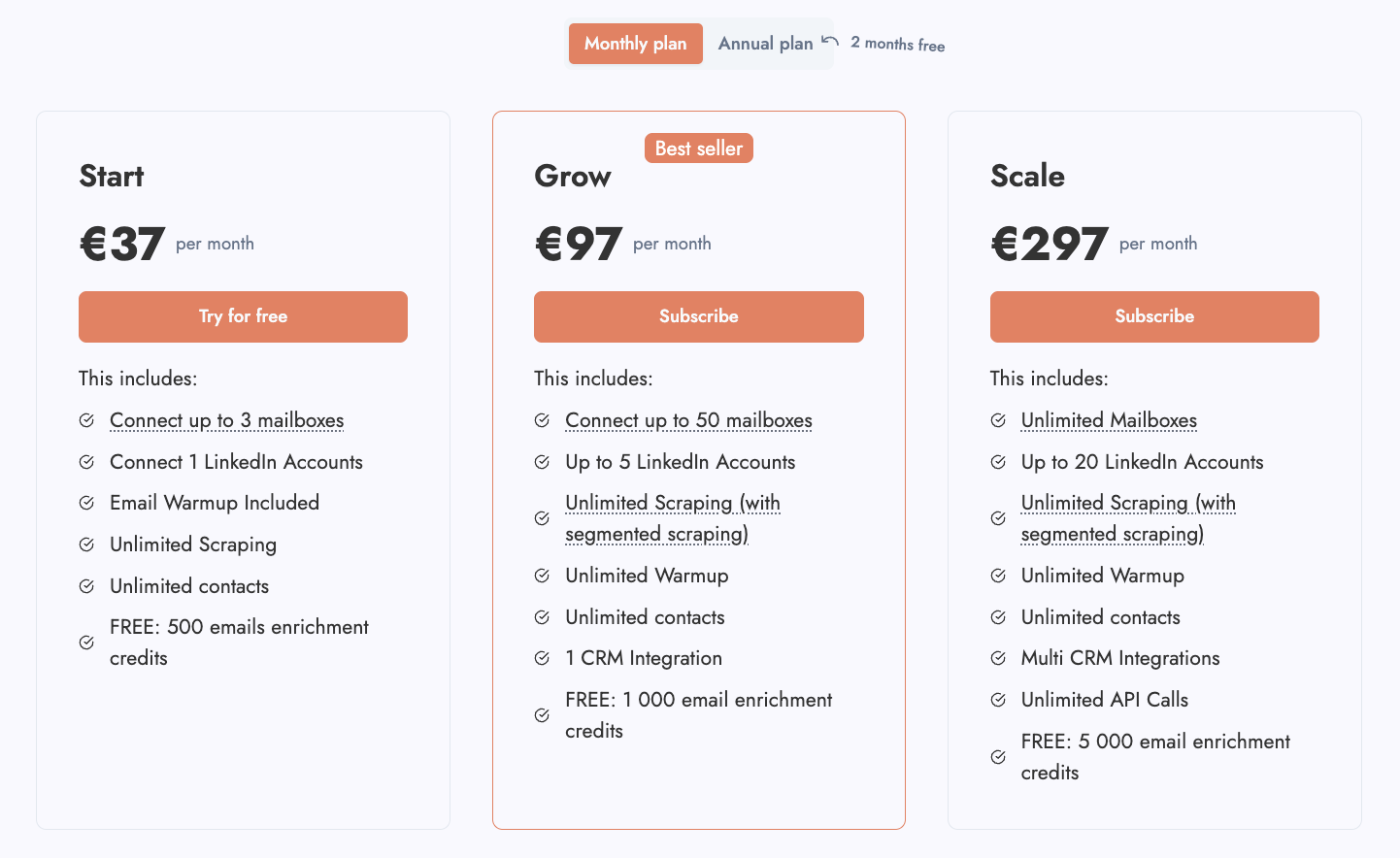
This is the alternative with the broadest scope, and that is why it opens this list. Emelia is a French prospecting platform that brings together cold email, LinkedIn automation, Sales Navigator scraping and contact data lookup in a single product, where GetProspect stops at the data and at simplified sending.
Plan | Price | Inboxes | LinkedIn accounts | Free credits |
|---|---|---|---|---|
Start | €37 | 3 | 1 | 500 |
Grow | €97 | 50 | 3 | 1,000 |
Scale | €297 | Unlimited | 10 | 5,000 |
The inboxes counted here are connected sending addresses, not users: Emelia does not bill per seat and has no team mode. A Grow plan with 50 inboxes is not a plan for 50 reps.
The base subscription covers sending, with unlimited emails and contacts, address warmup included and Sales Navigator scraping. Data is paid separately, in credits: €19 per 1,000 credits, an email found costing 1 credit, a verification 0.25 credit and a phone number 50 credits. The email therefore comes to about €0.019 and the number to about €0.95.
What Emelia does better than GetProspect.
Deliverability first, and it is the widest gap: address warmup is included and unlimited on all three plans, while GetProspect offers none and itself recommends staying under 100 daily sends per domain.
Sending next, genuinely sized for prospecting, with 3 to 50 inboxes driven and unlimited sends, where GetProspect offers a stopgap sequence. LinkedIn automation and Sales Navigator scraping last, absent from GetProspect.
Watch this video to scrape LinkedIn like a pro.
The starting point of the list, and it is a difference in nature more than in quality. GetProspect queries its own database, 780 million contacts and 47 million companies: you describe a company profile with firmographic filters, the tool returns the matching contacts.
Emelia starts from LinkedIn, and that is a source choice as much as a constraint. Its Sales Navigator scraping is included and unlimited on all three plans, without consuming a single credit, with segmented splitting from the Grow plan on to go past the 2,500 results of one search: GetProspect has nothing comparable.
The trade-off is that your targeting follows LinkedIn data, very current on people, their job and their company changes, more uneven on organizations with little presence on the network.
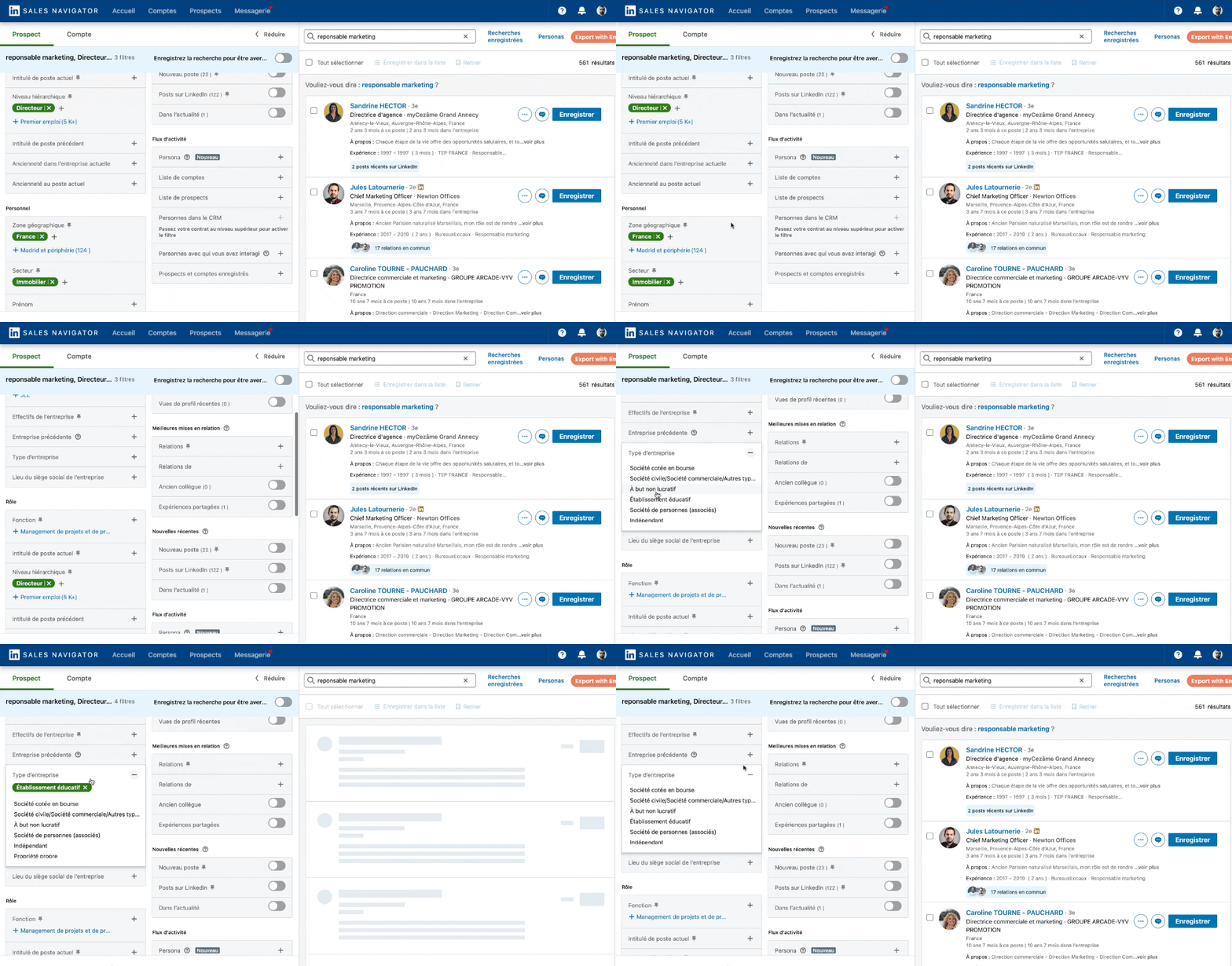
The GetProspect database does exactly the opposite: broader and filterable by company criteria, but frozen between two refreshes. Neither approach is superior, they fail on different targets.
On a French target, Emelia has a second entry point: Basile, published by the same team, holds the same place as Sales Navigator in the workflow.
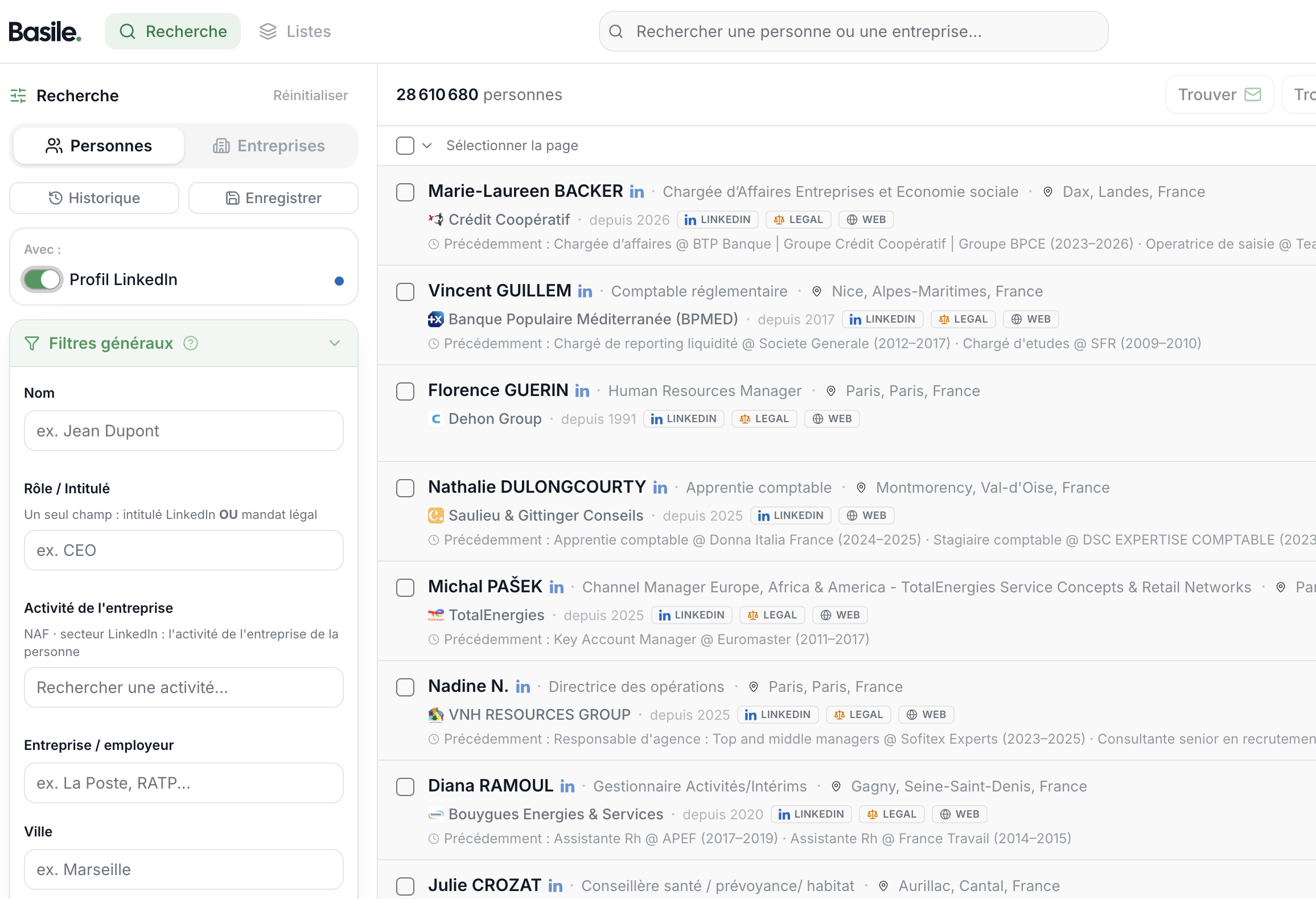
You build the list there, it plugs into your Emelia account whose credits do the enrichment, with no cap of 2,500 exports per day and without exposing a LinkedIn account. Basile, on the other hand, only covers France. Where GetProspect queries the whole world from a single database. On the cost of email, the two are equal up to 5,000 addresses per month, around two cents.
Hunter

Hunter is the closest competitor to GetProspect on its historical business, finding professional addresses.
Plan | Annual, per month | Monthly | Credits | Inboxes |
|---|---|---|---|---|
Free | $0 | $0 | 50 / month | 1 |
Starter | $34 | $49 | 2,000 / month, 24,000 / year | 3 |
Growth | $104 | $149 | 10,000 / month, 120,000 / year | 10 |
Scale | $209 | $299 | 25,000 / month, 300,000 / year | 20 |
Careful, Hunter displays its prices in dollars on its public page and expresses its credits per month as well as per year. Two thousand credits per month on Starter, or 24,000 over the year, for $34 per month on annual: the email found comes to about $0.017, a verification consuming half a credit. The annual discount reaches 30%, identical to the GetProspect one. Notable point, team members are unlimited on all plans.
What Hunter does better than GetProspect. The sending module is more serious, with 3 to 20 inboxes connectable depending on the plan, against stopgap sending at GetProspect. Hunter also offers four clear and displayed options, including inbox protection and managed inboxes, where GetProspect does not publish the price of its phone option.
What GetProspect does better. Volume at the same price: 24,000 credits per year on Hunter Starter against 60,000 emails per year on GetProspect Growth 5k for about twice the price, so a better unit ratio on the GetProspect side on the large tiers. GetProspect also provides phone numbers, even in symbolic quantity, where Hunter offers none. And its announced database is broader.
For whom, and at what real budget. A whole team stays at $34 per month on Starter, since users are unlimited. Hunter is for those who already know which companies to target and want the matching addresses, with light sending. It does not replace GetProspect for building a target from scratch.
Its free plan deserves a mention in the comparison: 50 credits per month, one connected inbox and up to 500 recipients per sequence, exactly the same address volume as the GetProspect free plan but with more complete sending. Four options are billed on top on the paid plans, all displayed: inbox protection, managed inboxes, extra inbox slots and credit packs.
This transparency on options contrasts with the GetProspect phone option, whose price stays invisible on the public page.
Dropcontact: €79 at the bottom of the slider, the most compliant option
Dropcontact is a French enrichment publisher, with no searchable database and no phone, with a stated compliance positioning.
Plan | Monthly price | Credits at the bottom of the slider | Cost per contact found |
|---|---|---|---|
Starter | €79 | 500 / month | €0.158 |
Growth | €120 | 500 / month | €0.240 |
Enterprise | Custom quote | From 200,000 | Negotiated |
Both plans rest on a volume slider running from 500 to 150,000 monthly credits, and that is the point most comparisons miss: the displayed prices of €79 and €120 match the lowest tier, 500 credits per month. The model is pay per success, as at GetProspect, and the Growth plan adds credit rollover, LinkedIn enrichment without login and job change detection. A 20% annual discount is announced in the sales documentation: check it at payment, the page does not always put a figure on it.
What Dropcontact does better than GetProspect. Compliance, very clearly: Dropcontact claims 100% GDPR compliant processing, with data rebuilt by algorithm rather than bought, and an audit against CNIL standards. For a European company prospecting in Europe, this weighs. Credit rollover on the Growth plan is also more flexible than the single month rollover of GetProspect.
What GetProspect does better. The price per contact, and the gap is wide: about $0.014 at GetProspect against €0.158 at Dropcontact at the bottom of the slider. The existence of a searchable database next, where Dropcontact enriches a list you provide without helping you build it. And integrated sending, absent from Dropcontact.
For whom, and at what real budget. €79 buys 500 contacts found per month on Starter, and you have to move the slider up to go beyond. Dropcontact is for organizations under a strong compliance requirement that already have their lists. It is not for those who want to discover new accounts, nor for those looking for the best unit price.
The volume slider is the parameter to work on before choosing: it starts at 500 monthly credits and climbs to 150,000, the Enterprise plan taking over beyond 200,000. Fifty free credits let you measure the match rate without a credit card, as at GetProspect.
Dropcontact is also driven without a dedicated interface: API and MCP access, Google Sheets module, enrichment by CSV or XLS file, and native CRM integrations with smart duplicate merging and job change detection, this last function being reserved for the Growth plan.
UpLead: $149 per month, expensive per email but not per contact

UpLead is the perfect counterexample, and its apparent price gap deserves to be explained rather than just noted.
Plan | Monthly | Annual | Credits | Seats |
|---|---|---|---|---|
Essentials | $99 | $74 | 170 / month | 1 |
Plus | $199 | $149 | 400 / month | 1 |
Professional | Not applicable | Custom quote | Custom | Custom |
At $0.37 per credit on the Plus plan on annual, UpLead looks more than twenty-five times more expensive than GetProspect. The explanation holds in one line of its grid: at UpLead, one credit unlocks a whole contact, verified email and direct mobile included. You are not paying for an address, you are paying for a full contact.
What UpLead does better than GetProspect. Phone, with no possible comparison: the mobile is included in the contact credit, where GetProspect gives five per month whatever the plan and does not publish the price of its option. If you call, the gap flips completely in favor of UpLead.
What GetProspect does better. Everything else. The price of email, more than twenty-five times lower. Team accounts, included on all plans, while UpLead limits Essentials and Plus to a single seat and has no public price as soon as there are two of you. The permanent free plan, which UpLead replaces with a 7 day trial and 5 credits. And cold email sending, which UpLead does not offer at all.
For whom, and at what real budget. UpLead is for the lone rep who calls as much as they write, and for whom $0.37 per contact with mobile is a good price. It is not for teams, nor for those who do email only: on that ground, it is the worst ratio in the comparison.
Two mechanisms are worth knowing before comparing the two products. The extra credit at UpLead costs $0.60 on Essentials and $0.50 on Plus, with a purchase requiring explicit confirmation and never an automatic charge, which protects against bad surprises but comes with a cap of $2,000 of purchases per day.
And the 95% accuracy guarantee displayed by UpLead is qualified by its own documentation, which specifies that it measures quality at verification time and does not guarantee the absence of bounces at send time. The trial is also limited to 7 days and 5 credits, where GetProspect offers a permanent free plan.
Apollo: $49 per seat, the most generous database in credits

Apollo brings together the database, the sending sequences and a dialer in a single subscription billed per seat.
Plan | Annual price, per seat | Credits per seat per year |
|---|---|---|
Free | $0 | 900 |
Basic | $49 | 30,000 |
Professional | $79 | 48,000 |
Organization | $119 (minimum 3 seats) | 72,000 |
Thirty thousand credits per seat per year on the Basic plan represent 2,500 monthly credits for $49. Apollo, however, applies variable consumption depending on the type of data, a mobile costing more than an email, which makes the unit cost less readable than the single credit of GetProspect.
What Apollo does better than GetProspect. The scope, clearly broader: full sending sequences, a dialer, buying intent data on the upper tiers, and a deliverability suite with address warmup on all three paid plans. Apollo is a platform where GetProspect is an email finder with a sending option. The free plan also gives 900 credits per seat per year with two sequences, enough to seriously evaluate coverage.
What GetProspect does better. The readability of the credit, which is worth one email and nothing else. Credit rollover from one month to the next, absent at Apollo. And billing, which is not per seat: team accounts are included at GetProspect, while every extra rep adds $49 at Apollo. Finally, watch out for the Organization plan, which imposes three seats minimum and brings the real ticket to $357 per month.
For whom, and at what real budget. Three reps on the Basic plan represent $147 per month with 90,000 annual credits. Apollo is for teams that want a single platform to build the list and attack it, and that call. Its free plan allows a serious evaluation before any commitment: 900 credits per seat per year, two sequences and an AI assistant limited to five conversations, enough to measure the coverage of the database on your target without paying.
Apollo displays its prices on annual billing: the monthly rate is higher, calculate the gap before choosing. Two points recorded on its pricing page on August 31, 2026. The first works in its favor and corrects a common belief: the three paid plans include a deliverability suite with email warmup, which no other data vendor in this comparison offers. The second calls for vigilance: the add-on modules, at $119 per team per month, carry the mention “introductory pricing, features and pricing subject to change”.
Kaspr: €45 per user, unlimited B2B emails

Kaspr is a French publisher whose model is almost the opposite of the GetProspect one: B2B email is unlimited from the first paid plan on, and it is phone and exports that are counted.
Plan | Annual commitment | No commitment | B2B emails | Numbers / month | Exports / year |
|---|---|---|---|---|---|
Free | €0 | €0 | 15 / month | 5 | 100 leads |
Starter | €45 / user | €59 | Unlimited | 100 | 12,000 |
Business | €79 / user | €99 | Unlimited | 200 | 30,000 |
Enterprise | Custom quote | Custom quote | Unlimited | Negotiated | Unlimited |
Prices are per user, with an annual discount, and credits are shared between the members of the account. On Starter on annual, 1,200 numbers per year cost the plan, or about €0.45 per number if the quota is used up. “Unlimited” emails are of no use anymore once the annual export ceiling is reached.
What Kaspr does better than GetProspect. Phone, with no comparison: a monthly quota of 100 or 200 numbers where GetProspect gives five. Unlimited B2B emails, which drive the cost of email toward zero as soon as volume rises. And billing in euros, with no exchange exposure for a French company.
What GetProspect does better. The searchable database: Kaspr is first an extension that reveals a contact profile by profile on LinkedIn, where GetProspect is a database you filter and from which you export a whole list. Billing, which is not per user. And cold email sending, absent from Kaspr.
For whom, and at what real budget. Three reps on Starter on annual represent €135 per month, with 300 shared monthly phone credits. Kaspr is for teams that prospect as they go on LinkedIn and that call. It is a poor fit for those who want to build a list of several thousand lines in one query. Details in our article on Kaspr pricing.
To dig into each of these tiers, you can read , , , and .
37 € a month, no quote, no notice
Unlimited emails and contacts, Sales Navigator scraping that spends no credit, cancel from your account.
Which GetProspect plan to choose based on your profile
You want to evaluate coverage on your target. The free plan, with no credit card and no time limit, with 50 addresses per month. Test on your real list, not on a broad search, and measure your actual match rate.
You prospect alone, under 1,000 addresses per month. Starter on annual, at $34. The monthly at $49 costs 44% more for exactly the same thing.
You go past 2,000 addresses per month. Growth 5k, where the unit cost falls below two cents. It is the balance point of the grid.
You handle tens of thousands of addresses. Growth 20k or 50k, with the option of stacking the 50k tier up to ten times. At that level, GetProspect is among the cheapest on the market.
You call your prospects. Ask support for the phone option grid before any decision. Five numbers per month included, whatever the plan, will not cover a regular calling pace.
You want to find and send seriously. GetProspect sending helps out but warms no inbox. Count on a sending tool alongside, or choose a platform that includes warmup.
Conclusion
GetProspect is one of the best priced email finders on the market, and its billing model is one of the most honest: no charge on failures, no charge on duplicates, one month credit rollover, free cancellation and data kept after you leave. Between $0.006 and $0.049 per address depending on the tier and the commitment, there is nothing to fault about the price of email.
Everything therefore plays out elsewhere, on two questions.
The first is phone. Five numbers per month, on a $399 plan as on a $49 one, disqualify the product for phone prospecting as long as the price of the option is unknown. That is the first thing to ask support.
The second is deliverability. GetProspect gives you valid addresses and a way to write to them, but nothing to prepare your sending domains, and it recommends itself staying under 100 daily sends. Without warmup, a clean file faces the same fate as a dirty one. This piece has to be added to the budget, or found in a product that includes it.
One last recommendation, valid whatever your choice: the free plan is permanent and requires no card. Use it to measure the match rate on your segment before paying anything. That is the only data that really counts, and it is the only one nobody can give you in your place.
Frequently asked questions about GetProspect pricing in 2026
How much does GetProspect cost per month in 2026?+
The Starter plan is $49 per month, or $34 on an annual commitment, for 1,000 valid emails. The Growth plan comes in three volumes: $99 for 5,000 emails, $199 for 20,000 and $399 for 50,000. A permanent free plan gives 50 emails per month.
Is the GetProspect free plan really free?+
Yes, and it is permanent. It gives 50 valid emails and 100 verifications per month, renewed every month, with no credit card. It also includes the LinkedIn extension, advanced filters, the API, CRM integrations, team accounts and a cold email sequence.
How much does an email cost at GetProspect?+
From $0.049 on the Starter plan on monthly to $0.008 on the Growth 50k plan, and about $0.006 with an annual commitment. It is one of the best ratios on the market on email alone.
Am I billed if GetProspect does not find the email?+
No. The publisher states in its FAQ that emails that are not found are not billed. Duplicates are not billed either, on all plans including the free one.
Do GetProspect credits roll over from one month to the next?+
Yes, but over one month only and within the limit of one monthly allocation. The FAQ specifies that unused credits are available in the following billing month. So this is not unlimited accumulation.
How many phone numbers are included at GetProspect?+
Five per month, on all paid plans, from Starter at $49 to Growth 50k at $399. Extra phone credits are bought as an option, in tiers of 300 up to 3,000 per month. The help center publishes one price point, 300 credits for $49, but the pricing page does not display a full grid.
Does GetProspect let you send emails?+
Yes. A cold email module is included, from the free plan on, with one sequence. The FAQ states that you can send 200 emails at once on the Free, Starter and Growth plans. Beyond that, sending is paid separately: the page announces 10,000 emails starting at $99, as a module bought on top. On the other hand, no address warmup is offered, and the publisher recommends not exceeding 100 sends per day per domain.
What is the real accuracy of GetProspect data?+
The publisher announces 98% accuracy on delivered addresses, as a guarantee with a refund in credits, and a match rate of 84 valid addresses per 100 contacts submitted. Both figures come from publisher tests and not from an independent body.
Can you cancel GetProspect at any time?+
Yes. The subscription renews automatically but can be canceled or paused at any time. After cancellation, you keep your credits until the end of the current cycle as well as access to all the data already collected.
Which alternative to GetProspect finds and sends in the same tool?+
Emelia, from €37 per month, brings together unlimited sending, address warmup included, LinkedIn automation and contact data lookup through credits at €19 per 1,000. GetProspect stays superior if your main need is a search engine on a worldwide database, which the publisher announces at 780 million contacts on its homepage.