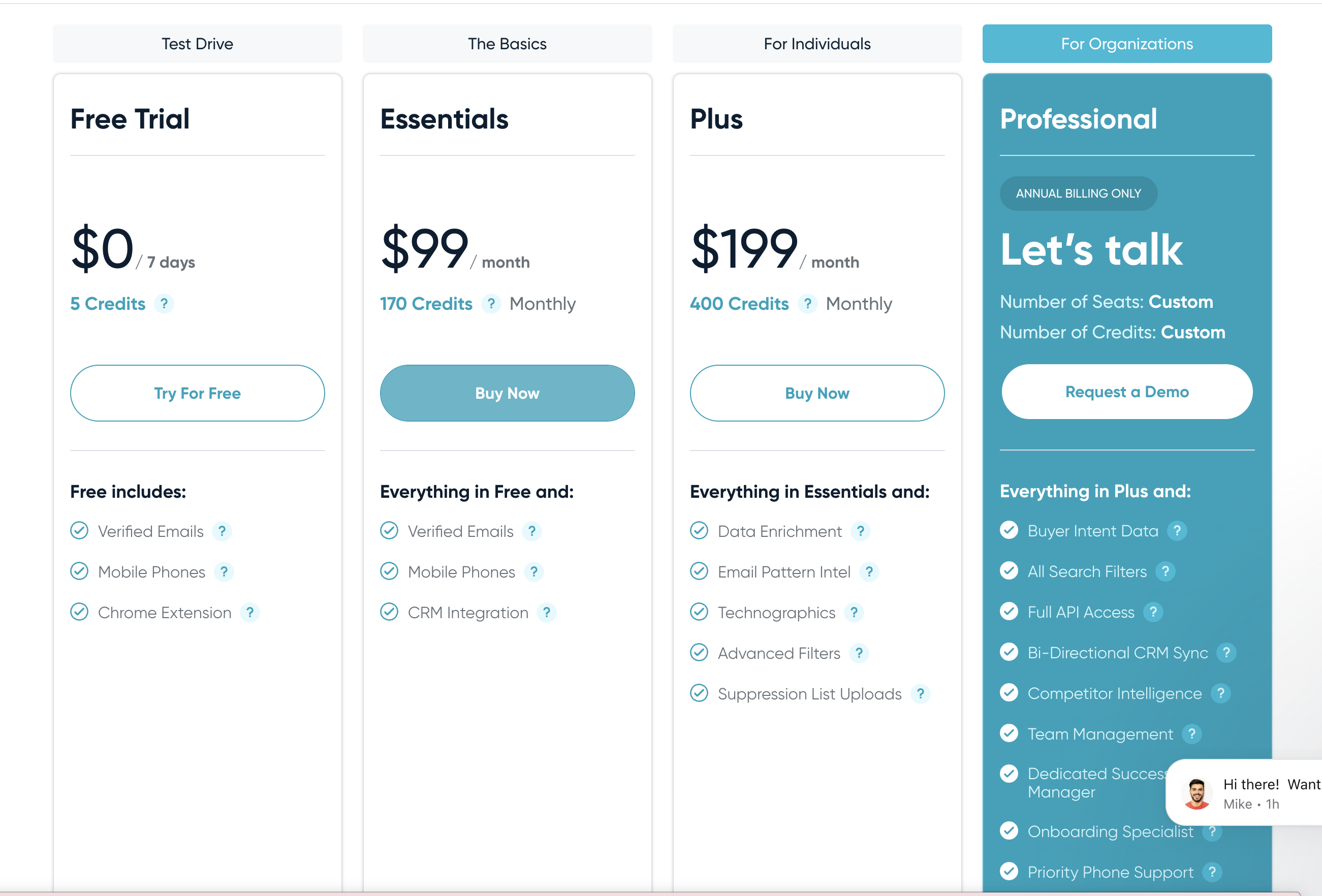
UpLead lists $99 per month. That number says nothing until you divide it by 170.
Because that is where the real information sits: the Essentials plan gives 170 credits per month, and one credit equals one contact. The real cost of a contact on UpLead is therefore $0.58, which puts the platform among the most expensive on the market per unit. Except that this same credit unlocks both the verified email and the contact's direct mobile number, where most competitors bill the phone separately and much higher.
That is the whole point of this article: UpLead is not expensive per enriched contact, it is expensive per enriched contact if you only take the email. As soon as you call, the math flips.
We recorded the official pricing page on August 31, 2026, opened the plan comparison matrix, read the help center on how credits work, and checked what the 95% guarantee actually covers. One framing point before we start: UpLead is a B2B database. It finds the contact. It does not send email, does not warm up any inbox, and does not automate LinkedIn.
Disclosure. This article is published by the company behind Emelia and Basile, two of the tools cited below. The other vendors' pricing was recorded on their official pages and the calculations are given so they can be redone.

The UpLead plans in 2026: the official pricing
UpLead offers four plans: a 7-day free trial and three paid ones. The first two are available monthly or annually, the third is annual only.
Test Drive | Essentials | Plus | Professional | |
|---|---|---|---|---|
Monthly price | $0 / 7 days | $99 | $199 | Not available |
Annual price | $0 / 7 days | $74 / month | $149 / month | Custom quote |
Credits | 5 total | 170 / month | 400 / month | Custom |
Annual credits | - | 2,040 / year | 4,800 / year | Custom |
Seats | 1 | 1 | 1 | Custom |
Extra credit | - | $0.60 | $0.50 | Custom |
Verified emails | Yes | Yes | Yes | Yes |
Direct mobile numbers | Yes | Yes | Yes | Yes |
CRM integration | No | Yes | Yes | Two-way CRM |
Data enrichment | No | No | Yes | Yes |
Technographics | No | No | Yes | Yes |
Advanced filters | No | No | Yes | All filters |
Suppression lists | No | No | Yes | Yes |
Buyer Intent | No | No | No | Yes |
Full API | No | No | No | Yes |
Commitment | None | None | None | Annual |
Three notes up front.
The annual discount is 25%. From $99 to $74 on Essentials, from $199 to $149 on Plus, or $888 and $1,788 for the year, amounts shown on the pricing page on August 31, 2026. The check is worth it: third-party comparison sites announced a Plus drop to $99 over the summer, which the official page does not show. Verify the annual total at checkout.
The credit count does not change between monthly and annual. 170 per month, or 2,040 for the year, which is exactly the same volume. Only the price drops. The difference lies elsewhere, and we get to it.
There is no commitment on the monthly plans. UpLead writes it in its FAQ: only the Professional plan is annual.
One UpLead credit is a whole contact, email and mobile included
It is the most important definition on the whole pricing page, and UpLead repeats it under each plan:
“One credit unlocks a contact for download or CRM export and gives you access to their email and their direct mobile number. One credit equals one contact.
”
This sentence is structural, because it describes a model different from almost the entire market. With most data providers, email and phone are two separate counters, and the phone costs much more. With UpLead, you pay for the contact, not the data point, and the mobile number costs nothing extra.
Two practical consequences.
If you only do email, you overpay. You are buying a mobile number you will not use, at a full contact rate.
If you call, the ratio flips and turns favorable. We put numbers on this further down, in the section on mobile, and it is where UpLead defends itself best.
The help center also spells out how file enrichment behaves: credits are charged upfront on the number of rows processed, then refunded for each contact not found. You are charged for each contact processed, whether you download the result or not, and you can re-download an already enriched file as many times as you want with no new charge.
A full contact record. Then what?
Emelia enriches and sends on the same subscription, with email warmup included, from 37 € per month.
A single seat on Essentials and on Plus
This line does not appear on the pricing cards. It sits in the detailed comparison matrix, which you have to expand to see, and it completely changes how you assess the product.
Plan | User seats |
|---|---|
Test Drive | 1 |
Essentials | 1 |
Plus | 1 |
Professional | Custom |
Essentials and Plus are strictly single-user products. There is no option to add a second user on those two plans: to work as a team, you have to move to Professional, which is annual, quote-based, and has no public price.
That is a hard break in the buying path. You can test, buy online and work alone up to $199 per month. At the first colleague, you switch into a classic sales cycle with a demo and a negotiation, with no price reference at all.
For an article about budget, that is the most important limit to know: UpLead's price for a team is not public.
The real cost of a contact, plan by plan
Here is the only table that matters for a decision. The cost per contact is the plan price divided by the included credits, assuming you use your full quota.
Plan | Price | Credits | Cost per contact | Cost if you use only half |
|---|---|---|---|---|
Essentials monthly | $99 | 170 / month | $0.58 | $1.16 |
Essentials annual | $74 / month | 170 / month | $0.44 | $0.88 |
Plus monthly | $199 | 400 / month | $0.50 | $1.00 |
Plus annual | $149 / month | 400 / month | $0.37 | $0.74 |
Remember that this contact includes the verified email and the direct mobile number.
The best self-serve rate UpLead publishes is therefore $0.37 per full contact, on the Plus plan billed annually. The worst is $0.58 on Essentials monthly, or 57% more for exactly the same data. The Professional plan, annual and quote-based, has no public price: third parties sometimes quote a credit around $0.30, a figure we do not repeat for lack of a vendor source.
Moving to annual is the first decision to make, even before choosing the tier: at identical volume, it saves $300 per year on Essentials and $600 on Plus.
And moving from Essentials to Plus is almost always worth it if you consume. Plus costs exactly twice Essentials but gives 2.35 times more credits, on top of enrichment, technographics, advanced filters and suppression lists. The tipping point sits around 250 contacts per month: beyond that, Plus costs less per contact.
Extra credits: $0.60 and $0.50, with a daily cap
When the quota runs out, UpLead sells credits by the unit, at a rate that depends on your plan.
Plan | Extra credit | Compared with the included credit (annual) |
|---|---|---|
Essentials | $0.60 | +38% |
Plus | $0.50 | +34% |
Professional | Custom | - |
The packs offered are 100, 250, 500, 1,000, 2,500 or 5,000 credits, with the option of a custom amount.
Two points deserve to be highlighted, and both work in UpLead's favor.
The purchase is deliberate, not automatic. You click "Buy More", you choose a volume, a confirmation window recaps the number of credits and the amount, and you validate. That is very different from tools that trigger a silent overage as soon as the quota hits zero, and it protects you from a bad surprise at the end of the month.
The overage is moderate. At $0.60 against $0.58 for the included credit on Essentials monthly, going over costs almost the plan rate. Compared with the market, where overage is often billed at twice the included rate, that is fair.
One cap to know: credit purchases are limited to $2,000 per day. Beyond that, the transaction fails and you have to go through support. That is about 3,300 credits on Essentials, enough in most cases but it can block a large-scale list-building operation.
One seat? Emelia counts none
No per seat billing: the plan sets the number of mailboxes, and your whole team works on them.
Monthly or annual: the real difference is not the price
As we saw, annual costs 25% less for the same number of credits. But there is a second difference, less visible, and it concerns how the credits are made available.
On the monthly plan, you receive 170 or 400 credits every month. On the annual plan, the help center and the pricing page speak of 2,040 or 4,800 credits for the year.
The difference is this: an irregular pace is punished monthly and absorbed annually. A team that builds a big list in January then eases off in February burns its January monthly quota and has to buy more, whereas an annual budget would have let it draw from the pool.
One point the public documentation does not settle: UpLead publishes neither an expiration rule for unused credits nor a rollover policy from one period to the next. Two hypotheses circulate, and the gap between them is considerable. If monthly credits do not roll over, a half-used month takes the contact from $0.44 to $0.88 on Essentials annual, and from $0.37 to $0.74 on Plus. If the annual pool is granted in one block and runs over twelve months, the dips even out and the unit cost stays the one in the table. That is the precise question to ask support during the 7-day trial, before choosing between monthly and annual.
What the 95% guarantee really covers
UpLead promotes a 95% accuracy guarantee on emails, displayed under each plan and on its data page, alongside three other figures: more than 200 million B2B contacts with an email address, more than 19 million company records and more than 27,000 technologies tracked.
These are good numbers and the promise is serious. You do have to understand what it measures, though, and on that point the most honest thing is to quote UpLead's own documentation. Its help center writes, in an article about emails that bounce, that the stated accuracy "is a measure of data quality at the time of verification" and that it "does not guarantee zero bounces when you send".
The same article adds that a verified address can become invalid later, on a job change or a domain shutdown, and that the bounce rate also depends on your sender reputation, your list hygiene, the content and the recipient server.
That is a clarification few vendors own up to so openly, and it deserves credit. Keep the practical consequence in mind: treat the 95% as a strong filter at a point in time, not as a deliverability guarantee. A verification before sending is still useful if your file is a few months old.
One small inconsistency on the site, finally: the pricing page states more than 16,000 technologies tracked in the technographics description, while the data page claims more than 27,000.
What UpLead's price does not include
No sending. UpLead does no sequences, no campaigns, no open tracking. The platform stops at the file or the CRM export. So you need a sending tool alongside it, which is a second budget line.
No inbox warm-up. No warm-up, no blacklist monitoring, no authentication audit. That is consistent with the positioning, but it means the deliverability piece is entirely on you.
No LinkedIn automation. The Chrome extension reveals a contact while you browse, including on LinkedIn. It does not automate invitations, messages, or the extraction of a full Sales Navigator search.
Teamwork. As seen above, past one user you need the Professional plan, quote-based.
For a team that actually prospects, the UpLead subscription is therefore one piece out of three or four. The full budget covers the data, the sending tool, the warm-up and the inboxes.
What UpLead bills well
The single credit for email and mobile. It is the product's best argument and it is real. One counter, one unit, no arithmetic between two credit types.
The credit refund when there is no match. In enrichment, a contact not found is credited back. You do not pay for the gaps.
Overage with explicit confirmation. No automatic charge, a validation window before every purchase, and an overage held to 34% or 38% above the included rate.
The 25% annual discount, clean and readable.
No commitment on the monthly plans, written in black and white in the FAQ.
The transparency about the limits of its own guarantee, in public documentation nothing required it to write.
Integration coverage, finally, is broad: Salesforce, HubSpot, Zoho, Pipedrive, Microsoft Dynamics 365, Outreach, SalesLoft, Reply.io, Woodpecker, Copper, Nimble, Mailshake, Lemlist, Close and Insightly, plus about 1,500 apps through Zapier.
Email warmup is not an add-on
It is included and unlimited on all three Emelia plans. It decides whether your emails land in the inbox.
UpLead against the market, on identical terms
Comparing list prices makes no sense when the units differ. So we set a single scope and price each tool on it.
The scope we use fits in three columns, because a single figure cannot compare models this different: the cost of a verified professional email alone, that of a direct mobile number alone, and that of a full contact combining the two. Each tool is taken at its cheapest plan allowing regular use, brought back to one user.
Tool | Plan used | Email only | Mobile only | Full contact |
|---|---|---|---|---|
UpLead | Plus annual, $149 / month, 400 contacts / month | Not sold separately | Not sold separately | $0.37 |
RocketReach | Pro annual, $52 / month, 3,600 exports / year | Not sold separately | Not sold separately | $0.17 |
Lusha | Starter, $49.90 / month, 400 credits | $0.125 (1 credit) | $1.25 (10 credits) | $1.38 (11 credits) |
Kaspr | Starter annual, €45 / user, 100 numbers / month | Unlimited, trends to 0 at volume | about €0.45 | about €0.45 |
Emelia | Start €37 / month + €19 pack for 1,000 credits | €0.019 (1 credit) | €0.95 (50 credits) | €0.97 (51 credits) |
Apollo | Basic annual, $49 / seat, 2,500 credits / month | Credit varies by data type | Higher credit cost on mobile | Variable |
Hunter | Starter annual, $34 / month, 2,000 credits / month | $0.017 (1 credit) | Not offered | Not offered |
Dropcontact | Starter, €79 / month, 500 credits at the bottom of the slider | €0.158 (1 credit) | Not offered | Not offered |
Prices recorded on the vendors' official pages on August 31, 2026, in their billing currency, without conversion: dollar and euro amounts are therefore not directly comparable. The RocketReach and Lusha figures come from our own records published in the articles devoted to those two tools.
The reading changes by column, and that is the whole point of the table. On email alone, UpLead has no rate: it does not sell the address separately. Per address, its bill comes out around twenty times that of a specialized enrichment tool, and that gap is exactly the price of the mobile number you do not use. On the full contact, the hierarchy flips: at $0.37, UpLead sits behind RocketReach and ahead of all the others, while Lusha asks $1.38 and Emelia €0.97 for the same record.
Emelia: €37 per month, sending and data in the same subscription

It is the alternative with the broadest scope, and the only one on this list to cover sending on top of data. Emelia is a French prospecting platform that brings together cold email, LinkedIn automation, Sales Navigator scraping and contact lookup in one product, where UpLead stops at the data.
Plan | Price | Inboxes | LinkedIn accounts | Free credits |
|---|---|---|---|---|
Start | €37 | 3 | 1 | 500 |
Grow | €97 | 50 | 3 | 1,000 |
Scale | €297 | Unlimited | 10 | 5,000 |
The base subscription covers sending, with unlimited emails and contacts, inbox warm-up included and Sales Navigator scraping.
Data is paid separately, as credits: €19 for 1,000 credits, knowing that a found email costs 1 credit, a verification 0.25 credit and a phone number 50 credits. An email therefore comes to about €0.019, and a number to about €0.95.
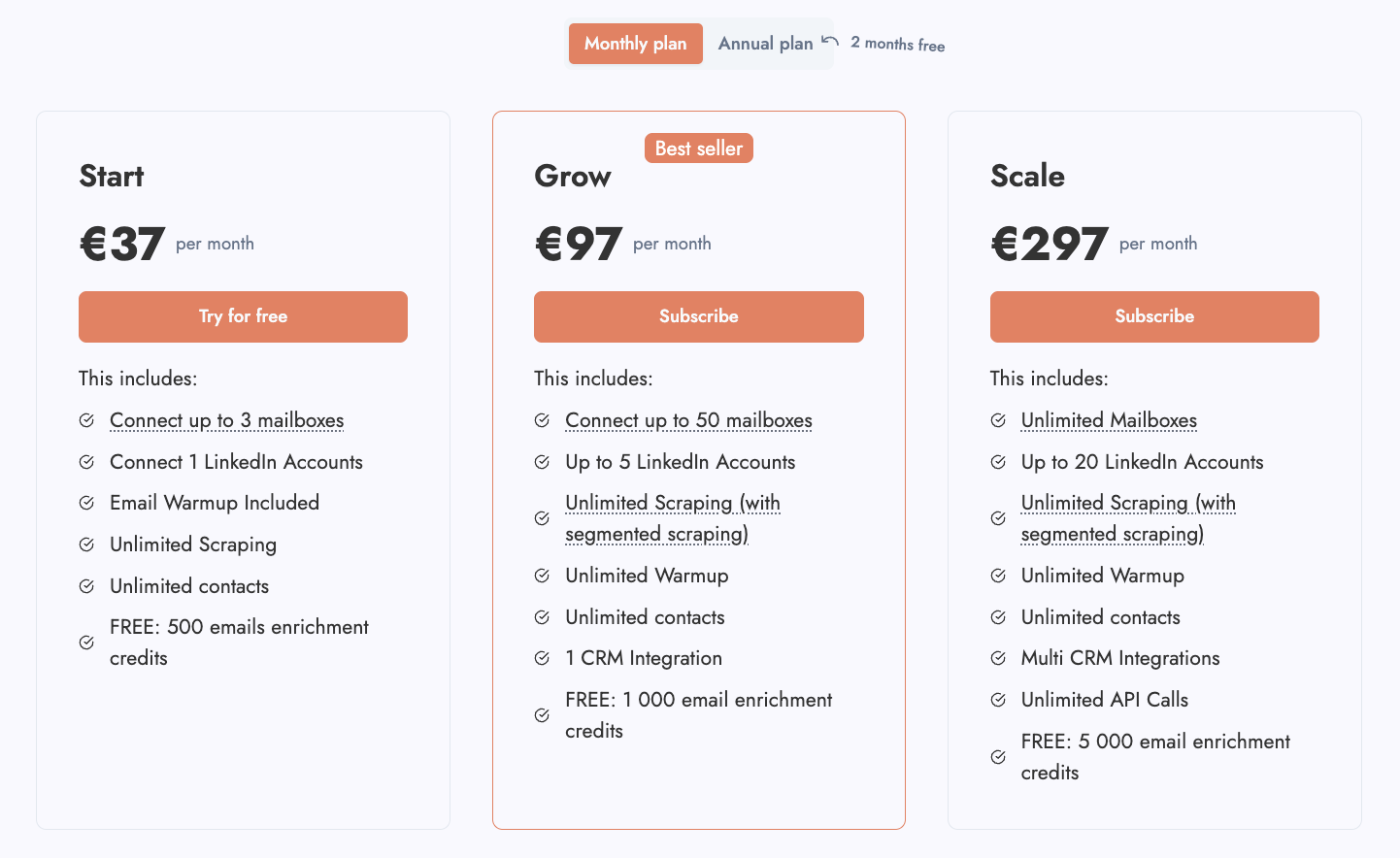
What Emelia does better than UpLead.
Scope, first: one subscription covers data and sending, when UpLead forces you to buy a sequencing tool on top. Then the cost of the email, about twenty times lower. Teamwork last, since the subscription is not billed per seat and the team shares one account, where UpLead limits Essentials and Plus to a single user.
What UpLead does better. The depth and coverage of the database: more than 200 million contacts and 19 million companies, with firmographic and technographic filters Emelia does not have.
RocketReach: $52 per month on annual, exports as the real cap

RocketReach is UpLead's closest competitor on model: a global database, a Chrome extension, and a contact paid for in one go. Its quirk is having two counters instead of one, lookups and exports, and the second is the one that binds.
Plan | Monthly price | Annual, per month | Lookups | Exports | Data |
|---|---|---|---|---|---|
Free | $0 | Not applicable | 5 total | None | Email only |
Essentials | $39 | $19 | 100 / month, unlimited on annual | 100 / month, 1,200 / year | Email only |
Pro | $79 | $52 | 250 / month, unlimited on annual | 250 / month, 3,600 / year | Email + phone |
Ultimate | $169 | $115 | 1,000 / month, unlimited on annual | 1,000 / month, 20,000 / year | Email + phone |
Team | Custom quote | Custom quote | Pooled | Pooled | Email + phone |
On annual billing, lookups become unlimited and it is the exports that carry the limit. The exported contact comes to $0.19 on Essentials, $0.17 on Pro and $0.07 on Ultimate, provided you empty the year's cap. The phone number only starts at the Pro plan: on Essentials, there is no full contact.
What RocketReach does better than UpLead. The price of the full contact, the lowest in this comparison: $0.17 on Pro annual against $0.37 on UpLead, and $0.07 on Ultimate. And teamwork, since the Team offers pool lookups and exports across several users, where UpLead stops at one seat.
What UpLead does better. The phone number from the first paid plan, when RocketReach puts it behind Pro and makes its entry tier an email-only offer. Readability, one credit for one contact against two counters of which only one really binds. And the accuracy guarantee stated at 95%, which RocketReach does not promote the same way.
Who it is for, and at what real budget. Three sales reps on Pro annual come to $156 per month for 10,800 exports in the year. RocketReach suits anyone who prospects internationally, calls, and knows they will empty their export quota. It suits poorly anyone who wants phone numbers on a small budget, since you have to move up to Pro to get them. Tier by tier detail in our article on RocketReach pricing.
Lusha: $49.90 for 400 credits, the phone number at 10 credits

Lusha is a B2B contact database driven by a browser extension. Its model differs from UpLead's on one decisive point: the price is not tied to a seat but to a credit volume, and not all data consumes the same number of credits.
Plan | Monthly price | Credits / month | Seats included | Credit rollover |
|---|---|---|---|---|
Free | $0 | 40 | 1 | No |
Starter | $49.90 | 400 | 1 | No |
Pro | $69.90 to $227.40 depending on the slider | 600 to 2,000 | 2 | Up to 2 times the allocation |
Premium | $399.90 | 3,400 | 5 | Up to 2 times the allocation |
Scale | Custom quote | Custom | Custom | Credits granted upfront |
The amounts above correspond to the slider set at 2,000 credits per month. An email consumes 1 credit, a phone number 10, a full contact 11. On Starter, the credit comes to $0.125: the email therefore costs $0.125, the number $1.25 and the full contact $1.38. One caveat before buying: the pricing page recorded in August 2026 states ten credits per number, while older vendor materials still say five. Get written confirmation of the value applied to your account, it doubles your phone budget.
What Lusha does better than UpLead. Teamwork: Pro includes two seats and Premium five, with shared credits, where UpLead stops at a single user with no public price beyond. Credit rollover, up to twice the allocation on monthly billing, which UpLead does not document. And a compliance positioning that the American databases do not display the same way.
What UpLead does better. The price of the full contact, no contest: $0.37 on Plus annual against $1.38 on Lusha Starter, nearly four times less. The readability of the credit, one credit for one contact against a scale of 1 and 10. And a database queryable with firmographic and technographic filters, where Lusha is worked profile by profile in the extension.
Who it is for, and at what real budget. Two sales reps on Pro set at 2,000 credits come to $227.40 per month, or about 333 full contacts to share. Lusha suits European teams that call and reveal contacts as they go on LinkedIn. It suits poorly anyone who wants to pull a list of several thousand rows in one query, and its cost per full contact works against it versus UpLead as soon as volume rises. Details in our article on Lusha pricing.
Apollo: $49 per seat, the most generous database on credits

Apollo is UpLead's most direct competitor in the sales database business, with built-in sending sequences on top.
Plan | Annual price, per seat | Credits per seat per year |
|---|---|---|
Free | $0 | 900 |
Basic | $49 | 30,000 |
Professional | $79 | 48,000 |
Organization | $119 (minimum 3 seats) | 72,000 |
Thirty thousand credits per seat per year on the Basic plan is 2,500 credits per month for $49, against the 400 monthly credits of UpLead's Plus plan at $149. The generosity gap is considerable. Apollo, however, applies variable credit consumption depending on the type of data revealed, a mobile number costing more than an email, which makes the unit cost less readable than UpLead's single credit.
What Apollo does better than UpLead. The credit volume, on another scale entirely. And the scope, since sending sequences are in the same subscription: where UpLead leaves you with a file, Apollo lets you write to the contacts without a second tool. The annual discount, at 24%, is comparable to UpLead's.
What UpLead does better. The readability of the model, far superior: one credit equals one contact, no arithmetic. And the accuracy guarantee stated at 95%, which Apollo does not promote the same way. Several customers quoted by UpLead say they left Apollo over data freshness, testimonials to take for what they are, published by UpLead.
Who it is for, and at what real budget. Three sales reps on the Basic plan come to $147 per month, or $1,764 per year, with 90,000 annual credits. Apollo suits teams that want a single platform to build the list and work it. Watch out for the Organization plan, which requires a minimum of three seats and pushes the real ticket to $357 per month. Apollo's free plan is also worth knowing before paying anything: it gives 900 credits per seat per year, two sequences and an AI assistant limited to five conversations, which is enough to seriously assess the database coverage on your target. One last point of caution, Apollo states on its own page that its rates are introductory prices subject to change, a mention no other vendor in this comparison displays and one that weighs on an annual commitment.
Kaspr: €45 per user, unlimited B2B emails

Kaspr is a French vendor whose model is almost the reverse of UpLead's: email is unlimited, the phone number is metered.
Plan | Annual | Monthly | B2B emails | Phone credits | Exports |
|---|---|---|---|---|---|
Free | €0 | €0 | 15 / month | 5 | 100 leads |
Starter | €45 | €59 | Unlimited | 100 / month | 12,000 / year |
Business | €79 | €99 | Unlimited | 200 / month | 30,000 / year |
Enterprise | Custom quote | Custom quote | Unlimited | Unlimited | Negotiated |
Prices are per user, with a 25% annual discount, and Kaspr states that on annual plans the twelve months of credits are granted to the account in one go. Another notable difference from UpLead: credits are shared across all users on the account, which considerably softens the per-seat model.
What Kaspr does better than UpLead. Unlimited B2B emails, which drive the cost of the email toward zero as volume rises. Teamwork, with pooled credits where UpLead stops at one seat. And billing in euros, with no currency exposure for a French company.
What UpLead does better. The way you work: Kaspr is first an extension that reveals a contact profile by profile on LinkedIn, when UpLead is a database you query with filters and from which you export a whole list. Exports are also capped at Kaspr, at 12,000 or 30,000 per year. And UpLead's coverage of English-speaking markets is deeper.
Who it is for, and at what real budget. Three sales reps on Starter annual come to €135 per month, with 300 shared monthly phone credits. Kaspr suits teams that prospect as they go on LinkedIn and that call. It suits poorly anyone who wants to build a list of several thousand rows in one query. The free plan gives a precise idea before committing to anything: 15 B2B email credits, 5 phone credits and 5 direct email credits per month, with exports limited to 100 leads.
That is little, but enough to measure the match rate on a dozen target profiles. Also worth noting, Kaspr plugs into Sales Navigator from the Starter plan and into Recruiter Lite from Business, which makes it an extension companion rather than a standalone product. The Business plan finally adds custom per-member permissions, useful to frame shared credit consumption inside a team.
Hunter: $34 per month, the cheapest on verified email

Hunter is the professional email specialist, with no phone numbers and no queryable database in UpLead's sense.
Plan | Annual, per month | Monthly | Credits | Inboxes |
|---|---|---|---|---|
Free | $0 | $0 | 50 / month | 1 |
Starter | $34 | $49 | 2,000 / month, 24,000 / year | 3 |
Growth | $104 | $149 | 10,000 / month, 120,000 / year | 10 |
Scale | $209 | $299 | 25,000 / month, 300,000 / year | 20 |
Careful, Hunter shows its prices in dollars on its public page and states its credits monthly as well as yearly. Two thousand credits per month on Starter, or 24,000 for the year, for $34 per month on annual: the email found comes to about $0.017, a verification consuming half a credit. The annual discount reaches 30%, the highest in this comparison. Notable point, team members are unlimited on every plan.
What Hunter does better than UpLead. The cost of the email, by far. Unlimited users, when UpLead stops at one seat. And the presence of basic campaign sending, absent from UpLead, with 3 to 20 inboxes connectable depending on the plan.
What UpLead does better. Everything else in the database business: Hunter starts from a name and a domain, it does not let you build a list from firmographic, technographic or intent filters. And Hunter provides no phone numbers, where UpLead includes the mobile in the same credit.
Who it is for, and at what real budget. A whole team on Starter stays at $34 per month, since users are unlimited. Hunter suits anyone who already knows which companies to target and is looking for the matching addresses at the best price. It does not replace UpLead for building a target from scratch. The free plan gives 50 credits per month, one connected inbox and up to 500 recipients per sequence, which allows a real test and not just a demo. Hunter also has a Discover module, a company database queryable by filters, basic on the free plan and enriched with advanced filters from Starter: that is the only point where Hunter gets close to UpLead's business, without its depth or its intent data.
Four options are billed extra on all paid plans, to budget for if they concern you: inbox protection, managed inboxes, extra inbox slots and credit packs. Finally, since the 30% annual discount is the highest in the comparison, the gap between monthly and annual is worth calculating before you sign.
Dropcontact: €79 at the bottom of the slider, the most GDPR-compliant option
Dropcontact is a French enrichment vendor, with no browsable database and no phone numbers, but with a firm compliance positioning.
Plan | Monthly price | Credits at the bottom of the slider | Cost per contact found |
|---|---|---|---|
Starter | €79 | 500 / month | €0.158 |
Growth | €120 | 500 / month | €0.240 |
Enterprise | Custom quote | From 200,000 | Negotiated |
Both plans rest on a volume slider running from 500 to 150,000 credits per month, and that is the point most comparisons miss: the displayed prices of €79 and €120 correspond to the lowest step, 500 credits per month. The model is pay for success, and the Growth plan adds credit rollover, LinkedIn enrichment without a login and job change detection. A 20% annual discount is announced in the sales documentation: check it at checkout, the page does not always put a figure on it.
What Dropcontact does better than UpLead. The cost of the email, about two times lower than UpLead's full contact, but far behind Hunter or the Emelia credits once the slider is read properly. Credit rollover on the Growth plan, which UpLead does not document. And above all compliance: Dropcontact claims processing that is 100% GDPR-compliant, with data rebuilt by algorithm rather than bought, and an audit against CNIL standards. For a European company prospecting in Europe, that point is not cosmetic.
What UpLead does better. The very existence of a queryable database: Dropcontact enriches a list you give it, it does not help you build one. No firmographic filters, no intent data, no phone numbers.
Who it is for, and at what real budget. €79 buys 500 contacts found per month on Starter, and you have to move the slider up to go further. Dropcontact suits European organizations under a strong compliance requirement, and those that already have their lists. It does not suit anyone who wants to discover new accounts. The volume slider is the point to work on before choosing: it starts at 500 credits per month and climbs to 150,000, with the Enterprise plan taking over beyond 200,000 monthly credits.
Fifty free credits let you test the match rate without a credit card. Dropcontact is finally driven without a dedicated interface: API and MCP access, a Google Sheets add-on, enrichment by CSV or XLS file, and native CRM integrations with smart duplicate merging and job change detection, that last function being available only from the Growth plan.
Mobile, where UpLead takes back the advantage
The "email only" column of the table is crushing for UpLead. The other two tell the opposite story, and they are the ones most comparisons forget.
The reading changes completely. On mobile, UpLead is at the level of the best on the market, and two times cheaper than Emelia. Two of the five alternatives simply do not offer phone numbers.
The practical conclusion is therefore clear. If your prospecting is email only, UpLead is a bad buy: Hunter, Dropcontact or the Emelia credits come out around twenty times cheaper per address. If your prospecting rests on calling, or on a mix of email and phone, UpLead becomes one of the best-placed offers, because you pay for the full contact at the price where others bill the number alone.
Two players publish nothing. Cognism and ZoomInfo, regularly cited as UpLead competitors and named in its own customer testimonials, show no rate on their pricing pages. Everything goes through a sales rep. So we did not include them in the table, for lack of a verifiable figure to put in it.
To dig into each of these tiers, you can read our article on Lusha pricing, our article on Apollo pricing, our article on Kaspr pricing, our article on Hunter pricing, our article on Dropcontact pricing and our article on Cognism pricing.
37 € a month, cancel this month
Unlimited emails and contacts, Sales Navigator scraping included, no quote to request when you add people.
Which UpLead plan to choose based on your profile
You want to test coverage on your target. The 7-day trial and its 5 credits are enough to check the match rate on your segment. Do it on your real list, not on a demo search.
You prospect alone, fewer than 170 contacts per month, email and phone. Essentials on annual, at $74. Take monthly only if you have a doubt about how long the need will last, it costs 25% more.
You prospect alone, more than 250 contacts per month. Plus on annual, at $149. The cost per contact falls to $0.37 and you get enrichment, technographics and advanced filters.
There are two or more of you. There is no public plan for you. Ask for a Professional quote, and require the per-seat price as well as the extra credit rate before going further.
You only do email. UpLead is probably not the right buy. You are paying for a mobile number you will not use, at a rate twenty times that of a specialized enrichment tool.
Your target is French and made of small and midsize regional companies. The coverage of an international database will be disappointing on that segment. Look at a database built on French public sources.
Conclusion
The $99 UpLead displays describes a single-user product of 170 contacts per month, or $0.58 per contact. The platform's best public rate is $0.37, on the Plus plan on annual, and there is no public price at all as soon as there are two of you.
The verdict depends entirely on one question: do you call your prospects? If the answer is no, UpLead is expensive, because you are buying a useless mobile number at the price of a full contact, when Hunter, Dropcontact or the Emelia credits give you the email for about €0.02. If the answer is yes, the math flips: at $0.37 per contact with the mobile included, UpLead sits at the level of the best phone offers on the market, and ahead of several competitors that offer no number at all.
Whatever your case, two checks remain to run during the 7-day trial. The real match rate on your segment, testing on your actual target and not on a broad search. And the exact rule on credit expiration or rollover, which UpLead does not document publicly, and which makes all the difference between monthly and annual when your prospecting pace is irregular.
Frequently asked questions about UpLead pricing in 2026
How much does UpLead cost per month in 2026?+
Essentials is $99 per month, or $74 per month on an annual commitment. Plus is $199 per month, or $149 on annual. The Professional plan is annual only and quote-based. A 7-day free trial with 5 credits is available.
How many credits does each UpLead plan include?+
Essentials gives 170 credits per month, or 2,040 for the year. Plus gives 400 credits per month, or 4,800 for the year. The credit count is identical monthly and annually, only the price changes.
What exactly is an UpLead credit?+
A credit unlocks a contact for download or export to a CRM, and gives access to their verified email and their direct mobile number. One credit equals one contact, whatever the number of data points revealed on that contact.
Is mobile data billed extra on UpLead?+
No, and that is the particularity of the model. The direct mobile number is included in the same credit as the email. On the Plus plan on annual, a contact with their mobile number therefore comes to $0.37, where several competitors bill the number separately.
How much does an extra credit cost on UpLead?+
$0.60 on the Essentials plan and $0.50 on the Plus plan. Packs run from 100 to 5,000 credits, with a custom amount possible. The purchase requires explicit confirmation and is never triggered automatically. A cap of $2,000 of credit purchases per day applies.
How many users can you have on an UpLead account?+
Only one on the Essentials and Plus plans. The number of seats is customizable only on the Professional plan, which is annual and quote-based. So there is no public price for a team.
What does the 95% accuracy stated by UpLead guarantee?+
It measures data quality at the time of verification. UpLead's help center states itself that it does not guarantee the absence of bounces when sending, since an address can become invalid later, and that the bounce rate also depends on your sender reputation and your list hygiene.
Does UpLead let you send emails?+
No. UpLead is a database and an enrichment tool. It does not send campaigns, does not warm up inboxes and does not automate LinkedIn. You have to plan for a separate sending tool, or choose a platform that combines the data and the sending.
Is there a commitment with UpLead?+
Not on the monthly plans, which have no contract and no minimum duration according to the official FAQ. The Professional plan, on the other hand, is annual.
Which alternative to UpLead for email only?+
Two enrichment tools come out about twenty times cheaper per address: Hunter from $34 per month for 2,000 monthly credits, or $0.017 per email, and the Emelia credits at €19 for 1,000 emails found, or €0.019. Dropcontact, often cited in the same group, starts at €79 for 500 credits at the bottom of its slider, or €0.158 per contact found. None of the three replaces UpLead for building a target from filters, and none provides phone numbers.