Prospeo advertises $49 per month. Two details change that figure completely.
The first: it is a per-user price. With three sales reps, the bill triples. The second, and the most expensive: credits do not roll over. Anything you have not used by the renewal date disappears, with no exception. The vendor writes it in capital letters in its own FAQ.
Those two rules mean a badly sized plan is paid for twice: once in subscription, once in evaporated credits. They also make the choice of tier more important than the choice of product.
We recorded the full pricing table and its comparison chart of more than forty rows, along with the entire pricing FAQ, on September 2, 2026.

What Prospeo actually is
Before talking money, you need to know what the tool does, because it covers more ground than its original positioning suggests.
A B2B database with a search engine. Prospeo is not just an email finder: it is a searchable database you query with filters, up to 41 depending on the tier, covering people as well as companies. You describe a target, and the tool returns the matching contacts.
What it covers. People and company search, revealing verified business emails and direct dials, CSV and CRM enrichment, job change tracking, buying intent signals, ideal customer profile detection, more than 50 AI-generated data fields, a similarity search called AI Lookalikes, and a Personas feature.
How you use it. A search interface, a Chrome extension, a Google Sheets add-on, a public API and an MCP server available on every plan, including the free one, which lets you drive the tool from an AI agent. Exports go out as CSV or into a CRM, with HubSpot and Salesforce integrations from the middle tier up.
Who it is for. Sales teams that build their own lists and call as much as they write, since direct dials are part of the offer. The vendor claims GDPR compliance and a weekly refresh of its data.
What it is not. Prospeo sends no email and warms up no mailbox. It does not automate LinkedIn. It is a data building block, to be placed between your targeting strategy and your sending tool.
The four plans in 2026: the full pricing table
All prices are per user. The annual commitment gives a 25% discount, and credits are then granted in one go at the start of the period.
Free | Starter | Growth | Pro | |
|---|---|---|---|---|
Monthly price | $0 | $49 | $99 | $249 |
Annual price | - | $37 / month | $74 / month | $187 / month |
Billed yearly | - | $441 | $888 | $2,241 |
Credits per month | 100 | 2,000 | 5,000 | 15,000 |
Annual credits, granted up front | - | 24,000 | 60,000 | 180,000 |
Search filters | 28 | 32 | 38 | 41 |
Intent topics | 3 | 6 | 9 | 12 |
Maximum selection per export | 25 | 20,000 | 20,000 | 20,000 |
Public API | No | Yes | Yes | Yes |
CRM integrations | No | No | Yes | Yes |
Job change tracking | No | No | Yes | Yes |
Three observations.
The 25% annual discount is clean and easy to read. It brings the Starter plan down from $49 to $37 per user per month.
The free plan is not a trial. It gives 100 credits per month, renewed, with 28 filters, the Chrome extension, AI search and CSV export. Its real limit lies elsewhere, and we are getting to it.
CRM integrations start with the Growth plan. If you were planning to plug Prospeo into HubSpot or Salesforce, the entry ticket is not $49 but $99, or $74 on annual billing.
The Prospeo credit: one simple rule, two prices
The counting rule is published without ambiguity in the FAQ, and it fits on one line.
What you reveal | Cost |
|---|---|
A verified business email | 1 credit |
A direct dial | 10 credits |
A phone number therefore costs ten times an email address, which is the most common ratio in this market.
Credits are granted in full at the start of each billing cycle. On an annual subscription, the entire volume is available from day one, which gives a welcome freedom of pace: you can burn 24,000 credits in three months if your campaign calls for it.
One important caveat: the vendor does not say whether an email it fails to find is charged or not. In a market where pay per result has become the norm, and where several competitors make it their headline argument, that silence deserves a written question to support before you commit.
Credits that do not evaporate
At Emelia, 19 € buys 1,000 credits you top up as needed, with no cycle resetting your balance to zero.
Credits do not roll over, and that is the rule that costs the most
This is the harshest point in the pricing table, and the vendor does not hide it. The question appears in its FAQ and the answer is categorical: no, credits do not roll over. Unused credits expire at renewal and the balance starts back at zero every cycle.
The consequences are concrete.
A slow month is a total loss. On a monthly Growth plan, a month with 1,000 credits used out of 5,000 costs exactly the same as a full one.
Oversizing is paid for twice. You pay the subscription, then you lose the unused credits. It is the most expensive mistake you can make on this pricing table.
Annual billing eases the problem without removing it. Since the 24,000 or 60,000 credits are granted up front for twelve months, you have a full year to spend them instead of one month. The cutoff still exists, but it falls once a year rather than twelve times.
The advice that follows is simple: take the tier below your estimate, and top up as needed. That brings us to a quirk of the pricing table that works in your favor.
The credit add-on, cheaper than the credits included
Once the balance runs out, the vendor states that you can no longer reveal or export new contacts until the next cycle. Two ways out: move up a tier, or buy an add-on.
According to the FAQ, that add-on starts at 1,000 credits for $10, or $0.01 per credit. Let us compare that price with the credits included in each plan.
Credit source | Unit cost |
|---|---|
Starter plan, monthly | $0.0245 |
Growth plan, monthly | $0.0198 |
Starter plan, annual | $0.0185 |
Pro plan, monthly | $0.0166 |
Growth plan, annual | $0.0148 |
Pro plan, annual | $0.0125 |
Credit add-on | $0.0100 |
The add-on is therefore cheaper per credit than any plan, including the largest one on annual billing. That is counterintuitive, since overage is usually billed at a higher rate than the plan itself, and it opens up a buying strategy: take a modest tier for the features you need, then feed the volume with add-ons.
Two limits to that reading. The quoted price is the entry point of a scale that is not published in full on the page, so higher volumes may vary. And credits bought as an add-on follow the same rule: they are added immediately, but the balance is reset to zero at the next cycle.
A price that does not multiply per seat
Emelia does not bill per user: the plan sets the number of mailboxes, not the number of reps behind them.
The real cost per email and per phone number
Here is the pricing table translated into unit cost, assuming every credit is used.
Plan | Price | Credits / month | Cost per email | Cost per direct dial |
|---|---|---|---|---|
Starter monthly | $49 | 2,000 | $0.025 | $0.25 |
Starter annual | $37 | 2,000 | $0.019 | $0.19 |
Growth monthly | $99 | 5,000 | $0.020 | $0.20 |
Growth annual | $74 | 5,000 | $0.015 | $0.15 |
Pro monthly | $249 | 15,000 | $0.017 | $0.17 |
Pro annual | $187 | 15,000 | $0.012 | $0.12 |
Two lessons come out of this table.
The gap between tiers is small, the gap between monthly and annual is wide. Moving from Starter to Pro divides the cost of an email address by 1.5, but multiplies the bill by five. Moving from monthly to annual on the same tier saves 25% without changing anything else. The priority trade-off is therefore the length of commitment, not the plan level.
Direct dials become worthwhile from Growth on annual billing up. At 15 cents a number, Prospeo sits in the solid middle of the market. At 25 cents on Starter monthly, far less so.
The free plan and its real limit
The Free plan gives 100 credits per month, renewed, with no credit card. It includes people and company search, 28 filters, three intent topics, AI search, Personas, the Chrome extension, more than 50 AI data fields, CSV export and the MCP server.
On paper, that is generous. In practice, one row of the comparison chart makes it unusable beyond testing: the maximum selection per export is 25 rows.
Plan | Maximum selection per export |
|---|---|
Free | 25 |
Starter | 20,000 |
Growth | 20,000 |
Pro | 20,000 |
So you can search the whole database with 28 filters, but you only pull out 25 contacts at a time. Add the absence of API and CSV enrichment on this tier, and the free plan becomes exactly what it should be: a way to assess the coverage and the quality of the data on your target, not a production tool.
It is an honest limitation, and more useful than a seven-day trial, since it never runs out.
What Prospeo does not do
No sending. No sequences, no campaigns, no open tracking. Prospeo produces data and pushes it to your sending tool or your CRM.
No email warmup. The deliverability of your domains remains entirely on you.
No LinkedIn automation. The extension reveals contact details; it automates neither invitations nor messages.
No credit rollover, as seen above, which calls for discipline in how you spend.
In a complete outreach stack, Prospeo is therefore one line out of three: the data, the sending tool, and the email warmup.
Without email warmup, nothing lands
It is included and unlimited on all three Emelia plans, when a pure data vendor offers none at all.
Prospeo against five all-in-one alternatives
What the five tools below have in common is that they cover at least one link more than data supply alone.
The scope used: the cost of one verified business email, on the cheapest plan that allows regular use, at annual pricing, brought back to a single user.
Tool | Plan used | Price | Volume | Cost per email | Sends |
|---|---|---|---|---|---|
Prospeo | Growth | $74 / user | 5,000 / month | $0.015 | No |
Emelia | Start + credits | 37 € | Depending on the tier | 0,019 € to 0,005 € | Yes |
Apollo | Basic | $49 / seat | 30,000 credits / year | Variable | Yes |
GetProspect | Growth 5k | about $69 | 5,000 / month | about $0.014 | Yes, basic |
Hunter | Starter | 34 € | 24,000 credits / year | 0,017 € | Yes, 3 mailboxes |
Lemlist | $55 | 50,000 emails sent | Separate credits | Yes |
Prices recorded from the vendors' official pages on September 2, 2026, in their billing currency.
Emelia

Emelia is a French B2B outreach platform that brings together Sales Navigator scraping, contact lookup, cold email, LinkedIn automation and email warmup in a single subscription. More than 1,000 companies use it.
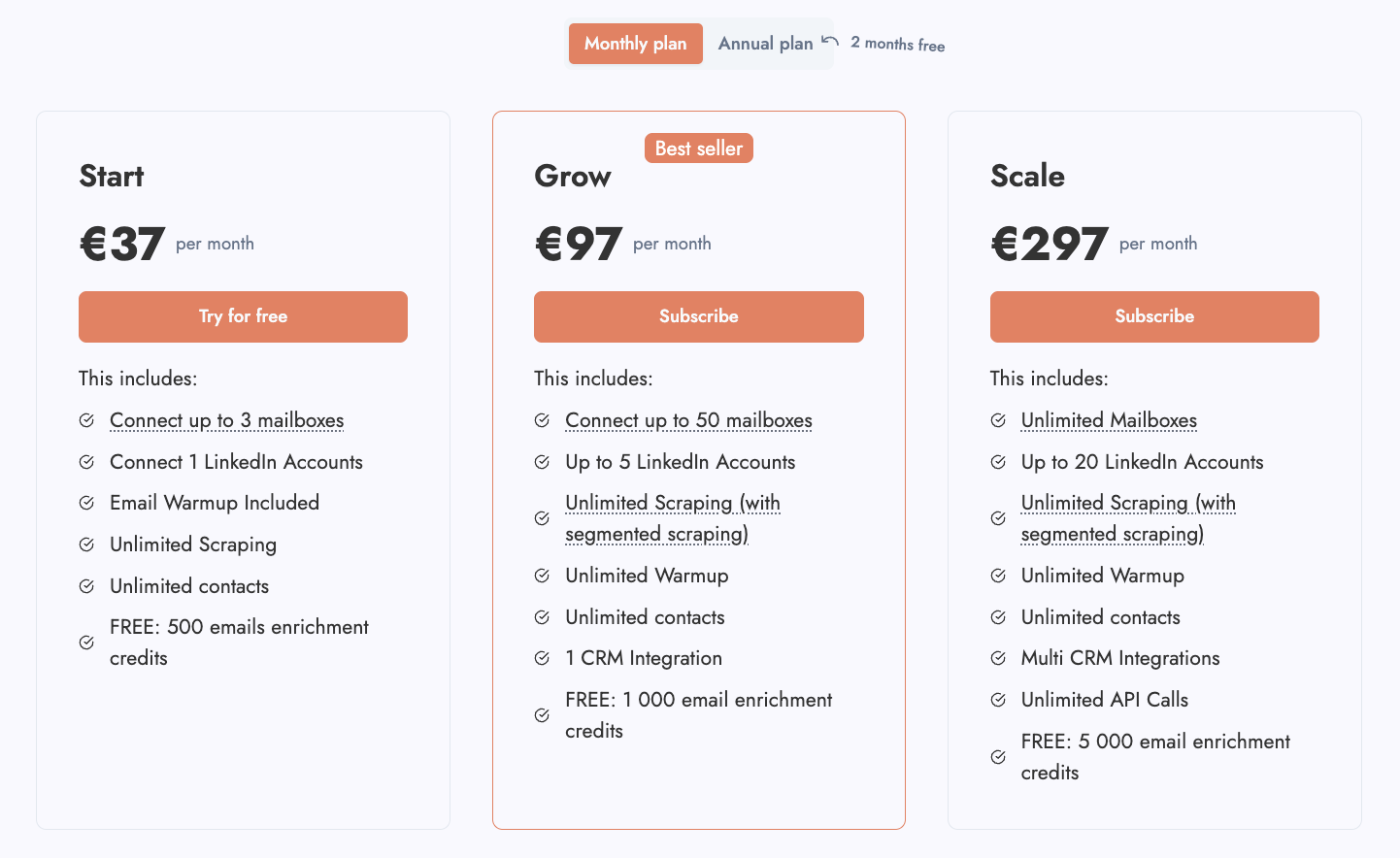
Plan | Price | Mailboxes | LinkedIn accounts | Included credits |
|---|---|---|---|---|
Start | 37 € | 3 | 1 | 500 |
Grow | 97 € | 50 | 3 | 1,000 |
Scale | 297 € | Unlimited | 10 | 5,000 |
The subscription covers unlimited sending and unlimited contacts, warmup with no cap, LinkedIn actions and Sales Navigator scraping, the last of which consumes no credits whatever the volume extracted. Credits are optional and go only toward data and AI.
Credits | Monthly subscription, with rollover |
|---|---|
1,000 | 19 € |
5,000 | 49 € |
10,000 | 99 € |
50,000 | 299 € |
100,000 | 499 € |
A found email costs 1 credit, a verification 0.25 credits and a phone number 50 credits. An address therefore works out to 0,019 € on the first tier and drops to 0,005 € on the 100,000-credit tier.
Its strengths. The scope, which runs from building the list to following up without ever switching tools. Unlimited scraping that consumes no credits, with automatic bypassing of Sales Navigator's 2,500-result cap. Pay per result billing, since only the emails actually found are counted. Automatic credit rollover, plus a purchase option with no expiration date. A stated bounce rate under 1% and claimed GDPR compliance. And no per-user pricing: the team shares a single account.
Its limits. The number of LinkedIn accounts is capped at 1, 5 or 20 depending on the plan. There is no searchable database of its own, the list being built from Sales Navigator, which assumes a LinkedIn subscription. An agency mode with separate workspaces per client does not exist yet. And a phone number, at 50 credits, is far more expensive than an email.
Who it is for, and at what budget. The Start plan costs 37 € a month, sending and warmup included, with 500 credits thrown in. Credits are a separate, optional line, and pointless as long as all you do is send. Emelia targets organizations that want one invoice and one interface, and whose constraint is volume rather than headcount.
Apollo

Apollo combines a sales database, enrichment, sending sequences and a dialer in a subscription billed per seat.
Plan | Annual price, per seat | Credits per seat per year |
|---|---|---|
Free | $0 | 900 |
Basic | $49 | 30,000 |
Professional | $79 | 48,000 |
Organization | $119 (minimum 3 seats) | 72,000 |
Thirty thousand credits per seat per year on the Basic plan amounts to 2,500 credits a month for 49 dollars. Consumption varies with the type of data revealed, a direct dial costing more than an email. The annual discount reaches 24%.
Its strengths. A credit volume that is very generous for the price. A proprietary database searchable through firmographic filters. Built-in sending sequences, which spares you a second subscription. A dialer included. And a free plan of 900 credits per seat per year with two sequences, enough to assess coverage on your target before committing to anything.
Its limits. Per-seat billing, which multiplies the spend as the team grows. Credit consumption that varies with the data, less legible than a fixed unit price. An Organization plan that imposes a three-seat minimum, taking the real ticket to 357 dollars a month. And an explicit note about introductory prices liable to change, which no other vendor in this comparison displays.
Who it is for, and at what budget. Three sales reps on the Basic plan come to 147 dollars a month, or 1,764 dollars a year with 90,000 annual credits shared across the team. Apollo speaks to teams that want a single platform to build the list and work it, and that call as much as they write. The Professional plan at 79 dollars mostly adds volume, with 48,000 annual credits per seat, while Organization climbs to 72,000 and opens up the advanced team features. The gap between tiers therefore comes down mainly to the number of credits, the platform staying functionally close from one level to the next. Also worth noting, API access and CRM integrations are there from the first paid tier, which is not the case everywhere. Tier by tier detail in our article on Apollo pricing.
GetProspect

GetProspect is an email finder backed by a database of 780 million contacts, with a cold email module built in.
Plan | Monthly | Annual | Valid emails | Phone numbers |
|---|---|---|---|---|
Free | $0 | $0 | 50 / month | 0 |
Starter | $49 | $34 | 1,000 / month | 5 |
Growth 5k | $99 | about $69 | 5,000 / month | 5 |
Growth 20k | $199 | about $139 | 20,000 / month | 5 |
Growth 50k | $399 | about $279 | 50,000 / month | 5 |
The model works on pay per result: emails that are not found and duplicates are not billed. Unused credits carry over to the following month, and the annual discount reaches 30%. The vendor publishes two figures that should not be confused: 98% accuracy on the addresses delivered, and 84 valid addresses found per 100 contacts submitted.
Its strengths. Volume pricing among the lowest on the market, with the address under a cent on the upper tiers. A permanent free plan of 50 addresses a month, no credit card required. A proprietary database of 780 million contacts with advanced filters. Team accounts included on every plan, so no per-seat pricing. And a cold email module available from the free plan onward.
Its limits. Phone numbers, which lag badly: five numbers a month whatever the plan, including at 399 dollars, and the volume option carries no public price. Credit rollover is limited to the following month. And the built-in sending comes with no email warmup, the vendor itself advising you not to exceed 100 daily sends per domain.
Who it is for, and at what budget. A team handling 5,000 addresses a month pays about 69 dollars on the annual plan, with no license commitment. GetProspect is for those who run email outreach at volume and want the best unit cost, provided they do not depend on the phone. The Growth plan comes in three volumes, 5,000, 20,000 and 50,000 monthly addresses, and the vendor specifies that the highest tier can be stacked up to ten times, which puts the theoretical ceiling at 500,000 addresses a month. Its FAQ also documents cancellation: the subscription can be cancelled at any time, credits stay usable until the end of the current cycle, and all the data already collected remains accessible after you leave. Tier by tier detail in our article on GetProspect pricing.
Hunter

Hunter is the long-standing specialist in professional email, with a sending module and a company database you can browse.
Plan | Annual | Monthly | Credits per year | Mailboxes |
|---|---|---|---|---|
Free | 0 € | 0 € | 50 / month | 1 |
Starter | 34 € | 49 € | 24,000 | 3 |
Growth | 104 € | 149 € | 120,000 | 10 |
Scale | 209 € | 299 € | 300,000 | 20 |
Hunter bills in euros and states its credits on a yearly basis. A found email costs 1 credit, a verification half a credit, which puts the address at around 0,017 € on the Starter plan. The annual discount reaches 30%, the highest in this comparison.
Its strengths. Unlimited team members on every plan, so no per-user cost. Real campaign sending, with 3 to 20 mailboxes connectable depending on the tier and up to 500 recipients per sequence. A Discover module for exploring a company database through filters. A free plan of 50 monthly credits. And four clearly displayed add-ons, among them inbox protection and managed mailboxes.
Its limits. No phone numbers whatsoever, which rules out any phone outreach. A database less deep than that of the big B2B directories, and fewer filters. And billing in euros, which introduces currency exposure for a company outside the eurozone.
Who it is for, and at what budget. An entire team stays at 34 € a month on the Starter plan, since users are unlimited. Hunter suits anyone who already knows which companies to target, wants the matching addresses at the best price, and wants light sending without a second subscription. Because credits are stated by the year, divide by twelve to think in monthly volume: 24,000 annual credits on the Starter plan means 2,000 addresses a month. The free plan allows a genuine test rather than a demo, with 50 monthly credits and one connected mailbox. And four add-ons are billed on top on the paid tiers, all of them displayed: inbox protection, managed mailboxes, extra mailbox slots and credit packs. Tier by tier detail in our article on Hunter pricing.
Lemlist

Lemlist is a sending platform that has folded in data, deliverability and LinkedIn automation.
Plan | Annual | Monthly | Billing unit |
|---|---|---|---|
$55 | $69 | Per account, unlimited users, 50,000 emails / month | |
Multichannel | $87 | $109 | Per user, 5 senders per user |
Enterprise | Quote only | - | From 5 users up |
The Email plan provides unlimited users, a database of more than 650 million contacts, email and phone number lookup, a unified inbox, AI agents, CRM integrations and the API, along with a deliverability hub that includes warmup. Search credits are topped up separately, one credit being worth one US cent and a verified address costing five.
Its strengths. An entry plan with unlimited users, a rarity in this market. Email warmup included, which removes an entire budget line. A proprietary database of 650 million profiles. Fifty thousand monthly emails on the Email plan. And a 14-day trial covering the whole thing.
Its limits. The unlimited-user advantage stops at the Email plan: multichannel, with LinkedIn, SMS and a dialer, goes back to 87 dollars per user. Data credits are billed separately, which makes the final budget less predictable. And the density of features noticeably stretches the learning curve.
Who it is for, and at what budget. Three sales reps on Multichannel come to 261 dollars a month, whereas the Email plan stays at 55 dollars whatever the size of the team. Lemlist targets teams that want one complete platform and are willing to put in the learning time. The Multichannel plan gives five senders per user, LinkedIn automation, SMS automation, a built-in dialer, task management and the ability to drive the tool from Gmail and LinkedIn, with WhatsApp automation offered as an add-on. The Enterprise offer, reserved for teams of at least five users, adds custom roles, single sign-on with SSO and SAML, and a dedicated account manager. Tier by tier detail in our article on Lemlist pricing.
37 € a month, no seat, no notice
Unlimited emails and contacts, Sales Navigator scraping with no credits, cancel from your account.
Which Prospeo plan to choose
You are assessing coverage on your target. The free plan and its 100 monthly credits, renewed, bearing in mind that exports are capped at 25 rows. It is built to judge quality, not to produce.
You prospect alone, by email only. The Starter plan billed annually, at 37 dollars, puts the address under two cents. Careful though, there is no CRM integration at this tier.
You need to plug in your CRM. The entry ticket is the Growth plan, at 74 dollars annually. That is where HubSpot, Salesforce, CRM enrichment and job change tracking show up.
You call your prospects. Count ten credits per number. Growth billed annually puts the direct dial at fifteen cents, which is fair; monthly Starter at twenty-five cents much less so.
There are several of you. Every user adds a full license. With three sales reps on annual Growth, count 222 dollars a month. Check that the credit volume per head really matches what each person uses, because it is not pooled automatically.
In every case, take the annual plan if you are sure of the need. Twenty-five percent off, and above all a credit cutoff that falls once a year instead of twelve times.
And do not oversize. Lost credits never come back. Better one tier below, topped up with add-ons at 0.01 dollar per credit.
Conclusion
Prospeo is a serious B2B database, with 41 filters on the top tier, intent signals, a stated weekly refresh and claimed GDPR compliance. On the quality of the offering there is little to fault, and the permanent free plan lets you check that for yourself.
On price, the product sits in the market average, at around two cents per address monthly and a cent and a half annually. The direct dial at ten credits is standard. Nothing excessive, nothing exceptional either.
What really sets this pricing table apart is its rigidity. Credits do not roll over, billing is per user, and CRM integrations arrive only at the second paid tier. Those three rules mean that a badly chosen plan costs appreciably more than its listed price, and that irregular usage gets punished.
Hence two reflexes before you sign. Take the annual plan, which gives 25% off and turns a monthly cutoff into a yearly one. And size on the low side, even if it means topping up with add-ons whose credits come, oddly enough, cheaper than those of any plan.
Frequently asked questions about Prospeo pricing in 2026
How much does Prospeo cost in 2026?+
Four plans billed per user: a free plan, Starter at $49 per month or $37 on annual billing, Growth at $99 or $74, and Pro at $249 or $187. The annual commitment gives a 25% discount and credits are granted in one go at the start of the period.
How many credits does each plan include?+
One hundred credits per month on the free plan, 2,000 on Starter, 5,000 on Growth and 15,000 on Pro. On annual billing, those volumes become 24,000, 60,000 and 180,000 credits respectively, granted up front for the year.
What is a Prospeo credit?+
One credit gives you one verified business email. A direct dial costs 10 credits, ten times more.
Do Prospeo credits roll over?+
No. The vendor states it explicitly: unused credits expire at renewal and the balance starts back at zero every billing cycle. It is the most expensive rule in this pricing table.
What happens if I run out of credits?+
You can no longer reveal or export new contacts until the next cycle. Two ways out: move up a tier, or buy a credit add-on, which starts at 1,000 credits for $10.
How much does an email cost with Prospeo?+
From $0.025 on the monthly Starter plan to $0.012 on the annual Pro plan. The credit add-on works out at $0.01 per unit, cheaper than the credits included in any plan.
How much does a direct dial cost?+
Ten credits, so about $0.25 on Starter monthly, $0.15 on Growth annual and $0.12 on Pro annual.
Is the Prospeo free plan usable?+
It gives 100 credits per month, renewed, 28 filters, AI search, the Chrome extension and CSV export, with no credit card. Its blocking limit is the maximum selection of 25 rows per export, which makes it an evaluation tool rather than a production one.
Is Prospeo billed per user?+
Yes, all prices are per user. Seats added mid-cycle are billed pro rata by the day, and removing one takes effect immediately and lowers the next invoice.
Which all-in-one alternative to Prospeo?+
Emelia, starting at 37 € per month, combines scraping, contact lookup, cold email, LinkedIn automation and email warmup, with no per-user pricing. Apollo at $49 per seat and Lemlist at $55 also cover sending, with different scopes.