Warm-up emails per day, not inboxes: what a TrulyInbox plan buys
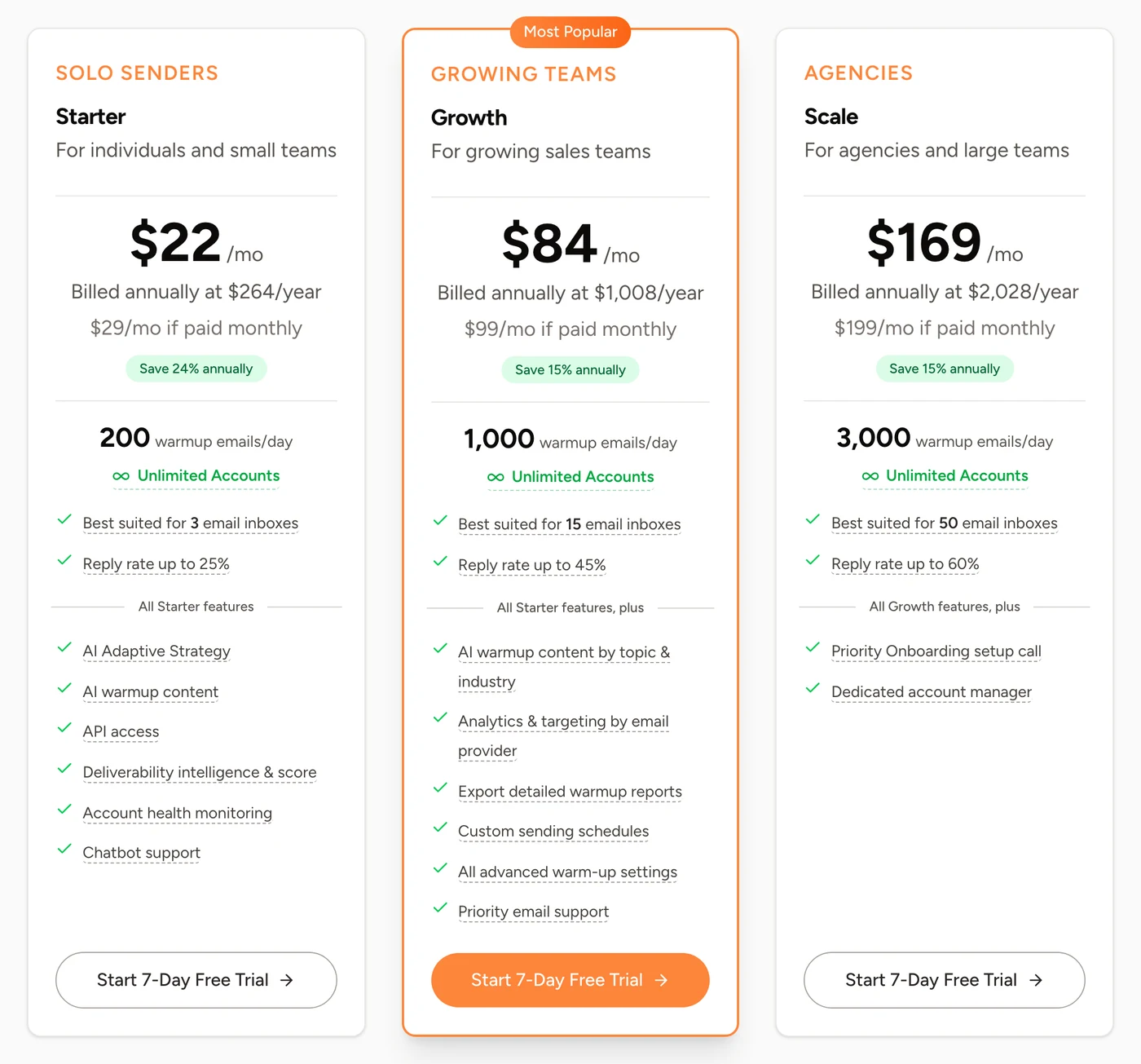
A TrulyInbox plan buys a daily warm-up volume for the whole organisation: 200 emails a day on Starter, 1,000 on Growth, 3,000 on Scale. Paid plans connect as many accounts as you like (“no per-inbox pricing, ever”, says the pricing page), and the volume is split between them, so each mailbox you add shrinks the share of the others. Client workspaces draw on the same daily budget.
The help centre adds two limits to the unlimited accounts. Each mailbox receives at most 100 warm-up emails a day on a paid plan (10 on the free one). And the plan decides how many mailboxes warm at the same time, a number TrulyInbox does not publish: its trial allows 5 connected mailboxes, and Saleshandy’s help centre gives 5, 20 and 50 for Starter, Growth and Scale.
Free, Starter, Growth, Scale and the Scale Plus tiers
All plans, the free one included, share the deliverability score, the SPF, DKIM and DMARC monitoring and a single warm-up strategy. What changes from one to the next is the daily volume, the settings they unlock and the support.
Free
$0/month
no card, no end date
- 1 account
- 10 warm-up emails a day
- Deliverability score and DNS monitoring
- Self-serve support, no API
Starter
$29/month
billed monthly
- 200 warm-up emails a day, shared
- Suggested for 3 inboxes
- API access
- Support within 48 hours
- $22 a month on a yearly plan
Growth
$99/month
billed monthly
- 1,000 warm-up emails a day, shared
- Suggested for 15 inboxes
- Warm-up content by topic and industry, your own daily cap, sending schedules, advanced settings, results by provider, report exports
- Priority support within 24 hours
- $84 a month on a yearly plan
Scale
$199/month
billed monthly
- 3,000 warm-up emails a day, shared
- Suggested for 50 inboxes
- Everything in Growth, plus a dedicated account manager and a setup call
- $169 a month on a yearly plan
Above Scale, a slider sets the volume: Scale Plus 5K at $479 a month (5,000 emails a day, suggested for 100 inboxes), Scale Plus 10K at $900 a month (10,000 emails a day, suggested for 150 inboxes) and Scale Plus 20K at $1,650 a month (20,000 emails a day, suggested for 350 inboxes), each with white-label options, an SLA and custom integrations. Past 20,000 a day, a Custom plan on quote. Nothing is sold as an add-on: more volume means a bigger plan.
Emelia’s plans against the TrulyInbox plan suited to your inboxes
A cold email team warms dozens of mailboxes, so every row begins with that volume on an Emelia plan. Grow connects up to 50 mailboxes and Scale has no mailbox limit; each one is warmed, then sends your sequences, and the plan also brings LinkedIn accounts and credits to find emails. Beside it sits the TrulyInbox plan its pricing page suggests for the same inboxes, billed monthly on both sides. TrulyInbox bills in US dollars only; Emelia’s figures follow your currency, at the same figure in euros or dollars.


Billed monthly
50 inboxes
100 inboxes
TrulyInbox prices a daily volume rather than inboxes, so each row uses the plan whose “Best suited for” matches the number of inboxes; in euros, a check mark goes to a side only when its lead holds at any exchange rate. The help centre’s sizes would put 50 inboxes on Growth, which warms 20 at a time, so the row keeps the plan that warms them all together (see below). At 100 inboxes and beyond, Emelia’s Scale connects unlimited mailboxes (fair use of 1,000).
How many inboxes per plan? TrulyInbox gives two different answers
TrulyInbox gives two sizes for the same plans. Its pricing page, and the pricing file it publishes alongside, call Starter best suited for 3 inboxes, Growth for 15 and Scale for 50. Its help article on choosing a plan, like the detailed product file it publishes on its site, speaks of around 5, 50 and 150: the sizes the pricing page itself displayed until mid-2026.
At 50 inboxes, the two readings lead to different plans: Scale on the pricing page, Growth in the help centre. Our tables go with Scale: the pricing page is TrulyInbox’s reference, and Saleshandy’s help centre lets Growth warm only 20 mailboxes at a time.
Neither figure caps the accounts you connect, which are unlimited on paid plans: the sizes only translate a daily volume into a number of mailboxes.
Already a Saleshandy customer? The same company’s warm-up is included
TrulyInbox and Saleshandy come from the same company, Ikigai Infotech LLP. Saleshandy, which calls TrulyInbox its “partner”, includes it at no extra cost: each Saleshandy subscription gets a separate TrulyInbox account, opened with the account owner’s email address, on a matching TrulyInbox plan.
The match is published only for Saleshandy’s former Outreach plans: Outreach Starter gets TrulyInbox Starter, Outreach Pro gets TrulyInbox Growth and Outreach Scale gets TrulyInbox Scale. Neither TrulyInbox nor Saleshandy says what Saleshandy’s current plans map to. On the TrulyInbox side, you link the two accounts with a Saleshandy API key, which imports the mailboxes and may switch your TrulyInbox plan; billing questions then go to Saleshandy’s support.
On Emelia, the warm-up of each connected mailbox belongs to the same plan as the sending: there is no second account to open.
Billing periods, trial, 14-day refund and cancelling
- Yearly. Starter, Growth and Scale can also be paid upfront for a year: $264, $1,008 and $2,028.
- Quarterly, for visitors in the United States. They see “$26/mo if paid quarterly” on the Starter card in place of the monthly price. The FAQ and the terms only mention monthly and yearly billing.
- Trial. 7 days on the paid plans, no card, up to 5 connected mailboxes and 200 warm-up emails a day for the account; without an upgrade, it falls back to the free plan.
- Refund. The pricing page announces a “14-Day Money-Back Guarantee”. The refund policy applies it to the first payment only, never to renewals, keeps the transaction fees, and can turn a request down when the recommended warm-up practices were not followed.
- Cancelling and changing plan. Cancel at any time in the app or in the Paddle portal; access runs to the end of the period paid. Moving up is self-serve; to move down, the help centre sends you to support, although the pricing FAQ says you can switch either way at any time.
- Price changes and payment. The terms promise 30 days’ notice before a price increase. You pay by card or PayPal, through Paddle.
Free plan, currencies and white label at TrulyInbox
1 connected account and 10 warm-up emails a day, for as long as you like, without a card. It keeps the deliverability score and DNS monitoring of the paid plans; the pricing page gives it no API access, and support is self-serve. Emelia has no free warm-up plan, by choice, to keep its warm-up clean; it has a 7-day trial without a card, and a work email at signup adds 20 credits to find emails.
Its pricing page has a “View in” selector (USD, EUR, GBP, AUD, CAD, INR and BRL) that converts the dollar prices at the day’s exchange rate. There is no separate euro grid: plans are priced in US dollars and paid through Paddle, and the page does not say whether tax is included.
It starts with Scale Plus: from $479 a month for 5,000 warm-up emails a day up to $1,650 for 20,000, with an SLA and custom integrations. Software companies that want TrulyInbox’s warm-up inside their own product go through its Partner API, on a volume contract with no public price.
Emelia features: Email warm-up · Cold email · Emelia pricing
Emelia is a TrulyInbox competitor. We have tried to stay fair: every figure about TrulyInbox comes from its own website or public review sites.


