Salesloft publishes no prices. Its pricing page promises "packages designed for results" and offers a form to book a fifteen-minute call. No tiers, no ranges, not even a starting price.
Here is what aggregated purchase data from several hundred signed contracts reveals: a Salesloft license costs between 100 and 170 dollars per user per month after negotiation, with a median annual budget of 30,700 dollars. On top of that come onboarding fees and an annual commitment paid up front, non-refundable.
This article breaks down the reconstructed price list, what the contract actually locks you into, and compares the pricing of six alternatives that do publish their rates.
How much does Salesloft cost in 2026? The reconstructed price list
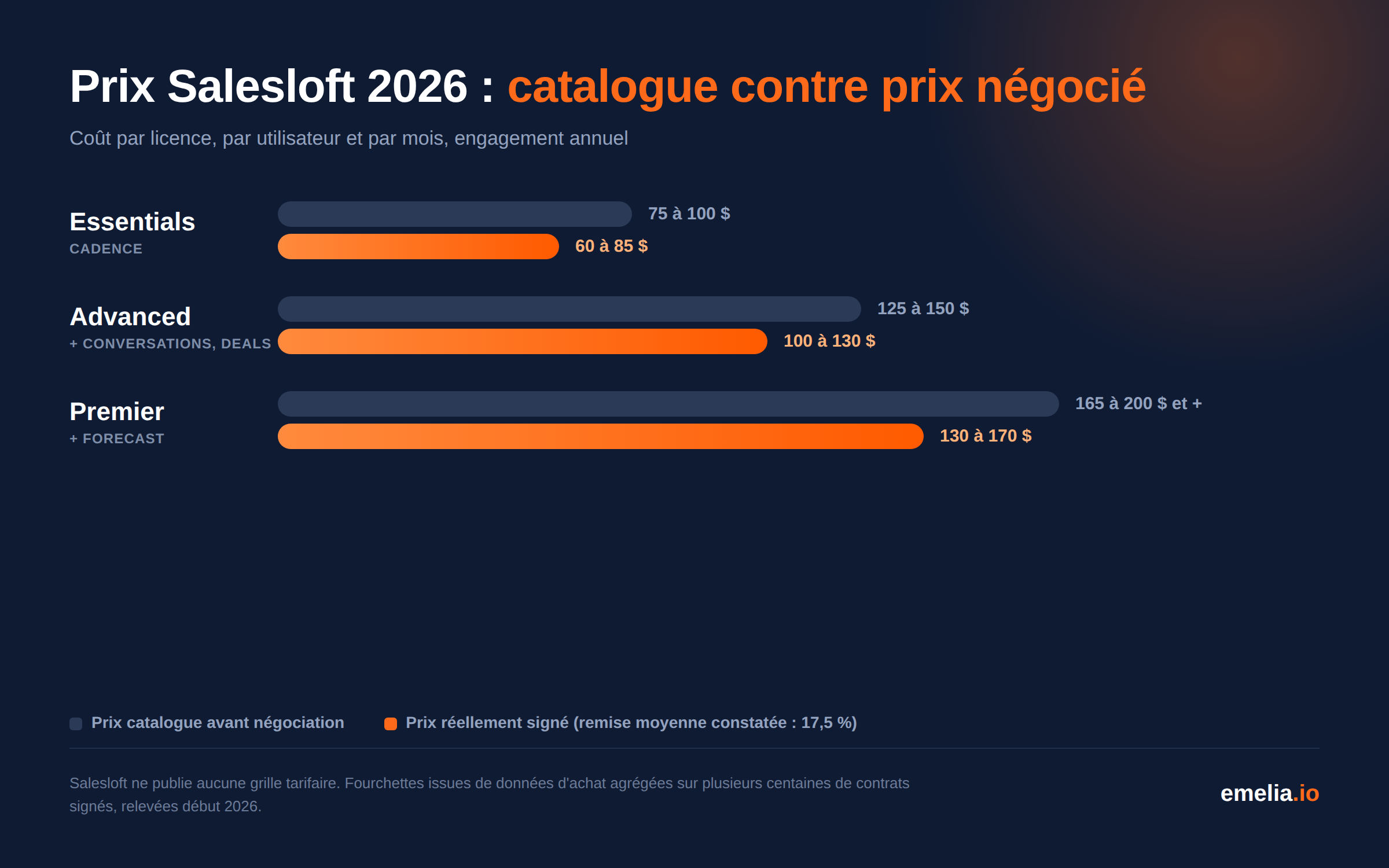
Since Salesloft publishes nothing, these figures come from platforms that aggregate contracts that were actually signed. They separate the list price floated at the start of a negotiation from the price that ends up in the contract.
Plan | List price | Negotiated price | Annual cost per license |
|---|---|---|---|
Essentials | $75 to $100 per month | $60 to $85 | $720 to $1,020 |
Advanced | $125 to $150 per month | $100 to $130 | $1,200 to $1,560 |
Premier | $165 to $200 and up | $130 to $170 | $1,560 to $2,040 |
The average discount observed is 17.5%. The first number you hear is never the final one.
Salesloft publishes no price. Emelia publishes €37.
Cold email, LinkedIn and unlimited warmup in one tool. No commitment.
Why Salesloft hides its pricing
Three reasons explain the choice, and not one of them works in the buyer's favor.
A published price sets a mental anchor that drags down high-end negotiations
A visible rate rules the tool out for smaller teams before they ever see a demo
A discount of 15 to 30% is hard to justify when the list price is sitting in the shop window
Comparison directories are no help either. The major review platforms display "Contact Us" and note that pricing details are not publicly listed. Some directories even show a starting price of 0.01 dollars, a form artifact that appears when the vendor refuses to fill in the field. Those listings do confirm two things: no free trial, no free version.
The practical consequence: you cannot assess what Salesloft costs without entering its sales cycle. Expect a qualification call, a demo and often a technical workshop before you see the first number.
Essentials: the prospecting plan
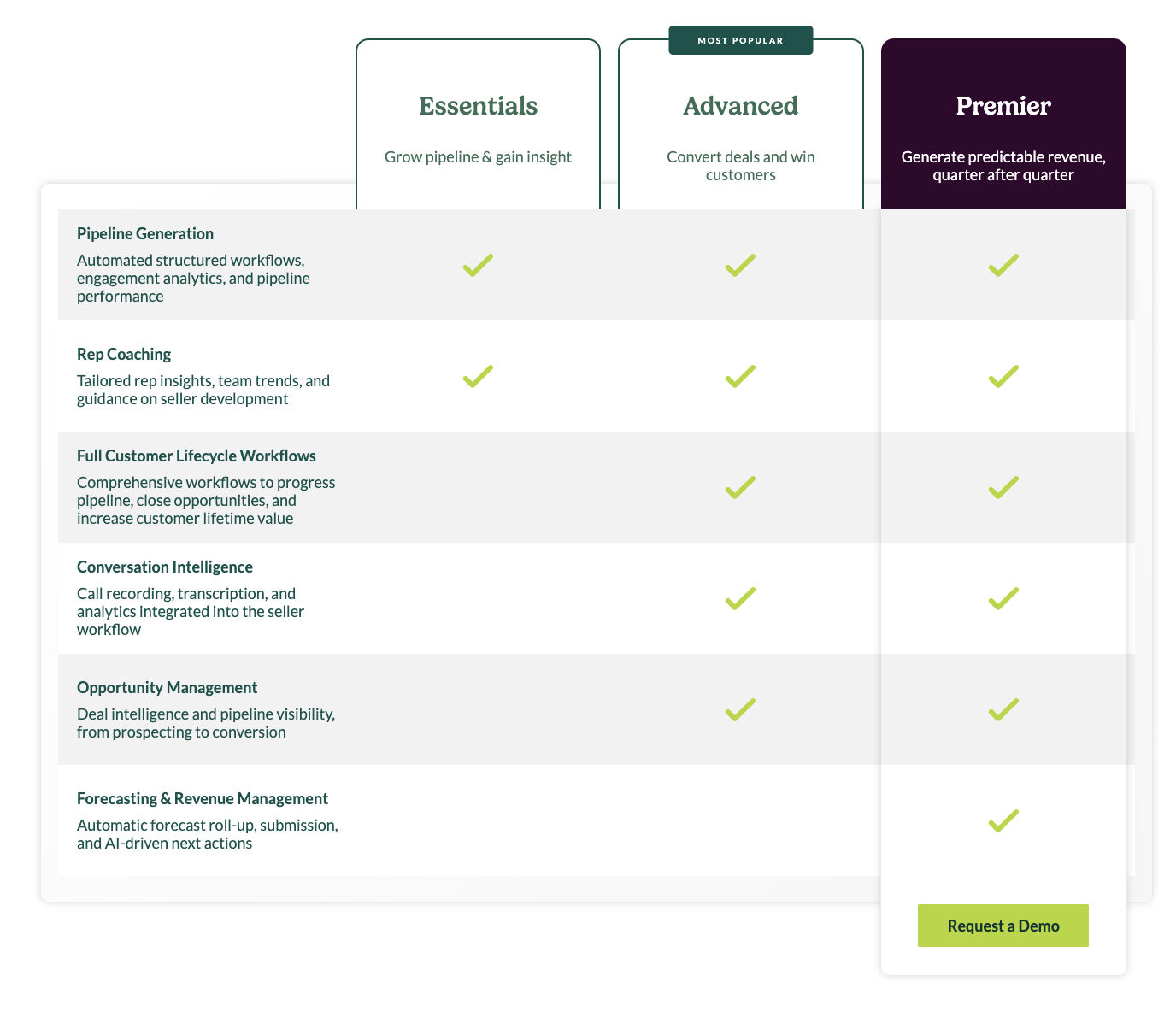
This is the foundation, and the only plan genuinely comparable to the prospecting tools on the market. It covers multichannel sequences across email, phone and LinkedIn, automated follow-ups and prioritization of the contacts to work next.
Important: Essentials disappeared from public listings in 2026, where only Advanced and Premier are still referenced. If prospecting is what you need, ask for it by name: it saves 35 to 40% per license.
Advanced: call intelligence and deal tracking
Advanced layers on two capabilities that have nothing to do with prospecting anymore.
Call intelligence: every call and video meeting is recorded, transcribed and summarized automatically, with key moments flagged, such as a competitor being mentioned, an objection raised or a decision-maker joining the conversation
Deal tracking: a pipeline view for managing open opportunities
This is the best-selling plan, and the one behind most of the quotes that land at 125 dollars and above.
Premier: revenue forecasting
Premier includes everything above and adds revenue forecasting, the tool that lets a sales leader commit to a quarterly number. It is the most expensive plan in the catalog, between 130 and 170 dollars per user per month after negotiation.
One rule of thumb circulates on the vendor side: roughly 2,000 dollars per license per year. It matches the top of that range exactly.
The median signed contract: $30,700 per year
Unit prices tell you nothing without volume. Spend data collected from around 160 customer companies paints a more concrete picture.
Company profile | Observed annual budget |
|---|---|
SMB and mid-market, 50 to 1,000 employees | about $43,400 per year |
Enterprise, more than 1,000 employees | about $168,400 per year |
Median across all profiles | about $30,700 per year |
One detail runs against intuition: the price per license goes up as the company gets bigger. The observed data shows 60 to 85 dollars for teams of 10 to 25 people, 100 to 130 dollars from 25 to 75 people, and 130 to 170 dollars above 75 users. Volume effects do exist, but they are more than offset by the fact that large organizations buy the higher tiers and more add-ons.
What Salesloft delivers for that price
The scope is wide, and that is what justifies the price positioning.
Multichannel prospecting sequences across email, phone and LinkedIn
An AI-prioritized task queue driven by buying signals
Recording, transcription and automatic analysis of calls and video meetings
Opportunity tracking and pipeline management
Revenue forecasting
Coaching scorecards pre-filled by AI from the transcripts
A conversational agent for the website
Two-way CRM sync, governance and security
This is a tool for sales leadership as much as for reps. That breadth is its strength and, for plenty of teams, the reason it delivers poor value for money.
The costs that never show up in the first quote
The license price is not the price of a fully equipped seat.
The dialer is billed separately, around 200 dollars per user per year according to available estimates, with some sources citing up to 480 dollars depending on volumes and countries
Revenue forecasting is included in Premier but billed separately on the lower tiers
Contact data is not included: Salesloft is not a data provider, so addresses and phone numbers have to come from somewhere else
Deliverability is not covered: no warmup, no sending address rotation, no management of large mailbox fleets
The CRM stays on your tab, with its own license
Setting up a Salesforce sandbox environment carries an extra charge
Onboarding fees
Salesloft does not deploy itself. The vendor publishes the contents of its onboarding packages, but never their price.
Package | Scope | Duration |
|---|---|---|
Essentials | Up to 20 users, webinar format with a consultant | 2 to 4 weeks |
Premier | Up to 30 users, hands-on workshops | 6 to 8 weeks |
Premier Plus | Up to 50 users, 2 groups | 8 to 12 weeks |
Custom | More than 50 users or 2 geographies | Quote on request |
Estimates drawn from buyer feedback put these fees between 3,000 and 25,000 dollars in year one, climbing toward 15,000 to 30,000 dollars for a fifty-license rollout.
The annual commitment: what the contract says
This is the most underestimated clause at signature, and the only one backed by official text. The vendor's master agreement, in the version in force in early 2026, is explicit.
"all fees are non-cancelable, will be invoiced in advance and are due within thirty (30) days from the date of Salesloft's invoice"
"all fees paid are non-refundable and not subject to set-off"
Termination on thirty days' notice is only available "if there are no Order Forms in effect"
"Additional End Users may be added during the Subscription Term at the same price applicable to that subscription type, prorated for the remainder of the then-current Subscription Term"
The asymmetry is striking: adding licenses is instant and prorated, removing them is impossible before renewal. A team that drops from twenty people to fifteen in March keeps paying for twenty licenses through December.
Worth noting too, multi-year commitments unlock rates 15 to 30% lower, but they lock you in for two or three years to a tool you were never able to trial for free.
No annual contract, no non-refundable fees
Emelia is billed monthly and you can stop whenever you want, from €37/month.
What a license really costs over three years
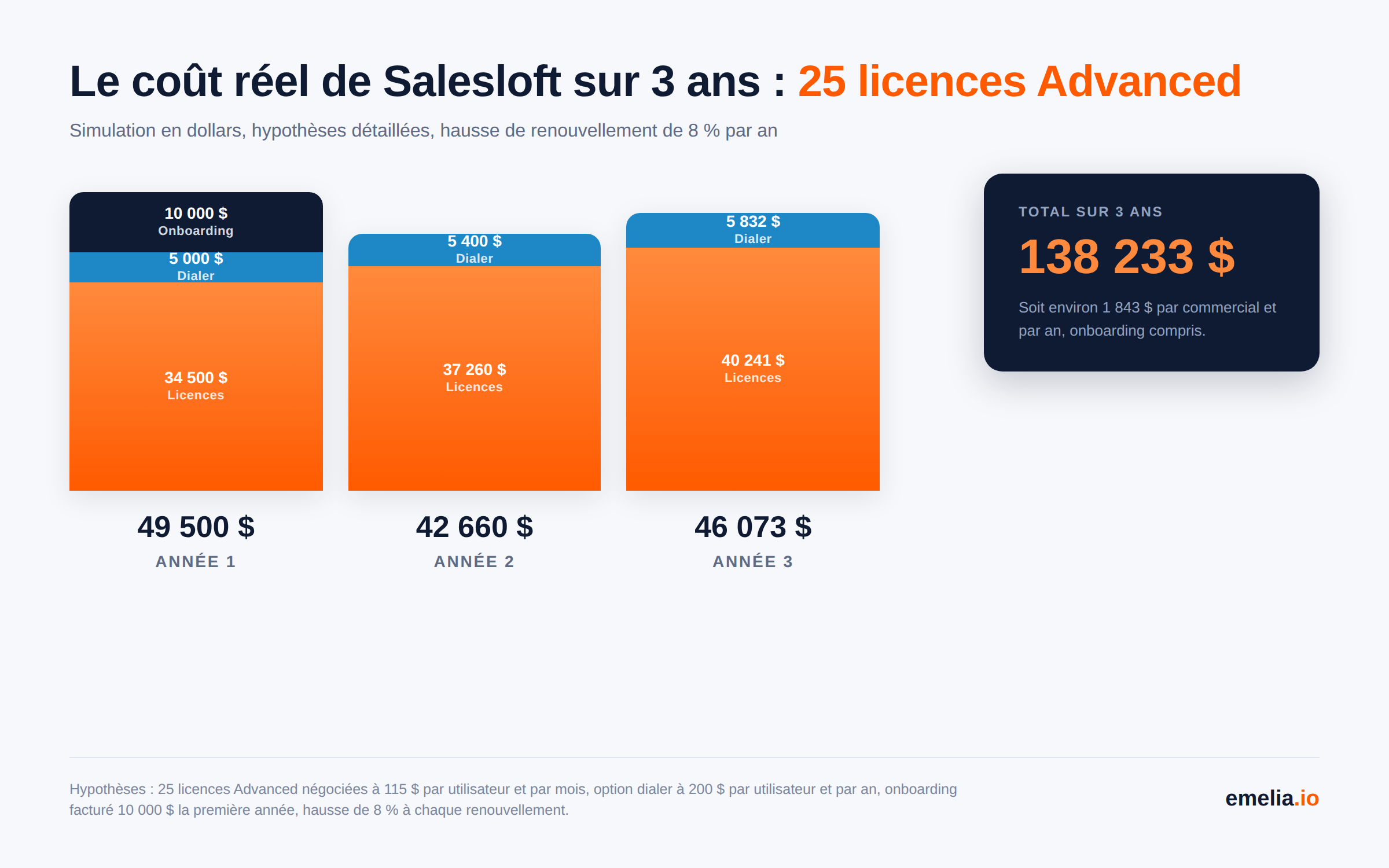
A simulation for 25 reps on the Advanced plan. Assumptions: 115 dollars per user per month, the midpoint of the negotiated range, a telephony add-on at 200 dollars per user per year, 10,000 dollars of onboarding in year one, and an 8% uplift at each renewal, within the 5 to 12% range buyers report.
Line item | Year 1 | Year 2 | Year 3 |
|---|---|---|---|
Licenses | $34,500 | $37,260 | $40,241 |
Telephony add-on | $5,000 | $5,400 | $5,832 |
Onboarding | $10,000 | $0 | $0 |
Total | $49,500 | $42,660 | $46,073 |
The three-year total lands at roughly 138,200 dollars, or 1,843 dollars per rep per year. And that calculation includes neither the data provider, nor the CRM license, nor sales ops time.
One thing to watch: the master agreement contains no clause capping renewal increases. The 5 to 12% buyers report is commercial practice, not a right. Negotiate it in writing before you sign the first time.
Is there a license minimum at Salesloft
No minimum is published and the master agreement mentions none. Industry practitioners state plainly that there is no formal floor.
Commercially, reality looks different. Onboarding packages start at "up to 20 users" and the observed price ranges begin at the 10 to 25 user tier. Below ten licenses, a contract does not justify the sales effort and therefore earns no discount.
For five reps at list price, with onboarding and telephony, budget 12,000 to 18,000 dollars in year one for a tool built for organizations ten times larger.
Salesloft's limitations to know before you sign
No pricing transparency, no free trial, no free version
Annual commitment paid up front, fees non-refundable and non-cancelable
No way to reduce the license count mid-term
Significant implementation cost in year one
No contact data, no warmup, no mailbox fleet management
Named-user billing, with no pooling possible
Who Salesloft pays off for, and who it does not
Salesloft makes sense for an organization of at least twenty reps, with a clean CRM, a named sales operations function, long sales cycles and a genuine coaching need. In that context, the price per license compares favorably to the fully loaded cost of a rep.
It does not make sense in four scenarios.
Fewer than ten reps: the economics of the contract simply do not work
Pure outbound prospecting, where the whole game is sending volume and deliverability
Agencies running campaigns for multiple clients, which named-user billing cannot accommodate
An annual prospecting budget under 20,000 dollars
The most common trap is the middle case: buying Advanced at 115 dollars per rep per month and using nothing but the prospecting sequences.
Only using sequences? Pay for that only.
Cold email, LinkedIn, warmup and data search in a single subscription, at €37 a month.
Six Salesloft alternatives and what they cost
The market splits into two families: platforms sold per seat with an annual commitment, and prospecting tools with public pricing. Here are the six most relevant comparables.
Outreach

Outreach is Salesloft's head-on competitor, occupying the same position as a revenue platform sold to sales leadership. The model is identical: named-user billing, annual commitment, no published pricing.
Outreach pricing
No published price, quote required
Three announced tiers: Standard, Professional and Enterprise
Average contract value of about $45,500 per year, measured across 910 purchases
Average observed discount of 12%, versus 17.5% at Salesloft
The average ticket is therefore higher than Salesloft's. Putting the two in documented competition remains the single most effective negotiating lever on either side.
HubSpot Sales Hub

HubSpot Sales Hub is the most credible alternative for a team already running the HubSpot CRM. The scope covers sequences, deal tracking and reporting, with fully public pricing.
HubSpot Sales Hub pricing
Free: free, up to 2 seats
Starter: $9 per seat per month billed annually, $15 monthly
Professional: $90 per seat per month billed annually, $100 monthly, plus a $1,500 onboarding fee
Enterprise: $150 per seat per month, plus a $3,500 onboarding fee
Professional therefore sits 25 to 45% below the negotiated price of a Salesloft Advanced license, with onboarding fees you know up front.
Apollo.io

Apollo.io combines a database of more than 275 million contacts, sequences, a dialer and enrichment in a single tool. It offers the best volume-to-price ratio in this lineup for a team that wants data and execution in the same place.
Apollo.io pricing
Free: free, 50 credits per month
Basic: $49 per seat per month billed annually, $59 monthly
Professional: $79 per seat per month billed annually, $99 monthly
Organization: $119 per seat per month billed annually, three-seat minimum
One credit exports an email address, revealing a phone number costs five. Billing stays per seat, so it scales with headcount.
Lemlist

Lemlist is the closest multichannel competitor on the prospecting side, with a built-in lead database, in-house warmup and LinkedIn automation. It covers neither call intelligence nor forecasting.
Lemlist pricing
Email: $69 per month, $55 billed annually, unlimited users, 50,000 emails per month
Multichannel: $109 per user per month, $87 billed annually, 5 senders per user, LinkedIn, SMS, WhatsApp and calls
Enterprise: quote on request, recommended from five users up
The Multichannel plan bills per user: five reps means $435 to $545 per month.
La Growth Machine
La Growth Machine is the French option for LinkedIn and email multichannel, with a built-in company database. Billing is per identity, meaning per person doing the prospecting.
La Growth Machine pricing
Basic: $70 per month per identity, LinkedIn and email, no CRM
Pro: $135 per month per identity, mailbox rotation and intent signals
Ultimate: $195 per month per identity, CRM and custom sequences
As with Salesloft, the bill scales with the number of people prospecting.
Waalaxy

Waalaxy is the best-known French option on LinkedIn, with a step into multichannel on its top plan. The scope is far narrower than Salesloft's, but the entry ticket is the lowest in the lineup.
Waalaxy pricing
Freemium: free, 80 invitations per month
Pro: $19 per month, 300 invitations
Advanced: 49 € per month, 800 invitations, 25 emails per month
Business: 69 € per month, 800 invitations and 500 emails per month
The Inbox add-on costs around 20 € per user on top.
Entry pricing compared
Tool | Billing unit | Paid entry plan | Commitment | Published price |
|---|---|---|---|---|
Salesloft | Per named user | $100 to $170 per month after negotiation | Annual, paid up front | No |
Outreach | Per named user | Quote, around $45,500 per year on average | Annual | No |
HubSpot Sales Hub | Per seat | $9 per month, $90 for Professional | Monthly or annual | Yes |
Apollo.io | Per seat | $49 per month billed annually | Monthly or annual | Yes |
Lemlist | Per user on multichannel | $55 per month billed annually | Monthly or annual | Yes |
La Growth Machine | Per identity | $70 per month | Monthly or annual | Yes |
Waalaxy | Per user | $19 per month | Monthly or annual | Yes |
Emelia | Per subscription | $37 per month | No commitment | Yes |
The picture gets sharp once the billing unit sits in its own column. Of the eight tools compared, only two hide their pricing, and they are precisely the two selling a five-figure annual contract. The other six publish a price list and start between 19 and 90 dollars or euros per month.
More to the point, six of the eight bill per head: their invoice is proportional to the number of reps using the tool. Emelia is the only one in the lineup whose subscription is measured differently, in the number of sending mailboxes and LinkedIn accounts connected.
Do not draw the opposite conclusion: Emelia has no team mode, one subscription is one user account. This is not cheaper team billing, it is a different model.
Warmup, email finder, phone finder and scraper: included
Four building blocks Salesloft does not offer and that you have to buy elsewhere. From €37 a month.
Where Emelia beats Salesloft, and why
On the prospecting side, Emelia's edge is not only about price. It is about what comes in the box, and what that changes day to day.
Contact data is included. The email finder and the phone number lookup are built in, and credits are only deducted when a data point is actually found.
Salesloft supplies no addresses and no phone numbers: you buy them elsewhere and import them.
An Emelia team therefore starts from a list of names and ends up with reachable contacts without ever leaving the tool.
Warmup is included on every sending mailbox. Salesloft does not offer it at all. That matters because deliverability decides whether your emails land in the inbox or in spam. Without warming up the addresses and spreading the sending across several mailboxes, scaling volume mechanically degrades your inbox rates.
The Sales Navigator scraper is built in. You build a list from a Sales Navigator search and it lands straight into a campaign. With Salesloft, that step means a manual export or one more third-party tool.
You only pay for what you use. Enrichment credits are topped up on demand and do not expire on a contract date. In an annual contract, the allocation is fixed at signature and lost if you do not consume it.
You can stop. Emelia is billed monthly, at a published price. Salesloft imposes an annual commitment settled up front, with fees that are non-cancelable and non-refundable. A rollout that never takes costs you twelve months with one, one month with the other.
And the invoice does not move as long as the capacity is enough. At Salesloft, every hire adds a prorated license immediately, and every departure keeps being billed until renewal. At Emelia, the subscription does not follow headcount, it follows the volume you send: going from 3 to 50 mailboxes means more sending capacity, not more seats.
Salesloft or Emelia: what actually compares

The shared scope is limited to prospecting: finding the contact data and starting the conversation. That, and only that, is where the comparison holds.
Within that scope, Emelia does everything Salesloft does, plus four things Salesloft does not offer at all: mailbox warmup, email address lookup, phone number lookup and a Sales Navigator scraper. With Salesloft, those four blocks have to be bought from third-party providers and added to the budget.
The structural difference fits in one sentence: Salesloft bills every rep who logs in, Emelia bills a capacity of sending mailboxes and LinkedIn accounts.
Criterion | Salesloft | Emelia |
|---|---|---|
Billing unit | Per named user | Per subscription, capacity in mailboxes and LinkedIn accounts |
Team mode | Yes, one license per rep | No, one subscription is one user account |
Entry ticket | $100 to $170 per user per month | $37 per month |
Commitment | Annual, paid up front, non-refundable | No commitment |
Published price | No | Yes |
Email and LinkedIn sequences | Yes | Yes |
Cold email sending | Included | Included, unlimited sending |
Mailbox warmup | Not offered | Included on every mailbox |
Email address lookup | Not offered | Included, charged on success |
Phone number lookup | Not offered | Included, charged on success |
Sales Navigator scraper | Not offered | Built in |
Call analysis and transcription | Included from Advanced | Not offered |
Deal tracking and forecasting | Included from Advanced | Not offered |
The other way round, it is worth being clear about what Emelia does not do. Call intelligence, deal tracking and revenue forecasting do not exist in Emelia, and they account for a real share of what Salesloft is worth to a sales leadership team. Those are downstream functions rather than prospecting ones, but they are real.
One more point deserves to be spelled out: Emelia does not offer a team mode yet. One subscription equals one user account. The model works when one person runs prospecting on behalf of several reps, which is the most common setup in growth and sales ops. If you want every rep to log into the tool themselves and manage their own campaigns, this is not the right answer today.
Emelia pricing
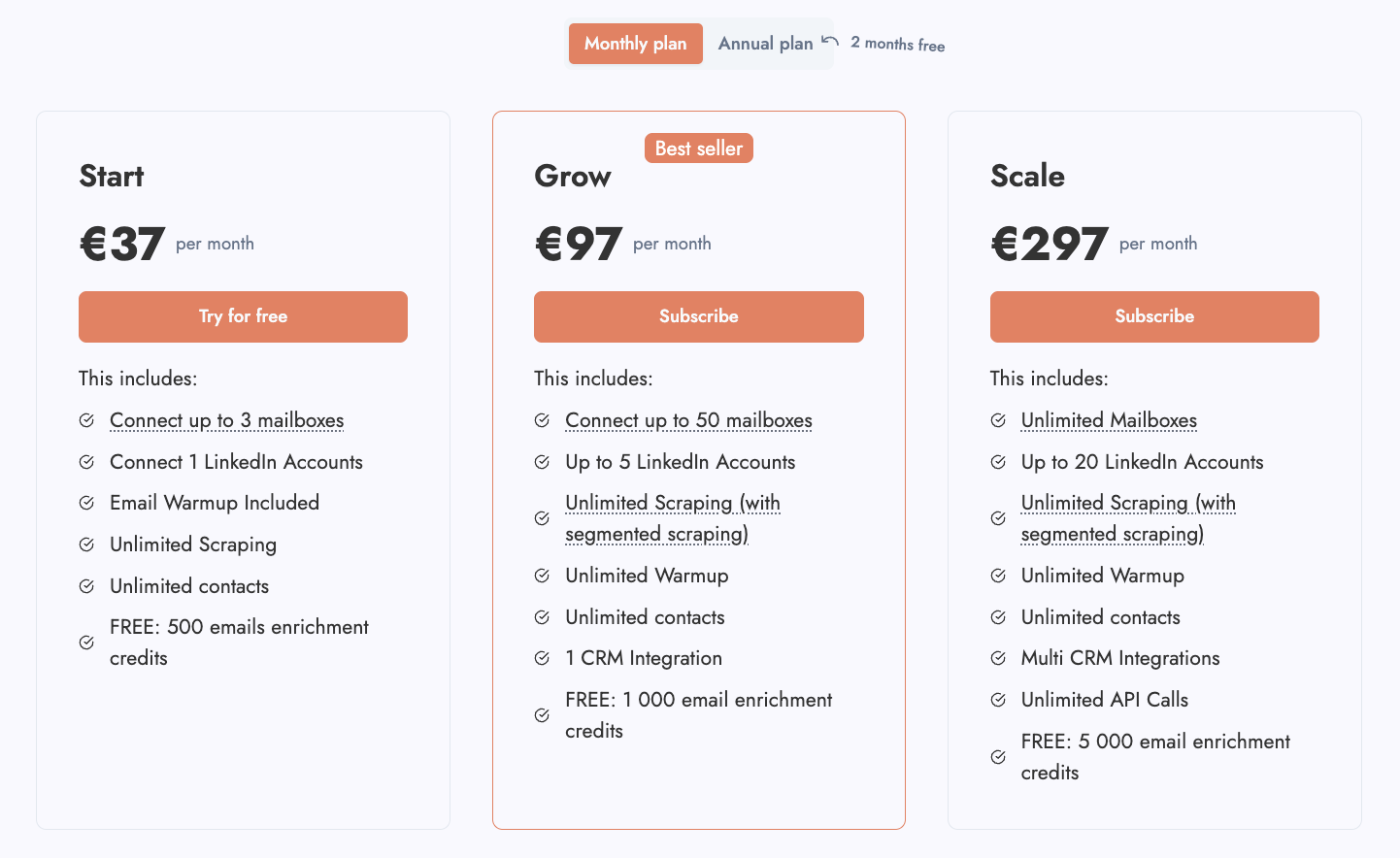
Emelia publishes its pricing, in three tiers at 37, 97 and $297 per month, with two months free on annual billing.
The Start plan opens 3 sending mailboxes and 1 LinkedIn account
The Grow plan, 50 mailboxes and 3 LinkedIn accounts
The Scale plan, unlimited mailboxes and 10 LinkedIn accounts
A word on those mailboxes, because it is the most misread figure on the grid. Three, fifty or unlimited mailboxes are not seats for three or fifty reps. They are sending addresses. In high volume prospecting, you spread sending across several addresses so you do not burn a domain and stay in the inbox: it is a deliverability constraint, not a team capacity. One person can run fifty mailboxes.
Contacts, emails, LinkedIn actions and scraping are unlimited across the whole range, and warmup is included from the first tier.
Email finder and phone lookup credits are topped up on demand and are only deducted when a data point is actually found. That is a difference of principle from a contract where the annual allocation is fixed at signature and lost if you do not consume it.
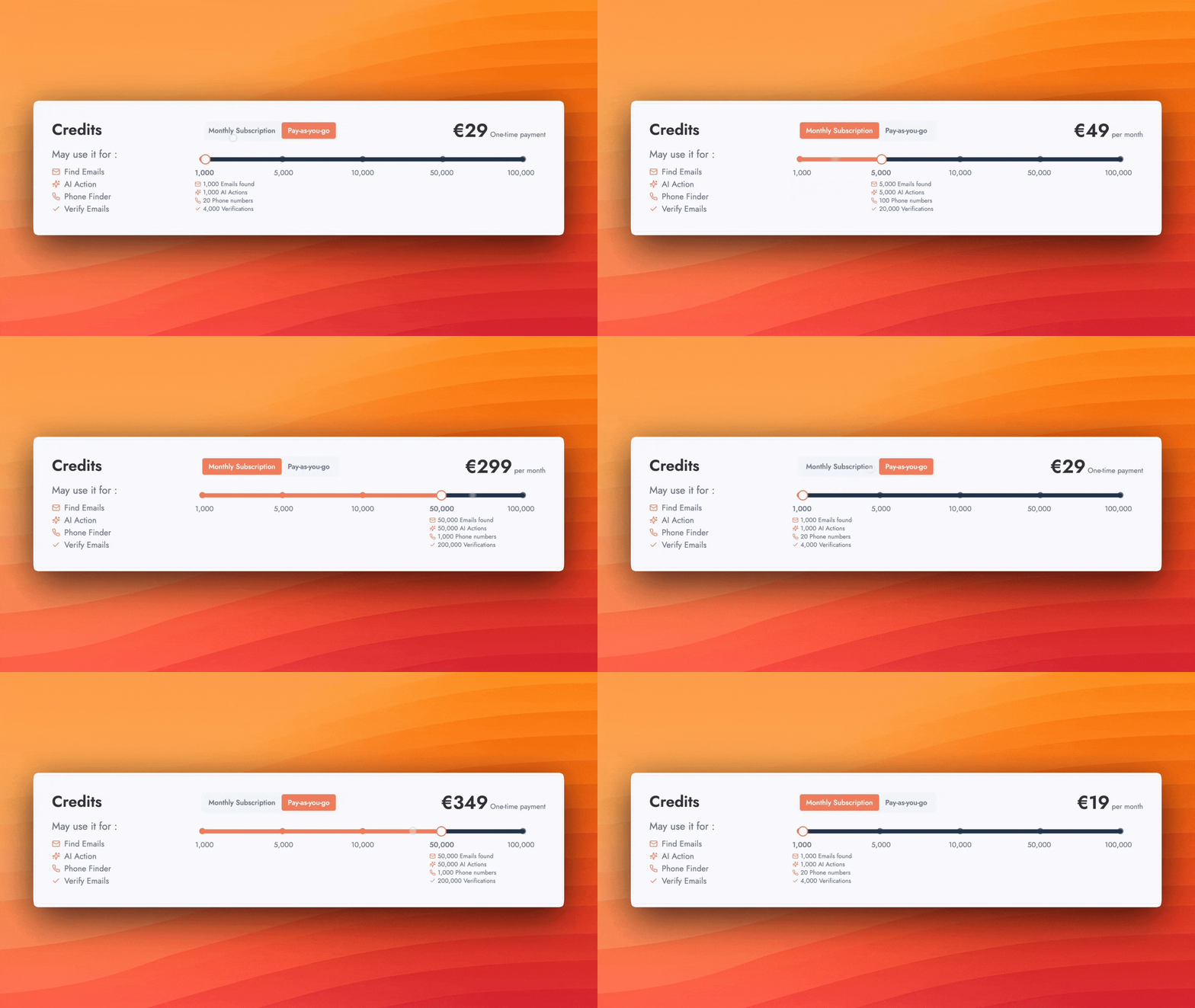
Sending and enrichment are two separate meters: hitting a credit limit does not pause your campaigns.
Find your prospects and reach them at the best price
Cold email, LinkedIn, warmup and email finding in a single subscription.
How to bring a Salesloft quote down
Since there is no published price, every quote is only a starting point. Three levers genuinely move the number.
A costed competing quote. Walking in with a proposal from Outreach in hand is by far the most effective lever, because it is the only head-on comparable on the market
Timing. The end of a quarter, and above all the end of a fiscal year, is when a rep has the most room to move
Paying the full year up front, which the contract requires anyway, and which often serves as the trade-off for a meaningful discount
But the real stakes are not in the unit price. They sit in four clauses you need written into the order form, because none of them is there by default.
A stated cap on renewal increases
Onboarding fees folded into the overall price
The dialer built into the license rather than sold as an add-on
The right to reduce your license count at renewal without penalty
That last point is the one most often forgotten, and the one that costs the most the day the team restructures.
Should you pay for Salesloft in 2026?
Yes, in one specific case. An organization with at least twenty field reps and a sales operations function already in place, that wants to record and analyze its calls, coach its managers off the transcripts and build its forecast in the same tool it prospects with. At 1,843 dollars per rep per year all in, the price stays coherent with that scope. No $37 tool does that.
No in every other case. If you are buying Salesloft to send prospecting sequences, you are paying for a sales management platform and using a tenth of it, on an annual commitment settled up front and non-refundable. Five licenses, onboarding and dialer included, is 13,900 dollars in year one, and you will not be able to scale back before renewal.
Before you sign, one question really settles it: how many of your reps will actually open call intelligence and the forecast? If the answer is two or three out of twenty, the problem is not what Salesloft costs, it is the scope you are buying.
Frequently asked questions about Salesloft pricing
How much does Salesloft cost per user per month?+
Salesloft publishes no pricing. Aggregated purchase data from signed contracts puts the negotiated cost between 60 and 85 dollars per user per month on the Essentials plan, between 100 and 130 dollars on Advanced, and between 130 and 170 dollars on Premier. The average discount observed against the list price is 17.5%.
Does Salesloft offer a free trial?+
No. There is neither a free trial nor a free version. To get a number, you have to go through the vendor's sales cycle: a qualification call, a demo, and often a technical workshop before the first costed proposal.
What annual budget should you plan for Salesloft?+
The median signed contract sits at around 30,700 dollars per year. Companies with 50 to 1,000 employees spend an average of 43,400 dollars per year, and organizations with more than 1,000 employees around 168,400 dollars per year.
Can you pay for Salesloft monthly?+
No. The master agreement imposes an annual commitment. Fees are invoiced in advance, due within thirty days, non-cancelable and non-refundable. There is no monthly billing option.
Can you reduce the number of licenses mid-contract?+
Not before renewal. The contract lets you add users during the subscription term, at the same price and prorated over the remaining period, but no clause lets you remove any. A team that shrinks keeps paying for its licenses until the term ends.
Are there onboarding fees at Salesloft?+
Yes. The vendor sells four levels of onboarding, from 2 to 4 weeks for twenty users up to a custom format above fifty. The prices are not published. Estimates drawn from buyer feedback put them between 3,000 and 25,000 dollars in year one, and higher for a fifty-license rollout.
Does Salesloft provide prospect email addresses and phone numbers?+
No. Salesloft is not a contact database. Email addresses, phone numbers and firmographic data have to be bought from a third-party provider, which is an additional budget line.
What is the cheapest alternative to Salesloft?+
For prospecting, Emelia is the only tool in this comparison whose subscription is not counted in licences: it is measured in sending mailboxes and LinkedIn accounts, from $37 per month with unlimited sending. Note that Emelia does not offer a team mode yet, so one subscription equals one user account. Among the per-seat tools, Waalaxy starts at 19 euros, Apollo.io at 49 dollars and HubSpot Sales Hub at 9 dollars per seat per month.