

NeverBounce vs Emelia at a glance


- Email verificationYesYes
- Email finderNoYes
- Phone number finderNoYes
- Cold email from your own mailboxesNoYes
- LinkedIn automationNoYes
- Native CRM integrationYesYes
- APIYesYes
Checked on November 5, 2026 on NeverBounce’s own pages and on Emelia’s pricing page.
Using NeverBounce for free: a list analysis and a few test credits
You cannot stay on NeverBounce for free: there is no free plan, only a way to try it. The pricing page says “No credit card required to verify your first email list” and promises “Free list analysis and free test credits”, without saying how many credits. The number depends on the source. 10 credits at sign-up, according to its help centre, to Snov.io’s comparison of verifiers and to the blog of ZoomInfo, its owner; 1,000 on an older comparison page; credits for people who book a demo, in another help article. Plan on 10, the lowest figure.
What is free whatever the count: the list analysis, which estimates your bounce rate before you pay; the removal of duplicates and badly formed addresses before the quote; and the box on the home page that tests one address at a time. Without a card on file, the API is slowed down and bulk verification is restricted.
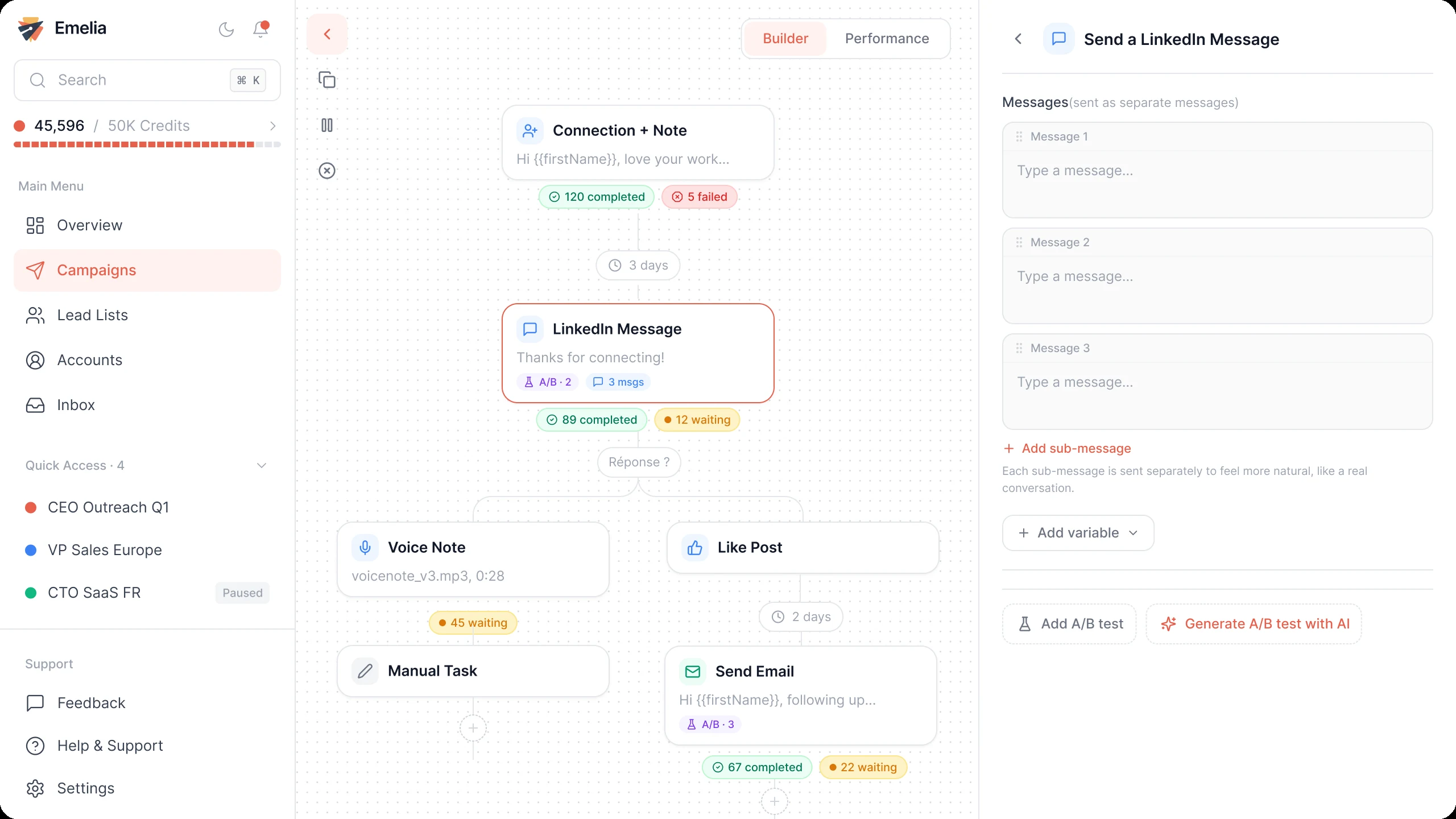
Emelia gives 20 credits to anyone who signs up with a work email, on top of a 7-day trial with no card. At 0.25 credit per address, that is 80 checks on a list you bring, or 20 emails found and already verified.
What NeverBounce is: a ZoomInfo verifier that finds no addresses
NeverBounce is an email verification service. You give it addresses you already hold, and each one comes back with a verdict before you send, for 1 credit. It presents itself as three products with one goal:
- Clean takes a whole list, as a CSV or from an integration, and returns it sorted; the “Deliverable” download keeps only the valid addresses.
- Verify checks one address as it is typed, in a signup form or a checkout, through the API or a JavaScript widget.
- Sync, part of the Growth plan, keeps the lists of a CRM or an email platform clean on a schedule.
How NeverBounce works, step by step
Upload a list and duplicates and malformed addresses are dropped at no charge. The free analysis then estimates what is wrong with the rest; if you go ahead, each remaining address costs a credit. NeverBounce’s help centre gives 2 to 10 minutes for 10,000 addresses.
What it leaves to other tools
No email finder, no phone numbers, no campaigns, nothing on LinkedIn. Growth does add “200 new leads/month picked by AI”, and Lookalike Audiences sells contacts drawn from ZoomInfo’s data, order by order, with no published price, but neither is a database you can filter yourself. A team that prospects needs one tool upstream to find contacts and another downstream to write to them.
NeverBounce statuses: valid, invalid, disposable, catch-all, unknown
Every address gets one of 5 results, each with a numeric code in the API. The help page “Result Codes” says, for each, whether it is OK to send:
- Valid (code 0): yes, send.
- Invalid (1): no; the mailbox does not exist or refuses mail.
- Disposable (2): no; a throwaway address.
- Accept all, also called catch-all or unverifiable (3): “use caution”. The domain accepts everything, so the mailbox cannot be confirmed; NeverBounce states that “catch-alls bounce at about half your list’s invalid rate”.
- Unknown (4): “use caution, re-verify first”. The server did not answer clearly in time, and NeverBounce insists that “it is not a negative result”.
Do unknown and catch-all results use up a credit?
Nothing says otherwise. The written rule is one credit per verification, and no help article we could read exempts either result, whereas ZeroBounce and Kickbox both state that an unknown is free. NeverBounce’s site only adds that its team “personally reviews lists with a high number of unknowns”.
NeverBounce and HubSpot: 80+ integrations and Sync
HubSpot is the connection most people look up. It is native, like Salesforce and Pipedrive, and belongs to a catalogue announced at “80+” on the pricing page, “over 85” in one block of the home page and 84 pages in its sitemap. Most are email platforms (Mailchimp, ActiveCampaign and SendGrid), CRMs and form builders (Typeform, Jotform and Google Forms), with Zapier and n8n for everything else.
Sync is what makes such a link last: the list held in the connected tool is checked daily, weekly or monthly, and only new, unique addresses are billed. It comes with Growth, from $49 a month.
For cold outreach, the only tool in its integration pages is QuickMail. Instantly, Smartlead, lemlist and Emelia do not appear, so with those the route is a file (export, clean, import again) or an automation through Zapier or n8n. Inside Emelia, a list imported from elsewhere goes through its Email Verifier in the same account as the campaign.
The NeverBounce API: single checks, bulk jobs, a form widget
The API is at version 4 and open to every account. `/v4/single/check` verifies one address, with a timeout you set; `/v4/jobs/create` starts a list job, including the free analysis. Keys are issued per application, and official libraries cover Node.js, PHP, Python, Ruby, Go, Java and .NET.
For forms, a JavaScript widget does the check while the visitor types, with no back-end work. Bulk work has written limits: 10 concurrent jobs and 50 runs a day per account, and the guidelines warn that running an existing list through single checks can get an account locked. No per-second rate is published. Every call costs 1 credit, the same as a line in a list.
NeverBounce at ZoomInfo: bought by DiscoverOrg in 2019
NeverBounce started in Cleveland, Ohio in 2014, built by a former marketing agency. On March 5, 2019, DiscoverOrg announced the acquisition of what it described as a service “used by over 100,000 sales and marketing professionals”, and promised that its products would remain on sale separately. DiscoverOrg has since taken the ZoomInfo name.
Today the terms of use name “ZoomInfo Technologies LLC d/b/a NeverBounce”, the footer carries the ZoomInfo copyright and the status page is ZoomInfo’s. The link shows up in the product too: the logo reads “by zoominfo”, and Lookalike Audiences draws on ZoomInfo’s contacts. NeverBounce itself claims 150,000+ clients on its About page and 125,000 users in its documentation.
NeverBounce reviews: why G2 and Trustpilot disagree
Scores read on November 9, 2026. G2 and Capterra block automated visits, so their figures come from search-engine results. NeverBounce’s home page advertises “7,000+ G2 Reviews”, far more than the 145 on the G2 listing.
Capterra’s stronger sub-scores
- Features: 4.4
- Customer service: 4.3
What pulls the scores down
- Recent reviews about credits that expired or were not refunded
- One account whose API access was cut after a billing error
- Capterra’s lowest sub-score is value for money, at 4.1
NeverBounce or Emelia: verifying 20,000 addresses, then writing to them
A prospecting team checks the addresses of its new contacts every month, and those volumes are what Emelia’s credit packs are sized for. NeverBounce’s prices are in dollars and Emelia’s follow your currency, so no difference is worked out between them. NeverBounce sends nothing itself, so the last price line adds Instantly, a common sending tool.
Monthly address checks
4,000 addresses
20,000 addresses
Verified, then contacted
Verify 20,000 addresses, then run the campaign
Beyond the verification itself
Finding an email from a name or profile
Phone numbers
Sending campaigns
Credit life
Checking an address as it is typed in a form
Automatic cleaning of a CRM list
Prices per month as read on November 9, 2026, Emelia’s before tax. NeverBounce: 1 credit per check, the cheaper of credits bought that month and Growth. Emelia: 0.25 credit per check, credit packs alone with no plan; Grow covers the 26 mailboxes those contacts need at 35 new contacts per mailbox per day, and includes 3 LinkedIn accounts. Instantly’s Hypergrowth loads 25,000 contacts in total, never reset, so a second month at this pace goes past it.
What NeverBounce costs, in one paragraph, and the ZeroBounce duel
There are two ways to pay, both in US dollars: credits bought when you need them, from $8 for 1,000, valid 12 months, or Growth, a monthly allowance from $49 (up to 10,000 checks) to $999 (up to 1,000,000). Every pack, every tier and what actually gets billed are on the NeverBounce pricing page.
The verifier it is most often measured against has its own page: NeverBounce vs ZeroBounce sets the two grids side by side, along with what each charges for unknown results and how long credits last.
NeverBounce questions
The application is at app.neverbounce.com, and that is where you sign in. Colleagues do not need separate purchases: team accounts are free and share the credits, with Owner, Admin, User and Developer roles.
No. Neither its site nor the Chrome Web Store lists one from NeverBounce; “Smart Email Verifier” is a third-party extension that plugs in a NeverBounce, ZeroBounce or MillionVerifier API key. On a LinkedIn profile, the Emelia extension finds the person’s email, already verified, and their number, paid in credits only when found, then adds them to a campaign.
An envelope icon next to the NeverBounce wordmark, with “by zoominfo” underneath, as in the navigation of its site. We found no version without the ZoomInfo mention.
Our NeverBounce alternatives page sorts them by the moment you verify: as the address is found, before a send, or at signup, with Kickbox and ZeroBounce among them and Emelia first.
Emelia features: Email finder · Emelia pricing
Emelia is a NeverBounce competitor. We have tried to stay fair: every figure about NeverBounce comes from its own website or public review sites.


