You have a list of prospects: names, companies, job titles. The one column you need to launch a campaign is missing, the email address. That is exactly the gap an email finder fills, and it is the only subject of this article.
One detail has changed over the past two years, and it changes the whole reasoning. Not long ago, the real dividing line between these tools was the billing model: some spent a credit on every search, found or not, others only when they found something. Today, all eight tools in this comparison charge per email found. The argument no longer separates anyone.
What separates them in 2026: the real cost of an email found once brought back to money, how solid the verification is, and what the tool can do around enrichment. A pure email lookup player and a platform that enriches then sends do not answer the same need, even when their headline price looks alike.
The grids below were recorded on 18 September 2026 on the publishers' pricing pages. Each tool is quoted in the currency it bills in, with no conversion: an exchange rate is right on the day you write it, and wrong the week after.
What an email finder actually is
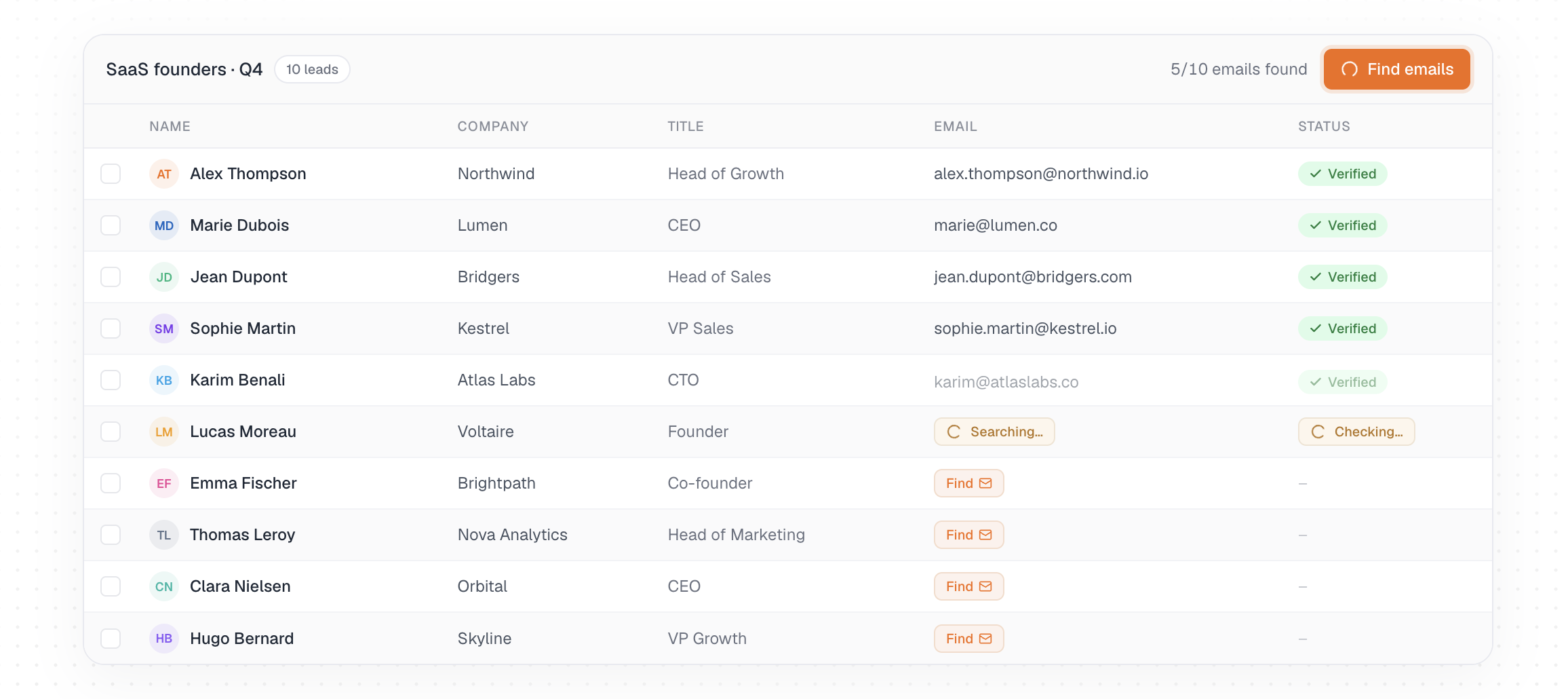
An email finder takes a first name, a last name and a company as input, and returns that person's work email address as output. Nothing more. You give it a 2,000-row file with no addresses, it hands back the same file with an email column filled in on some of the rows.
The mechanism comes down to three steps. The tool first works out the address format in use at the company, then cross-checks that guess against what it already knows about the domain, and finally verifies that the mailbox really exists by querying the mail server.
The first step works far better than people think, and that is why all these tools end up looking alike. A Sendburg study covering 336,782 B2B profiles shows that 47.7% of addresses follow the firstname.lastname@ format and 26.8% the flastname@ format, close to three quarters of B2B between them, and that 91.4% follow some naming rule. A work address, most of the time, can be deduced.
The wall is not deduction, then, it is verification. Roughly one server in two refuses to say whether a mailbox exists: it accepts anything presented to it, which is what we call a catch-all domain. Among large companies, close to half of domains are in that situation. That is where the tools genuinely separate, not on their ability to build a plausible address.
Three things an email finder is not. It is not a database: it starts from your list and will never hand you prospects you did not ask for. It is not an email verifier, even though most of them embed one. And it is not a sending tool: finding the address and writing to it are two distinct trades, which some platforms bring together and others leave apart.
The 8 email finders compared in 2026
The table below brings every tool back to the one measure that really compares: how much an email actually found costs, at entry level then at volume. The last column says what that price buys, because a pure enrichment player and a full platform do not produce the same invoice at the end of the month.
Tool | Entry level | Cost per email found | What that price covers | Billing |
Emelia | 19 € for 1,000 credits | 0.019 € to 0.005 € | Enrichment, verification, phone numbers, campaign sending | Per account |
Enrow | $17 for 1,000 credits | $0.015 to $0.0072 | Enrichment, verification, phone numbers | Per account |
Icypeas | $19 for 1,000 credits | $0.019 to $0.00499 | Enrichment, verification, profile scraping | Not specified |
Dropcontact | 19 € for 500 credits | 0.038 € to 0.0099 € | Enrichment, legal company data, CRM sync | Per account |
Hunter.io | 49 € for 2,000 credits | 0.0245 € to 0.012 € | Enrichment, verification, campaign sending | Per account |
Anymailfinder | 26 € for 400 credits | 0.065 € to 0.007 € | Enrichment and verification only | Per account |
FullEnrich | $29 for 500 credits | $0.058 to $0.035 | Waterfall enrichment across 20 sources, phone numbers | Per account |
Prospeo | $49 for 2,000 credits | $0.0245 to $0.0125 | Database, enrichment, phone numbers | Per user |
Emelia

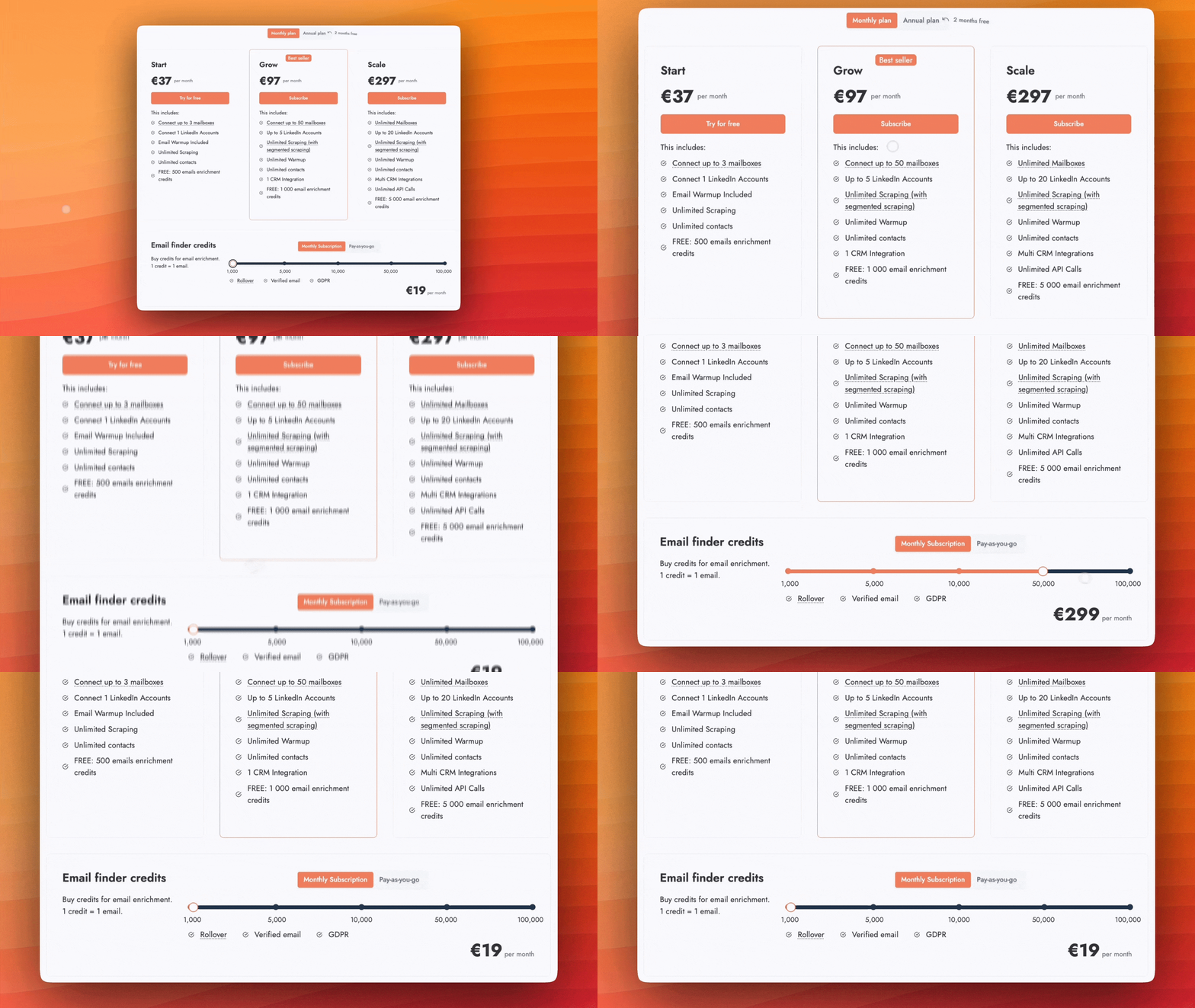
Emelia finds the address, verifies it, then uses it in the campaign, without the file ever leaving the platform. That is the fundamental difference with the pure players on this list: enrichment is not the product, it is the first step of a chain that runs all the way to sending. One credit per address found, a quarter of a credit per verification, fifty credits for a mobile number.
Credits | Monthly subscription, with roll-over |
1,000 | 19 € |
5,000 | 49 € |
10,000 | 99 € |
50,000 | 299 € |
100,000 | 499 € |
The platform subscription starts at 37 € per month and covers sending. Credits are bought separately, either as a monthly subscription with the balance rolling over, or one-off with no expiry. The two lines are independent: credits only serve to find addresses and phone numbers, and every plan already includes an allowance, from 500 on Start to 5,000 on Scale.
The caveat is plain: if all you want is to enrich a file and send it elsewhere, Emelia's appeal narrows and its entry price is beaten by two tools on this list. The saving appears when the two needs meet: a single subscription, and no more exports to stitch back together between two tools.
Emelia, the all-in-one B2B prospecting tool
Cold email + LinkedIn + Email Finder.
Enrow

Enrow is the cheapest in this comparison at entry level, and that is its reason for being. A pure email lookup player that does nothing else, with unit rates shown in black and white on its pricing page, which almost nobody else does. One credit per email found, forty for a phone number, a quarter of a credit per verification.
Plan | Price | Credits | Cost per email |
Start | 17 €/month | 1,000 | 0.015 € |
Pro | 87€/month | 10,000 | 0.0075 € |
Scale | 397 €/month | 50,000 | 0.0072 € |
Custom | from 1,000 €/month | bespoke | on quotation |
Team members are unlimited from the Pro plan up, with no seat fee, and the unused balance rolls over up to three times the plan's volume on monthly billing. The API and the MCP server are included on every plan, the first one included.
Its limit is the exact counterpart of its strength: Enrow only does enrichment. The whole chain upstream, building the list, and downstream, sending and tracking replies, is on you and calls for other tools. The Start plan is also limited to a single user, which reserves it for solo work.
Icypeas

Icypeas plays the volume game and owns it. Its unit rate collapses as the tiers climb, down to less than half a cent per email found, which makes it the most aggressive offer on this list for anyone enriching hundreds of thousands of rows. The French publisher also supplies several white-label prospecting platforms, which explains a price structure cut for high volume.
Plan | Price | Credits | Cost per email |
Basic | $19/month | 1,000 | $0.019 |
Premium | $39/month | 4,000 | $0.00975 |
Advanced | $89/month | 10,000 | $0.0089 |
Hypergrowth | $499/month | 100,000 | $0.00499 |
Credits never expire, including after a downgrade or a cancellation, which brings the subscription close to a prepaid reserve. The tool also scrapes profiles and company records, billed separately.
Two caveats. Email lookup is indeed billed on results, but the domain scan is charged per domain analysed and contact search per row returned, found or not: the pay-on-success principle does not cover the whole product. And the Phone Finder has been announced as coming for a while, with no published price.
Launch your B2B prospecting
Starts at €37/month, no commitment.
Dropcontact
Dropcontact does not just look for an address, it straightens out a record. Salutation, normalised job title, company registration number, detection of company changes, matching a trading name to a domain: the French tool aims at data quality inside a CRM more than at filling a prospecting file. It is a different product from the pure players, and that is what its price reflects.
Credits | Starter | Growth |
500 | 19 €/month | 29 €/month |
1,500 | 39 €/month | 59 €/month |
4,000 | 59 €/month | 89 €/month |
11,000 | 129 €/month | 189 €/month |
22,000 | 249 €/month | 359 €/month |
100,000 | 999 €/month | on quotation |
One point deserves correcting, because many comparisons, including an earlier version of this article, say the opposite: Dropcontact now bills per email found and re-credits unsuccessful searches. The old complaint about systematic charging no longer holds.
That said, the cost per email remains the highest of the French tools on this list at equal volume, and the Growth plan, the only one offering credit roll-over and company data enrichment, costs close to double the Starter. CRM enrichment pricing, for its part, is not published. The detail of credits and billing is in our article on Dropcontact pricing.
Hunter.io

Formerly Email Hunter, created in 2015, Hunter is the elder of the sector and has kept its advantages: a domain index built over ten years, a domain search that returns all known addresses at a company in one go, and a browser extension many sales reps use without even knowing they are using Hunter.
Plan | Monthly price | Annual price | Credits per month |
Free | 0 € | 0 € | 50 |
Starter | 49 € | 34 €/month | 2,000 |
Growth | 149 € | 104 €/month | 10,000 |
Scale | 299 € | 209 €/month | 25,000 |
An email found costs one credit, a verification half a credit, and an unsuccessful search is not charged. Users are unlimited on every plan, the free one included, with a shared credit pool. The free plan at 50 credits a month remains the most generous on the market for testing seriously.
Cost per email is the real caveat: at 0.0245 € on the entry plan, Hunter is close to twice as expensive as the European pure players, and its highest published tier only drops to 0.012 €. Beyond 25,000 credits a month, you have to go through a quotation. The built-in sending platform is also more basic than that of dedicated tools. The detail of tiers and cost per search is in our article on Hunter.io pricing.
Anymailfinder

Anymailfinder bets everything on the reliability of what it returns rather than on the volume found. The tool advertises a 97% deliverability guarantee and re-credits addresses it declared verified that bounce anyway. Its promise is not to find more addresses, it is not to hand you bad ones.
Credits per month | Price | Cost per email |
400 | 26 € | 0.065 € |
1,000 | 39 € | 0.039 € |
5,000 | 129 € | 0.026 € |
10,000 | 179 € | 0.018 € |
50,000 | 449 € | 0.009 € |
100,000 | 719 € | 0.007 € |
A search repeated within thirty days is not charged again, and unused credits roll over without a ceiling as long as the subscription is active. Team members are unlimited, with no seat billing, and 100 credits are given to try it out. Company search returns up to twenty addresses for a single credit, which makes it the best value in this comparison when you target a department rather than a person.
Entry level is by far the most expensive in this comparison, at 0.065 € per email: this grid is only of interest from several thousand credits a month, where it becomes competitive again. The tool also provides no phone numbers at all, and is strictly limited to finding and verifying addresses.
FullEnrich

FullEnrich does not look for the address itself: it queries around twenty providers until one of them answers, then verifies the result before billing it. That is the waterfall principle, and it makes full sense on mobile numbers, a piece of data that cannot be deduced and has to be fetched from whoever collected it.
Credits per month | Price | Cost per credit |
500 | $29 | $0.058 |
1,000 | $55 | $0.055 |
5,000 | $255 | $0.051 |
10,000 | $499 | $0.050 |
50,000 | $1,950 | $0.039 |
100,000 | $3,500 | $0.035 |
A work email costs one credit, a personal email three, a verified mobile ten, and a landline returned in place of a mobile is not charged at all. Users are unlimited on every plan and the balance rolls over for three months.
On email alone, the waterfall does not justify its price, and the publisher shows it itself: its June 2026 benchmark gives 87.1% coverage for a twenty-source waterfall against 86.4% for a single provider, but with 4% false positives against 0.9%. Seven tenths of a point for four times the bounces. The waterfall genuinely wins on mobile, where the databases only overlap by 20 to 30%.
Prospeo

Prospeo is the only one on this list to start from its own database: you search for prospects there with 41 filters before enriching them, where the others wait for you to bring your file. Search and preview are free, the credit is only debited at the moment the address is revealed, and a mobile costs ten.
Plan | Monthly price | Annual price | Credits per month |
Free | $0 | - | 100 |
Starter | $49 per user | $441 per user | 2,000 |
Growth | $99 per user | $888 per user | 5,000 |
Pro | $249 per user | $2,241 per user | 15,000 |
The free plan at 100 credits a month has no time limit, and native HubSpot and Salesforce integrations arrive on the Growth plan. The number of search filters rises with the plan, from 28 on the free one to 41 on the highest, which drives how fine the targeting can be more than the credit volume does.
Two caveats, and the first weighs heavily. Prospeo bills per seat: the headline price is that of one user, and credits are counted per user too, so a four-person team pays four times the amount in the table. Second caveat, credits do not roll over from month to month: the unused balance is reset at every renewal.
Which email finder to choose for your situation
You enrich a file now and then and send from elsewhere. Enrow at the lowest rate in this comparison, or Icypeas if the volume climbs fast. Either way you pay for enrichment and nothing else, which is exactly what you want.
You enrich and you send your campaigns. Emelia, because the chain is not cut between two tools and there is only one subscription to pay. Hunter.io follows the same reasoning with an older index, but at a markedly higher cost per email.
You mostly want mobile numbers. FullEnrich, whose waterfall makes full sense on data that cannot be deduced. Emelia and Enrow supply them too, à la carte, if mobile is only a complement.
Your subject is how clean your CRM is. Dropcontact, the only one that straightens out records and supplies French companies' legal data on top of addresses.
You are starting from a blank page, with no list. Prospeo brings the two steps together in a single product, provided you accept per-seat billing. Otherwise, build the list first, then enrich it with any of the tools above.
You just want to test. Hunter.io gives 50 credits a month with no time limit, Prospeo 100, and Enrow, Icypeas and FullEnrich all give 50 credits on sign-up. Enough to run a sample through each and compare the results on your own contacts, which is worth more than any comparison, this one included.
What to remember
The billing model no longer separates these tools: they all charge per email found. What still compares is the unit cost once brought back to money, how solid verification is on catch-all domains, and the scope of the product.
On pure cost, Enrow and Icypeas are ahead at entry level. On mobile, FullEnrich's waterfall keeps a real lead. On French company data, Dropcontact stands alone on its ground.
Emelia becomes the logical choice when finding the address and writing to it are the same project, and its volume pricing then becomes the lowest in the comparison.
One last reflex, worth more than every table on this page: take a hundred contacts you already know, run them through two or three of these tools, and compare what comes back. The coverage rates publishers announce are measured on their samples, not on your market.
Create your Emelia account
First campaign in 10 minutes.
Email finders FAQ
What is an email finder and how does it work?+
An email finder is a tool that returns a professional email address from a name and a company (or a LinkedIn profile URL). It combines proprietary databases, web scraping, and pattern matching algorithms (like firstname.lastname@company.com) with real-time SMTP verification.
What's the best email finder in 2026?+
Top 3 from 2026 independent tests: Emelia (92% validity rate, hard-to-beat pricing from $19 per 100 credits), Hunter.io (89% validity, the historical leader), Apollo (87%, but data sometimes stale). For France and Europe, Emelia and Dropcontact stand out on freshness.
Are free email finders worth using?+
For 5 to 25 searches per month, yes: Hunter, Snov.io, Skrapp, and Anymailfinder offer honest free tiers, perfect for testing. Beyond that, you'll quickly hit limits (reduced verification rate, no API, less fresh data). For real outreach, plan $20 to $50/month.
What does an email finder typically cost?+
Between $0.01 and $0.15 per email found, depending on volume and plan. Pay-as-you-go credit packs (Emelia, Hunter, Dropcontact) often come out cheaper than per-seat monthly subscriptions. At volume (5,000+/month), expect $0.02 to $0.04 per email.
Is a found email always valid?+
Never 100%. Top tools advertise 90 to 95% validity after SMTP verification. For the remaining 5 to 10%, the address was disabled, the server blocks verification, or the person changed companies. Always pass your lists through a dedicated email verifier before launching a campaign.