
Klenty advertises $50 per month. That entry price is not billed per sales rep but per sending domain, and it unlocks email only. The moment you want the phone, LinkedIn or your CRM, billing switches to a per-seat model and the price changes nature entirely.
One clarification before the numbers. Klenty is a sales engagement platform: it orchestrates multichannel sequences across email, phone, LinkedIn and SMS, and measures what comes out of them. It sells no contact data and surfaces no buying signals. The prospect list is yours to bring.
This article breaks down the official pricing table, what each plan actually unlocks, the real cost per sales rep once the dialer is added, and compares six alternatives whose prices are public.
How much does Klenty cost in 2026? The full pricing table
Klenty publishes three plans, all listed at annual billing rates. The fourth one is negotiated.
Plan | Listed price per month | Billing unit | Annual cost | What it unlocks |
|---|---|---|---|---|
Starter | $50 | Per sending domain | $600 per domain | Email only, 15,000 contacts and 75,000 emails per month |
Growth | $70 | Per user | $840 per seat | Dialer, LinkedIn, SMS, CRM, unlimited contacts, 200 call minutes |
Plus | $99 | Per user | $1,188 per seat | 4,000 credits, 1,000 minutes, conversation AI and coaching |
Enterprise | Custom quote | Per user | Custom quote | Security, governance and dedicated support |
Parallel dialer, optional add-on | $45 | Per user | $540 per seat | Parallel dialer and power dialer, on every plan |
Two things stand out immediately. The listed rates assume an annual commitment: quarterly billing costs roughly 20 percent more. And the parallel dialer, which is the tool's central selling point for a team that calls, is included in no plan at all.
Per-user pricing, the unit that decides everything
This is the structural point, and it deserves a nuance most comparisons skip. From the Growth plan onward, you pay for every sales rep who logs in. On the Starter plan, you pay for a sending domain, no matter how many people use it.
A team that hires watches its bill climb mechanically, at constant sending volume. A team that restructures keeps paying until the annual renewal date, since seats are settled upfront. And a rep who touches the tool three days a week costs exactly the same as a full-time SDR.
This model is not specific to Klenty, it is the norm across the whole sales engagement category. It becomes decisive the moment you compare against tools billed by subscription or by volume, where the third and the tenth user cost nothing extra.
A useful reference point: at $70 per user per month, Klenty lands below a negotiated Salesloft Advanced and well below an Outreach contract under thirty seats. The positioning is coherent, and that is exactly the ground the vendor chooses to compete on. The question is not whether it undercuts the legacy platforms, it does. The question is whether you need a sales engagement platform at all.
$50 per domain at Klenty, €37 all in at Emelia
Cold email, LinkedIn and unlimited warm-up in one subscription, with no annual commitment.
What Klenty delivers for that price
The execution scope is broad, and that is what justifies the positioning.
Multichannel sequences combining email, calls, LinkedIn and SMS in a single scenario
Conditional cadences that adapt the next step to prospect behavior
Built-in dialer with voicemail and auto-attendant detection
SmartLists that prioritize the call queue based on recent engagement
Personalization through merge fields and conditional templates
Sender rotation, custom domain tracking and mailbox warm-up
A/B testing on subject lines and message bodies, with per-step attribution
Native integrations with the major CRMs and two-way sync
On the Plus plan, live transcription, objection detection and call coaching
This is a sales manager's tool as much as an SDR's. That breadth is its strength on the phone, and precisely what makes it expensive for a team that only sends email.
What each plan actually unlocks
The gap between the headline price and the usable price plays out right here.
Feature | Starter | Growth | Plus |
|---|---|---|---|
Email, sequences and A/B testing | Yes | Yes | Yes |
Custom domain tracking | Yes | Yes | Yes |
Contacts per month | 15,000 | Unlimited | Unlimited |
Emails per month | 75,000 | Unlimited | Unlimited |
One-click dialer | No | Yes | Yes |
LinkedIn automation | No | Yes | Yes |
SMS | No | Yes | Yes |
Native CRM integrations | No | Yes | Yes |
Call minutes included | None | 200 | 1,000 |
Enrichment credits | None | None | 4,000 |
Conversation AI, coaching, transcription | No | No | Yes |
The Starter plan is not a stripped-down version of the product, it is a different product with its own billing unit. No dialer, no LinkedIn, no SMS and no CRM leaves a multichannel outreach sequencer with its channels cut off. At $50 per month per domain, with no seat limit, it stays defensible for a team that only sends email from a single domain. The trap is not its price, it is assuming it gives you access to the product Klenty actually sells.
The Starter plan and its email ceiling
The Starter quotas need to be read the right way around. The 15,000 contacts and 75,000 emails per month apply per domain, which is consistent with its billing unit: five SDRs on the same sending domain share the same allowance and pay a single subscription. That is the exact inverse of the Growth model, where each rep pays for a seat but contacts become unlimited.
The plan also enforces a daily cap in the region of 500 emails, which is the real brake on any volume campaign. Past that point, moving up to Growth is not a comfort upgrade, it is a technical necessity.
That ceiling is not abnormal in itself: sending more than a few hundred messages a day from a single domain is inadvisable anyway. The issue lies elsewhere. A tool that bills per seat and caps sending globally charges twice for the same constraint, once per sales rep and once by volume, when cold email logic says you should pay for sending capacity and nothing else.
The dialer, the add-on that resets the reference price
The one-click dialer is included from the Growth plan onward. The parallel dialer, the one that dials several numbers simultaneously and takes an SDR from thirty to a hundred calls a day, is sold at $45 per user per month on top.
For a team that calls, the reference price is therefore not $70 but $115, and not $99 but $144 on the Plus plan. That is a 45 percent gap on the listed rate, and it is the first line to check on any quote.
Call minutes deserve the same scrutiny. The 200 minutes on Growth amount to roughly three hours on the phone, or one to two days of intensive prospecting, and the Plus plan takes it to 1,000 minutes. Two details the vendor does not print in large type: those credits cover calls to the United States and Canada, with other destinations billed separately, and the pricing page does not specify whether they are allocated per seat or per account. For a European team calling within Europe, those included minutes cover close to nothing: budget that line separately with a sales rep on their side.
Native LinkedIn and unlimited warm-up, no boxes to tick
Sales Navigator scraping included, from the very first plan.
The Plus plan enrichment credits
The Plus plan includes 4,000 credits usable for finding email addresses and phone numbers. Take the word convenience literally here: this is not a data layer, it is a top-up. Klenty owns no contact database, those credits are resold by third-party providers, and nothing tells you which ones or at what match rate.
The order of magnitude settles the debate. 4,000 credits amount to a few thousand addresses at best, once a month, for an entire team. Any organization prospecting seriously burns through that in a week and will have to buy its data elsewhere regardless. So these credits replace neither a database nor a dedicated enrichment tool: they save you from opening one in month one, nothing more.
The real budget for a sales team
Here is what Klenty costs per year, excluding the parallel dialer, by team size.
Team size | Growth | Plus |
|---|---|---|
3 sales reps | $2,520 | $3,564 |
5 sales reps | $4,200 | $5,940 |
10 sales reps | $8,400 | $11,880 |
25 sales reps | $21,000 | $29,700 |
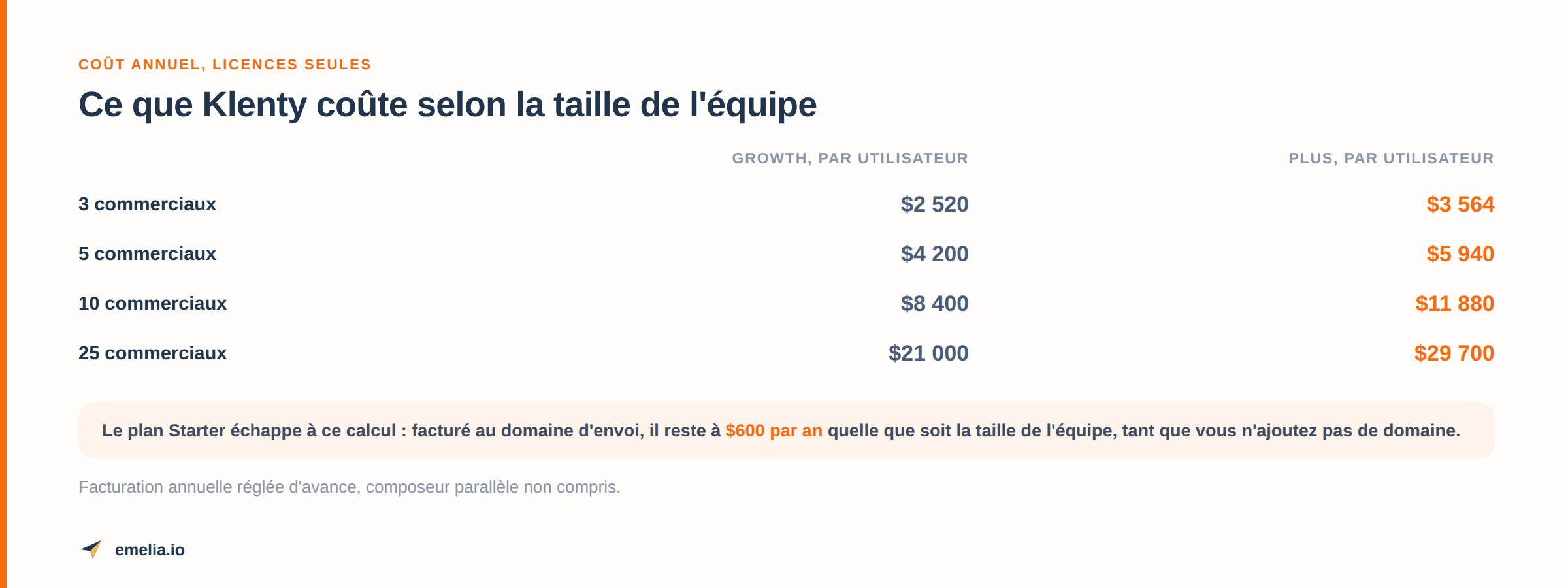
The progression is perfectly linear, which is both the strength and the flaw of the model. No nasty surprises, but no volume effect either: the twenty-fifth rep costs exactly what the first one did. The Starter plan escapes that rule, since it stays at $600 per year as long as you add no sending domain, whatever the size of the team.
The real cost per sales rep once the dialer is added
This is the number to remember for any team doing phone work.
Setup | Per user per month | Per user per year | For 10 sales reps |
|---|---|---|---|
Growth alone | $70 | $840 | $8,400 |
Growth with parallel dialer | $115 | $1,380 | $13,800 |
Plus alone | $99 | $1,188 | $11,880 |
Plus with parallel dialer | $144 | $1,728 | $17,280 |
A ten-person sales team on the Plus plan with the parallel dialer therefore pays $17,280 a year, settled upfront. That is the entry budget for a Salesloft contract, for a tool positioned as the affordable alternative to Salesloft.
Is there a minimum seat count at Klenty
No minimum is published, and the rates are available from a single seat. That is a genuine differentiator against the legacy platforms, where the master agreement often imposes three to five seats. On the Starter plan the question does not even arise, since billing is tied to the domain rather than to seats.
In practice, the question comes up fast. If a single person runs the prospecting, a capacity-based subscription covers the same email and LinkedIn scope for a third of the price of one seat. Per-user pricing only starts making sense once every sales rep genuinely spends their day inside the tool, phone included.
The annual commitment: what it changes
Every listed price assumes an annual payment. Switching to quarterly costs roughly 20 percent more, which puts the Growth plan around $84 per user per month.
The annual commitment carries the usual trade-off for this category: it is paid upfront and cannot be reduced mid-term. You can add seats at any time, prorated. You cannot remove any before renewal.
The free trial, on the other hand, is fair: 14 days, no credit card, full feature access and a cap of 200 test emails.
The full cost of one prospecting seat
The Klenty license is not the price of the workstation. Here is what a fully equipped sales rep actually costs, on an annual basis, for a team of five.
Line item | Annual cost for 5 sales reps |
|---|---|
Klenty Plus, 5 seats | $5,940 |
Parallel dialer, 5 seats | $2,700 |
LinkedIn Sales Navigator, 5 seats | roughly $6,000 |
Contact data source | $3,000 to $9,000 |
CRM, share attributable to prospecting | $3,000 to $6,000 |
Annual total | $20,640 to $29,640 |
The sequencing tool accounts for less than a third of the bill. That is why comparing two sequencers is never decided on listed price alone: what matters is what each one makes unnecessary everywhere else.
What users criticize about Klenty
Public feedback converges on three points, and none of them are about features.
The first is billing. Charges after cancellation and difficulty getting a support response on disputes come up repeatedly in 2025 and 2026 reviews. On an annual contract paid upfront, that is the topic to pin down in writing before signing.
The second is the learning curve. Several users report having to go back to the documentation to reconfigure a sequence, a sign of an interface denser than the category average.
The third is per-user pricing, judged expensive as soon as the team passes ten people, especially since the most differentiating features are sold as add-ons.
On the flip side, feedback is solidly positive on two points: dialer reliability, parallel mode included, and the quality of per-step sequence reporting. Those are the two reasons teams stay with Klenty despite the billing model.
Klenty limitations to know before signing
No monthly price, every listed rate assumes an annual commitment paid upfront
The parallel dialer is a $45 per user per month add-on, never included
The Starter plan unlocks no LinkedIn, no SMS, no dialer and no native CRM integration
Starter is billed per domain with shared quotas, and moving to Growth flips the bill to per seat
No native contact database, data still has to be bought elsewhere
No buying signals, no funding rounds, no hiring data, no technology changes
Included call minutes cover the United States and Canada, other destinations are billed on top
Prices are in dollars, so a European team carries the currency risk
Who Klenty pays off for, and who it does not
Klenty makes sense for a team of five to twenty sales reps whose primary channel is the phone, with a CRM already in place and a genuine need for call coaching. At that level, the ratio between conversation features and price stays better than at the legacy sales engagement platforms.
It does not make sense in three cases. If your prospecting runs on email first, you are paying for a dialer you will never open. If a single person runs the prospecting for the team, per-seat pricing costs more than a capacity-based subscription. And if you have no data source yet, Klenty solves only half the problem.
The most common trap is the team that buys the Starter plan thinking they are testing the tool, discovers it only does email, and ends up negotiating an upgrade to Growth three weeks after signing an annual commitment.
Six Klenty alternatives and their prices
Every alternative listed here belongs to the same family: these are sequence execution tools, not databases. The dividing line runs between those that bill per seat and those that bill by subscription or by volume.
Salesloft
Salesloft is the legacy platform of the category, sold to sales leadership with call analysis, deal tracking and revenue forecasting. No price is published.
Salesloft pricing
Essentials: $75 to $100 per user per month at list, $60 to $85 negotiated
Advanced: $125 to $150 at list, $100 to $130 negotiated
Premier: $165 to $200 and up at list, $130 to $170 negotiated
Annual commitment mandatory, paid upfront
Contract clauses and onboarding costs are covered in detail in our Salesloft pricing breakdown.
Outreach.io

Outreach is Salesloft's head-on competitor, on the same revenue platform positioning sold to large accounts. Quote-based pricing as well.
Outreach.io pricing
1 to 29 seats: $1,154 to $1,344 per user per year, or $96 to $112 per month
30 to 99 seats: $1,020 to $1,236 per year, or $85 to $103 per month
100 to 199 seats: $920 to $1,116 per year
250 seats and up: $756 to $910 per year, or $63 to $76 per month
Reply.io

Reply.io covers email, LinkedIn and phone inside a single sequence, with an AI agent sold separately.
Reply.io pricing
Email Volume: from $59 per month, $49 annually, per user and per contact tier
Multichannel: $99 per user per month, $89 annually
Agency: roughly $166 to $210 per month depending on the number of workspaces
AI SDR: from $500 per month
The split by channel and by tier is explained in our Reply.io pricing breakdown.
Lemlist

Lemlist is the best-known European multichannel alternative, with a built-in lead database and warm-up included.
Lemlist pricing
Email Pro: roughly $59 per user per month annually, $79 monthly
Multichannel Expert: roughly $87 annually, $109 monthly
Outreach Scale: from $159 per month, quote-based annually
For five people, the Multichannel plan lands between $435 and $545 per month
The full per-user math is in our Lemlist pricing breakdown.
Woodpecker

Woodpecker applies a radically different model: the bill depends on the number of prospects contacted, not on the number of sales reps.
Woodpecker pricing
500 prospects contacted per month: €35 monthly, €23 annually
2,000 prospects: €67 monthly, €45 annually
10,000 prospects: €188 monthly, €125 annually
40,000 prospects: €587 monthly, €391 annually
The cost per 100 contacts drops from €7 to under €1.50 with volume, as detailed in our Woodpecker pricing breakdown.
Smartlead

Smartlead is the reference tool for high-volume cold email, with unlimited mailboxes and sender rotation.
Smartlead pricing
Basic: $39 per month, 2,000 active contacts and 6,000 emails
Pro: $94 per month, 30,000 contacts and 150,000 emails
Unlimited Smart: $174 per month, unlimited contacts
Unlimited Prime: $379 per month, 510,000 emails
The volume against price comparison is detailed in our Smartlead pricing breakdown.
Entry pricing compared
Tool | Billing unit | Entry ticket | Public pricing |
|---|---|---|---|
Klenty | Per domain on Starter, per user after that | $50 per month per domain on Starter, $70 per user after that | Yes |
Salesloft | Per named user | $60 to $85 per user per month, negotiated | No |
Outreach.io | Per named user | $96 to $112 per user per month | No |
Reply.io | Per user and per tier | $49 per user per month annually | Yes |
Lemlist | Per user | Roughly $59 per user per month annually | Yes |
Woodpecker | Per prospect contacted | €23 per month annually | Yes |
Smartlead | Per subscription | $39 per month | Yes |
Emelia | Per subscription | €37 per month | Yes |
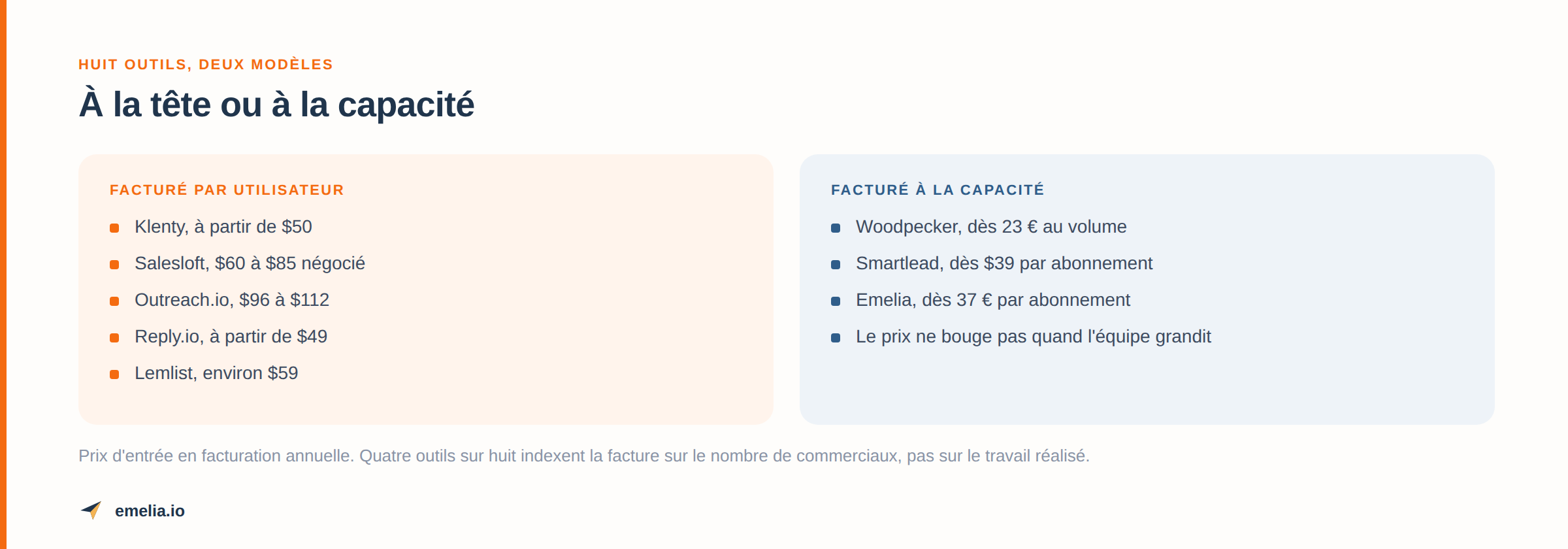
The picture gets sharp once the billing unit is put in its own column. Of eight tools, four bill per head: their invoice tracks the number of sales reps who log in, not the work produced. The other four bill for capacity: the price follows the number of connected mailboxes and LinkedIn accounts, not the number of people.
Unlimited contacts, emails and LinkedIn actions
No monthly quota to watch, no contact tier to buy back. From €37 per month.
Emelia vs Klenty: what actually compares
The shared scope is real: sending multichannel sequences and tracking what they produce. The difference lies in what gets counted.
Criterion | Klenty | Emelia |
|---|---|---|
Billing unit | Per domain on Starter, per named user after that | Per subscription, capacity in mailboxes and LinkedIn accounts |
Entry ticket per month | $50 per domain on Starter, $70 per user on Growth | €37 |
Commitment | Annual, paid upfront | Monthly, no commitment |
Contacts and emails | Capped on Starter, per domain | Unlimited across the range |
Included | Unlimited, included from the first plan | |
LinkedIn automation | From the Growth plan | Native, from the first plan |
Sales Navigator scraper | No | Included |
Email finder and phone lookup | 4,000 credits on the Plus plan, from third-party providers | Built in, charged on success only |
Phone and dialer | Yes, $45 add-on for parallel mode | No |
Call coaching AI | On the Plus plan | No |
The structural difference fits in one sentence: Klenty bills every sales rep who logs in, Emelia bills sending capacity. Do not draw the opposite conclusion: Emelia has no team mode, one subscription is one user account. The model works when one person runs the prospecting on behalf of several reps, not when each of them logs in separately.
Emelia pricing
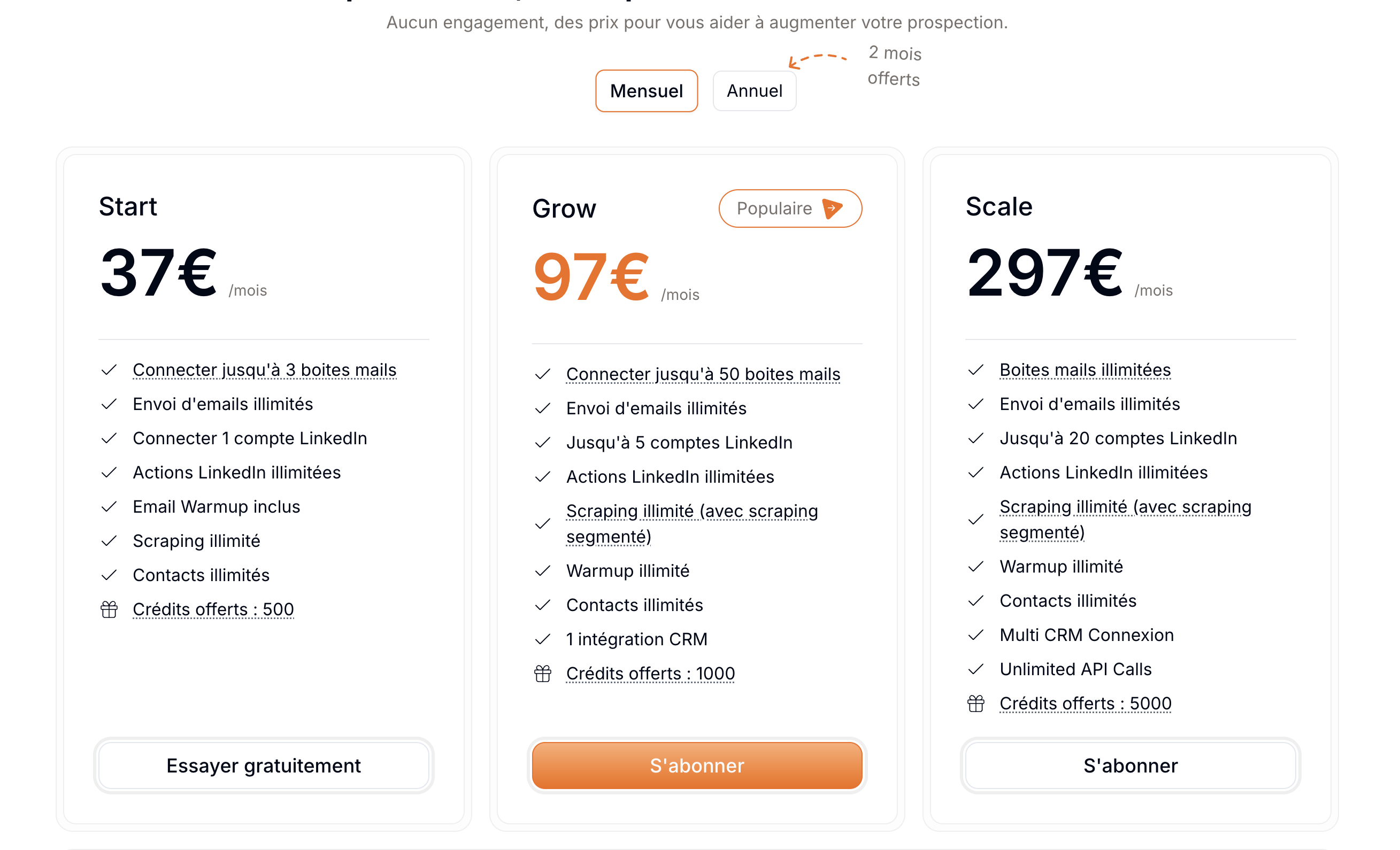
Emelia publishes its rates, in three tiers at €37, €97 and €297 per month, with no commitment and two months free on annual billing.
The Start plan opens 3 sending mailboxes and 1 LinkedIn account
The Grow plan 50 mailboxes and 3 LinkedIn accounts
The Scale plan unlimited mailboxes and 10 LinkedIn accounts
Contacts, emails, LinkedIn actions and scraping are unlimited across the range, and warm-up is included from the first tier.
Email lookup and phone lookup credits top up on demand, from €19 per 1,000 credits, and are only deducted when a data point is actually found.
For a team of five sales reps prospecting by email and LinkedIn, the annual gap against a Klenty Growth plan equipped with the dialer runs to roughly a factor of ten.
Data credits are only charged on success
Email finder and phone lookup included, from €19 per 1,000 credits.
How to bring your Klenty bill down
If your need stops at email, stay on Starter: billed per domain, it costs no more for five sales reps than for one
Count the Growth or Plus seats genuinely in use, not the accounts opened: every dormant seat costs $840 to $1,188 a year
Buy the parallel dialer only for the profiles who call every day, it is priced per user
Get calls outside the United States and Canada quoted before signing, the included minutes do not cover them
Negotiate onboarding and training inside the overall price, not as a separate engagement
Get a renewal increase cap written into the contract, no standard clause provides one
Pull email and phone lookup out of the Plus plan if a dedicated tool does it cheaper on a success basis
Line up the annual renewal date with your hiring cycle, so you do not pay for seats before the reps arrive
Is Klenty worth paying for in 2026?
Yes, if the phone is your primary channel. A team of five to twenty sales reps who spend their days calling will find a better feature-to-price ratio at Klenty than at Salesloft or Outreach, with decent call coaching and a parallel dialer that holds up under load.
No, if you prospect through cold email and LinkedIn first. You would be paying $70 to $144 per sales rep per month for a scope that subscription-billed tools cover from $39, with no annual commitment paid upfront.
There is also a grey zone, the mixed teams that do a bit of everything. The instinct there is to buy the most complete platform, on the assumption it will cover every case. That is almost always the most expensive and least used option: you pay for the phone for everyone when two people actually call, and you pay for data inside a top-tier plan when a dedicated tool finds it on success.
Before signing, one question really settles it: how many of your sales reps will genuinely pick up the phone every day. That number, not the advertised $50, decides whether Klenty is an investment or a cost line.
Frequently asked questions about Klenty pricing
How much does Klenty cost per month in 2026?+
The Starter plan is listed at $50 per month, billed per sending domain rather than per user. The Growth plan is $70 per user per month and the Plus plan $99, both on annual billing. The Enterprise plan is negotiated. The parallel dialer is an add-on at $45 per user per month, and it is not included in any plan.
Is Klenty billed per user or per domain?+
Both, depending on the plan. Starter is billed per sending domain: five reps working on the same domain pay a single subscription and share the 15,000 contacts and 75,000 emails per month. From the Growth plan on, billing switches to seats: every connected rep costs $70 or $99 per month. That is the point that changes the whole calculation for a small team.
Does Klenty offer monthly billing?+
The listed prices all assume an annual commitment, paid upfront. Quarterly billing exists, around 20 percent more expensive, which puts the Growth plan at about $84 per user per month. There is no month-to-month option without a commitment.
Is there a minimum number of seats at Klenty?+
No, no minimum is published and the pricing is available from a single seat. That is an advantage over legacy platforms, where the contract often requires three to five seats. On the Starter plan the question does not come up, since billing is based on the domain and not on seats.
What exactly does Klenty's Starter plan include?+
Email only: sequences, A/B tests, personalization, custom domain tracking, 15,000 contacts and 75,000 emails per month per domain, with a daily limit of around 500 emails. It unlocks neither the dialer, nor LinkedIn, nor SMS, nor the native CRM integrations.
Do Klenty's call minutes cover international calls?+
No. The Growth plan includes 200 minutes and the Plus plan 1,000 minutes, but those credits cover calls to the United States and Canada. Other destinations are billed on top, and the pricing page does not say whether the allowance is per seat or per account. For a European team calling within Europe, that is a line item to price separately with a sales rep.
Is the dialer included in Klenty's plans?+
The one-click dialer is included from the Growth plan on. The parallel dialer and the power dialer, however, are an add-on billed at $45 per user per month on every plan. For a team that calls, the reference price is therefore $115 on Growth and $144 on Plus.
Does Klenty include a contact database?+
No. Klenty is a sales engagement platform: it runs and measures sequences, it does not sell data. The Plus plan includes 4,000 credits usable to look up addresses and phone numbers through third-party providers, but that is a top-up, not a data layer: 4,000 credits represent at best a few thousand addresses per month for an entire team.
How much does Klenty cost for a team of ten reps?+
$8,400 per year on Growth and $11,880 on Plus, seats only. Adding the parallel dialer takes the Growth plan to $13,800 and the Plus plan to $17,280 per year, paid upfront. On the Starter plan, the same team pays $600 per year as long as it sends from a single domain.
What are the cheapest alternatives to Klenty?+
On the same sequence execution scope, Smartlead starts at $39 per month for a full subscription and Woodpecker at €23 per month on annual billing, both billed by capacity rather than by seat. Reply.io starts at $49 per user per month on annual billing, Lemlist around $59. To cover email and LinkedIn with no commitment, Emelia starts at €37 per month.