What Seamless.AI actually is

Before talking money, you need to know what you are buying. Seamless.AI does not do the same job as the databases it gets compared to, and the way it bills follows directly from that product choice.
Transparency. This article is published by the company behind Emelia and Basile, two of the tools mentioned below. The pricing tables of the other vendors were taken from their official pages, and the calculations are shown so you can redo them.
How it works day to day
The daily entry point is the web app, not the extension. You start by declaring the list the contacts will land in, then you stack filters: job title, seniority, department, industry, headcount, revenue, location, technologies used, recent job changes, keywords. The search returns previews where you only see the name, the title and the company. The contact details stay hidden.
The central action comes next. You click "Find" next to a contact, and that click is what assembles the full record, emails, mobile and direct line, consuming one credit. A "Find All" button runs the same operation on the whole page while you keep working. So you are paying for a search, not for a row in a file. Remember that, it is the key to everything that follows on price.
The Chrome extension is the second action, and a more occasional one. It shows a sidebar on the page you are viewing, mostly on LinkedIn, Sales Navigator and Recruiter, and lets you add to a list, push to the CRM or run an enrichment without going back into the app.
The real-time engine, and what to make of it
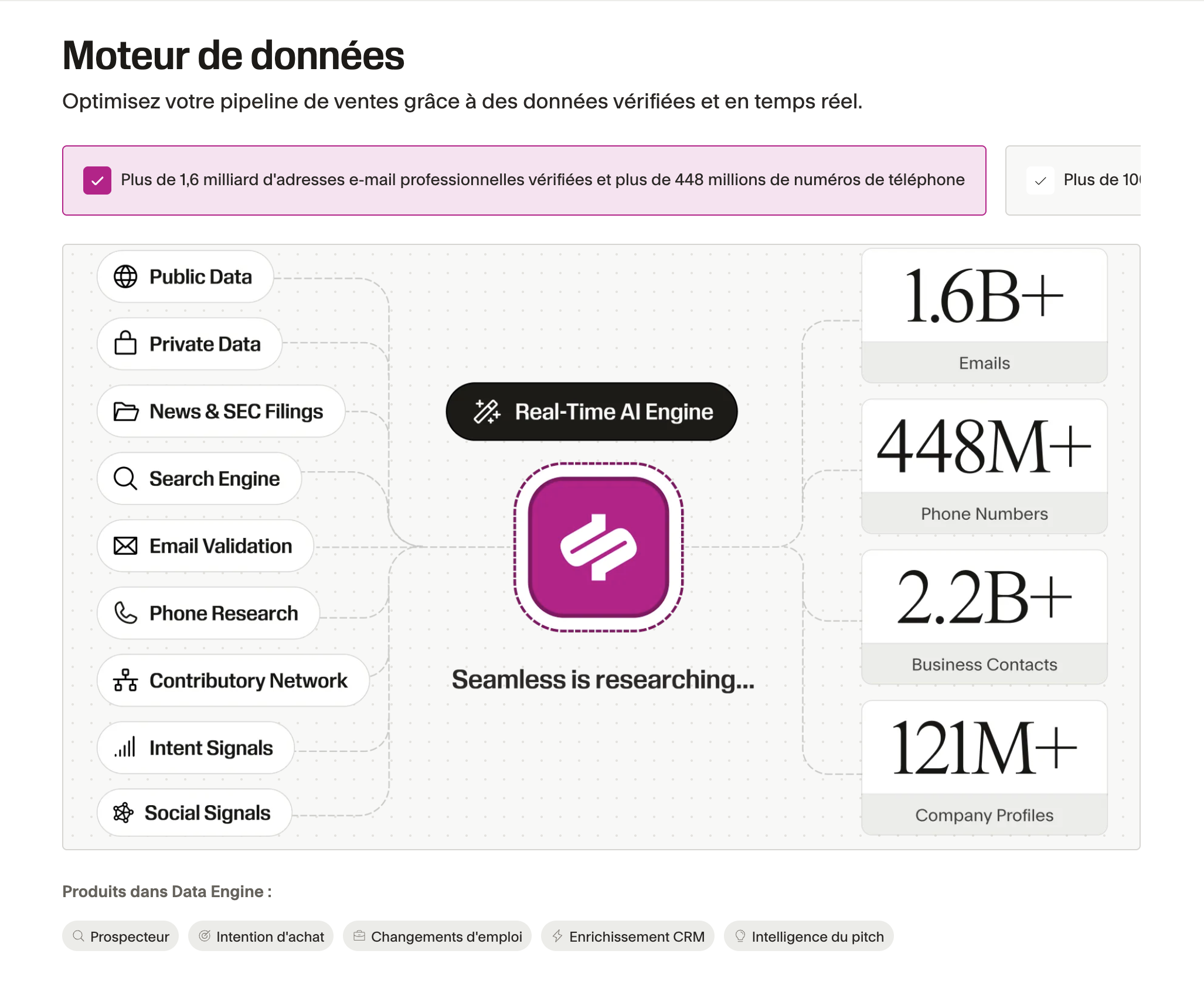
This is the angle the vendor pushes everywhere: a "real-time search engine" that assembles the record at the moment of the request, rather than a database built in advance which, it writes, "can quickly get stale and outdated". Its FAQ states that the platform retrieves information "based on various pings including digital foot-printing". The phrase is defined nowhere, and no data source is named.
Three things temper the promise. First, the vendor does display stock volumes anyway, and not the same ones depending on the page: 1.8 billion verified emails on the homepage, 1.6 billion on the Email Finder page, 1.8 million on the Platform Overview page. Second, LinkedIn removed the Seamless.AI company page on March 6, 2025 for data scraping, at the same time as those of Apollo, LGM and Evaboot, which cut off one of the extension's supply lines. Finally, some of the addresses are inferred rather than confirmed, and nothing in the interface tells the two apart before the credit is spent.
The vendor does, however, publish a useful and rarely imitated indicator: Total AI, a score from 0 to 100 assigned to each address, calculated on deliverability verification, the match between the name and the company, the frequency of the address pattern and the credibility of the source. Four tiers are published, and the vendor itself recommends not going below 70. That is the setting to adjust before any campaign.
What the platform contains
Module | What it contains |
|---|---|
Data Engine | Prospector, the filter-based search. Buyer Intent, the buying signals, at the account level and not the contact level. Job Changes, a filter on recent job changes. CRM Enrich, database enrichment with a log and a rollback. Pitch Intelligence, which surfaces news, hiring and tech stack. |
Engagement Hub | Connect: email sending, calls through Twilio, task management, social copywriting help, open and reply tracking. |
Automation Network | Autopilot, which runs a saved search in the background. An AI writing assistant. An API. An MCP server with 54 tools, compatible with Claude, ChatGPT and Cursor. |
Browser | A Chrome extension, used mostly on LinkedIn, Sales Navigator and Recruiter. |
On the data side, you get the work email, the mobile, the direct line, company data, technologies used, job changes and account-level intent data. The personal email is never advertised: the product is strictly B2B. The vendor claims 1.3 billion contacts and 121 million companies. On integrations, the "6,000 tools" advertised correspond to the Zapier catalog; around twenty connectors are named, including Salesforce, HubSpot, Pipedrive, Outreach and Salesloft, without the vendor specifying which ones are native and which ones go through Zapier.
What Seamless.AI does not do
This list matters as much as the previous one, because it determines the tools you will have to add alongside it, and therefore the real budget.
No email warmup for sending addresses. The Emailing page does say "warm your inbox safely", but no mechanism is described: no gradual ramp-up, no exchange network. It is a good starting practice, not a feature.
No deliverability or blacklist monitoring. There is validation upstream and open tracking downstream, which is not the same thing.
No LinkedIn automation. The Social Selling module writes the messages, it does not send them.
No verification of a list you bring in. You cannot have your own address file cleaned: verification is built into the search flow.
Coverage designed for the United States. Outside the US market, reviews report switchboards rather than direct lines, and no phone verification is documented.
What the data is worth, according to the people who use it
The overall rating is good: 4.4 out of 5 across roughly 5,300 reviews on G2, 4.5 out of 5 across 571 reviews on Capterra. But G2 also counts the complaints, and the ranking speaks for itself: inaccurate data is cited in 410 reviews, outdated contacts in 295, outdated information in 285. On G2's rated criteria, Seamless.AI comes last in its peer group on contact accuracy, while beating ZoomInfo and Cognism on data availability. Volume and coverage, then, rather than precision.
A word of warning about the rates that circulate. The "20 to 30% bounce rate" repeated in most comparisons traces back to a single isolated customer review on G2, not to a measurement. No independent, reproducible test exists on this product: the only quantified protocols we could find are published by competing vendors, who rank first in their own comparison. So we quote no accuracy rate at all, neither the vendor's nor its rivals'.
One last point for a European reader, often misreported: the Seamless.AI privacy policy does mention the GDPR and does name a representative in the Union, contrary to what some competing comparisons claim. The sensitive point lies elsewhere, in the opacity around where the data actually comes from, which is precisely the subject of this article.
Who is behind it
Seamless Contacts, LLC, founded by Brandon Bornancin, based in the Columbus area, in Ohio. A private, unlisted company with a few hundred employees. Even the founding year is unstable depending on the source: 2015 for the local economic development agency, 2018 for some directories, not published on Crunchbase. The vendor mentions it nowhere.
That leaves the question of price. And this is where the exercise becomes unusual.
The Seamless.AI pricing page weighs 231 kilobytes and does not contain a single amount. Not one dollar, not one euro, nowhere. Yet it is titled "Perfect Pricing for Startups to the Fortune 500", and its FAQ states that "the prices displayed on this page reflect the annual discount".
There is no price displayed on that page.
That is the starting point of this article, and it changes the method. When a vendor publishes nothing, you cannot compare pricing tables: you read what it writes elsewhere. So we went through two documents that Seamless.AI does publish, its pricing page and its terms of service, as recorded on August 31, 2026. The second is a contractual document, and it is far more talkative than the first.
What we learn there fits in one sentence: all subscriptions are annual, they renew automatically for twelve months, and they must be cancelled no later than 60 days before the renewal date.
The three plans, and what the vendor says about them
The page presents three tiers. Only one carries a number.
Free | Pro | Enterprise | |
|---|---|---|---|
Price | $0 | Contact sales | Contact sales |
Users | 1 | Per user | Unlimited |
Credits | 50 | 10,000 per year to start | Daily allocation, starting at 5 seats |
Exports | - | Unlimited | Unlimited |
Credit packages | - | Annual | Custom |
Customer Success | No | No | Yes |
Enterprise support | No | No | Yes |
The 10,000 annual credits of the Pro plan and the 5-seat threshold of the custom plan do not come from the pricing table: they are written into the answer to the "do credits expire?" question in the FAQ. That is the only quantified figure the vendor publishes about its paid offers.
Note too that the question actually asked, credit expiration, never gets an answer. The text moves straight on to volumes without saying whether an unused credit survives the end of the period.
The Seamless.AI credit: one whole contact, 10,000 per year
On the definition of the credit, by contrast, the vendor is clear, and the model is rather favorable.
A credit is consumed when Seamless.AI searches for a contact to find their emails, their phone numbers and their information. The Pro plan card sums it up even more simply: 1 credit = phone + email.
In other words, you are not paying for the data but for the contact, and the mobile costs nothing more than the address. It is the same principle as at UpLead, and it is clearly more advantageous than models that count the email and the number separately.
So the problem is not the credit, it is its volume. Ten thousand credits a year is 833 contacts a month. For a rep prospecting five days a week, that comes to around forty contacts per working day. It is a decent pace for qualified phone outreach, and well short of enough for volume.
And because this quota is annual rather than monthly, an intense month is paid for over the following ones. Whether unused credits roll over from one year to the next has no public answer at all.
833 contacts a month runs out fast
At Emelia, 19 € buys 1,000 credits, and you top up whenever you want without going back through a sales rep.
What the terms of service say: the subscription is annual, period
This is where the article becomes useful, because the Seamless.AI terms of service say everything the pricing page leaves unsaid. The key passage is in section 6, on subscription fees.
"All subscriptions to the Services are annual", with monthly or annual billing. The distinction matters and is often misunderstood: paying every month does not mean committing for one month. You are committed for twelve months either way, only the payment cadence changes.
"Payment is due in advance at the start of each billing cycle."
"Except as expressly provided otherwise, all sales are final as soon as you choose to take out a subscription."
So there is neither a refundable paid trial nor a contractual cooling-off period. The only way to evaluate the product risk-free is the free plan and its 50 credits.
The 60-day notice period, the costliest clause in the contract
Here is the clause to remember before all the others, quoted in its exact mechanism.
If you want to cancel your subscription, you must make the corresponding change in the Seamless.AI platform no later than 60 days before the renewal date of the annual contract. If the subscription is neither modified nor cancelled more than 60 days before renewal, the annual contract renews automatically for another 12 months.
Let us put that in practical terms. On a contract signed on March 1, your exit window closes on December 31. Past that date, you are committed until March 1 of the following year, then for twelve months more.
That means you have to decide not to continue before you have even lived through the last two months of your contract. A 60-day notice period on a 12-month commitment is among the longest on the B2B data market, where 30 days is already considered strict.
The operational consequence is simple, and it is the most concrete piece of advice in this article: the day you sign, set a reminder in your calendar 75 days before the anniversary date. Not 60, so you leave yourself time to act.
No notice period, no auto renewal
You cancel Emelia from your account, and the plan stays active until the end of the period you already paid for.
The other financial clauses to know about
The same section of the terms of service contains three other provisions that weigh on the budget.
Prices can change along the way. The text provides that Seamless.AI may modify subscription fees by giving you notice, and that the price change takes effect immediately. Continuing to use the service counts as acceptance. A twelve-month commitment therefore does not necessarily lock in your rate.
Optional purchases are non-refundable. The "Opt-in Purchases", meaning add-on purchases, are explicitly non-refundable, and the vendor reserves the right to change their prices at any time.
A refund if the vendor terminates is optional. If Seamless.AI ends the service for a reason other than a fault on your part, it "may" grant you a prorated refund of the amounts already paid. The verb used expresses an option, not an obligation.
Two non-financial clauses are worth flagging as well. The terms include a mandatory arbitration clause together with a class action waiver, highlighted in capitals right in the header. And they can be updated without notice, with changes taking effect as soon as they are published.
The four options that are not in the price
The feature table is identical across the three plans, with one difference: four modules appear there with an "Add-on" label, meaning at extra cost, whatever your plan.
Option billed on top | What it covers |
|---|---|
Data Enrichment | Completing records, fighting data decay |
Buyer Intent Data | Identifying prospects in a buying cycle |
AI Assistant | Assisted message writing |
Autopilot | Automatic workflow execution |
This is structural information that the sales presentation glosses over. Data enrichment, which many consider the core of a tool of this kind, is not included in the base subscription. Neither is intent data.
None of these four add-ons has a public price. A Seamless.AI quote that does not explicitly include these lines therefore does not cover these functions, and you need to have them priced separately before comparing anything at all.
One positive point, on the other hand, and the vendor confirms it in its FAQ: there are no setup fees. That is worth underlining, because several platforms in this sector charge a mandatory four-figure onboarding package.
What it really costs: what can be said, and what cannot
Let us be methodical, because this is precisely the subject of this article.
What is certain, because the vendor writes it: the free plan gives 50 credits for one user. The Pro plan starts at 10,000 annual credits and is billed per user. The custom plan starts at 5 seats. One credit gives the email and the phone. There are no setup fees. The commitment is annual with automatic renewal and a 60-day notice period.
What is not certain, because nobody official publishes it: the price. No amount exists on the Seamless.AI site, neither on its pricing page nor anywhere else.
What circulates, and should be taken for what it is: software comparison and purchasing benchmark platforms publish ranges drawn from their customers' actual contracts. They put the Pro plan at several thousand dollars a year for five seats, and Enterprise contracts at several tens of thousands of dollars a year. One purchasing benchmark platform puts the average contract value at around $18,000 a year.
These figures do not come from the vendor. They are orders of magnitude reconstructed by third parties, from samples whose size and composition cannot be verified. So we are not putting them in a table, because a table would give them an authority they do not have. They are enough to hold on to one thing: this is not a product at a few tens of dollars a month, and the real entry ticket is negotiated.
The only solid calculation you can make is the cost per contact, once you have the quote in hand: divide the annual amount by the number of annual credits in the contract. Since one credit gives the email and the mobile, that ratio is directly comparable to the rates of the competitors who publish theirs, and it is the only figure that lets you decide.
A price you can work out before signing
37 € per month and 19 € for 1,000 credits. It is all on the pricing page, with no quote to request.
Eight alternatives that publish their prices
The eight tools that follow do not all have the same scope, and that is not what brings them together. What they have in common is a pricing table you can consult online, with no form and no sales call. That is the only ground on which a quantified comparison remains possible, and it is also what makes them usable reference points when you are facing a quote.
Comparing displayed prices makes no sense, however, when the units differ. A credit is worth a whole contact here, an address there, a tenth of a phone number elsewhere. So we set a single scope and price each tool on it, in three columns rather than one: the cost of a verified work email alone, that of a direct dial alone, and that of a full contact combining the two. Each tool is taken at its cheapest plan that allows regular use, brought back to a single user.
Tool | Plan selected | Email only | Direct dial only | Full contact |
|---|---|---|---|---|
Seamless.AI | Pro, price not published, 10,000 credits / year | Cannot be calculated | Cannot be calculated | Cannot be calculated, 1 credit |
Emelia | Start 37 € / month + 19 € pack for 1,000 credits | 0,019 € (1 credit) | 0,95 € (50 credits) | 0,97 € (51 credits) |
Apollo | Basic annual, $49 / seat, 30,000 credits / year | Credit varies with the data | Higher credit cost on the mobile | Variable |
RocketReach | Pro annual, $52 / month, 3,600 exports / year | Included in the export | Included in the export | $0.17 |
UpLead | Plus annual, $149 / month, 400 contacts / month | Not sold separately | Not sold separately | $0.37 |
Lusha | Starter, $49.90 / month, 400 credits | $0.125 (1 credit) | $1.25 (10 credits) | $1.38 (11 credits) |
Kaspr | Starter annual, 45 € / user, 100 numbers / month | Unlimited, tends toward 0 at volume | about 0,45 € | about 0,45 € |
GetProspect | Growth 5k annual, about $69 / month, 5,000 emails / month | about $0.014 | Add-on, 300 credits for $49 | about $0.18 |
Dropcontact | Starter, 79 € / month, 500 credits at the bottom of the slider | 0,158 € (1 credit) | Not offered | Not offered |
Prices recorded on the vendors' official pages on August 31, 2026, in their billing currency and without conversion: amounts in dollars and in euros are therefore not directly comparable. The Seamless.AI row is empty by construction, for lack of a public pricing table.
Two readings stand out. On the full contact, RocketReach at $0.17 and UpLead at $0.37 are the two public benchmarks on the market, since they sell the same unit: a record with the email and the mobile. On the email alone, GetProspect at about $0.014, Emelia at 0,019 € and Kaspr with its unlimited option are playing a different game, and nobody has any interest in paying for a full contact only to use the address.
What the price does not buy in the same way
| Searchable database | Email warmup | Sequence sending | Phone | Commitment |
|---|---|---|---|---|---|
Seamless.AI | Yes, real-time engine | No | No | Included in the credit | Annual, 60-day notice period |
Emelia | No, Sales Navigator scraping | Yes, unlimited on all three plans | Yes, unlimited | 50 credits per number | Monthly, cancellable from the account |
Apollo | Yes | Yes, deliverability and email warmup on the paid plans | Yes | Higher credit cost | Monthly or discounted annual |
RocketReach | Yes | No | No | From the Pro plan up | Monthly or discounted annual |
UpLead | Yes | No | No | Included in the credit | Monthly or discounted annual |
Lusha | Partial, browser extension | No | No | 10 credits per number | Monthly or discounted annual |
Kaspr | No, LinkedIn extension | No | No | Monthly credit quota | Monthly or discounted annual |
GetProspect | Yes, 780M claimed | No | Basic | 5 / month | Monthly or discounted annual |
Dropcontact | No | No | No | No | Monthly or discounted annual |
Three rows in this table weigh more heavily than the others on a real budget.
Email warmup. Only two tools offer it: Emelia, included and unlimited on its three plans, and Apollo, which advertises a deliverability suite with email warmup on its three paid plans. The other six have none. Yet this is the piece that decides whether your emails arrive, and an honest budget has to add its cost to the cost of the data.
The commitment. Every tool in this table offers a cancellable monthly plan, the annual formula being nothing more than a 20 to 30% discount. That is the market norm, and it makes the automatically renewed twelve-month contract described above all the more conspicuous.
The phone. It splits the market in three. UpLead, and RocketReach from its Pro plan up, include it in the price of the contact. Lusha bills it at 10 credits, Emelia at 50, Kaspr counts it against a monthly quota. GetProspect gives five a month before switching to an add-on, and Dropcontact does not offer it at all. Answer this question before all the others: do you call your prospects?
Emelia: 37 € per month, sending and data in the same subscription

Emelia opens this list because it covers the widest scope of the eight: cold email, LinkedIn automation, Sales Navigator scraping and contact detail lookup in a single product. It is a sending platform that carries the data, not a database to which sending was added.
Plan | Price | Mailboxes | LinkedIn accounts | Included credits |
|---|---|---|---|---|
Start | 37 € | 3 | 1 | 500 |
Grow | 97 € | 50 | 5 | 1,000 |
Scale | 297 € | Unlimited | 20 | 5,000 |
The mailboxes counted here are connected sending addresses, not users: Emelia does not bill per seat and has no team mode. A Grow plan with 50 mailboxes is not a plan for 50 reps.
The base subscription covers sending, with unlimited emails and contacts, email warmup included and Sales Navigator scraping that burns no credits.
Enrichment is paid for in credits: 19 € per 1,000 credits, with a found email costing 1 credit, a verification 0.25 credit and a phone number 50 credits. An email therefore works out to about 0,019 € and a number to about 0,95 €.
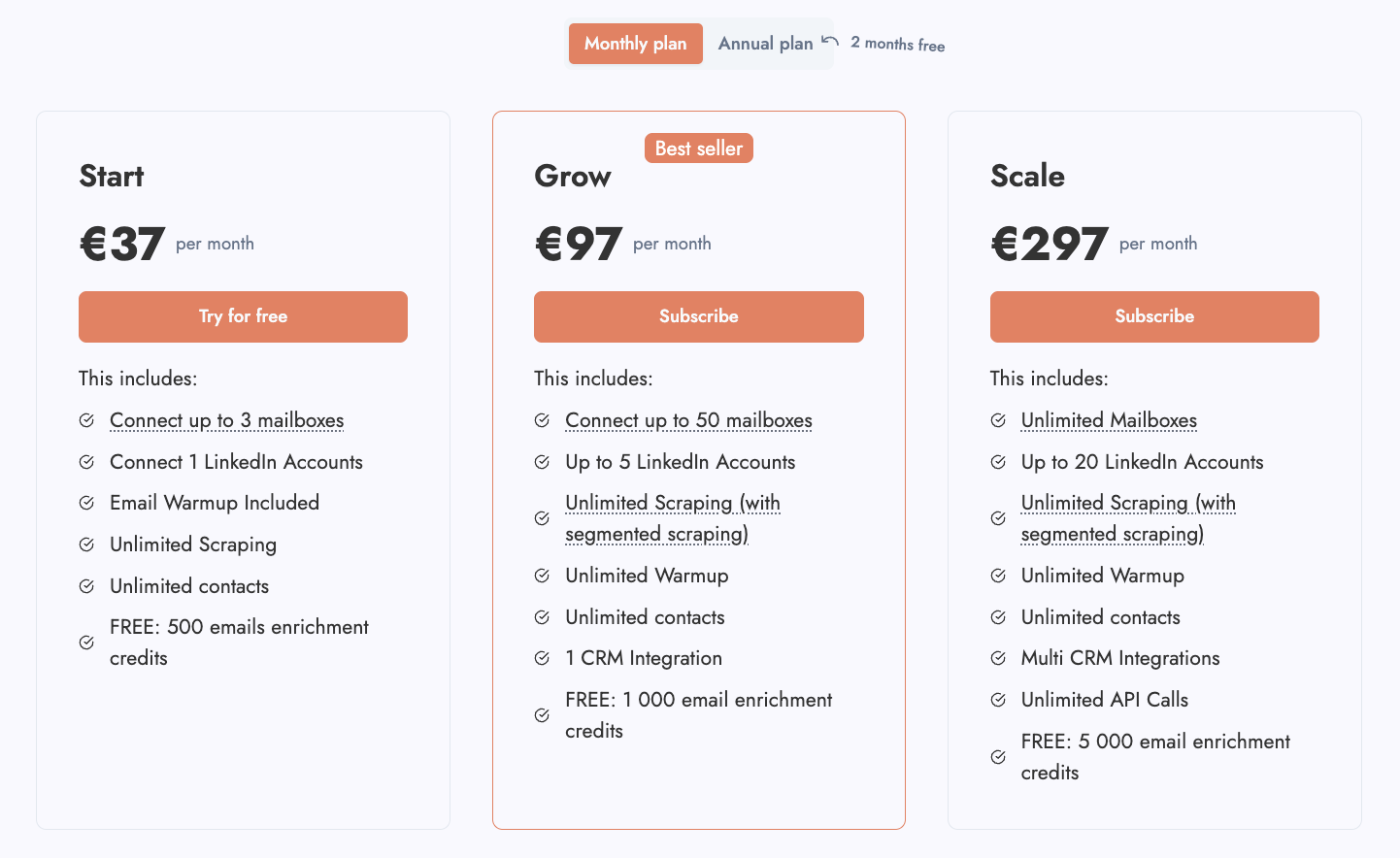
Two inclusions account for most of the subscription's value. Email warmup, unlimited on all three plans, is the piece that decides whether emails land, and almost nobody sells it in the same subscription as the data.
Then Sales Navigator scraping, also included and consuming no credits, with segmented splitting from the Grow plan on to get past the 2,500 results of a single search.
The limits are clear-cut. Emelia has no searchable database: targeting starts from LinkedIn, very current on people, their job title and their company moves, patchier on organizations with little presence on the network. And phone numbers are expensive, 50 credits each, roughly 0,95 €: this is not the tool for a team that calls at volume.
On a French target, Basile, built by the same team, offers a second way in and runs on the account's credits.
Apollo: $49 per seat, the most complete platform

Apollo brings the global database, enrichment, sending sequences and a dialer together in a single subscription billed per seat. It has the broadest scope on this list after Emelia, with international coverage Emelia does not have.
Plan | Annual price, per seat | Credits per seat per year |
|---|---|---|
Free | $0 | 900 |
Basic | $49 | 30,000 |
Professional | $79 | 48,000 |
Organization | $119 (3 seats minimum) | 72,000 |
Thirty thousand credits per seat per year on the Basic plan, which is 2,500 a month for $49, with a 24% annual discount. Read it carefully: Apollo burns a variable number of credits depending on the data revealed, a mobile number costing more than an email. The unit cost therefore depends on what you are looking for, and cannot be worked out in advance.
Two things genuinely set it apart. The free plan first, 900 credits per seat per year with two sequences and an AI assistant capped at five conversations: enough to seriously gauge how well the database covers your target before paying anything. Deliverability next, since all three paid plans include a suite with email warmup, as recorded on the pricing page on August 31, 2026. No other data vendor on this list offers that.
Two reservations pull the other way. The Organization plan requires three seats minimum, which brings the real ticket to $357 a month and not $119. And the add-on modules, at $119 per team per month, carry the note "introductory pricing, features and pricing subject to change," wording no other vendor on this list displays.
Three reps on the Basic plan come to $147 a month, or $1,764 over the year for 90,000 credits. Apollo is for teams that want one platform to build the list and then work it, and that make calls. Tier by tier breakdown in our article on Apollo pricing.
RocketReach: $52 a month on annual billing, the cheapest full contact

RocketReach is a global database driven from a browser extension, where a contact is paid for as a block, email and mobile number together. Its quirk is having two counters instead of one, lookups and exports, and it is the second one that binds.
Plan | Monthly price | Annual, per month | Lookups | Exports | Data |
|---|---|---|---|---|---|
Free | $0 | N/A | 5 in total | None | Email only |
Essentials | $39 | $19 | 100 / month, unlimited on annual | 100 / month, 1,200 / year | Email only |
Pro | $79 | $52 | 250 / month, unlimited on annual | 250 / month, 3,600 / year | Email + phone |
Ultimate | $169 | $115 | 1,000 / month, unlimited on annual | 1,000 / month, 20,000 / year | Email + phone |
Team | Quote only | Quote only | Pooled | Pooled | Email + phone |
On annual billing, lookups become unlimited and it is the exports that carry the limit. An exported contact works out to $0.19 on Essentials, $0.17 on Pro and $0.07 on Ultimate, provided you drain the year's allowance. That is the best price per full contact in this whole comparison, and by a wide margin.
The entry point deserves attention. Phone numbers only start at the Pro plan: Essentials, despite its $19 headline price on annual billing, is an email-only offer. Buying the entry tier expecting to get numbers is the classic mistake on this product, and it costs the price of a plan change.
The Team offer is the only place where the pricing table stops. Lookups and exports are pooled across several users there, which changes the math from the third person on, but you have to go through a sales rep to learn the amount. On the three individual plans, by contrast, everything is published.
Three reps on Pro with annual billing come to $156 a month for 10,800 exports over the year. RocketReach is for anyone prospecting internationally, making calls, and confident they will use up their export quota. It is a poor fit for anyone who wants phone numbers on a small budget. Full detail in our article on RocketReach pricing.
UpLead: $149 a month, the credit that includes the mobile number

UpLead runs the clearest model on the market: one credit unlocks an entire contact, verified email and direct dial included. You are not paying for a data point, you are paying for a record, and the budget math fits into a single multiplication.
Plan | Monthly | Annual | Credits | Seats |
|---|---|---|---|---|
Essentials | $99 | $74 | 170 / month | 1 |
Plus | $199 | $149 | 400 / month | 1 |
Professional | N/A | Quote only | Custom | Custom |
$0.37 per contact on the Plus plan with annual billing. An extra credit costs $0.60 on Essentials and $0.50 on Plus, is bought in packs of 100 to 5,000 units with an explicit confirmation window, never an automatic charge, and a ceiling of $2,000 a day mechanically caps any overrun. The stated database holds more than 200 million B2B contacts and 19 million companies.
The 95% accuracy guarantee deserves to be read with the nuance UpLead itself publishes: it measures quality at the moment of verification and promises nothing about bounces at send time. That is rare honesty in this market, and it is worth more than an unsourced round number.
The limit is teamwork. Essentials and Plus are capped at a single seat, and you have to move up to Professional, sold quote only, as soon as there is a second user: a team of five has no public price at UpLead. The trial is also limited to 7 days and 5 credits, which leaves little room to assess coverage on a precise target.
UpLead is for the solo rep who calls as much as they write, and for whom $0.37 per contact with a mobile number is a good price. On email alone it is the worst ratio on the list, and that is not what to buy it for. Details in our article on UpLead pricing.
Lusha: $49.90 for 400 credits, a phone number at 10 credits

Lusha is a B2B contact database driven by a browser extension, with a tiered credit scale: not all data costs the same number of credits, and it is that scale, more than the headline price, that sets the budget.
Plan | Monthly price | Credits / month | Seats included | Credit rollover |
|---|---|---|---|---|
Free | $0 | 40 | 1 | No |
Starter | $49.90 | 400 | 1 | No |
Pro | $69.90 to $227.40 depending on the slider | 600 to 2,000 | 2 | Up to 2 times the allocation |
Premium | $399.90 | 3,400 | 5 | Up to 2 times the allocation |
Scale | Quote only | Custom | Custom | Credits granted upfront |
The Pro plan amounts correspond to the slider set at 2,000 credits a month. An email costs 1 credit, a phone number 10, a full contact 11. On Starter, a credit works out to $0.125: an email therefore costs $0.125, a phone number $1.25 and a full contact $1.38.
One reservation before you buy, and it weighs heavily. The pricing page recorded in August 2026 states ten credits per phone number, while older vendor material still lists five. Get the value applied to your account confirmed in writing: between the two scales, your phone budget doubles.
The rest of the pricing table is fairly favorable. Seats are included by plan, two on Pro and five on Premium, with credits shared across the members of the account. Credits roll over up to twice the allocation on monthly billing. And the European compliance positioning is documented, which remains rare in this segment.
Two reps on Pro set at 2,000 credits come to $227.40 a month, roughly 333 full contacts to share between them. Lusha is for European teams that call and reveal contacts as they go on LinkedIn; it is a poor fit for anyone who wants to pull a list of several thousand rows in one query. Details in our article on Lusha pricing.
Kaspr: 45 € per user, unlimited B2B emails

Kaspr is a French vendor whose model takes the problem from the other end: B2B email is unlimited from the first paid plan on, and it is phone numbers and exports that get counted.
Plan | Annual, per user | Monthly | B2B emails | Phone numbers / month | Exports / year |
|---|---|---|---|---|---|
Free | 0 € | 0 € | 15 / month | 5 | 100 leads |
Starter | 45 € | 59 € | Unlimited | 100 | 12,000 |
Business | 79 € | 99 € | Unlimited | 200 | 30,000 |
Enterprise | Quote only | Quote only | Unlimited | Negotiated | Unlimited |
Prices are per user, with a 25% annual discount, and the vendor specifies that on annual plans the twelve months of credits land on the account in one go. Credits are shared across all members, which considerably softens the per-seat billing. On Starter with annual billing, 1,200 numbers a year cost you the plan, roughly 0,45 € per number if the quota is drained.
The word "unlimited" calls for careful reading. B2B emails are, but the annual export ceiling is not: 12,000 leads on Starter, 30,000 on Business. Once that ceiling is reached, unlimited stops being worth anything. It is that line, and not the price, that determines your sizing.
Kaspr is a field tool rather than an engine: it reveals a contact profile by profile inside the LinkedIn extension, with no database searchable by firmographic filters. Its free plan is permanent, 15 emails and 5 numbers a month, which lets you come back and test again the following month instead of burning a one-off allowance.
Three reps on Starter with annual billing come to 135 € a month with 300 shared monthly phone credits. Full detail in our article on Kaspr pricing.
GetProspect: about $69 a month, the best price per email

GetProspect is a database of a stated 780 million contacts, which you filter on company criteria to export lists from. It is also the vendor on this list that publishes the most, and not only its prices.
Plan | Monthly | Annual | Valid emails | Phone numbers |
|---|---|---|---|---|
Free | $0 | $0 | 50 / month | 0 |
Starter | $49 | $34 | 1,000 / month | 5 |
Growth 5k | $99 | about $69 | 5,000 / month | 5 |
Growth 50k | $399 | about $279 | 50,000 / month | 5 |
The model is pay per result: emails that are not found and duplicates are not billed, and unused credits roll over to the following month. The free plan is permanent, 50 addresses a month with no credit card. On Growth 5k with annual billing, an address works out to about $0.014, the best ratio in this entire comparison on email alone.
The transparency goes further than the pricing table. The vendor publishes its match rate, 84 valid addresses per 100 contacts submitted according to its own tests, and explicitly distinguishes that from the 98% accuracy it claims on delivered addresses. It also documents credit rollover, its cancellation policy and what becomes of the data once you leave. Few data vendors go that far.
Phone numbers are the weak point, and structurally so: five numbers a month whatever the plan, including at $399, with the rest sold as an add-on in tiers of 300 credits for $49. If you call, no advantage on the price of an email will make up for that ceiling.
A team that processes 5,000 addresses a month pays about $69, with no commitment, and knows its budget in advance. Tier by tier breakdown in our article on GetProspect pricing.
Dropcontact: 79 € at the bottom of the slider, the most compliant option
Dropcontact is a French enrichment vendor: you bring a list, it completes it. No database to browse, no search engine, no phone numbers, and a compliance positioning it fully owns.
Plan | Monthly price | Credits at the bottom of the slider | Cost per contact found |
|---|---|---|---|
Starter | 79 € | 500 / month | 0,158 € |
Growth | 120 € | 500 / month | 0,240 € |
Enterprise | Quote only | From 200,000 | Negotiated |
Both plans rest on a volume slider running from 500 to 150,000 credits a month, and that is the point most comparisons miss: the advertised prices of 79 € and 120 € correspond to the lowest tier, 500 credits a month, which is 0,158 € per contact found on Starter. The model is pay per result. A 20% annual discount is announced in the sales documentation: check it at checkout, the page does not always put a figure on it.
Compliance is the real argument here. Processing claimed to be 100% GDPR compliant, data rebuilt by algorithm rather than bought, an audit against CNIL standards. For a European company prospecting in Europe, that weighs as much as the unit price, and billing in euros removes any currency exposure.
The Growth plan adds credit rollover, LinkedIn enrichment without a login and job change detection. The tool is driven without a dedicated interface: API and MCP access, a Google Sheets module, CSV or XLS files, and native CRM integrations with duplicate merging.
79 € buys 500 contacts found a month on Starter, and you have to push the slider up to go beyond that. Fifty free credits let you measure the match rate with no credit card. Dropcontact is aimed at organizations under a strong compliance requirement that already have their lists. Details in our article on Dropcontact pricing.
One last benchmark to place these eight pricing tables. Cognism, ZoomInfo and now Clearbit, absorbed by HubSpot, publish no prices at all. In the large B2B database segment, the absence of a published price is the rule and not the exception. That is precisely what gives the eight tools above their value: their pricing tables are the only comparison points a buyer can hold up against a quote.
56 € a month, sending and email warmup
Three mailboxes and 1,000 enriched contacts: 37 € plus 19 €, cancellable at the end of the current month.
How to protect yourself if you sign anyway
Seamless.AI can be the right call, particularly for a team that phones and that values a credit giving both the email and the mobile number. Here are the six points to lock down in writing before you sign.
The number of annual credits, spelled out in the quote. It is the only variable that lets you work out a cost per contact and compare it with a competitor.
What happens to unused credits. The vendor says publicly neither that they roll over nor that they expire. Have the question settled in the contract.
The price of the four options. Enrichment, intent data, the AI assistant and Autopilot are billed on top. A quote that does not mention them does not include them.
A price freeze for the term of the contract. The terms of service allow fees to be changed with immediate effect once notice is given. Have a firm price clause added.
The exact renewal date, and the cancellation procedure. The notice period is 60 days and cancellation goes through the platform, not by email. Write the date down the day you sign.
The minimum number of licenses. The custom offer starts at five licenses. If there are three of you, check what that does to the unit price.
And one reflex that holds for any purchase without a public price: get a quote from two transparent competitors before the call. You will negotiate with a figure to point to rather than a hunch.
Conclusion
Seamless.AI is not hiding its prices by accident, it applies the dominant model among the large American B2B databases, the one built on quotes. That model is not illegitimate, and it sometimes gets you a better deal than a fixed pricing table. But it shifts the burden of verification onto the buyer, and it makes any comparison impossible before the sales call.
What we know for certain turns out to be more instructive than the price itself. The credit is well designed, since it gives you the email and the mobile number for one unit. The entry volume is modest, at 10,000 annual credits on the Pro plan, or 833 contacts a month. There are no setup fees, which counts in the vendor's favor. And enrichment and intent data alike are paid options, not included features.
That leaves the clause that will cost the most to anyone who has not read it: the subscription is annual whatever the billing cadence, it renews automatically for twelve months, and the exit window closes 60 days before the term. On a contract signed in March, that means deciding in December.
If you sign, write that date down the same day. If you are hesitating, start with the 50 free credits, and in parallel ask two vendors that publish theirs for a pricing table. You will then know what you are buying, and at what relative price.
Frequently asked questions about Seamless.AI pricing in 2026
How much does Seamless.AI cost in 2026?+
Seamless.AI publishes no price at all. Its pricing page presents three plans, only one of which carries a number, the free plan at $0. The Pro and Enterprise plans point to a sales contact form. No amount appears on the vendor's site.
What does the Seamless.AI free plan include?+
One user and 50 credits. It is a one-time allocation and not a renewed quota, which makes it an evaluation tool rather than a plan you can use over time.
How many credits does the Pro plan include?+
Ten thousand credits per year to start, according to the vendor's FAQ, which is about 833 contacts per month. The custom plan works on a daily allocation and starts at five seats.
What is a Seamless.AI credit?+
A credit is consumed when the platform searches for a contact to find their emails, their phone numbers and their information. The pricing table specifies that one credit gives the phone and the email, so a full contact.
Do Seamless.AI credits expire?+
The vendor asks the question in its FAQ but never answers it: the published response details the volumes per plan without saying whether unused credits roll over or expire. It is a point to have clarified in writing before signing.
Does Seamless.AI require an annual commitment?+
Yes. The terms of service state that all subscriptions to the services are annual, with monthly or annual billing. Paying every month therefore does not shorten the commitment, which stays at twelve months.
How do you cancel a Seamless.AI subscription?+
The cancellation must be carried out in the platform no later than 60 days before the renewal date of the annual contract. Failing that, the contract renews automatically for another twelve months. The terms also specify that all sales are final.
Are there setup fees at Seamless.AI?+
No. The vendor's FAQ explicitly states that there are no setup fees.
Which features are billed on top?+
Four modules carry the "Add-on" label on all three plans: data enrichment, buyer intent data, the AI assistant and Autopilot. None of them has a public price.
What is a transparent alternative to Seamless.AI?+
Several vendors publish their pricing table and can be subscribed to online. On the full contact, email and mobile included, RocketReach shows $0.17 per unit on its Pro plan billed annually and UpLead $0.37 on its Plus plan. On the email alone, GetProspect starts at $34 per month, Emelia at 37 € with credits at 19 € per 1,000, and Dropcontact at 79 € for 500 credits. Apollo starts at $49 per seat, Kaspr at 45 € per user and Lusha at $49.90 for 400 credits. None of them imposes an annual commitment with a 60-day notice period.